SEC Killed the Fake AI Bots. Here's How to Verify Real Wallet Performance
By CMM Team - 31-May-2026
SEC Killed the Fake AI Bots. Here's How to Verify Real Wallet Performance
The SEC just sued a Texas man for raising $12.3 million from roughly 150 investors through a crypto scheme built on fake AI trading bots that never existed. He promised returns of 40% to 50% within 30 to 45 days. In reality, only about $380,000 (roughly 3% of investor funds) ever touched a crypto exchange. The rest went to personal expenses and Ponzi-like payments to earlier investors.
This case, filed on May 28 in the U.S. District Court for the Southern District of Texas, is part of a broader enforcement wave. In December 2025, the SEC charged seven entities across three fake crypto platforms and four "AI investment clubs" for defrauding retail investors out of more than $14 million using AI-generated investment tips funneled through WhatsApp groups.
The pattern is clear: scammers wrap old Ponzi mechanics in new AI language, and retail investors cannot tell the difference between fabricated returns and verifiable performance. But if you're trading on a fully on-chain perpetual futures exchange like Hyperliquid, the entire premise of the fraud collapses. Every trade, every position, every PnL is publicly verifiable. The question is how to read it efficiently.
Why "AI Bot" Fraud Works (And Why On-Chain Breaks It)
Nathan Fuller, the defendant in the SEC's latest case, operated through entities called Privvy Investments LLC and Gateway Digital Investments. His pitch was simple: proprietary AI bots running high-frequency arbitrage across digital asset markets. When investors asked for proof of performance, he provided fabricated account statements and even an AI-generated letter from a fake auditing firm.
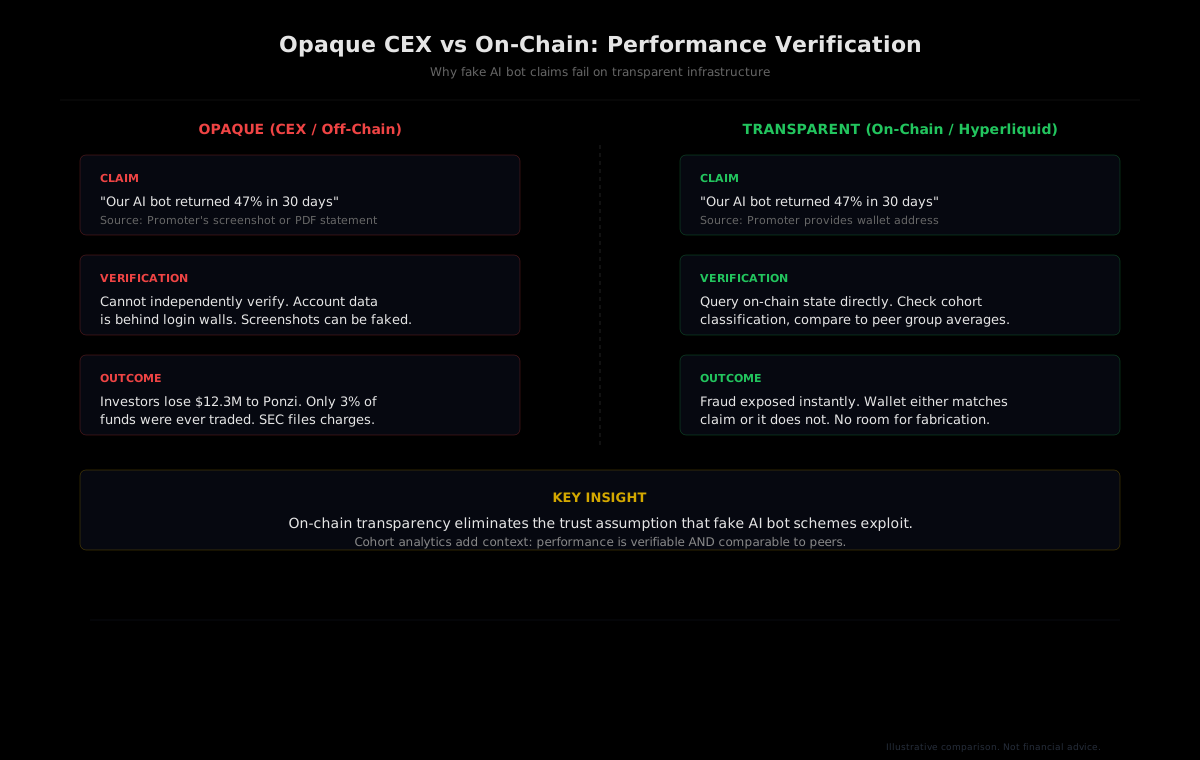
This only works in opaque environments. On centralized exchanges, you cannot independently verify another trader's performance without their cooperation. Account statements can be Photoshopped. Screenshots can be fabricated. Trading histories exist behind authentication walls that only the account holder controls.
On-chain perpetual futures platforms flip this model entirely. On Hyperliquid, every open position is a matter of public record. Every fill is on-chain. Every PnL calculation derives from verifiable state transitions. You can look up any wallet address and see exactly what they hold, what they've traded, and what their all-time performance record looks like. There is nothing to fabricate because the data lives on an immutable ledger that neither the trader nor any intermediary can alter.
The Problem with Raw Wallet Lookups
Transparency alone is necessary but not sufficient. You can look up any Hyperliquid wallet on a block explorer and see raw position data, but that raw data creates its own problems for evaluating performance.
Consider what happens when someone shares a "Money Printer" wallet address on Twitter and claims it represents an AI bot's track record. You can verify the positions are real. But raw data does not tell you:
- Context: Is this wallet's performance exceptional relative to its cohort, or is it a Whale-sized account where modest percentage gains produce large dollar amounts?
- Consistency: Did this wallet profit from a single lucky trade, or does it demonstrate sustained edge across market conditions?
- Typicality: How does this wallet compare to the broader population of similarly-sized or similarly-performing wallets?
- Behavior class: Is this a systematic trader, a momentum chaser, or a liquidation survivor who got lucky on a reversal?
Without these dimensions, raw transparency is just noise with extra steps. You can confirm a wallet exists and has PnL, but you cannot assess whether that PnL is meaningful, repeatable, or representative of actual skill versus luck.
Cohort Classification: The Missing Verification Layer
This is where behavioral cohort analytics change the game. Instead of evaluating wallets in isolation, cohort systems classify every active wallet into segments based on measurable attributes, then let you compare any individual wallet against its peer group.
Our data classifies every Hyperliquid wallet into 16 behavioral cohorts across two axes. Eight cohorts segment wallets by perp equity (account size), from Shrimp ($0-$250) up through Fish, Dolphin, Apex Predator, Small Whale, Whale, Tidal Whale, and Leviathan ($5M+). Eight more segment wallets by all-time PnL performance, from Money Printer (+$1M+) down through Smart Money, Consistent Grinder, Humble Earner, Exit Liquidity, Semi-Rekt, Full Rekt, and Giga-Rekt (below -$1M).
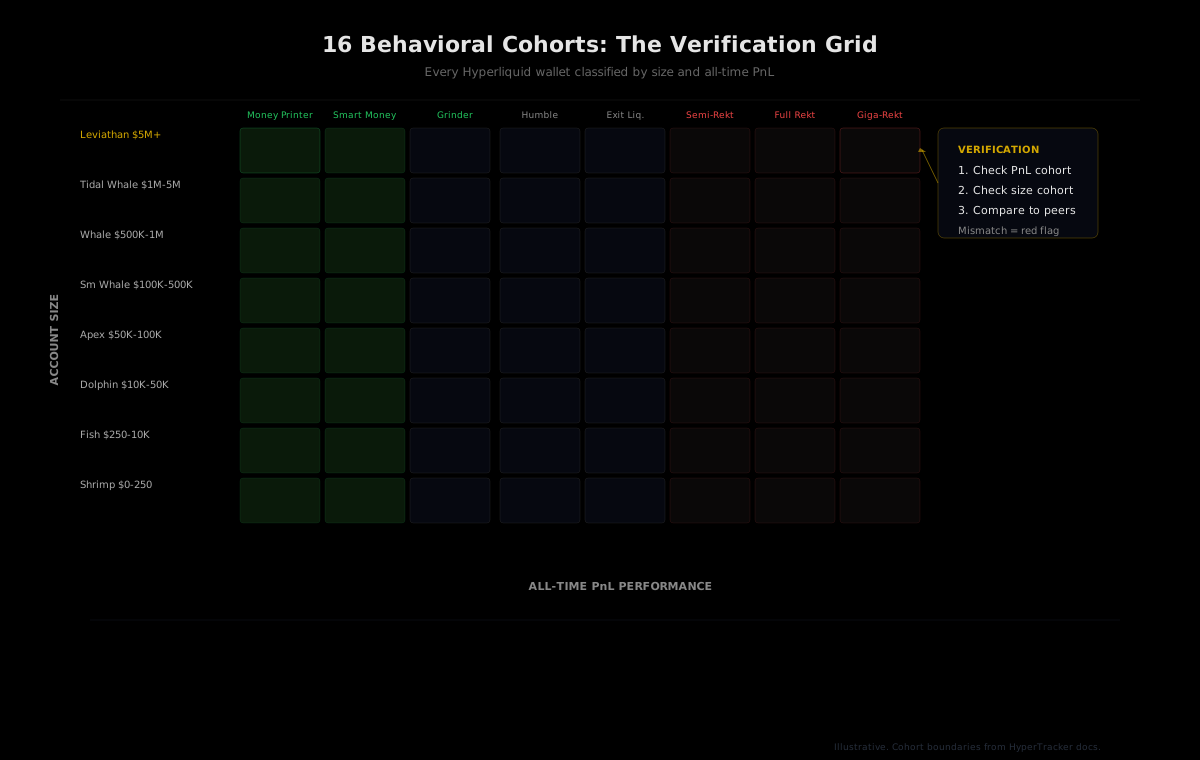
When someone claims their "AI bot" wallet belongs in the Money Printer category, you can verify that claim directly. Pull the wallet's cohort classification via a single API call and compare its actual segment against the claimed performance tier. If the wallet is classified as Exit Liquidity or Semi-Rekt while the promoter claims consistent profits, the fraud is immediately apparent.
What Cohort Data Reveals That Raw PnL Cannot
Cohort positioning tells you how a wallet performs relative to its structural peers. A Shrimp wallet that's also a Consistent Grinder is demonstrating genuine edge at small scale. A Leviathan wallet that's classified as Exit Liquidity is losing money despite massive capital. The intersection of size and performance reveals behavioral patterns that raw dollar PnL hides.
More importantly for fraud detection: cohort bias data shows what an entire segment is doing at any given moment. If a supposed AI bot claims to be running a unique alpha strategy, but its positioning mirrors the exact behavior of the broader Fish cohort (the most common retail segment), the "proprietary AI" claim becomes very difficult to maintain. The wallet is doing exactly what thousands of other small retail wallets do. There is no unique intelligence, just repackaged crowd behavior.
A Practical Verification Framework
If someone promotes a wallet's performance and claims AI or algorithmic trading, here is a structured approach to verify those claims using on-chain cohort data:
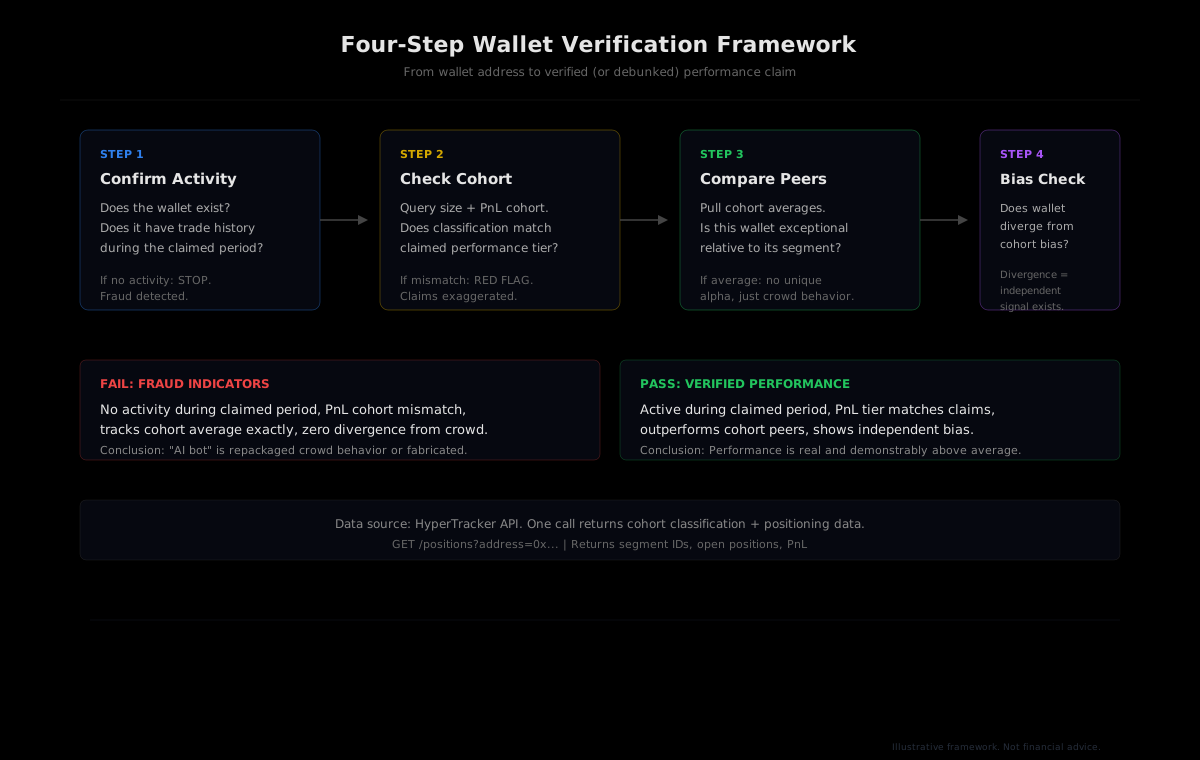
Step 1: Confirm the Wallet Exists and Trades
Pull the wallet's open positions and trade history. On Hyperliquid, this is trivially verifiable. If the promoter cannot provide a wallet address, or the address shows no meaningful trading activity during the claimed performance period, you can stop here. The Fuller case would have failed this test immediately because no real trading was happening.
Step 2: Check Cohort Classification
Query the wallet's size cohort and PnL cohort. Does the classification match the performance claims? A wallet promoted as generating consistent double-digit monthly returns should classify in the upper PnL tiers (Money Printer or Smart Money). If it sits in Humble Earner or lower, the claimed returns are either exaggerated or based on a cherry-picked time window.
Step 3: Compare Against Cohort Averages
Pull the aggregate metrics for the wallet's cohort. How does this specific wallet perform relative to its peer group? Exceptional wallets stand out from their cohort. Average wallets tracking cohort behavior are not running unique alpha, they're riding the same wave as everyone in their segment.
Step 4: Check Bias Alignment
Look at the wallet's directional positioning over time and compare it to cohort-level bias shifts. Genuine algorithmic traders often diverge from their cohort during key market transitions because they are acting on independent signals. Fake "AI bots" tend to mirror crowd behavior because there is no actual algorithm making decisions.
Red Flags That Cohort Data Exposes
Once you have cohort context, several fraud patterns become instantly visible:
| Red Flag | What It Looks Like | What It Means | | --- | --- | --- | | Size/PnL mismatch | Claims "top trader" status but classified in lower PnL tiers | Performance is exaggerated or cherry-picked from a single winning period | | Cohort-tracking behavior | Wallet positioning mirrors its entire cohort exactly | No independent signal or algorithm, just crowd-following relabeled as "AI" | | Inconsistent history | Wallet inactive during claimed "live trading" periods | The demo or backtest does not match on-chain execution | | Cohort downgrade over time | Wallet migrates from Smart Money toward Exit Liquidity across months | Strategy is degrading, losses compounding, or the "bot" never worked | | Tiny wallet, massive claims | Shrimp account claiming whale-level returns | Dollar PnL is small but percentage is high because account size is trivial |
Why This Matters Now
The SEC's enforcement trajectory is accelerating. The Fuller complaint in May 2026 follows the $14 million multi-entity takedown in December 2025. The commission has made clear that AI-wrapped investment schemes are a priority enforcement target, and the pattern of fake bot fraud shows no signs of slowing.
For legitimate builders and traders, this environment creates both risk and opportunity. The risk is guilt by association: as AI bot scams make headlines, retail investors become more skeptical of all algorithmic trading claims, including legitimate ones. The opportunity is differentiation through verifiability. If you build on transparent infrastructure and can prove performance through immutable on-chain records, you separate yourself from every opaque "trust me" operator.
Hyperliquid's fully on-chain architecture is uniquely positioned for this moment. Unlike centralized exchanges where performance claims require trust, every trade on Hyperliquid is a matter of public record. Pair that transparency with cohort-level analytics that contextualize individual wallet performance, and you have a verification stack that makes the entire category of fake AI bot fraud structurally impossible.
Verify Before You Mirror
HyperTracker classifies every Hyperliquid wallet into 16 behavioral cohorts by account size and all-time PnL. Before you follow any wallet, check its cohort classification, compare it against its peers, and verify that the performance is real. One API call gives you what fabricated screenshots never can: proof.
Explore HyperTracker Free Tier
The Verification Standard Going Forward
As regulators tighten enforcement and retail investors grow more cautious, verifiable performance will become the baseline expectation for any trading product, bot, or signal service. The era of "trust my PnL screenshots" is ending because regulators are making the cost of fraud prohibitively high, and on-chain infrastructure makes verification trivially easy.
The wallets that survive this scrutiny are the ones whose performance is anchored in immutable, publicly queryable data, contextualized by behavioral classification systems that separate genuine skill from luck, crowd-following, or outright fabrication. The SEC is clearing out the fakes. On-chain cohort analytics make sure the fakes cannot hide in the first place.