
SpaceX Is Trading on Hyperliquid Before It Hits Nasdaq
By CMM Team - 04-Jun-2026
SpaceX Is Trading on Hyperliquid Before It Hits Nasdaq
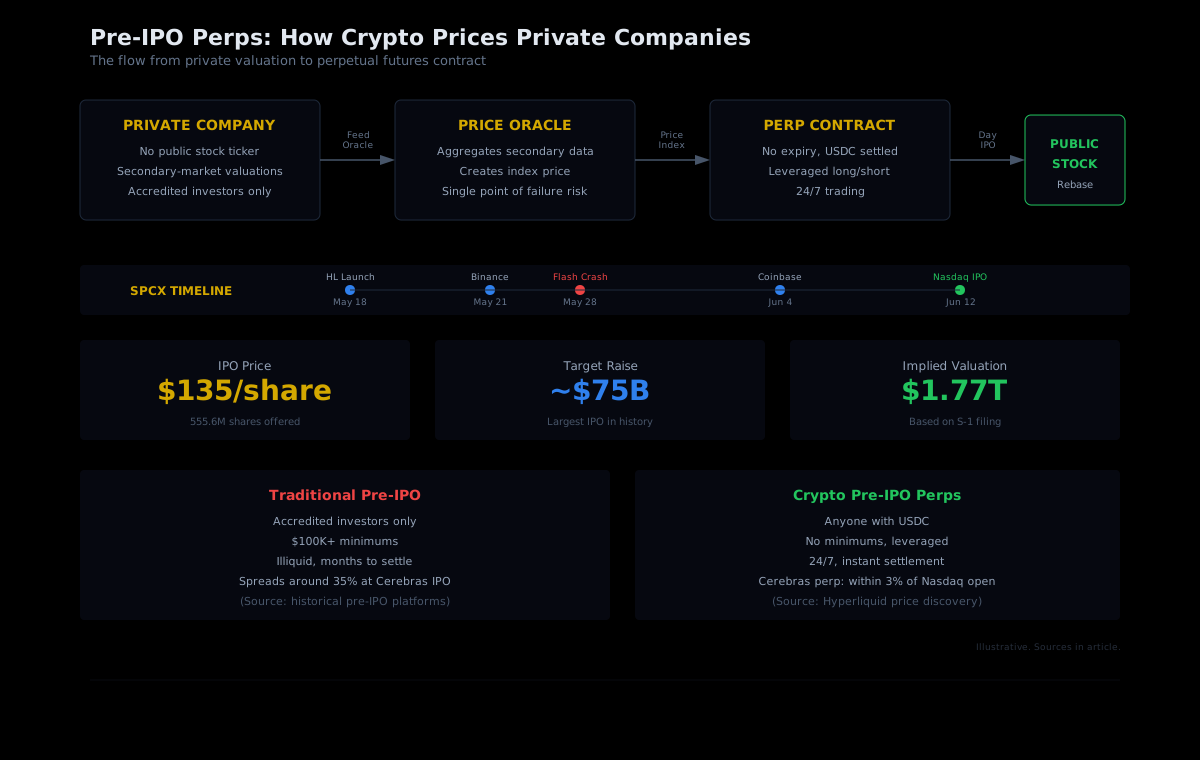
SpaceX filed its S-1 amendment on June 1, setting an IPO price of $135 per share and targeting a roughly $75 billion raise on Nasdaq. The company is aiming for a $1.77 trillion valuation, which would make it the largest public debut in history. But crypto traders have been pricing SpaceX for weeks already. On May 18, Trade.xyz launched the SPCX-USDC perpetual futures contract on Hyperliquid's HIP-3 framework at a $150 reference price, and it spiked to $216 before settling at $202.89, pulling $33 million in 24-hour volume on day one.
Today, Coinbase joined the race with its own SPCX-PERP contract, opening shortly after 6:00 AM UTC. Binance, OKX, Crypto.com, and Bitget have all listed their own versions too. Crypto is no longer waiting for Wall Street to set the price. It is doing its own price discovery, in real time, with leverage.
This article breaks down how pre-IPO perpetual futures work, what the SpaceX contract landscape looks like right now, and how cohort analytics can help you read what smart money is doing before the June 12 Nasdaq listing.
Pre-IPO Perps Explained: How You Trade a Company That Is Not Public Yet
Perpetual futures are derivatives that track an asset's price without ever expiring. You post collateral in stablecoins, take a long or short position, and settle the difference when you close. No shares change hands. No brokerage account required. No investor accreditation needed.
Pre-IPO perps extend this mechanic to private companies. Instead of tracking a live exchange price, they reference secondary-market data, private sale valuations, or custom oracle feeds to derive an index price. The product gives traders synthetic exposure to a company's valuation before it has a public stock ticker, which means you can speculate on where SpaceX will open on Nasdaq without owning a single share of the company.
This is a genuinely new financial primitive. Traditional pre-IPO markets require accreditation, minimum investments in the hundreds of thousands, and illiquid settlement windows measured in months. Crypto pre-IPO perps let anyone with USDC take a leveraged position in minutes, trade 24/7, and exit whenever they want.
The SpaceX SPCX Contract Landscape
Multiple exchanges are now running SpaceX pre-IPO perps, each with different mechanics, leverage caps, and risk profiles. Here is how they compare.
Hyperliquid (SPCX-USDC via Trade.xyz)
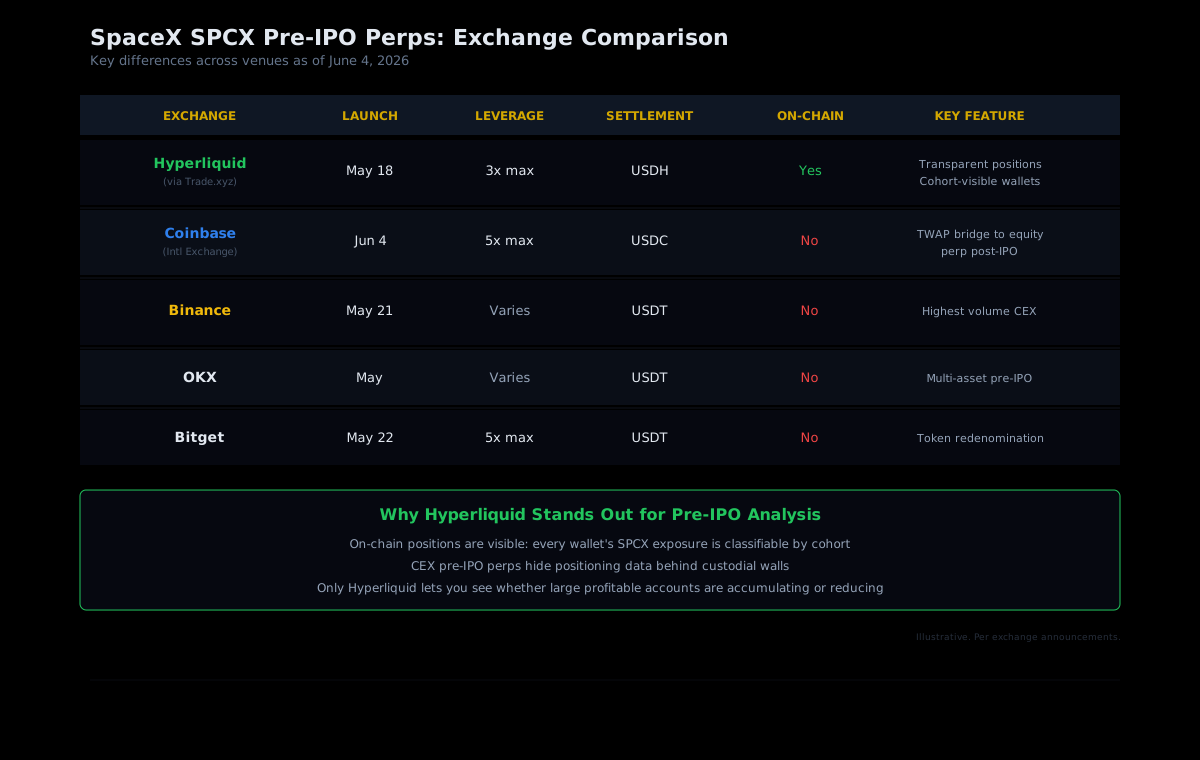
First mover. Launched May 18 on the HIP-3 framework, which lets third-party deployers create perpetual markets on Hyperliquid's order book. Collateral is in USDH, leverage is capped at 3x, and the contract trades fully on-chain. Open interest jumped from $22 million to $73 million in early trading. Because Hyperliquid is a transparent on-chain exchange, every position is visible, which means you can see exactly how large wallets are positioning before the IPO.
Coinbase (SPCX-PERP)
Launched today, June 4. USDC-settled, 24/7 trading, with up to 5x leverage. Position limits are tiered: up to $350,000 in notional at 2x, then $200,000 at 5x. The product is available through Coinbase International Exchange, but restricted in the U.S., Canada, UK, Singapore, India, Australia, and several other markets. After the IPO, Coinbase will pause trading, cancel open orders, and rebase into a standard equity perpetual future using a five-minute TWAP bridge.
Binance, OKX, and Others
Binance launched its SPCXUSDT perpetual on May 21, settled in USDT. OKX has listed pre-IPO perps for SpaceX alongside OpenAI and Anthropic. Bitget launched its SpaceX pre-IPO perpetual with 5x leverage on May 22. Each exchange runs its own oracle feed, its own leverage rules, and its own liquidation engine, which means prices can diverge across venues, sometimes by wide margins.
The Oracle Problem: What the Flash Crash Taught Us
On May 28, Hyperliquid's SPACEX-USDH perpetual plunged from an open of $2,277 to a low of $1,254, a near-45% collapse in 30 minutes. The crash liquidated 405 users across 1,393 positions, wiping $1.51 million in notional value.
The cause was a faulty oracle feed from Notice.co that mishandled SpaceX's 5-for-1 stock split announcement. Hyperliquid restricts mark price movements to 1% per three-second interval, but the circuit breaker proved insufficient once corrupted data entered the pricing engine. Ventuals, the deployer, announced it would compensate affected users within 48 hours.
This incident illustrates the core risk of pre-IPO perps. There is no centralized spot market for SpaceX shares. Liquidity is thin. Oracle feeds can break. A single bad data point can cascade through the entire order book. Coinbase itself warned that "a 25% or larger move on IPO open day is plausible", and at 3x to 5x leverage, that is enough to trigger forced liquidations.
Why Cohort Data Matters for Pre-IPO Positioning
Hyperliquid's transparency is what makes it different from every other venue running SpaceX pre-IPO perps. Every position is on-chain. Every wallet is classifiable. You can see whether the accounts accumulating SPCX exposure are historically profitable traders or retail speculators chasing the narrative.
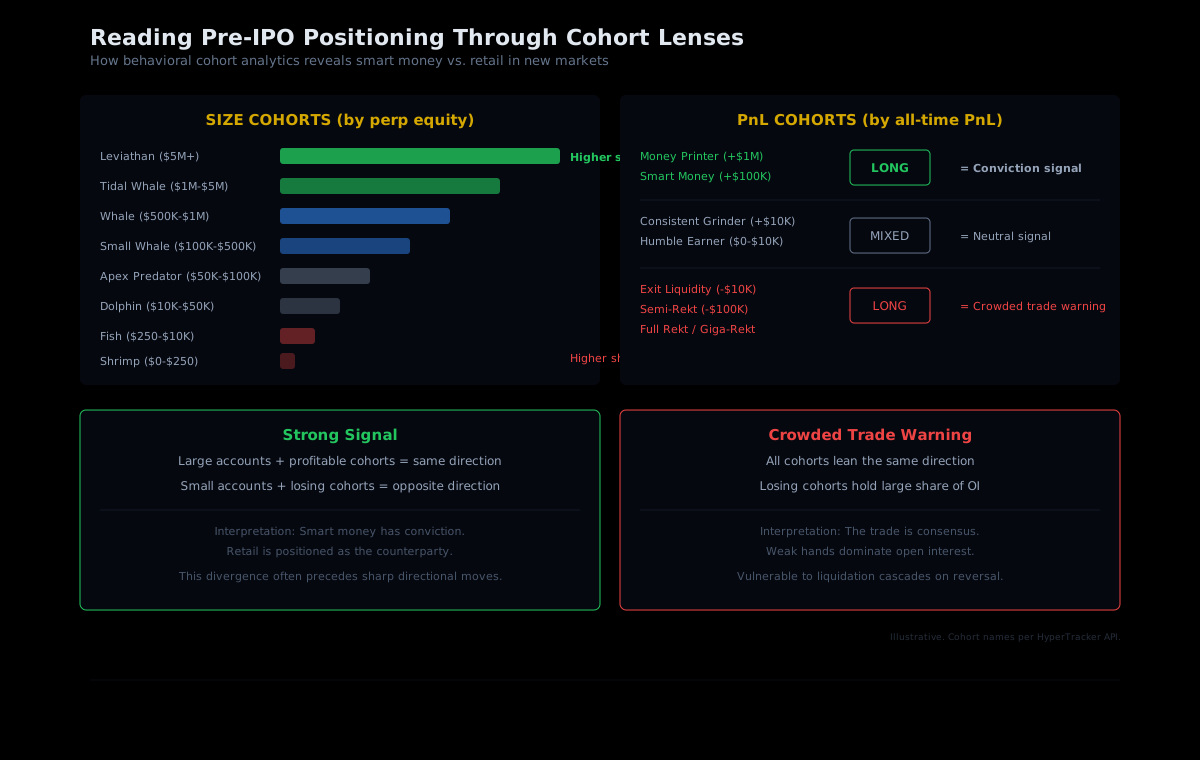
This is where behavioral cohort analytics becomes useful. Instead of tracking individual wallets (which can be gamed with multiple addresses), cohort analysis groups wallets by objective metrics like total equity and all-time profit and loss. Our data classifies every Hyperliquid wallet into 16 behavioral cohorts: eight based on account size (from Shrimp accounts under $250 to Leviathans above $5 million) and eight based on all-time PnL (from Money Printers with over $1 million in lifetime gains to Giga-Rekt accounts that have lost more than $1 million).
When a new asset like SPCX launches and open interest surges, the cohort breakdown tells you whether that growth is driven by large, profitable accounts (a conviction signal) or smaller, historically losing accounts (often a crowded-trade warning). The difference between "smart money is accumulating" and "retail is piling in" is the difference between a well-supported position and one that is vulnerable to a flush.
Reading the SPCX Setup Through Cohort Lenses
Consider what you would want to know before taking a position in SPCX ahead of the June 12 IPO. Are the largest Hyperliquid accounts building exposure or reducing it? Are the most profitable cohorts (Money Printer, Smart Money) leaning long or short? What about the historically losing cohorts, are they crowding the same side of the trade?
These questions are answerable with cohort-level position data. Here is a practical framework for reading the signals:
- Check the size cohort breakdown. If Whale and Leviathan accounts hold a disproportionate share of SPCX open interest relative to their share of total Hyperliquid OI, that suggests informed conviction. If Shrimp and Fish accounts dominate, the market is likely more speculative and more vulnerable to volatility.
- Compare PnL cohort bias. When Money Printer and Smart Money cohorts lean long while Exit Liquidity and Semi-Rekt accounts also lean long, the trade is getting crowded. Divergence between these groups (smart money one direction, retail the other) often precedes sharp moves.
- Watch for cohort rotation around key dates. The June 12 Nasdaq listing is a hard catalyst. If large profitable accounts start reducing SPCX exposure in the days before, that is a signal to pay attention to, regardless of what the price is doing.
- Monitor the funding rate context. Hyperliquid funding rates are hourly. Persistent positive funding on SPCX means longs are paying shorts, which tells you the market is skewed long. Cross-reference with cohort data to see if the longs are strong hands or weak hands.
None of this guarantees an outcome. But it narrows the information gap between "everyone is excited about SpaceX" and "here is who is actually positioned, how much, and which direction."
Pre-IPO Perps Are Changing How Markets Price Private Companies
The SpaceX SPCX contract is part of a broader shift. Crypto exchanges are becoming the default venue for price discovery on assets that traditional markets cannot or will not list yet. Hyperliquid was first, but Coinbase, Binance, and OKX are all building pre-IPO derivatives verticals. Coinbase has already said more pre-IPO perps are planned for technology, AI, energy, and space companies.
The precedent is already being set. When semiconductor manufacturer Cerebras went public, Hyperliquid's pre-IPO perp closed within 3% of its Nasdaq opening price, while traditional private-market platforms showed spreads of around 35%. Crypto markets are getting better at pricing companies before Wall Street does.
For traders, this means a new category of opportunity, but also a new category of risk. Pre-IPO perps carry structural fragilities that standard crypto perps do not: single-source oracle feeds, no deep spot market for price anchoring, thin liquidity, and event-driven volatility around IPO dates that can overwhelm circuit breakers.
Track Smart Money Positioning on Hyperliquid
HyperTracker's cohort analytics API classifies every Hyperliquid wallet into 16 behavioral cohorts by size and all-time PnL. See how Money Printers, Whales, and Leviathans are positioning across every asset, including new listings. One API call gives you the cohort breakdown that takes weeks to build from raw chain data.
Positioning for June 12
The SpaceX IPO is eight days away. Crypto has already been pricing it for nearly three weeks, and the pre-IPO perp markets will only get more active as the listing approaches. Here is what to keep in mind.
First, the post-IPO conversion mechanics differ across exchanges. Coinbase will rebase SPCX-PERP into a standard equity perpetual using a TWAP bridge. Hyperliquid's HIP-3 contract may handle the transition differently. Understand how your specific venue converts the contract before the listing date.
Second, the days immediately before and after an IPO tend to produce the most volatile price action. The gap between the pre-IPO reference price and the actual Nasdaq opening print can be significant. At the leverage levels available on these contracts, even a moderate gap can trigger liquidations.
Third, and most importantly: watch what smart money does, because in thin markets with fragile infrastructure, the positioning of large experienced accounts is a better signal than any price prediction. Cohort data gives you that visibility on Hyperliquid. Use it.
SpaceX is the biggest IPO anyone alive has seen. Crypto gave traders a front-row seat three weeks early. The question is whether you are watching the show or reading the order book.