
When Bitcoin ETFs Bleed, Hyperliquid Whales Buy the Dip
By CMM Team - 01-Jun-2026
When Bitcoin ETFs Bleed, Hyperliquid Whales Buy the Dip
U.S. spot Bitcoin ETFs just recorded their longest outflow streak since listing in January 2024: ten consecutive trading sessions with roughly $2.97 billion pulled from the funds. Net assets across the ETF complex fell from $104.29 billion to $94.17 billion in less than a month. BlackRock's IBIT, the largest Bitcoin fund on the planet, hemorrhaged hundreds of millions in a single week.
And yet, on Hyperliquid, the largest perpetual futures traders did the opposite. Wallets holding positions above $10 million pushed their BTC longs to roughly $257 million against $126 million in shorts, a 2-to-1 long/short ratio and the most aggressively bullish positioning since early March. They did this while 47 consecutive days of negative funding confirmed that most of the market was positioned for further downside.
Two pools of capital. Two completely different readings of the same macro environment. Understanding why they diverge, and which side tends to be right, is where actionable intelligence lives.
The Record Outflow Streak, in Numbers
The scale of the ETF sell-off is hard to overstate. Between May 15 and May 29, U.S. spot Bitcoin ETFs bled for ten straight sessions, breaking the previous record of eight consecutive outflow sessions set in early 2025.
The worst day came on May 27, when $733 million exited in a single session. BlackRock's IBIT alone accounted for roughly $528 million of that wave, one of the fund's largest single-day redemptions since launch.
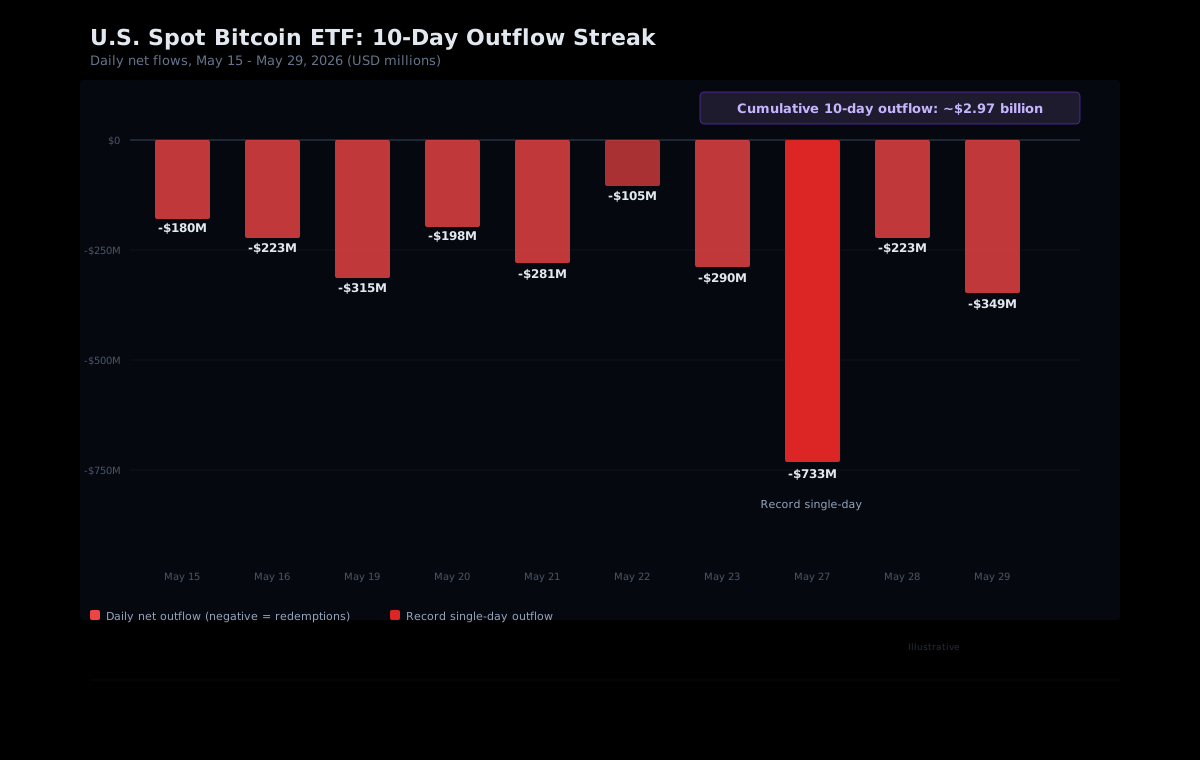
The weekly picture was equally stark. In the final week of May alone, roughly $1.4 billion left Bitcoin funds. The monthly total for May hit $2.3 billion in net outflows, the largest monthly outflow of 2026, reversing gains from a strong April that had brought in $1.97 billion in net inflows.
Some of the biggest names in institutional finance contributed to the exit. Jane Street cut its Bitcoin ETF holdings by roughly 70% in Q1, and Goldman Sachs reduced its position by 10% over the same period. Cumulative 2026 net inflows slipped to just $536 million, approaching net-outflow territory for the year for the first time since the products launched.
Why the Institutions Are Leaving
The outflow isn't a simple panic trade. Multiple forces converged to make Bitcoin the asset institutional allocators trimmed first.
Treasury yields repriced higher. Bond traders shifted their expectations toward a higher-for-longer rate environment from the Federal Reserve, which raised the opportunity cost of holding a zero-yield asset like Bitcoin. When risk-free rates climb, the hurdle for risk assets climbs with them.
AI equities absorbed the capital. The rotation wasn't just out of Bitcoin. It was into something specific. Semiconductor stocks, AI infrastructure plays, and memory-chip companies have been the clear winners of 2026. Bitcoin has lagged "high-flying AI and semiconductor stocks" for months, and institutional allocators followed the momentum.
Strategy (formerly MicroStrategy) stopped buying. For years, Michael Saylor's aggressive Bitcoin treasury strategy provided a structural bid that partially offset ETF outflows. That bid has "nearly disappeared," removing a key demand floor. ETF outflows are no longer being absorbed by corporate treasury purchases at the same pace.
The result: Bitcoin fell from roughly $80,000 to around $73,000 over the period, a roughly 9% decline driven largely by institutional repositioning rather than retail capitulation.
Meanwhile, on Hyperliquid: Whales Go Long
Here's where the story splits. While ETF investors were redeeming, the largest perpetual futures traders on Hyperliquid were doing the exact opposite.
Wallets running positions above $10 million held roughly $257 million in BTC longs against $126 million in shorts, a 2-to-1 imbalance that represents the most aggressively net-long Bitcoin positioning since early March.
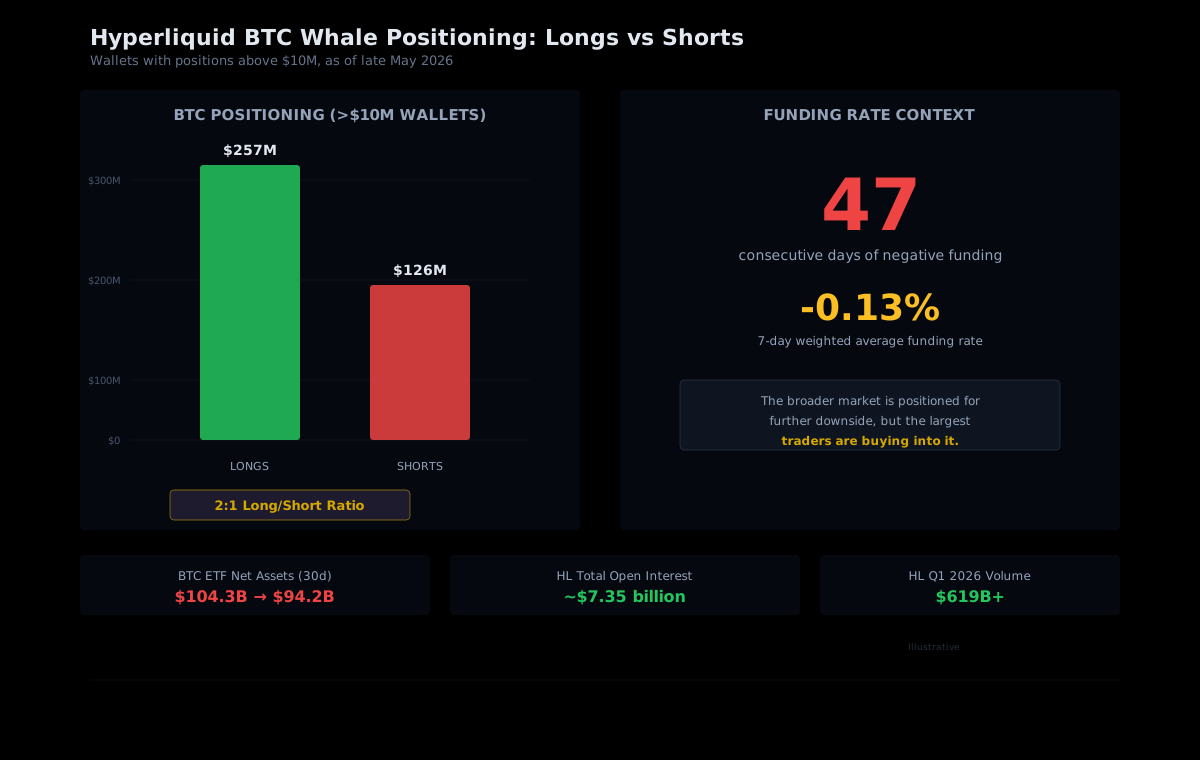
They're doing this against the grain. The 7-day weighted average funding rate sat at -0.13%, and negative funding had persisted for 47 consecutive days. Negative funding means short sellers outnumber longs to such a degree that shorts are paying longs to hold their positions. The annualized cost of holding a short position was roughly 6.8%.
In simpler terms: the crowd was paying to bet on further downside, and the biggest wallets on Hyperliquid were taking the other side of that trade. As one analysis put it, "The largest traders on Hyperliquid are building their biggest BTC long positions in two months while 47 consecutive days of negative funding confirm that the broader market remains positioned for further downside."
A nuance worth noting: The 590 highest-profit wallets on Hyperliquid (those with the strongest all-time PnL track records) are actually net short, with roughly $417 million in shorts against $207 million in longs. The divergence isn't just between ETF investors and crypto-native whales. It's also between different tiers of Hyperliquid traders. The largest wallets by size are bullish. The most historically profitable wallets are cautious.
The Divergence Explained: Different Capital, Different Horizons
Why would two groups of sophisticated market participants reach opposite conclusions from the same data? The answer comes down to structure, mandate, and time horizon.
ETF capital operates on quarterly cycles. Institutional allocators managing ETF exposure often rebalance on monthly or quarterly schedules. When Bitcoin underperforms their benchmark (increasingly dominated by AI and semiconductor equities), they trim mechanically. The selling doesn't necessarily reflect a bearish fundamental view. It reflects portfolio construction constraints. Jane Street's 70% cut wasn't a conviction call on Bitcoin's long-term trajectory. It was a market-making inventory adjustment.
Hyperliquid whale capital operates on signal. The traders building $257 million in longs on Hyperliquid aren't rebalancing a multi-asset portfolio. They're making a directional bet that the ETF outflow panic is overdone, that spot demand outside the ETF channel can absorb the selling, and that 47 days of negative funding creates a short squeeze opportunity. As Phemex's analysis noted, "BTC spot is sitting at $77,000 because spot demand outside the ETF channel absorbed almost every dollar US institutions pushed out."
The funding rate itself is a signal. Sustained negative funding is historically associated with local bottoms in crypto markets. When the crowd is positioned short long enough to pay 6.8% annualized for the privilege, the pressure to cover builds. Every day the position costs money to hold and the expected drop doesn't materialize, some portion of those shorts close. If enough close at once, a short squeeze cascades upward.

Historical Precedent: Who Tends to Be Right?
CoinDesk's reporting offered a clue: "sustained ETF outflows have often historically coincided with periods of market stress that later developed into local bottoms."
This makes sense structurally. ETF outflows are a lagging indicator. They reflect decisions made by portfolio managers using month-old performance data, approved by investment committees that meet quarterly, and executed through redemption processes that take days to settle. By the time a record outflow streak makes headlines, the narrative driving the selling is already widely priced in.
Onchain perpetual futures positioning, by contrast, updates in near real time. Hyperliquid whale positions reflect decisions made today, using data available now, with capital that can rotate in hours. When these two signals diverge, the faster-moving signal has historically been more predictive of what comes next.
None of this is guaranteed, of course. The historically profitable wallets (those with the strongest all-time PnL) are net short, which suggests the picture is more nuanced than "whales are bullish, buy the dip." But the divergence itself, the gap between what institutional wrappers are doing and what native market participants are doing, is the signal worth tracking.
Reading the Divergence with Cohort Analytics
The challenge for individual traders is that "whales are going long" is too blunt. You need to know which whales. Are the largest wallets by portfolio size accumulating, or is it the wallets with the best track records? Are Leviathan-tier accounts (those with over $5 million in perp equity) sizing up while Dolphin-tier accounts (those with $10K to $50K) are cutting exposure?
Our data segments every wallet on Hyperliquid into 16 behavioral cohorts: eight by portfolio size (from Shrimp through Leviathan) and eight by all-time PnL (from Money Printer through Giga-Rekt). When institutional narratives shift, cohort-level positioning shifts first. Seeing that shift across every segment, updated every 5 minutes, is the difference between trading the headline and trading what the market is actually doing.
In the current environment, cohort analytics reveal a layered picture. The size-based whale cohorts (wallets above $10 million) are net long. The PnL-based top cohorts (wallets with the strongest all-time track records) are net short. That disagreement between "largest" and "most profitable" is itself a signal, one that a simple "whales are bullish" headline completely misses.
Track How Every Cohort Positions Around ETF Flows
Our API classifies every Hyperliquid wallet into 16 behavioral cohorts by size and PnL. See which segments are accumulating and which are trimming, updated every 5 minutes. One call gives you the full picture.
Three Scenarios for June
Three scenarios worth watching as June opens:
- Short squeeze scenario. If BTC holds the $72K-$73K range and funding stays deeply negative, the cost of carrying shorts becomes unsustainable. Forced covering pushes price higher, which triggers more covering. The whale longs would be proven right, and the ETF outflow narrative fades.
- Continued institutional de-risking. If Treasury yields keep climbing and AI equities keep outperforming, the quarterly rebalance trade may have more room to run. Cumulative 2026 ETF inflows are down to $536 million. If they turn negative for the year, that's a new psychological level that could trigger further selling.
- Convergence. ETF outflows slow (as they historically do after extended streaks), whale positions get trimmed, and BTC enters a range-bound period where neither bulls nor bears have conviction. The boring outcome, but also the most common one after extreme divergences.
Whatever happens, the signal structure remains the same. ETF flows tell you what institutional allocators did last week. Onchain perp positioning tells you what the most active market participants are doing right now. When they disagree, the native signal, the one that updates every few minutes rather than every few quarters, has been the better guide to what comes next.
The $2.97 billion headline will dominate the news cycle. The 2:1 long/short ratio on Hyperliquid won't. Which one you track says a lot about which side of the trade you'll end up on.