Copy Trading on Hyperliquid: How to Find and Follow Smart Wallets
By CMM Team - 14-Apr-2026
Copy Trading on Hyperliquid: How to Find and Follow Smart Wallets
Last week a wallet with $4.2 million in cumulative perp profits opened a fresh ETH short at 3x leverage. Within six hours, fourteen other wallets opened the same trade. Some of them were bots. Some of them were humans watching the same leaderboard. Most of them had no idea why the original wallet took the position, what their stop was, or whether the trade was a hedge against a larger portfolio they could not see.
On Hyperliquid, you don't need the exchange to curate "lead traders" for you. Every wallet's positions are onchain. The question is not whether you can copy trade here. It is how to filter 344,000 wallets down to the handful worth following, and the cohort layer is what makes that filter work.
This guide covers how copy trading actually works on Hyperliquid's transparent onchain infrastructure, how to discover wallets worth following using cohort filtering and PnL ranking, the concrete API workflow for building a copy trading system, the five ways copy trading fails that nobody talks about, and how to use cohort-level positioning as a safer alternative to single-wallet mirroring. By the end you will understand both how to build a copy trader and why the best traders use cohort signals instead.
How copy trading works on Hyperliquid
Hyperliquid is fully onchain. Every position, every fill, every account balance is transparent and queryable. This means any wallet's trading activity is public by default, which makes Hyperliquid the most copy-tradeable perp venue in crypto. On a centralized exchange, you need the exchange to explicitly offer a copy trading feature with curated "lead traders." On Hyperliquid, you just need the wallet address and an API to poll it.
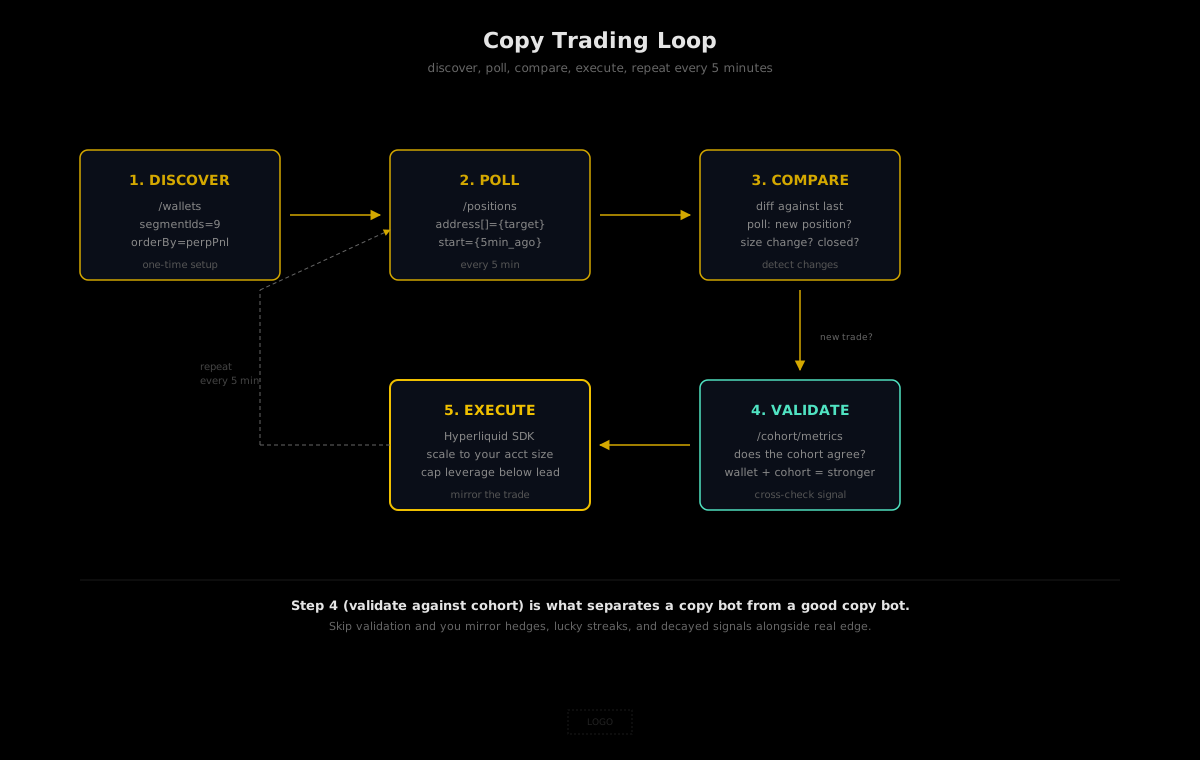
The basic copy trading loop is three steps:
- Discover a wallet. Find an address with a track record worth following. This could come from a leaderboard, a cohort filter, a social media post, or on-chain analysis.
- Poll their positions. Query the wallet's open positions at regular intervals (every 5 minutes is the standard cadence for non-HFT copy trading). When a new position appears or an existing one changes, that is the signal.
- Mirror the trade. Execute the same direction on the same asset, scaled to your own account size. If the lead wallet opens a 3x ETH long worth $500,000, and your account is 1/50th that size, you open a 3x ETH long worth $10,000.
The mechanical simplicity is the trap. The three steps above take an afternoon to build. The edge cases that blow up accounts take months to discover.
Finding wallets worth following
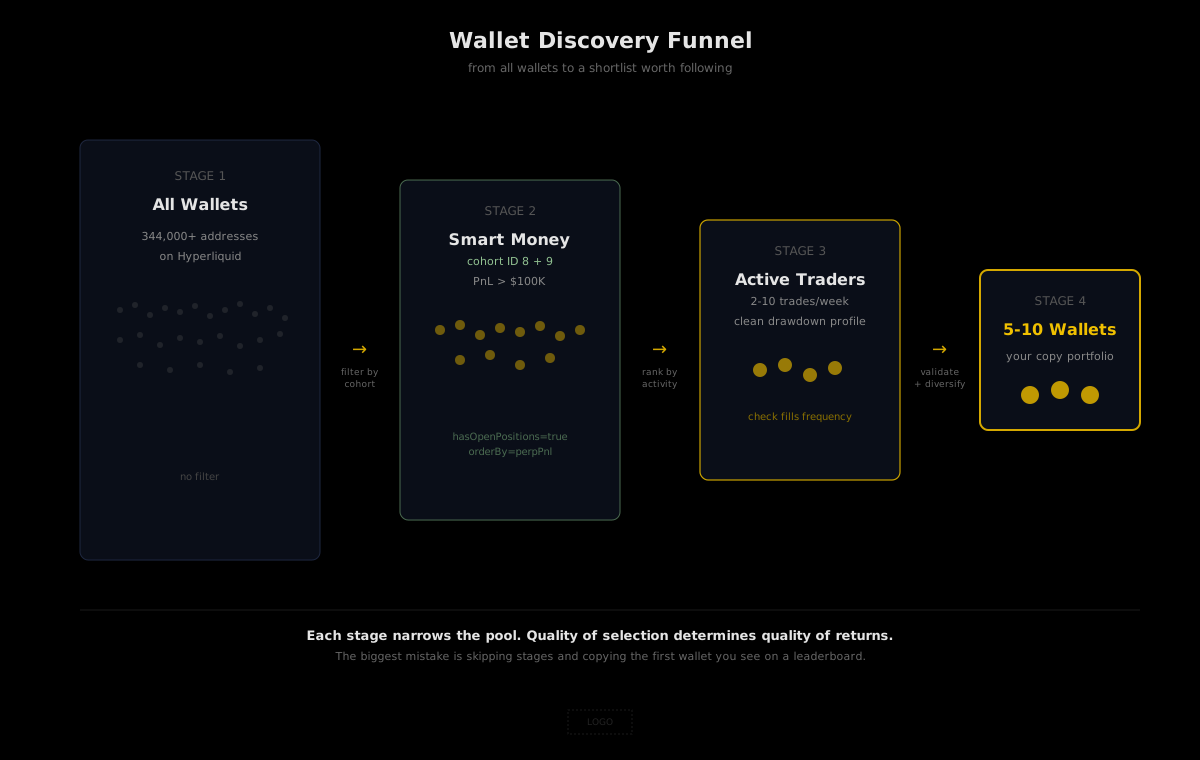
The quality of your copy trading system is entirely determined by wallet selection. A perfect execution engine mirroring a bad wallet will lose money with perfect fidelity. Here is how to filter for wallets that are actually worth following.
Start with PnL, not followers. Leaderboards ranked by all-time perp PnL are the starting point. HyperTracker's /leaderboards/perp-pnl endpoint ranks wallets by cumulative profitability across all-time, monthly, weekly, and daily timeframes. Sort by pnlAllTime for the most reliable signal: a wallet that has been profitable over hundreds of trades across multiple market regimes has demonstrated something closer to real edge than a wallet that caught one good week.
Filter by cohort. Raw leaderboard ranking does not tell you whether a wallet's profits come from consistent small edges or one lucky moonshot. Filtering by cohort adds context. The Money Printer cohort (ID 8, all-time PnL above $1M) and Smart Money cohort (ID 9, PnL $100K to $1M) are the two segments where sustained profitability is most likely to reflect genuine skill. Query /wallets?segmentIds=9&hasOpenPositions=true&orderBy=perpPnl&order=desc to get Smart Money wallets with live positions, ranked by profitability.
Check activity patterns. A wallet that trades once a month is hard to copy because the signal is too sparse. A wallet that opens 200 positions a day is hard to copy because the signal is too noisy and your execution costs will eat the edge. The sweet spot for copy trading is a wallet that takes 2 to 10 positions per week with clear entries and defined holding periods. You can check trade frequency by querying a wallet's recent fills.
Look at drawdown, not just total PnL. A wallet with $2M in cumulative profit and a $1.5M peak drawdown has a very different risk profile than a wallet with $800K in profit and $150K peak drawdown. The second wallet is a better copy target even though the headline number is smaller, because the equity curve is smoother and the position sizing is more sustainable.
The API workflow for building a copy trader
Here is the concrete flow for a copy trading system using HyperTracker's API. This is not pseudocode. These are the actual endpoints and parameters.
Step 1: Discover target wallets.
import requests

API_BASE = "https://ht-api.coinmarketman.com/api/external"
headers = {"Authorization": "Bearer YOUR_JWT_TOKEN"}

# Smart Money wallets with open positions, sorted by PnL
wallets = requests.get(
    f"{API_BASE}/wallets",
    headers=headers,
    params={
        "segmentIds": 9,
        "hasOpenPositions": True,
        "orderBy": "perpPnl",
        "order": "desc",
        "limit": 20,
    },
).json()

# Pick the top wallet as copy target
target = wallets[0]["address"]
print(f"Following: {target}")
Step 2: Poll for position changes.
from datetime import datetime, timedelta

# Check every 5 minutes for new/changed positions
start = (datetime.utcnow() - timedelta(minutes=5)).isoformat() + "Z"

positions = requests.get(
    f"{API_BASE}/positions",
    headers=headers,
    params={
        "address[]": target,
        "open": True,
        "start": start,
    },
).json()

for pos in positions:
    print(f"{pos['coin']}: {pos['side']} {pos['size']} @ {pos['entryPrice']}")
Step 3: Mirror via the Hyperliquid SDK.
Once you detect a new position from the target wallet, execute the same trade on your own account using the Hyperliquid Python SDK. Scale the position size proportionally to your account equity. This step is outside the HyperTracker API since execution happens directly on Hyperliquid.
The polling cadence matters. Five minutes is the standard for position-level copy trading. Faster polling (1 minute) catches entries earlier but costs more API requests and adds noise from partial fills. Slower polling (15 minutes) misses short-lived positions entirely.
Five ways copy trading fails
Copy trading looks simple in a tutorial and breaks in production. These are the failure modes that are not obvious until they cost you money.
1. The lead wallet is hedging, you are not. A wallet opens a large ETH short. You mirror it. What you cannot see is that the same wallet holds a larger ETH spot position on another venue, or has a call option that makes the short a hedge. Their net exposure is long. Yours is naked short. Same trade, opposite risk profiles.
2. The signal decays before you act. On Hyperliquid, onchain transparency means you are not the only one watching. By the time a top leaderboard wallet's position shows up in your polling loop, dozens of other copy traders have already piled in. The entry you mirror is worse than the original because the copy flow itself moved the price. On liquid assets (BTC, ETH) this is minimal. On thinner markets, the copy crowd can add 0.5% to 1% of slippage to the entry.
3. Position sizing mismatch kills you. The lead wallet is running 2x leverage on a $3M account. Their risk per trade is 0.5% of equity. You mirror the direction and leverage but your account is $10,000, so you are running 2x on your full balance. Same leverage, same direction, completely different risk management. When the lead wallet takes a calculated -3% drawdown, you take a -3% drawdown that feels like a crisis on a small account. And if you compensate by running higher leverage to "match" their notional size, you get liquidated on moves they barely notice.
4. Exit timing diverges. Even if you enter at a similar price, exit is harder. The lead wallet may scale out in three tranches over two days. Your polling loop catches the first exit but misses the second and third because they happen between polling intervals. You end up holding a position the lead wallet has already closed. Or worse, the lead wallet exits into a spike that your limit order misses.
5. Survivorship bias in wallet selection. The leaderboard shows you who has been profitable. It does not show you the 500 wallets that used the same strategy and blew up. A wallet at the top of the PnL leaderboard may have gotten there through genuine skill, through survivor bias, or through one concentrated bet that happened to work. All-time PnL is better than weekly PnL for filtering this, but it is not a guarantee.
These are not edge cases. They are the default experience for retail copy traders who build a system from a tutorial and run it without understanding the structural risks.
Why cohort signals beat single-wallet copying
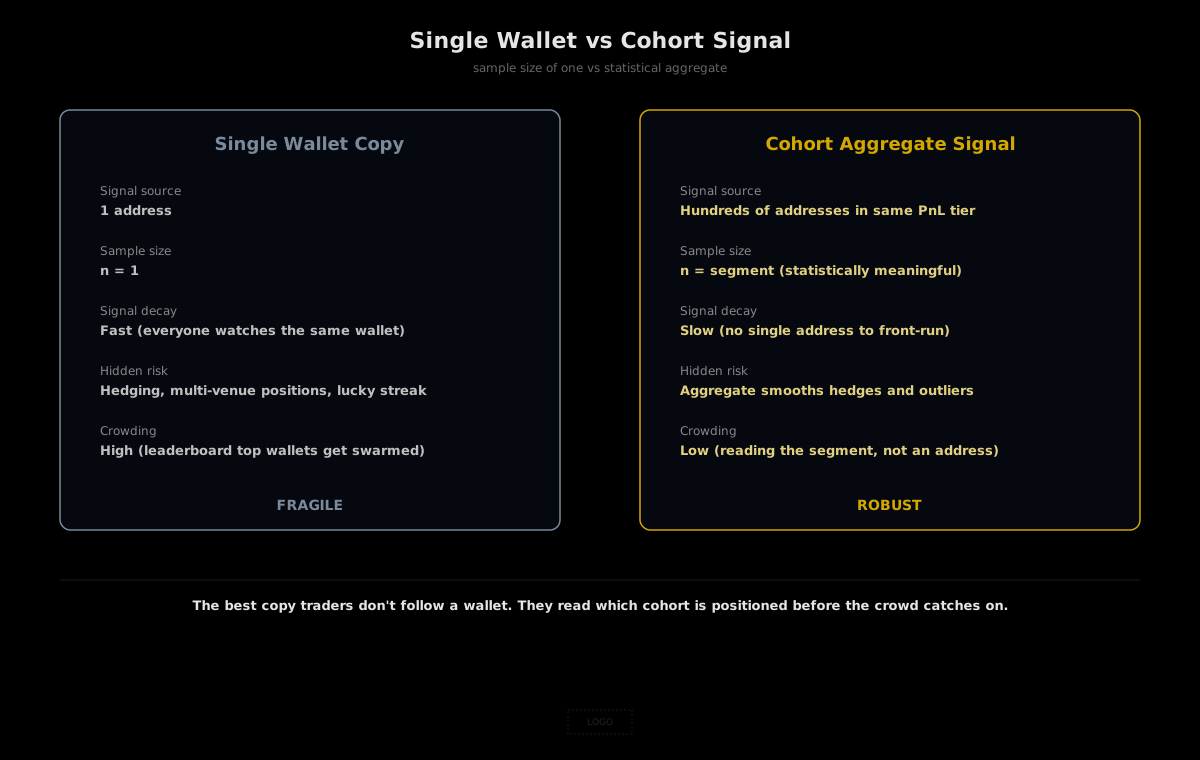
Every failure mode above traces back to the same root problem: single-wallet copying treats one wallet as a signal source, and one wallet is a sample size of one. Cohort analytics solves this by aggregating hundreds of wallets with the same profitability profile and tracking their collective behavior.
When you follow a single Smart Money wallet and they go long ETH, you are betting on one trader's judgment. When the entire Smart Money cohort (ID 9, hundreds of wallets with $100K to $1M in all-time profits) shifts net long on ETH, you are reading a consensus signal from a statistically meaningful sample. The individual wallet can be hedging, getting lucky, or making a mistake. The cohort cannot all be hedging at the same time.
The practical difference:
- Single wallet: one address, one thesis, one risk profile you cannot see. Signal decays fast because everyone is watching the same address. Entry gets crowded.
- Cohort aggregate: hundreds of addresses, aggregate positioning, statistical reliability. No single address to crowd. The signal is the segment, not the wallet.
This does not mean copy trading is useless. It means the best version of copy trading is not "follow wallet X." It is "when the Money Printer cohort is 75% long and the Giga-Rekt cohort is 85% short, the historically profitable side of the market is telling you something the chart cannot." That is copy trading at the segment level, and it is what cohort analytics was designed for.
Making copy trading work (if you still want to do it)
If you understand the risks and still want to build a wallet-level copy trader, here is how to reduce the failure rate.
Follow 5 to 10 wallets, not one. Diversifying across multiple lead wallets gives you portfolio-level signal instead of single-trader signal. If 7 of 10 wallets are long and 3 are short, the aggregate lean is the read, not any individual position.
Cap your leverage below the lead wallet's. If the lead runs 5x, run 2x. You are paying for the signal, not replicating the risk profile. Lower leverage gives you room to survive the drawdowns that single-wallet copying amplifies.
Set hard time exits. If the lead wallet has not exited after 48 hours and your position is flat or losing, close it. Copy trading breaks on long holds because the original thesis may have changed in ways you cannot observe.
Use cohort data to validate. Before mirroring a wallet's trade, check if the cohort agrees. If the wallet you are following is long but the Money Printer cohort is net short, the wallet may be hedging or wrong. If the wallet and the cohort agree, the signal is stronger.
Run it on paper first. Track the signals for two weeks without executing. Compare the theoretical P&L to what you would have actually gotten after slippage and timing. If the edge survives the simulation, deploy with small size. If it does not, the tutorial was more useful than the strategy.
Free tier on HyperTracker allows 100 requests per day: enough to poll 5 wallets every 15 minutes and check cohort metrics several times per hour. Start with discovery and paper trading before committing capital.
Closing thoughts
Copy trading on Hyperliquid is easier to build than on any other perp venue because every position is onchain and queryable. That accessibility is also the risk: the barrier to building a copy trader is so low that the market is full of them, which means the signal from watching any single wallet degrades the moment other people start watching the same wallet.
The traders who extract consistent value from this infrastructure are the ones who treat wallet data as an input to a thesis, not as the thesis itself. Cohort-level signals, cross-validated against individual wallet activity, with disciplined position sizing and hard exits. That is the version that works.
The best copy trade you can make on Hyperliquid is not following one wallet. It is reading which entire cohort of wallets is positioned before the rest of the market catches on.