Cross Margin vs Isolated Margin on Hyperliquid: Which One to Use and When
By CMM Team - 19-Apr-2026
Cross Margin vs Isolated Margin on Hyperliquid: Which One to Use and When
A trader opens a BTC long and an ETH short on Hyperliquid, both under cross margin. BTC drops 4% and ETH drops 6%. The ETH short is profitable, the BTC long is underwater, and the margin pool is still healthy because the gains on one side are cushioning the losses on the other. That is cross margin working as designed. Now imagine BTC drops 12% in a liquidation cascade. The BTC long hits its liquidation threshold and the entire cross account transfers to the liquidator, including the profitable ETH short. The same setting that saved the account yesterday just cost the trader both positions today.
Cross margin and isolated margin are not a quality choice. They are a risk architecture choice. Cross is more capital-efficient. Isolated is more damage-contained. The right answer depends on whether your positions are related to each other or not, and most traders never think about that before they toggle the setting.
This guide covers how each margin mode works on Hyperliquid specifically, how the liquidation math changes between them, when to use cross (hedged pairs, correlated portfolio), when to use isolated (single-conviction bets, uncorrelated positions), the common mistakes that blow up cross-margin accounts, and how to think about margin mode as part of your risk management before you size the trade.
How cross margin works
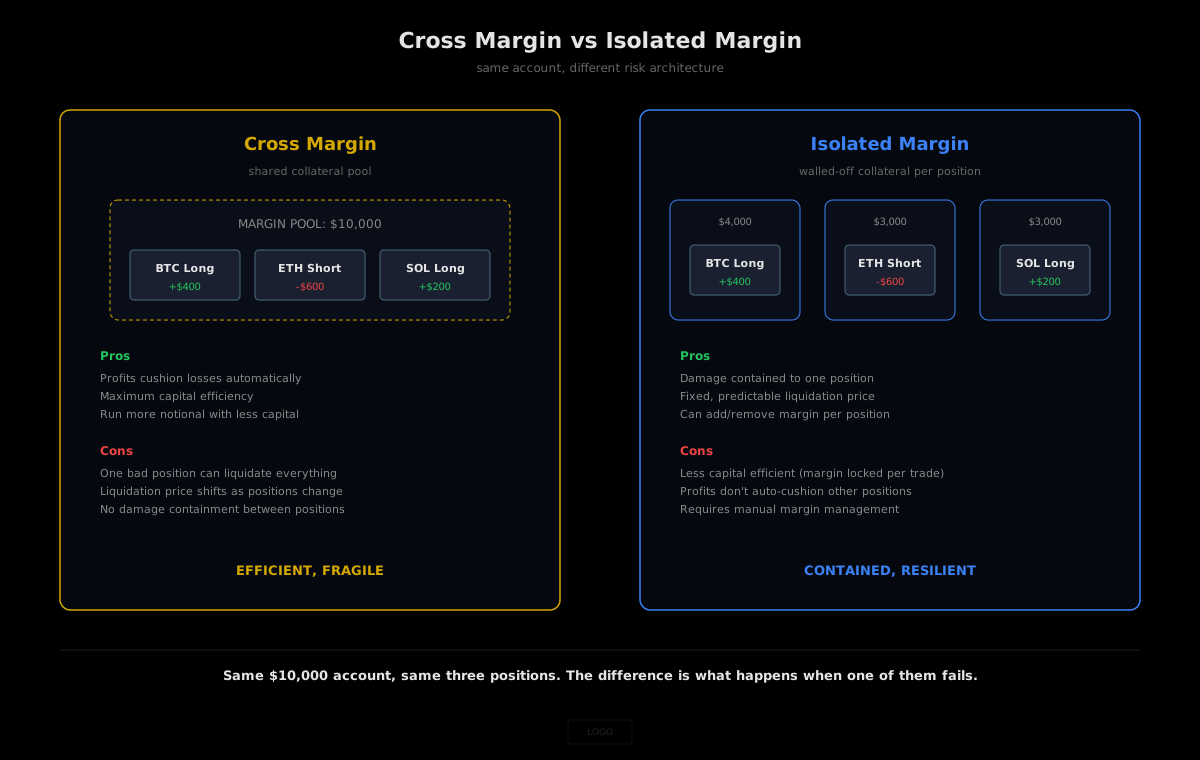
Cross margin is the default on Hyperliquid. It pools all your collateral into a single account that every cross-margin position draws from . When you open a BTC long and then open an ETH long, both positions share the same margin pool. If BTC is profitable and ETH is losing, the BTC profits automatically become available as margin for the ETH position.
The capital efficiency advantage is real. On cross margin, unrealized profits from one position can collateralize another without any manual transfer. A $10,000 account running three positions does not need to allocate $3,333 to each. The entire $10,000 backs all three, and the account only liquidates when the combined losses across all positions eat through the total margin.
The liquidation formula for cross margin looks at the entire account: you get liquidated when your account value drops below the maintenance margin requirement for all of your open positions combined . This means a profitable position actively protects a losing one by keeping the total account value above the threshold.
The required margin to open a position is position_size * mark_price / leverage . You set your leverage between 1x and the maximum for that asset. The leverage is only enforced at entry. After that, you need to monitor it yourself.
How isolated margin works
Isolated margin constrains collateral to a single position . When you open a BTC long on isolated margin, only the margin assigned to that specific position is at risk. If it gets liquidated, your other positions and your cross-margin balance are untouched .
The key difference from cross: you can actively add or remove margin from an isolated position after opening it. If a position is moving against you, you can add margin to push the liquidation price further away. If it is moving in your favor, you can pull margin out and redeploy it. This manual control does not exist on cross margin, where the pool manages itself.
Hyperliquid also offers a "strict isolated" variant that prevents margin removal entirely. On strict isolated, your margin reduces proportionally as the position closes but you cannot withdraw it while the position is open. This is the safest mode for traders who do not trust themselves to manage margin actively.
The liquidation formula for isolated positions uses the same maintenance margin logic as cross, but it only considers the isolated position's own margin and notional value. A single isolated position liquidates independently of everything else in the account.
How the liquidation math changes
The liquidation threshold on Hyperliquid is the same for both modes: maintenance margin is half of the initial margin at max leverage . What changes is what counts as "available margin."
Cross margin liquidation price: calculated from total account value minus total maintenance margin required across all positions. A losing BTC position's liquidation price moves further away when your ETH position is profitable, because the account value is higher. But if the ETH position starts losing too, the BTC liquidation price tightens because the overall account value is dropping.
Isolated margin liquidation price: calculated only from the margin assigned to that one position. It does not change based on what other positions are doing. If you assign $5,000 of margin to an isolated BTC long at 10x leverage, the liquidation price is fixed relative to that $5,000 regardless of whether your other trades are printing or bleeding.
The practical difference: on cross margin, your liquidation price is a moving target that shifts with every position in the account. On isolated, it is a fixed number you set when you open the trade and adjust only when you manually add or remove margin.
When to use cross margin
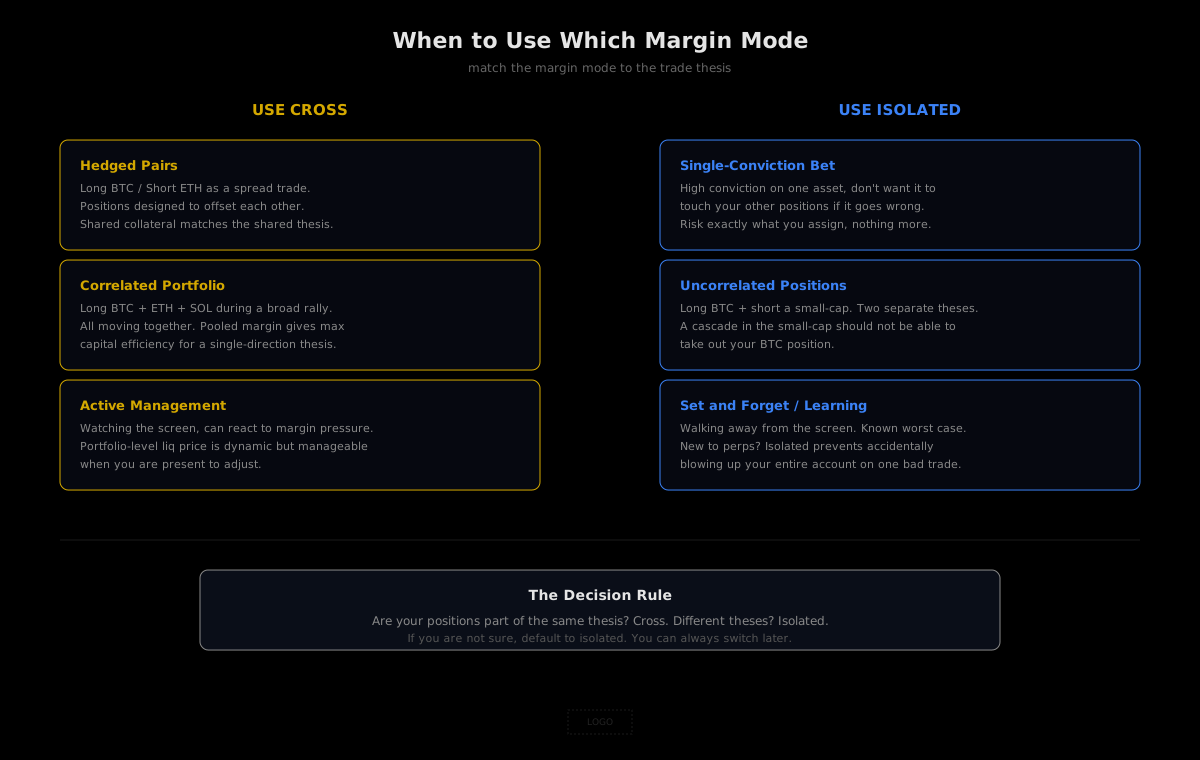
Cross margin works best when your positions are deliberately related to each other.
Hedged pairs. If you are long BTC and short ETH as a spread trade, cross margin is the natural setting. The positions are designed to offset each other, and sharing collateral means the portfolio-level risk is lower than either individual position. A drawdown on one leg is cushioned by the other, which is exactly what a hedge is supposed to do.
Correlated portfolio. If all your positions are in the same direction on correlated assets (long BTC, long ETH, long SOL during a broad crypto rally), cross margin gives you maximum capital efficiency. The positions are likely to profit or lose together, so pooling the margin is not adding hidden risk because the correlation is already in the thesis.
Active management. If you are watching your positions in real time and can react to margin pressure quickly, cross margin lets you run more notional with less capital. The tradeoff is that you need to monitor the portfolio-level liquidation price, not just individual positions.
When to use isolated margin
Isolated margin works best when your positions are independent of each other, or when you want to cap the maximum loss on a specific trade.
Single-conviction bets. You have high conviction on a DOGE trade but do not want it to touch your BTC and ETH positions if it goes wrong. Isolated margin lets you risk exactly the amount you assign, nothing more. If DOGE liquidates, your core positions are untouched.
Uncorrelated positions. If you are long BTC and short a small-cap perp as two separate theses, there is no reason for them to share margin. A cascade in the small-cap market should not be able to take out your BTC position. Isolated margin prevents the blast radius from spreading.
Set-and-forget trades. If you are entering a position and walking away from the screen, isolated margin gives you a known worst case. You will lose at most the margin you assigned. On cross margin, the worst case is your entire account.
Learning. If you are new to Hyperliquid or perps in general, isolated margin is the safer default. The damage is contained to one position, the liquidation price is predictable, and you cannot accidentally blow up your entire account on one bad trade.
Common mistakes with margin modes
Using cross margin with uncorrelated positions. This is the most expensive mistake on the platform. Two positions with no relationship to each other share a margin pool, which means a black swan on one asset can liquidate both. The ETH position that was profitable does not survive because the BTC liquidation takes the entire cross account.
Never adjusting isolated margin. Isolated margin lets you add or remove collateral. Traders who set it once and forget it miss the opportunity to tighten stops (by removing margin to force a closer liquidation price, capping risk) or add a buffer when the trade is working (by adding margin to give the position more room).
Switching modes without understanding the transition. Changing a position from isolated to cross (or vice versa) changes the liquidation price immediately because the margin pool changes. Traders who switch modes on an active position without recalculating the new liquidation level sometimes discover they are closer to liquidation than they expected.
Running max leverage on cross margin. Cross margin's capital efficiency advantage tempts traders to run higher leverage because "the other positions are backing this one." That is true until all positions lose at the same time, which is exactly what happens in a broad market crash. The cushion that cross margin provides evaporates when the entire portfolio is correlated to the downside.
Ignoring the withdrawal rules. You can withdraw unrealized profits on both modes, but the remaining margin must stay above max(initial_margin_required, 0.1 * total_position_value) . Traders who try to withdraw profits during a drawdown sometimes find the withdrawal blocked because the remaining margin no longer meets the threshold.
How cohort data reveals margin mode behavior
One pattern that shows up in HyperTracker's cohort data: the Money Printer and Smart Money cohorts tend to run lower effective leverage than the bottom PnL cohorts, which means their liquidation distances are wider and their margin buffers are deeper. This holds regardless of margin mode.
The useful read for margin mode decisions: check the /cohort/metrics endpoint for your target asset. If the Money Printer cohort has an average leverage of 3x and the Giga-Rekt cohort is running 15x on the same asset, the smart money is running conservative margin (wider liquidation distance, more room to be wrong) while retail is leveraged to the edge. That tells you something about which margin mode is working for the people who are actually making money.
For a full breakdown of all 16 cohorts and how they behave, see The Complete Guide to Hyperliquid's 16 Trader Cohorts. For how liquidation mechanics specifically work under each margin mode, see Hyperliquid Liquidations Explained.
Free tier on HyperTracker allows 100 requests per day. No credit card required.
Closing thoughts
Margin mode is the first risk decision you make on every trade, and it is the one most traders spend the least time thinking about. Cross margin pools everything together: efficient when it works, catastrophic when it does not. Isolated margin walls everything off: less efficient, more survivable. Neither is better. The right choice depends entirely on whether your positions are part of the same thesis or not.
The traders who survive cascades are never the ones with the best entries. They are the ones who chose the right margin mode before they entered, so that one bad position could not take the others with it.