
Drift Lost $295M. The Settlement Layer Made It Worse.
By CMM Team - 25-Aug-2026
Drift Lost $295M. The Settlement Layer Made It Worse.
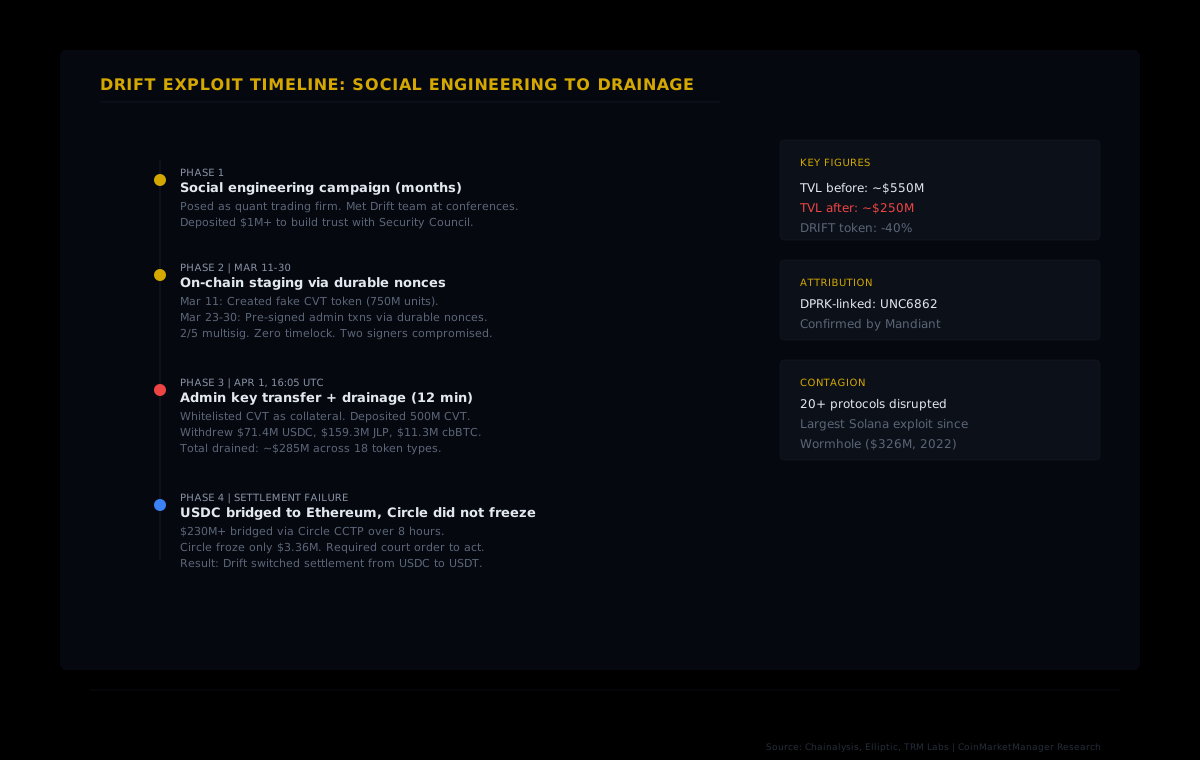
When Drift Protocol was drained of approximately $285 million on April 1, 2026, most of the coverage focused on the social engineering campaign that made it possible. And that story is worth telling: North Korean state-backed hackers spent months posing as a quant firm, attended conferences, deposited over $1 million of real capital, and tricked two of five multisig signers into pre-signing transactions that transferred admin control in a single second.
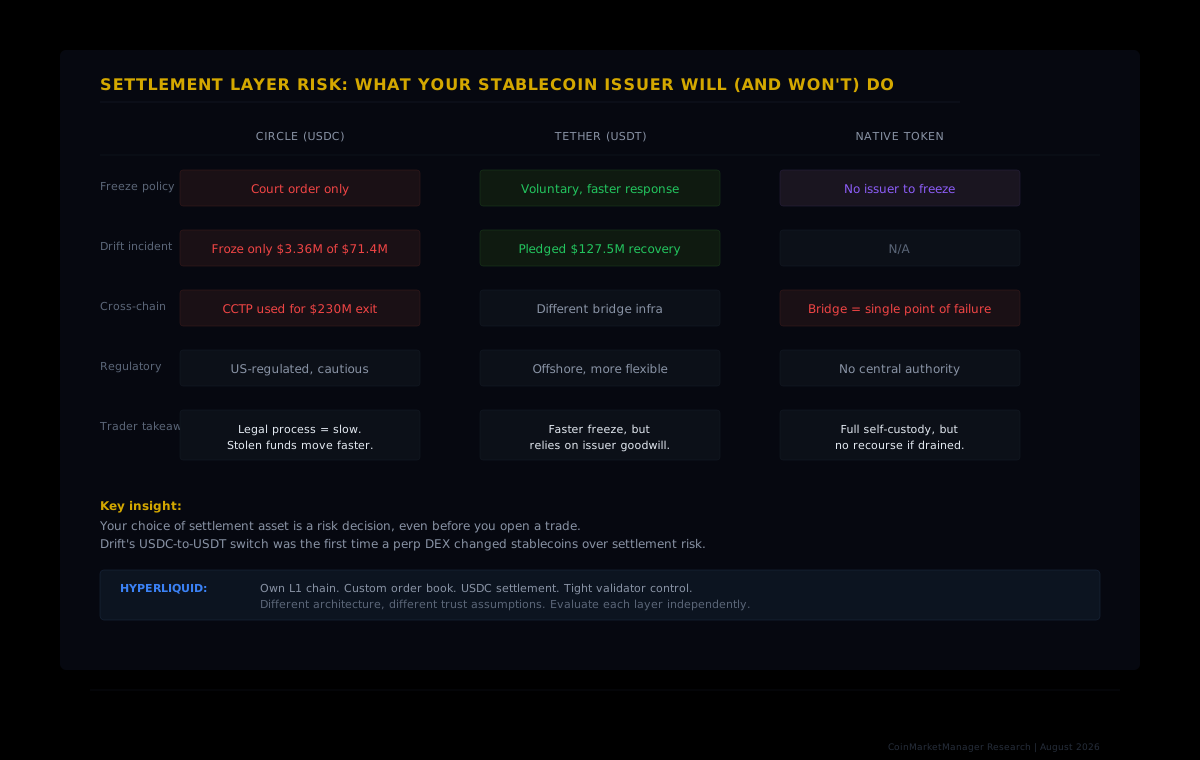
But the exploit itself was only half the damage. The other half came from the settlement layer. Attackers bridged more than $230 million in stolen assets from Solana to Ethereum using Circle's own Cross-Chain Transfer Protocol. Circle froze just $3.36 million of the $71.4 million in stolen USDC. The rest moved freely, because Circle's policy requires a court order before freezing wallets. By the time any legal process could have intervened, the funds were already on Ethereum and being laundered.
That failure triggered the first settlement-layer switch in perp DEX history. Drift dropped Circle's USDC and moved to Tether's USDT. The decision exposed a risk category that most perpetual futures traders have never evaluated: what happens to your settlement asset after someone steals it?
The 12-Minute Drain
Drift Protocol was the largest perpetual futures exchange on Solana. Its Security Council operated a 2/5 multisig with zero timelock, meaning two compromised signers could execute any admin operation instantly. The attackers, attributed to DPRK-linked group UNC6862 by Mandiant, exploited this by using Solana's durable nonces feature to pre-sign dormant transactions between March 23 and 30.
The on-chain staging started even earlier. On March 11, the attackers created a fake token called CarbonVote Token (CVT), minted 750 million units, and used wash trading to anchor its price near $1. They deployed their own oracle to feed that artificial price into Drift.
On April 1 at 16:05 UTC, everything fired. The attackers executed the admin key transfer, whitelisted CVT as valid collateral, deposited 500 million units, and withdrew real assets: $71.4 million in USDC, $159.3 million in JLP tokens, and $11.3 million in cbBTC, among others. The drainage ran for roughly 12 minutes across 31 transactions, hitting 18 different token types.
Why Settlement Risk Matters More Than the Exploit
Hacks get patched. Code gets audited. Multisig thresholds get raised. But the settlement layer is structural. It determines whether stolen funds can be recovered, how fast a protocol can respond, and what recourse users actually have.
Drift settled in USDC. After the exploit, attackers bridged stolen USDC from Solana to Ethereum using Circle's CCTP infrastructure. Circle's CEO Jeremy Allaire stated publicly that the company freezes wallets only when directed by law enforcement or courts. That policy is reasonable from a legal perspective. But from a trader's perspective, it means stolen stablecoins can move through Circle's own bridge for hours without intervention.
The contrast with Tether is instructive. Tether has historically been more willing to freeze wallets proactively in response to hacks, without waiting for court orders. Whether that flexibility comes from regulatory arbitrage or genuine policy difference, the practical effect is the same: faster intervention windows.
The USDC-to-USDT Switch
On April 16, 2026, Drift announced a recovery deal with Tether. The terms were significant: Tether proposed up to $127.5 million in recovery funding, plus partners pledged $20 million, structured around a $100 million revenue-linked credit facility. In exchange, Drift agreed to relaunch as a USDT-settled exchange.
This was the first time a major perp DEX switched its settlement stablecoin because of post-exploit risk. The decision was practical: Tether offered both capital and a market-making facility for day-one liquidity. But it also signaled something deeper about how protocols now evaluate stablecoin partners. The question is no longer just "Is this stablecoin liquid?" but "What will the issuer do when things go wrong?"
The Recovery Plan: Promising Structure, Uncertain Timeline
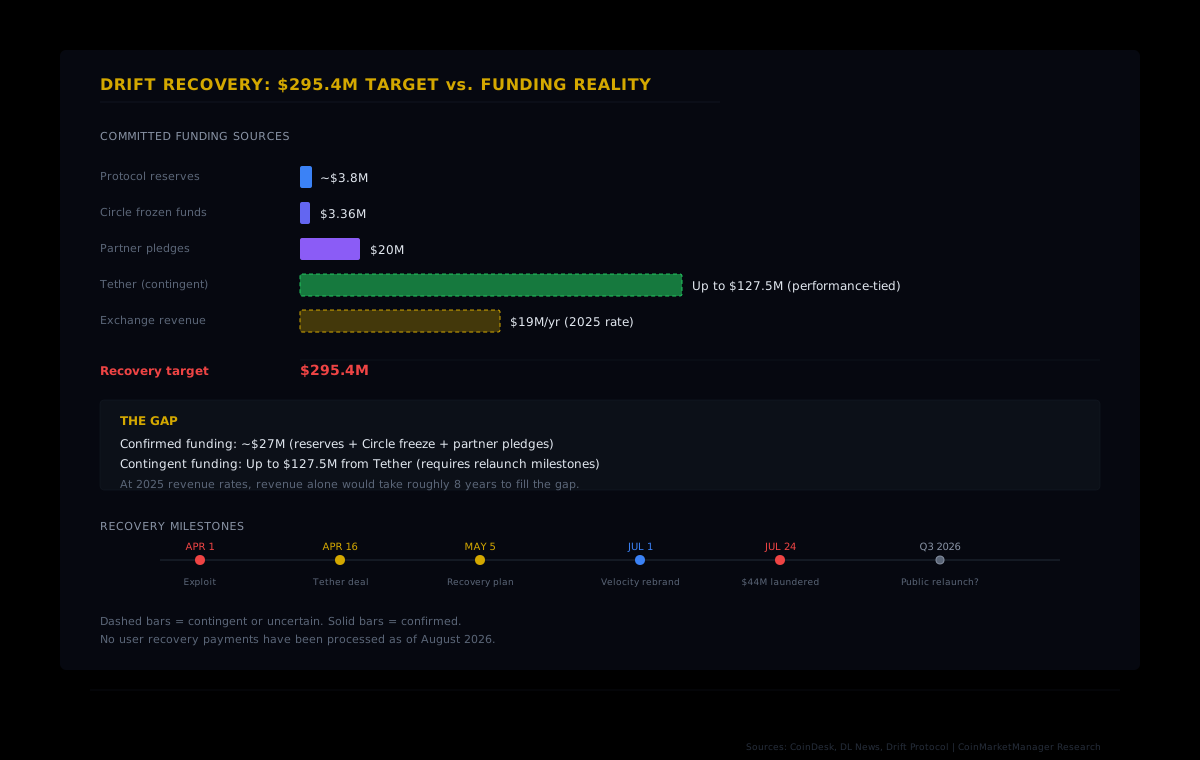
In May 2026, Drift published a detailed recovery plan targeting $295.4 million in verified user losses. The mechanics are worth understanding, because they illustrate the real-world constraints of DeFi recovery.
Recovery Tokens
Each affected user receives transferable SPL recovery tokens, where each token represents $1 of verified loss. These are separate from the DRIFT governance token and can be traded on secondary markets. Users who want immediate liquidity can sell at a discount. Users who prefer to wait for full redemption can hold.
Three Funding Streams
The recovery pool draws from three sources. First, approximately $3.8 million in remaining protocol reserves, converted to stablecoins. Second, up to $127.5 million from Tether, contingent on the relaunch hitting performance milestones. Third, up to $20 million from strategic partners, plus a quarterly cut of exchange revenue.
The math is sobering. Confirmed funding (reserves plus Circle's frozen $3.36 million plus partner pledges) totals roughly $27 million. The Tether commitment is performance-tied, meaning it depends on Drift (now Velocity) actually relaunching and generating meaningful volume. And Drift earned $19 million in total revenue in 2025. At that rate, revenue alone would need roughly eight years to fill the gap.
Early redemptions become available once the pool crosses $5 million, but payouts at that stage would be at a steep discount to face value. No user recovery payments have been processed as of August 2026.
Velocity: The Rebrand and Relaunch
On July 1, 2026, Drift rebranded to Velocity and announced a private beta for a rebuilt exchange. The new version strips out the attack surface: no durable-nonce mechanism, timelocked admin operations, full key rotation, and independent audits from Ottersec and Asymmetric before mainnet deployment. New leadership includes Noah Prince, formerly Head of Protocol Engineering at Helium.
The relaunch targets becoming the largest USDT perps exchange on Solana. But recovery efforts face headwinds. On July 24, 2026, the attacker laundered 23,095 ETH through Tornado Cash, making fund recovery significantly harder. The DRIFT token trades near its all-time low, around $0.028.
Five Questions Every Perp Trader Should Ask
The Drift hack was a governance failure. The settlement layer failure turned it into a recovery crisis. Together, they form a checklist that applies to any venue where you deposit capital for perpetual futures trading.
- What is the multisig structure? How many signatures are required for admin operations? Is there a timelock between signing and execution? Drift's 2/5 with zero delay was the structural weakness that made the exploit possible.
- What is the settlement asset, and what is the issuer's freeze policy? USDC requires court orders. USDT has historically frozen faster. Native tokens have no issuer to intervene. Each choice carries different risk in a post-exploit scenario.
- How composable is the platform? Drift's exploit cascaded to 20+ protocols through shared liquidity and yield strategies. If you deposit into a vault that deploys capital across DeFi, you inherit every downstream protocol's risk.
- What does the recovery mechanism look like? Recovery tokens? Insurance fund? Corporate reserves? The answer determines how long you wait and how much you recover. Drift's structure is more transparent than most, but "transparent" and "fast" are different things.
- Who controls the keys? Formal verification and smart contract audits cover code. They do not cover people. Social engineering, phishing, device compromise, and poor operational security are attack vectors that no audit can protect against.
Reading the Fallout With Cohort Data
Exploits create cascading effects across the entire perps market. When a major protocol goes down, traders on other platforms reposition: some de-risk, some speculate on contagion, and some open new positions to trade the volatility. The question is who is moving and in what direction.
Our data classifies every wallet on Hyperliquid into one of 16 behavioral cohorts. Eight are based on account size: from Shrimp ($0-$250 perp equity) up to Leviathan ($5M+). Eight are based on all-time PnL performance: from Giga-Rekt (below -$1M lifetime) up to Money Printer (+$1M+ lifetime). When market stress events hit, cohort-level positioning data reveals whether experienced, profitable traders are adding exposure or reducing it, often hours before the move shows up in price.
That kind of signal turns a news headline into something you can actually trade around. If Money Printers are aggressively shorting a token after an exploit on a different chain, that positioning shift carries more weight than another opinion thread on Crypto Twitter.
Track How Smart Money Repositions After Market Shocks
HyperTracker's cohort analytics classify every Hyperliquid wallet by size and track record. See how Money Printers, Smart Money, and Whales position during stress events. One API call, 16 behavioral segments, 5-minute refresh.
Settlement Is a Risk Decision
Before the Drift hack, settlement layer risk was an afterthought for most perp traders. You picked a venue, deposited USDC or USDT, and assumed the stablecoin was just a unit of account. Drift proved that assumption wrong. Your choice of settlement asset determines your recovery options when something breaks, and in DeFi, something always eventually breaks.
Drift's USDC-to-USDT switch was not just a business deal with Tether. It was a signal that perp DEX architecture now includes the stablecoin issuer as a load-bearing counterparty. Evaluating a perp venue without evaluating its settlement layer is like stress-testing a bridge without checking the foundations. The next time you size a position on any perp DEX, ask yourself: if this venue got drained tomorrow, what would the settlement layer do for you? The answer might change where you trade.