For the First Time, Hyperliquid Traded More RWAs Than Crypto
By CMM Team - 24-Jul-2026
For the First Time, Hyperliquid Traded More RWAs Than Crypto
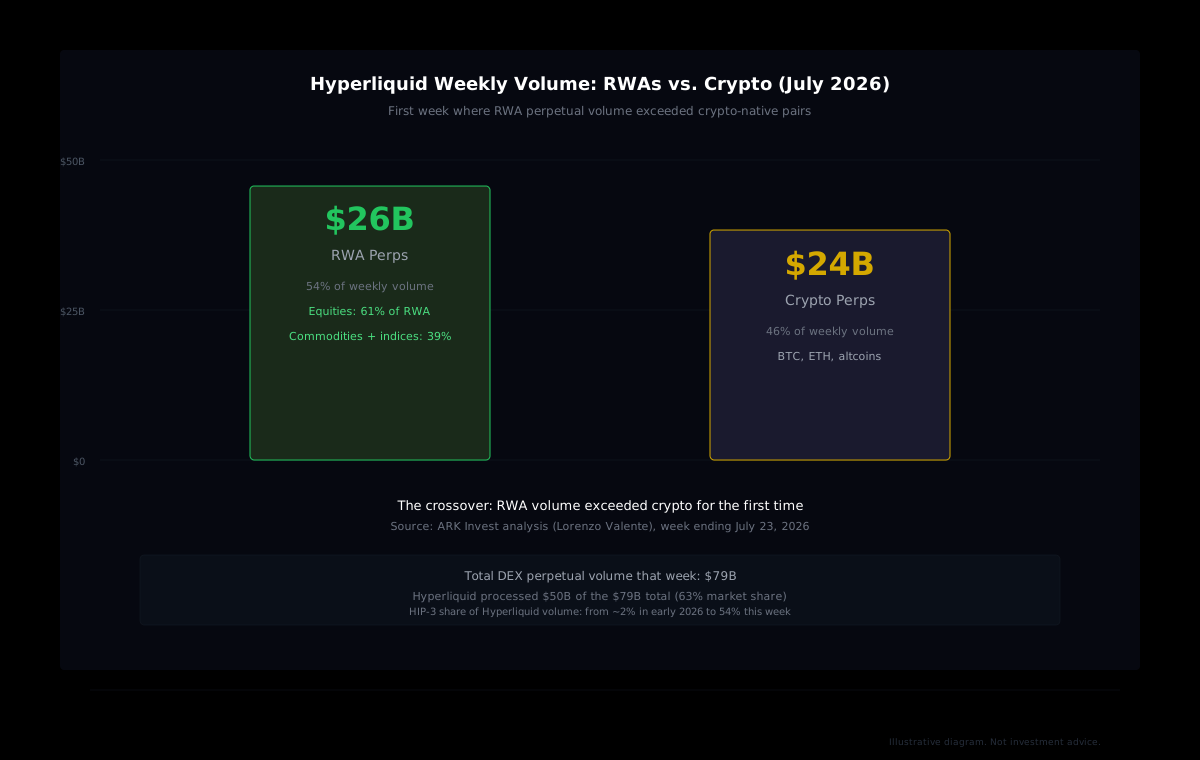
A decentralized exchange built for crypto perpetuals just generated more trading volume from stocks, commodities, and indices than from Bitcoin and altcoins. ARK Invest's Lorenzo Valente confirmed it on July 23: real-world asset perps accounted for 54% of Hyperliquid's weekly trading volume, the first time RWA markets have outpaced crypto-native pairs on the platform.
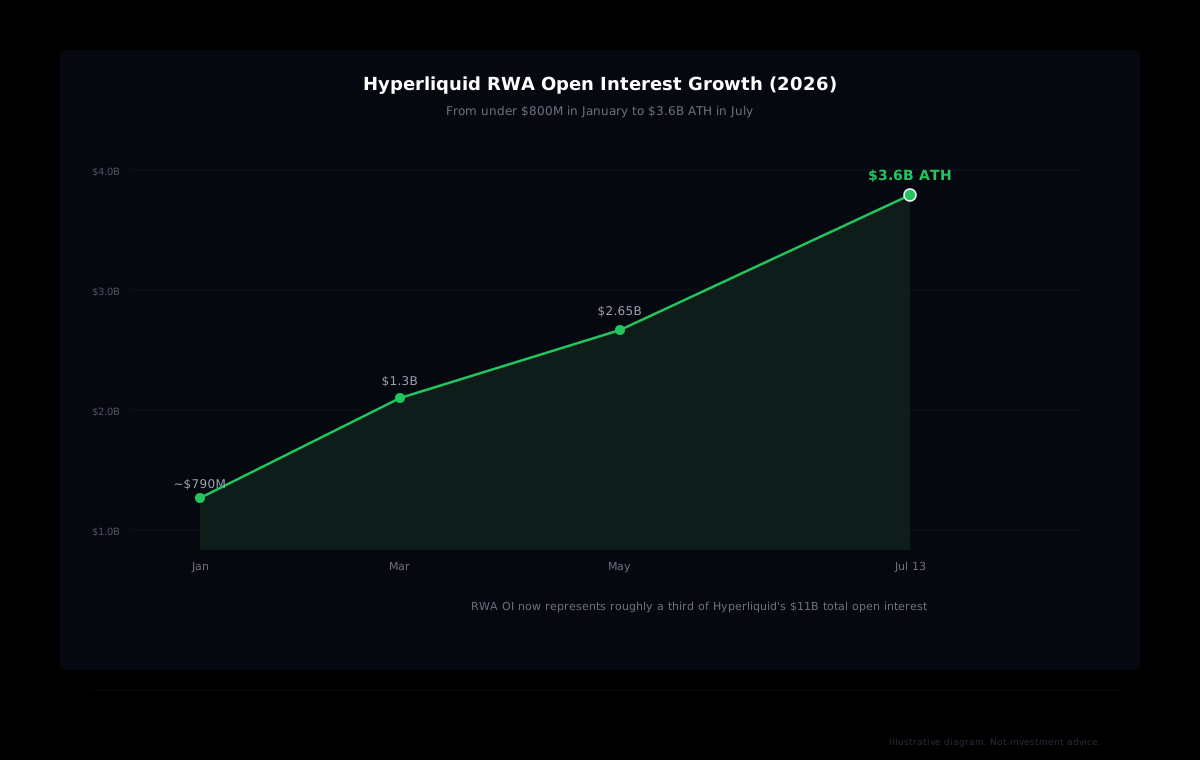
The milestone didn't arrive overnight. RWA open interest on Hyperliquid climbed from roughly $790 million in January to a record $3.6 billion by mid-July, while total open interest hit $11 billion, its highest level of 2026. But the volume crossover carries a different kind of significance, because it redefines what Hyperliquid actually is. A platform that started as a crypto derivatives exchange is now, by trading activity, a multi-asset venue where equities and commodities are the dominant product.
For builders working with on-chain trading data, this shift changes the analytical surface entirely. Every wallet that trades NVIDIA perps or WTI crude on Hyperliquid generates the same cohort-classifiable flow as a BTC or ETH position. The same 16 behavioral segments apply. The same API endpoints serve our data. What changes is the universe of tradeable assets and the types of strategies those assets attract.
The Numbers Behind the Crossover
Valente, ARK Invest's Director of Research for Digital Assets, posted the analysis on X (formerly Twitter) on July 23, 2026. His framing was direct:
"We are entering a new era for DeFi. For the first time ever, @HyperliquidX generated more volume from RWAs than crypto in a single week."
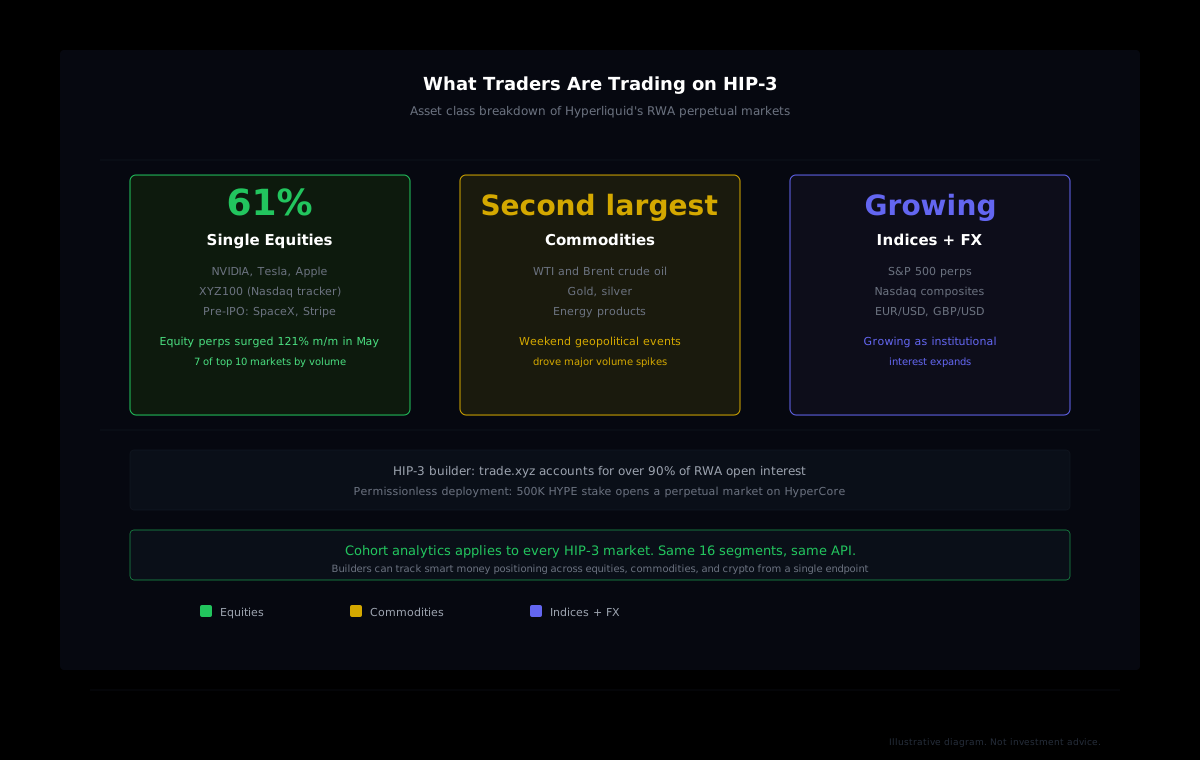
Single equities led the RWA category, accounting for 61% of all RWA trading volume on HIP-3 markets. That means traders are actively positioning in NVIDIA, Tesla, and Apple perps through Hyperliquid's on-chain infrastructure. Commodities (oil, gold, silver) and index trackers like the XYZ100 Nasdaq-100 perpetual made up the remainder.
To put the scale in context: total DEX perpetual volume across all platforms reached $79 billion that week, and Hyperliquid processed $50 billion of it. That gives the platform roughly 63% of global decentralized perpetual futures volume, which aligns with the broader trend: The Motley Fool reported Hyperliquid holds 70% of the global decentralized perps market.
How the Composition Changed So Fast
The catalyst is HIP-3, Hyperliquid's permissionless market framework that launched on October 13, 2025. Before HIP-3, every perpetual market on Hyperliquid was crypto-native. HIP-3 changed that by letting outside builders stake 500,000 HYPE tokens to deploy their own perpetual markets on HyperCore, Hyperliquid's main trading front-end.
The most prominent builder, trade.xyz, accounts for over 90% of HIP-3 open interest and is responsible for the bulk of the equity and commodity listings. The growth since then has been steep and consistent:
- January 2026: HIP-3 open interest sat around $790 million, roughly 2% of the platform's total activity.
- March 2026: RWA OI crossed $1.3 billion. Hyperliquid's overall share of perpetual DEX volume hit 44%.
- May 2026: RWA open interest reached $2.65 billion, doubling in roughly two months. Equity perps surged 121% month-over-month to $54 billion in May alone.
- July 13, 2026: RWA open interest hit a record $3.6 billion, and total platform OI reached $11 billion.
- Week of July 23: RWA volume crossed 54% of total. The crossover is official.
Why RWAs Attracted the Volume
Three forces converged to drive this shift, and they're all structural rather than speculative.
24/7 access to traditional markets
Traditional commodity and equity markets close on weekends and holidays. Hyperliquid doesn't. When geopolitical events break on a Sunday evening, crypto-native traders can immediately position themselves in gold or crude oil perps while traditional markets sit idle until Monday morning.
Earlier this year, a geopolitical crisis in West Asia drove HIP-3 commodity markets to 40% of the platform's total volume in a single weekend. Traders couldn't access CME or ICE, so they traded WTI crude, Brent oil, and silver on Hyperliquid instead. That behavior created a durable pattern: once traders discover they can trade oil perps at 2am on a Sunday, the habit sticks. CryptoBriefing reported that non-crypto assets showed 60% trader retention in late March, confirming the product is sticky.
Permissionless listing attracts builder capital
HIP-3's design lets any builder with a sufficient HYPE stake deploy new markets without approval. This means the asset surface grows organically. When SpaceX's IPO drew interest, someone listed a pre-IPO SpaceX perpetual. When gold spiked, builders listed gold and silver perps. The market creation speed on Hyperliquid outpaces anything a centralized exchange can do through its internal listing committee.
The fee structure funds real incentives
Hyperliquid's cumulative protocol revenue crossed $1 billion on June 30, 2026, with 91% coming from perpetual futures transaction fees. Of that revenue, 99% is routed to an on-chain buyer bot that acquires and destroys HYPE tokens, creating a direct link between trading volume and token value. This flywheel incentivizes both builders (who benefit from HYPE appreciation) and traders (who benefit from deep liquidity).
The Broader RWA Perps Market
Hyperliquid's crossover didn't happen in isolation. The entire RWA perpetual category exploded in 2026. CryptoBriefing reported that Q2 2026 total RWA perps volume across all platforms hit $202.67 billion, compared to $12.37 billion in Q4 2025. Q1 2026 alone reached $524.8 billion, surpassing the entire 2025 annual volume of $313 billion.
Hyperliquid's market share in the decentralized segment has been dominant: 70% of global decentralized perpetual volume, up from 4% at the start of 2026 by overall (including centralized) perpetual market share to 6.2% as of early July. In the RWA-specific category, Binance held 55.7% market share in May 2026, with Hyperliquid capturing between 19% and 29% across various periods.
The infrastructure provider behind many of these markets is Pyth Network, whose oracle feeds powered $110 billion in May 2026 RWA volume alone, representing 52% of the entire market.
What This Means for On-Chain Analytics
When a trader opens a NVIDIA perpetual on Hyperliquid, that position generates the same on-chain data as a BTC or ETH perp. The wallet gets classified into one of 16 behavioral cohorts (eight by wallet size, eight by all-time PnL), the position shows up in fills data, and the wallet's aggregate exposure contributes to cohort-level metrics.
This matters because the analytical surface just expanded dramatically. Consider what changes:
- Cross-asset cohort behavior becomes visible. Do Money Printers (wallets with over $1M all-time PnL) position differently in equity perps than in crypto perps? Do Shrimp-tier accounts ($0-$250) concentrate on memecoins while larger wallets diversify into commodities? Our data can answer these questions because the same cohort classification applies regardless of the underlying asset.
- Smart money rotation patterns emerge. When experienced traders shift from BTC to gold perps or from ETH to S&P 500 futures, that flow is now trackable. The RWA crossover means the majority of Hyperliquid's activity is now in assets that correlate with traditional macro forces, which creates a new signal layer for anyone monitoring smart money moves.
- Liquidation risk scoring extends to new markets. Our API scores liquidation exposure at the asset level. With equity and commodity perps now representing the majority of volume, builders can flag liquidation clusters forming in Tesla or crude oil positions the same way they'd flag them in BTC.
Same API, new universe: Our cohort analytics, order flow snapshots, and liquidation risk scoring work across every HIP-3 market. Builders querying our API for BTC cohort data can use the same endpoints and the same 16 segments for NVIDIA, gold, or S&P 500 perps. No separate integration required.
What Builders Should Watch Next
The volume crossover is a milestone, but it also creates new questions worth tracking. Here's what matters for anyone building on this data:
- Retention durability. The 60% retention rate for non-crypto assets reported in March is strong, but it's still early. If equity and commodity traders maintain that stickiness through a sustained market downturn, it validates RWAs as a permanent product category on Hyperliquid, something that would fundamentally change the platform's identity.
- Institutional presence signals. Grayscale recently filed an S-1 for a potential spot HYPE ETF, and VALR (Africa's largest crypto exchange) integrated Hyperliquid to offer perpetuals across equities, indices, precious metals, commodities, and forex. When regulated entities start piping volume into on-chain venues, the flow composition shifts again, typically toward larger positions and more deliberate strategies.
- Regulatory attention. The CME Group and ICE have warned U.S. authorities about the risks of continuously accessible markets operating outside traditional regulatory frameworks. If regulators move to restrict weekend commodity trading on decentralized venues, it could dampen one of Hyperliquid's primary RWA growth drivers.
- Cohort composition evolution. As RWA traders fill out the upper cohorts (Whale, Tidal Whale, Leviathan), the behavioral patterns in those segments may start reflecting traditional finance strategies more than crypto-native ones. Monitoring how cohort behavior shifts as the asset mix changes is a new analytical frontier.
Track Smart Money Across Every HIP-3 Market
HyperTracker's API classifies every wallet on Hyperliquid into 16 behavioral cohorts by size and PnL. Monitor how Money Printers and Leviathans position across crypto perps, equity perps, and commodity perps from a single endpoint.
A year ago, Hyperliquid was a crypto derivatives exchange. Today, by volume, it's an everything exchange where stocks and oil generate more flow than Bitcoin. The infrastructure didn't change. The asset universe did. And for anyone building analytics on that flow, the signal just got a lot more interesting.