From Static Wallet Labels to Behavioral Cohorts: Why Nansen-Style Intelligence Misses Hyperliquid
By CMM Team - 13-May-2026
From Static Wallet Labels to Behavioral Cohorts: Why Nansen-Style Intelligence Misses Hyperliquid
Wallet labeling has been crypto analytics' default product for almost a decade. Identify the address. Tag it. "Binance hot wallet," "Jump Trading," "vitalik.eth." The promise is simple: turn anonymous on-chain activity into named actors so you know who's moving the market. Nansen pioneered the category. Arkham scaled it. Most of crypto twitter now references wallet labels in trading commentary as if they were the gold standard.
They're not — at least not on Hyperliquid. Static labels work in spot markets and slow-moving ecosystems where a wallet's identity is the most important fact about it. On a perp DEX where 818,000+ addresses trade actively, where capital allocation shifts hourly, and where the same wallet might be brilliant one quarter and rekt the next, behavioral classification is a more useful signal than identity. Knowing that a wallet is "VC fund X" tells you who's trading. Knowing that a wallet sits in the Money Printer cohort with $2.1M in all-time PnL tells you whether to copy them.
This article unpacks why the wallet-labels paradigm breaks down on a high-frequency perp exchange, what behavioral cohort classification does differently, and how to build alpha-generating intelligence systems without paying for pre-labeled wallet lists that go stale within months.
The wallet-label paradigm and where it works
Wallet labeling started in the Ethereum spot ecosystem for good reasons. A small number of mega-addresses (exchanges, VC funds, protocols, named individuals) account for a disproportionate share of on-chain volume. Identifying those addresses lets you separate "real" capital flows from noise. When you see 50,000 ETH move from a wallet labeled "Coinbase Cold Storage" to one labeled "Binance Deposit," you can reason about it: exchange-to-exchange transfer, probably arbitrage or rebalancing, not retail panic selling.
This kind of labeling is genuinely useful for slow-moving markets. Three things make it work:
- The labeled set is stable. Major exchanges, custodians, and protocols don't change their wallet structure often. A label assigned in 2022 still applies in 2026.
- Volume concentrates in known wallets. A single exchange wallet might handle 10x the daily volume of all retail addresses combined.
- The "who" question is the right question. When you're trying to understand whether a price move was driven by institutional rebalancing or retail FOMO, identity is the decisive variable.
For ETH spot, BTC on-chain analytics, and slow DeFi protocols, this paradigm holds up. Most of Nansen's actual product value comes from these use cases, not from labels of individual traders.
Where it breaks: high-frequency perp DEXes
Hyperliquid is a different animal. The platform processes around $6 billion in daily derivatives volume. Most of that flow comes from individual traders running their own strategies — not from a small set of institutional wallets that can be reliably labeled. The action is in the long tail.
Three structural reasons wallet labels lose their grip:
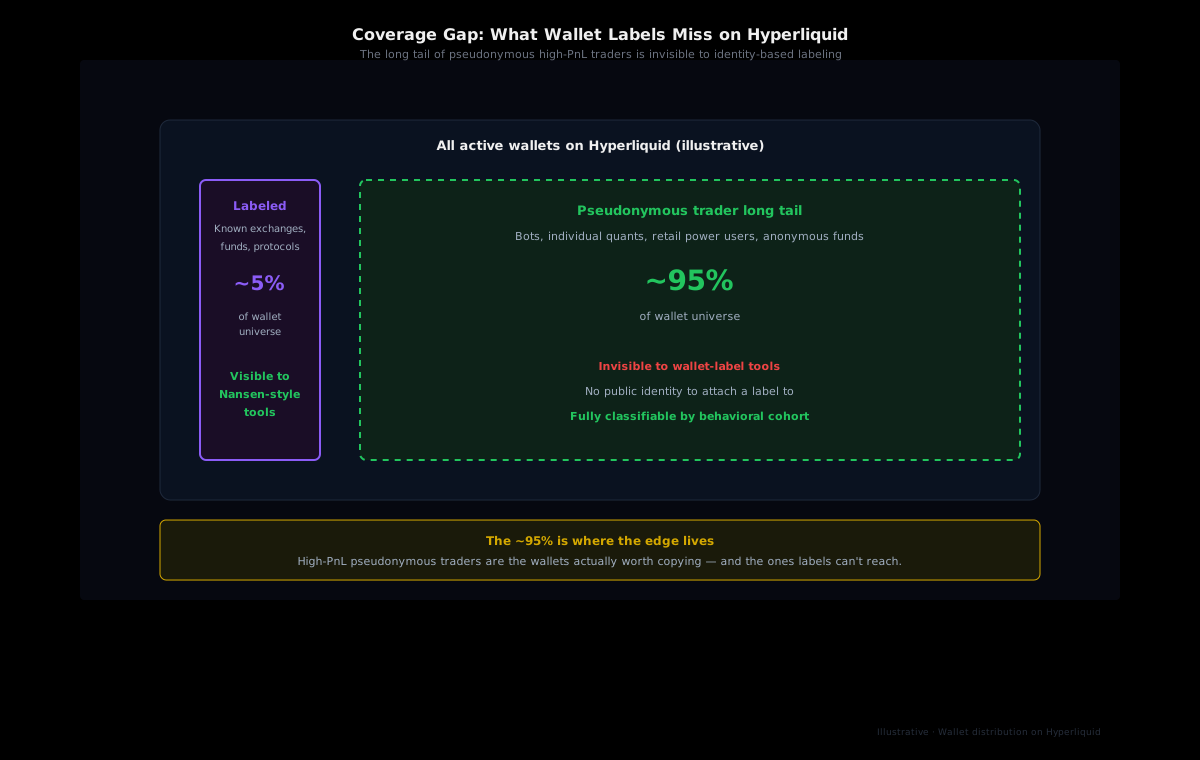
The labeled set doesn't cover what matters. Even if Nansen tagged every known fund and exchange on Hyperliquid, those labeled wallets account for maybe 5% of active addresses. The 95% you actually need to understand — the anonymous high-PnL traders, the bot operators, the rotating retail flow — have no labels and never will, because they have no public identity to attach a label to.
The "who" stops being the right question. On a perp DEX, what matters is whether a trader has demonstrated edge, not who they are. A pseudonymous wallet that has compounded $50K into $2M over two years of perp trading is more interesting than a labeled VC fund that's been steadily underperforming. The wallet label tells you about reputation; the PnL track record tells you about skill.
Labels go stale faster than the market moves. A wallet labeled "Smart Money" in 2024 because of a successful early position might be losing money in 2026. Static labels assume identity predicts behavior — but on a market that updates every hour, behavior changes faster than labels can.
The behavioral classification alternative
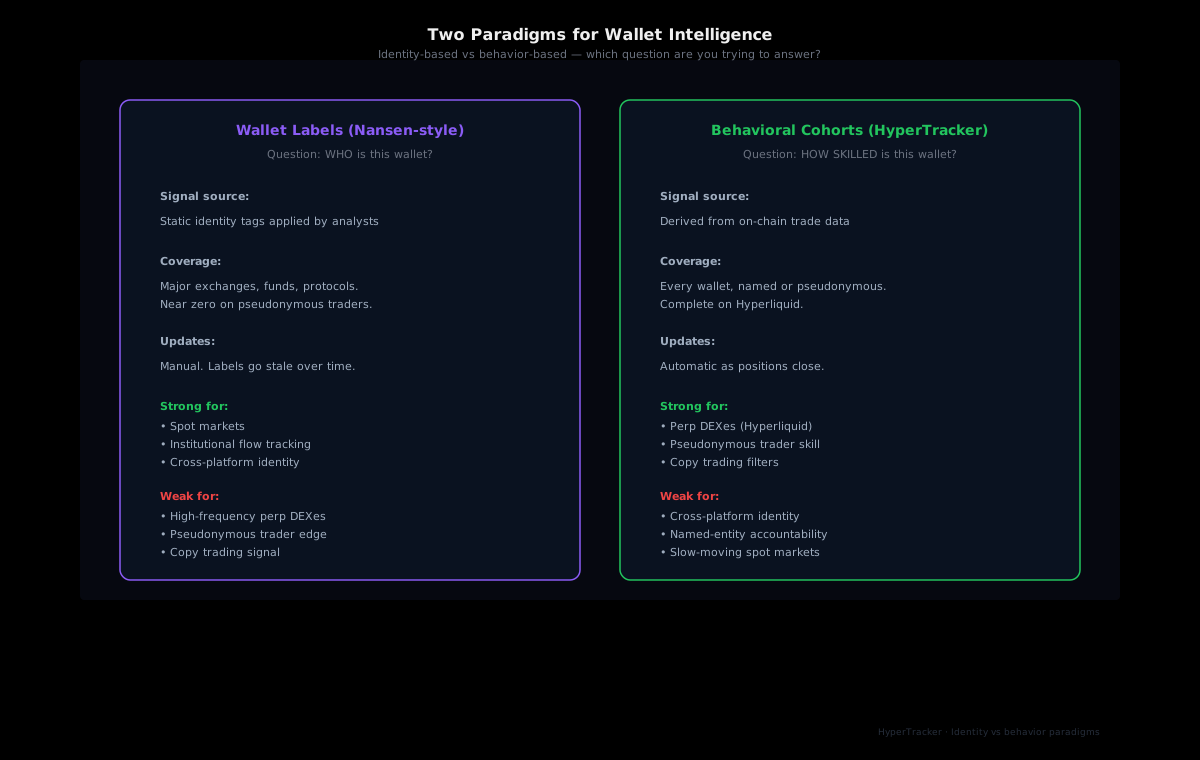
Instead of asking "who is this wallet?" cohort analytics asks "how has this wallet behaved?" The classification is derived from on-chain data the wallet itself generates: position sizes, leverage usage, holding periods, realized PnL. Every wallet sits in one of 16 cohorts based on these signals, and the cohort updates as new behavior accumulates.
On Hyperliquid, the framework runs across two independent dimensions:
Size cohorts (current perp equity): Shrimp ($0-$250), Fish ($250-$10K), Dolphin ($10K-$50K), Apex Predator ($50K-$100K), Small Whale ($100K-$500K), Whale ($500K-$1M), Tidal Whale ($1M-$5M), Leviathan ($5M+).
PnL cohorts (all-time realized profit on Hyperliquid): Money Printer (+$1M+), Smart Money (+$100K to +$1M), Consistent Grinder (+$10K to +$100K), Humble Earner ($0 to +$10K), Exit Liquidity (-$10K to $0), Semi-Rekt (-$100K to -$10K), Full Rekt (-$1M to -$100K), Giga-Rekt (below -$1M).
A wallet's classification is the intersection of these two dimensions. A Money Printer who's also a Tidal Whale is large-cap smart money. A Money Printer who's an Apex Predator is high-skill small capital — often more replicable for retail copy traders than the whales. A Tidal Whale who's also Exit Liquidity has size but no edge. Same on-chain signature, but the classification distinguishes them in a way wallet labels never could.
Why this matters for copy trading
If you're building a copy-trading system or alert framework on Hyperliquid, the difference between wallet-label intelligence and behavioral cohort intelligence is the difference between rented insight and earned insight.
With wallet labels, you're paying someone to maintain a list of named addresses, then betting that those names still mean something months after the label was applied. The signal degrades with time, and it never covers the long tail of pseudonymous high-performers.
With behavioral cohorts, the signal updates with the wallet. A trader who used to be a Smart Money grinder but stopped trading falls out of the active cohort. A new wallet that proves itself by accumulating profitable trades graduates into Smart Money. The classification reflects current reality, not a snapshot from a year ago.
The practical translation:
- Filter your copy targets by PnL cohort, not by label. Following "Smart Money" wallets you found from a Nansen export will overweight wallets that earned that label in a previous market regime. Following the current Money Printer cohort on Hyperliquid gives you wallets actively demonstrating edge in this regime.
- Use size cohort for sizing decisions, not selection. A wallet's size tells you what scale they trade at, not whether they're good. Small accounts often have better risk discipline than large ones because they have less margin to absorb mistakes.
- Track cohort migrations. When a wallet moves from Smart Money up into Money Printer, that's a buy signal — the wallet just crossed a meaningful performance threshold. When a Money Printer falls back into Smart Money, that's a flag worth investigating.
Building this yourself vs API access
You could build a behavioral classification system from raw Hyperliquid data. The platform's L1 publishes every fill, every funding payment, every liquidation. With enough infrastructure, you could compute all-time PnL per address, size buckets, and recent performance windows. The hard parts:
- Cold-start cost. Reconstructing all-time PnL for every active wallet means processing every fill since the chain went live. Storage and compute aren't trivial.
- Maintenance. New wallets appear daily. Existing wallets' classifications shift as positions close. Keeping this current requires continuous ingest.
- Validation. Classifying a wallet incorrectly is worse than not classifying it. Edge cases like sub-account transfers, deposit-then-withdraw patterns, and bot-driven activity all need careful handling.
For most builders, the build-vs-buy calculus tilts toward buy. HyperTracker's API exposes all 16 cohort classifications, the underlying PnL and position data, and historical cohort trajectories. A single endpoint returns the cohort for any wallet. Cohort-level positioning queries return aggregate stats across each tier on any asset. Starting at $179/mo with a free tier for testing, the math beats building from scratch — and the data is consistent with what powers our own dashboard and alerts.
Get behavioral cohort intelligence on Hyperliquid →
What labels still do better
To be clear: wallet labeling isn't useless. There are two things it does that behavioral classification doesn't:
-
Identity-linked accountability. When a labeled fund moves $50M into a token, the fact that it's a named entity matters for regulatory, reputational, and counterparty reasons. Behavioral cohorts strip identity by design — useful for analytics, useless for KYC-style accountability questions.
-
Cross-platform tracking of known entities. If you want to follow what "Jump Trading" is doing across Ethereum, Solana, and Hyperliquid simultaneously, you need their addresses labeled on each chain. Behavioral cohorts are platform-specific and won't aggregate identity across venues.
For these use cases, Nansen-style labels are the right tool. They just shouldn't be your default tool for tracking trader skill on a perp DEX, because skill is a behavior, not a name.
The trade-off, summarized
| Question | Wallet Labels | Behavioral Cohorts | |---|---|---| | Who is this wallet? | Strong | Weak (by design) | | How skilled is this wallet? | Weak | Strong | | Is the signal current? | Goes stale | Updates with behavior | | Coverage of pseudonymous traders | Near zero | Complete | | Best for spot/slow markets | Yes | No | | Best for perp DEXes | No | Yes | | Cross-platform identity | Strong | Weak | | Copy trading edge | Weak | Strong |
Wallet labeling answers "who" and assumes identity predicts edge. Behavioral cohort classification answers "how skilled" and lets behavior speak for itself. On Hyperliquid, where 818,000+ addresses trade actively and most edge is concentrated in pseudonymous accounts, the second framework wins on almost every dimension that matters for trading.
The Nansen paradigm built the entire wallet-intelligence category. It's a useful tool for the markets it was designed for. But the next generation of on-chain analytics — the one built for high-frequency perp markets where edge is concentrated in the pseudonymous long tail — is going to be behavioral first. That's the bet HyperTracker is making, and the GSC data shows traders are already searching for it.