PnL-Based Trader Classification: Why Performance Matters More Than Size on Hyperliquid
By CMM Team - 12-May-2026
PnL-Based Trader Classification: Why Performance Matters More Than Size on Hyperliquid
A $5M wallet that has lost $2M over the past two years and a $50K wallet that has compounded steady $5K-a-month gains for eighteen months are both visible on the Hyperliquid leaderboard. One ranks as a Tidal Whale by size. The other doesn't make any "whale watcher" list at all. Most copy-trading tools would surface the first wallet and ignore the second. That gets the signal backwards.
Account size tells you who can afford to lose money. All-time PnL tells you who has been consistently right. Those are two different questions, and the wallets that answer the second one correctly are the ones worth following — regardless of whether they're flush or scrappy.
This article breaks down why PnL-based cohort classification is the more reliable signal for copy trading on Hyperliquid, how the eight PnL tiers actually work, and how to combine size and PnL data to filter out the wallets that look impressive but underperform.
The size-vs-skill confusion
The crypto industry has spent years equating "whale" with "smart money." It's an easy heuristic — big positions move markets, so whoever holds them must know something. The leaderboards reinforce this. CoinGlass, Arkham, Nansen, and most onchain analytics platforms surface the largest wallets first because size is the most visible metric.
But size is just a measure of capital, not edge. A wallet can grow to Tidal Whale status ($1M to $5M) through any combination of: a single early-entry position that ran 100x, inherited treasury from a previous venture, capital deployed from a fund, or accumulated profits from genuinely skilled trading. From the outside, all four look identical. Only the fourth tells you anything useful about future performance.
The same wallet, classified by all-time PnL, gives you a clearer answer. If that Tidal Whale is also a Money Printer (cumulative profit over $1M), they've earned that capital through sustained profitable trading. If they're a Tidal Whale who sits in the Full Rekt cohort (lifetime PnL between -$1M and -$100K), they have a $1M-plus account because they started with $3M or more and are slowly losing it.
Those are very different traders. Following the first one is a reasonable copy-trading bet. Following the second one is just expensive entertainment.
How PnL cohorts work on Hyperliquid
HyperTracker classifies every wallet on Hyperliquid into one of eight PnL cohorts based on realized profit and loss across the wallet's entire trading history on the platform. This isn't a snapshot of recent performance or a measure of unrealized gains on open positions. It's the cumulative net of every closed trade the wallet has ever made on Hyperliquid.
The eight cohorts are:
| Cohort | All-time PnL | Cohort ID | |---|---|---| | Money Printer | +$1M and above | 8 | | Smart Money | +$100K to +$1M | 9 | | Consistent Grinder | +$10K to +$100K | 10 | | Humble Earner | $0 to +$10K | 11 | | Exit Liquidity | -$10K to $0 | 12 | | Semi-Rekt | -$100K to -$10K | 13 | | Full Rekt | -$1M to -$100K | 14 | | Giga-Rekt | Below -$1M | 15 |
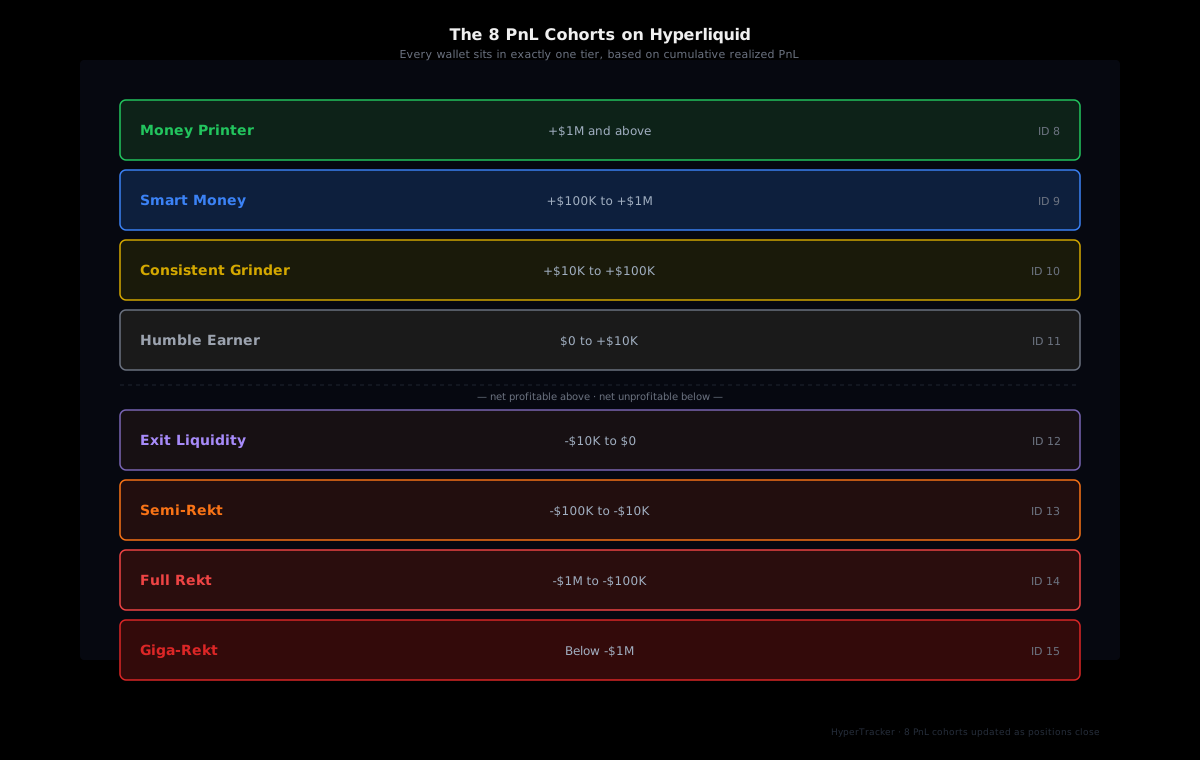
Every wallet sits in exactly one of these. The classification updates as positions close and PnL gets realized, so a Smart Money wallet that has a great month can move into Money Printer, and a Money Printer who blows up on a leveraged ETH long can fall back to Smart Money or lower.
That mobility is part of what makes the classification useful. It's not a static label. It reflects the wallet's most recent performance reality.
Why all-time matters more than recent
A common alternative to all-time PnL is recent-window PnL — last 7 days, last 30 days, last 90 days. Most leaderboards default to one of these short windows because they update fast and produce visible movement on the rankings.
The problem with short windows is that they're dominated by variance. A wallet that goes 4-for-5 on highly leveraged trades during a trending market can top the weekly leaderboard without demonstrating any skill that survives a regime change. The next month, when the trend breaks, that wallet is gone.
All-time PnL is the opposite. It rewards sustained edge across multiple market conditions. A Money Printer who has crossed $1M in cumulative realized profit has done it across enough trades and enough market regimes that the result is unlikely to be luck. They've held positions through dips, taken profits at peaks, and survived the kind of drawdowns that wipe out short-window leaders.
If you're copy trading and you want to follow wallets whose edge is durable rather than seasonal, all-time PnL is the better filter. Short-window leaders are interesting to watch, but they're not the wallets you build a copy-trading framework around.
How to combine size and PnL cohorts
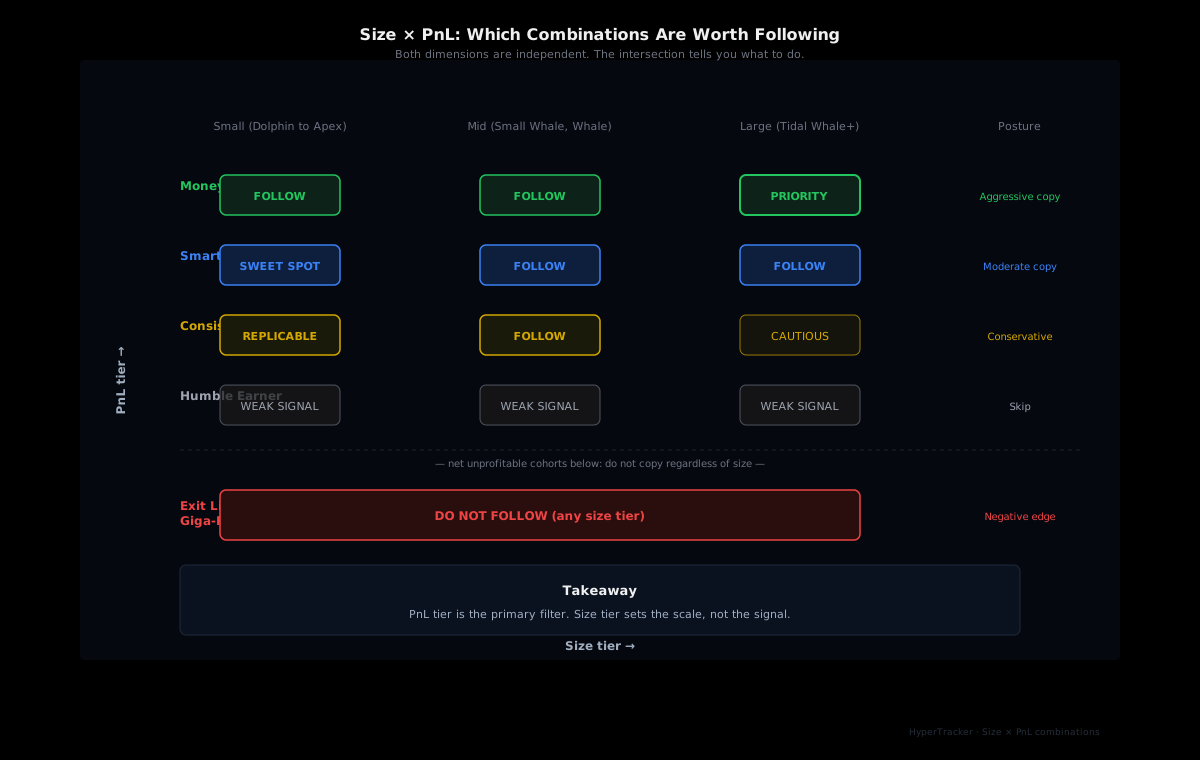
The most actionable signal isn't either cohort alone. It's the intersection of both — checking which size-cohort a wallet sits in and which PnL-cohort it sits in, then weighting accordingly.
Some practical combinations:
Money Printer + Whale (or above): The classic "smart money" wallet. Large account, proven track record. These are the wallets that justify the cliché. Worth weighting heavily in any copy-trading framework.
Money Printer + Apex Predator (or smaller): Sophisticated small accounts. They've compounded a smaller capital base into seven-figure cumulative profits, which usually means they trade with high precision and good risk management. Often more replicable for retail copy traders than million-dollar accounts running 2x leverage.
Tidal Whale or Leviathan + Exit Liquidity (or worse): Large accounts with negative all-time PnL. These wallets are visible because of their size, but they're not generating alpha. Avoid copying them. The size tells you nothing useful.
Consistent Grinder + Dolphin or Fish: Solid mid-tier performers in normal-size accounts. Realistic copy-trading targets for retail. They're not running million-dollar positions, so their setups are easier to mirror at proportional scale.
Smart Money + Apex Predator: Mid-tier capital with strong track record. Often the sweet spot for copy traders — large enough that their trades are meaningful, small enough that their strategies translate well to smaller follower accounts.
The point isn't to memorize every combination. It's to recognize that size and PnL are independent dimensions, and the wallets worth tracking are the ones that score well on PnL — regardless of what their size dimension looks like.
Reading cohort positioning, not just individual wallets
A natural next step beyond filtering individual wallets is reading positioning across an entire PnL cohort. Instead of asking "is this specific Money Printer wallet long BTC?" you can ask "what percentage of the Money Printer cohort is net long BTC right now?"
That's a fundamentally different signal. A single wallet's position tells you what one trader thinks. Cohort-level positioning tells you what hundreds of historically profitable wallets collectively think. The aggregate is more robust to individual biases, single-wallet manipulation, or one trader having a bad week.
This is where the PnL classification really compounds in value. The same cohort framework that lets you filter wallets also lets you read sentiment at the tier level. When the Money Printer cohort flips from net short to net long on an asset, that's a statistically meaningful shift in the most-profitable-historically wallets' collective bias — and it tends to lead price action rather than follow it.
API access
HyperTracker exposes all 16 cohorts — eight by size, eight by PnL — through a single API. You can query individual wallets, pull cohort-level positioning across any asset, and rank wallets within a cohort by recent performance.
import requests

# Get the Money Printer cohort's net positioning on BTC
response = requests.get(
    "https://api.hypertracker.cmm.app/cohorts/8/positions",
    headers={"Authorization": "Bearer YOUR_API_KEY"},
    params={"asset": "BTC"}
)

# Returns net long/short distribution across all Money Printer wallets
data = response.json()
The free tier includes enough requests to test the classification on individual wallets. Paid tiers (starting at $179/mo) unlock cohort-level positioning queries and historical PnL data.
Start tracking PnL-tier wallets on Hyperliquid →
The bigger lesson
The crypto industry over-indexes on size because size is visible. Wallet balances are public, position sizes are public, leaderboard rankings are public. All-time PnL is harder to compute — it requires reconstructing the wallet's entire trade history and netting every closed position — so most analytics platforms skip it.
But size and skill aren't the same thing. The wallets worth following are the ones with edge that has compounded across enough trades to be more than luck. PnL classification is how you find them. Size classification just tells you who has the biggest account, and the biggest account is rarely the best trader.
For copy trading specifically, this distinction matters more than almost anything else. Copy the right cohort and you inherit the edge of historically profitable wallets. Copy the largest cohort and you might just be following someone slowly losing their capital with confidence.
The data is there. The classification is there. Most traders are still ranking by size out of habit. The ones who switch to PnL-first analysis are getting a structural advantage that, ironically, scales the longer they keep doing it.