
How Hyperliquid Builders Get Cohort Analytics for $179 Instead of $10K/Month
By CMM Team - 21-Apr-2026
How Hyperliquid Builders Get Cohort Analytics for $179 Instead of $10K/Month
You have a Hyperliquid trading product. You need cohort analytics: which segments are accumulating, which are dumping, where the smart money is positioned. The question on the whiteboard is whether your team builds that infrastructure in-house or buys it from someone who already has.
This is the question every serious builder on Hyperliquid faces eventually. And the answer looks obvious until you start tallying the actual costs.
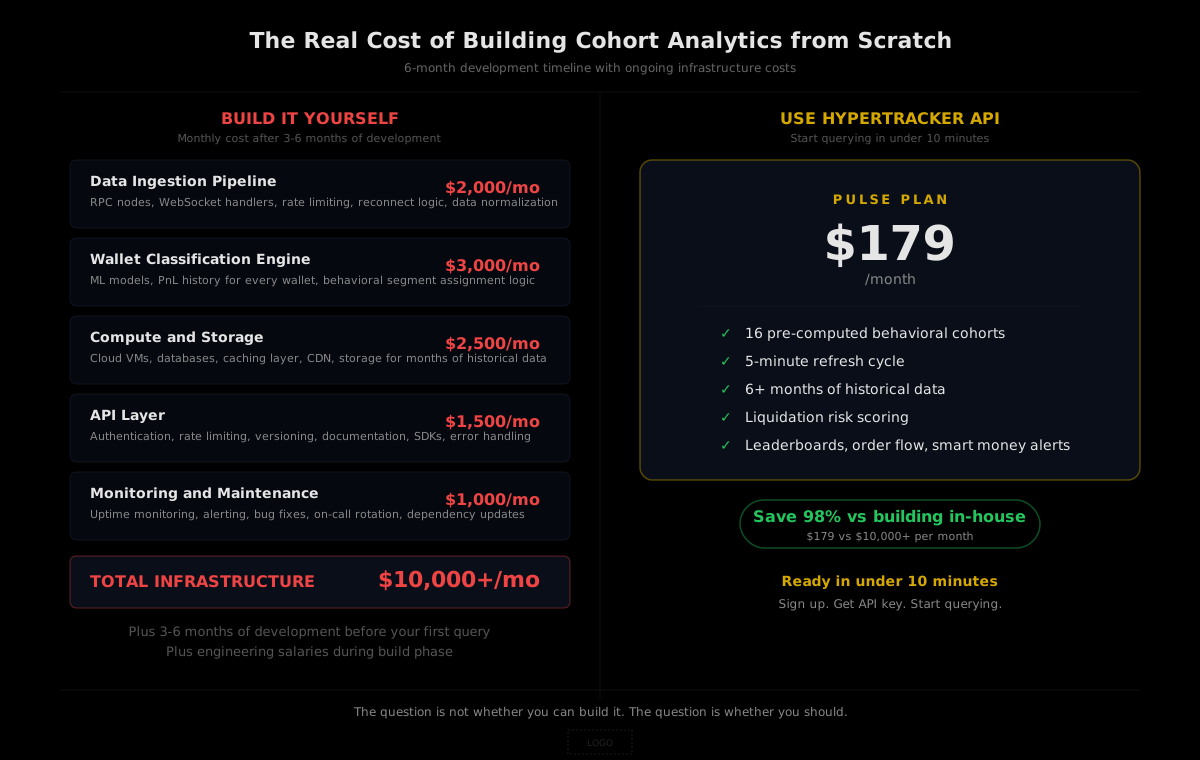
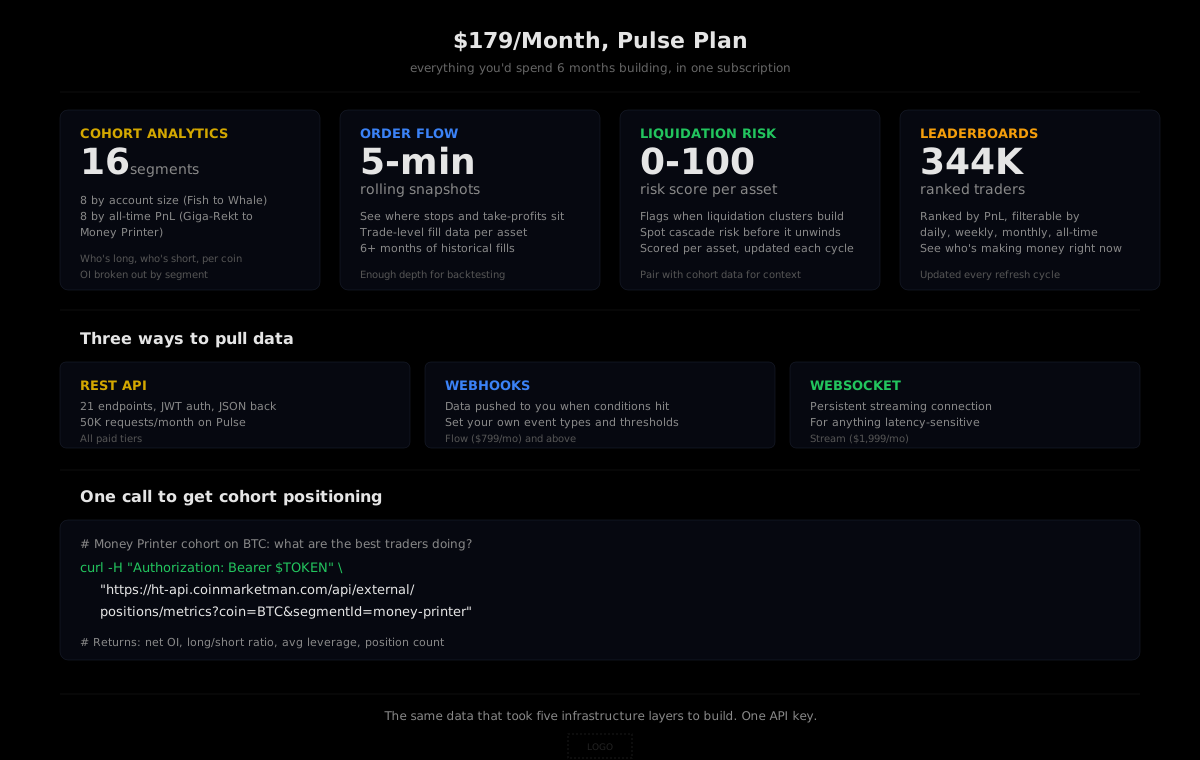
Building cohort analytics infrastructure from scratch costs roughly $150,000 in upfront engineering time and $10,000+ per month in ongoing infrastructure. HyperTracker's Pulse plan delivers the same intelligence for $179/month, ready in under 10 minutes.
This article breaks down the full cost of building your own cohort analytics pipeline: the engineering hours, the cloud bills, and the hidden expenses that balloon after launch. Then it compares that against what you actually get for $179/month on HyperTracker's API.
The five-layer problem
Cohort analytics sounds simple on a whiteboard: classify wallets by size and PnL, track their positioning, serve it through an API. Sixteen segments, two dimensions, refresh every few minutes. A senior engineer might estimate two weeks. They'd be off by about five months.
Data ingestion (~$2,000/month)
You start by connecting to Hyperliquid's L1 via RPC. WebSocket connections, rate limit handling, reconnect logic when the connection drops at 3am, schema normalization so the raw event stream becomes something queryable. Two months of engineering to get this stable, and it never really stops needing attention. RPC providers change rate limits. Hyperliquid ships protocol updates. Your parser breaks on a Friday night.
Wallet classification (~$3,000/month)
To segment wallets, you need every wallet's complete trading history. All-time PnL across every position they have ever opened. Then you bucket them by account size and profitability, and keep those buckets current as new trades settle and wallets cross tier boundaries. New addresses appear daily. Dormant wallets wake up. One wallet splits activity across three addresses. None of this is a batch job you run once. It runs continuously, and the edge cases multiply.
Compute and storage (~$2,500/month)
Cloud VMs, databases holding months of per-asset per-cohort positioning history, a caching layer so every API request does not re-query your database, CDN if you serve distributed clients. Storage grows linearly. The longer you retain data, the more you pay.
API layer (~$1,500/month)
Authentication, rate limiting, versioning, error handling, documentation good enough that someone can integrate without pinging your team on Telegram. About a month of backend work to build properly.
Monitoring and ops (~$1,000/month)
Uptime checks, alerting, on-call rotation, dependency updates, adapting to protocol changes. The pipeline is live. Now you keep it live, indefinitely.
The costs teams forget to budget
The line items above add up to $10,000+ per month in infrastructure alone. But that is the optimistic number. Four costs consistently blindside teams that go the build route.
Opportunity cost
Your best engineers spend 3 to 6 months building data plumbing. During that time, they are not working on your actual product: the trading strategies, the UI, the features that differentiate you in the market. For a startup or small team, this is the biggest cost and the one least likely to appear on a spreadsheet.
Maintenance drag
Infrastructure does not stay built. Hyperliquid updates its API. RPC providers change pricing or rate limits. A dependency gets a security patch that breaks your parser. Every month, something needs attention, and that attention comes from the same engineers who should be shipping features.
Data quality debt
Your cohort classifications will not be accurate on day one. Gaps in wallet history, missed events during downtime, misclassified wallets from edge cases you did not anticipate. It takes months of iteration before your data quality matches what a dedicated analytics provider ships from the start.
Hiring pressure
To build and maintain this system properly, you need at minimum: a data engineer (pipeline and classification), an infrastructure engineer (cloud, monitoring, scaling), and a backend developer (API, auth, docs). Three roles. Even if one person covers two, you are looking at hiring at least two experienced engineers with crypto-specific domain knowledge. That market is not cheap.
What $179/month gets you
HyperTracker's Pulse plan is the entry point for API access. For $179/month, here is what ships with it:
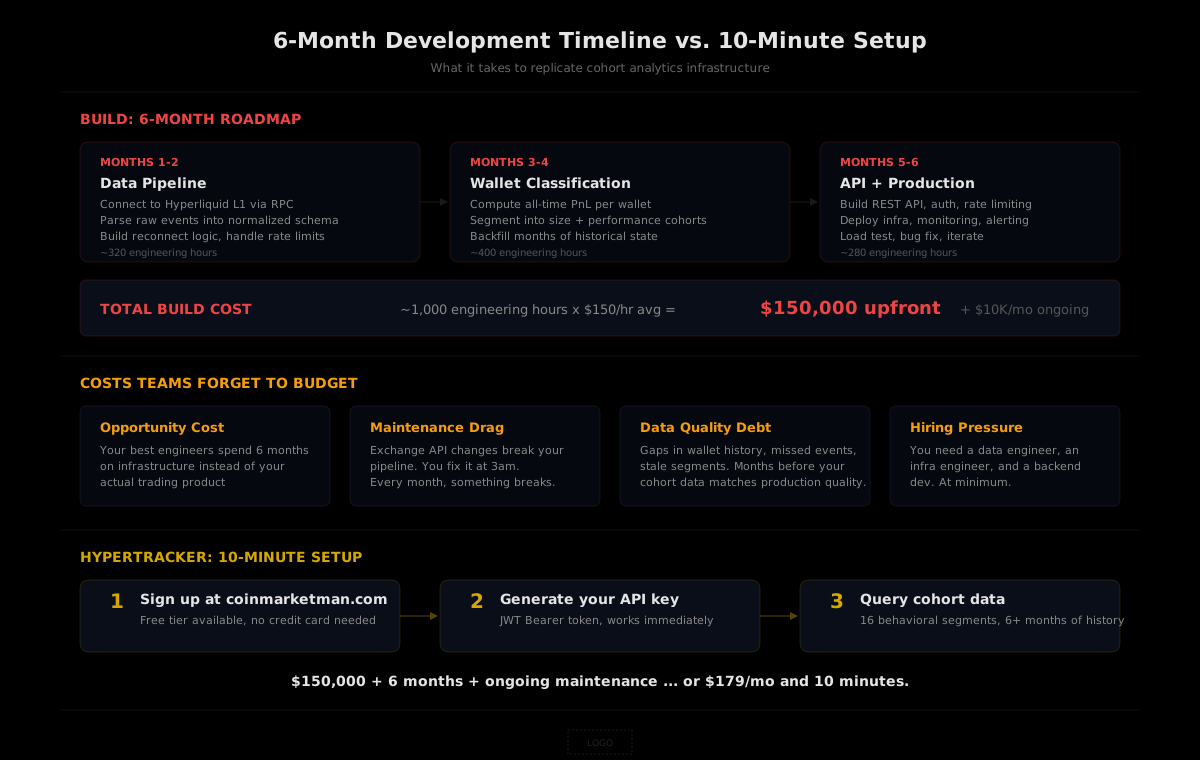
16 behavioral cohorts, pre-computed and refreshed every 5 minutes. Eight segments by account size (Fish, Shrimp, Crab, Octopus, Dolphin, Shark, Orca, Whale). Eight segments by all-time PnL (Giga-Rekt through Money Printer). Net positioning, bias direction, and segment-level open interest for every supported asset.
Order flow intelligence: stop and take-profit visibility, trade flow analysis, rolling 5-minute snapshots. Fill-level data going back 6+ months for backtesting.
Liquidation risk scoring: per-asset exposure assessment that flags elevated cascade probability before it happens.
Leaderboards: 344,000+ traders ranked by PnL across daily, weekly, monthly, and all-time timeframes.
21 REST API endpoints with JWT authentication, structured JSON responses, and 50,000 requests per month at 60 requests per minute.
One API call returns what took five infrastructure layers and months of development to produce:
curl -H "Authorization: Bearer $TOKEN" \
  "https://ht-api.coinmarketman.com/api/external/positions/metrics?coin=BTC&segmentId=money-printer"
That returns the Money Printer cohort's net open interest, long/short ratio, average leverage, and position count on BTC. No pipeline to maintain. No wallets to classify. No servers to monitor at 3am.
When building does make sense
The build route is not always wrong. Two scenarios favor it:
Custom cohort definitions. If your trading strategy requires segments that do not map to HyperTracker's 16 (say, wallets that traded a specific token in the last 48 hours, or wallets with a particular leverage profile), you may need your own classification engine. Even then, consider whether HyperTracker's raw position and fill data can feed your custom logic without rebuilding the entire pipeline.
Volume that justifies the investment. If you are processing more than 2 million requests per month and need custom SLAs with guaranteed uptime commitments, an in-house build can eventually cost less per query. The Stream plan at $1,999/month handles 2 million requests with WebSocket and Webhooks. Beyond that, a conversation about enterprise pricing or a custom build starts to make financial sense.
For everyone else, the math is unambiguous. $179/month versus $10,000+/month, with zero build time and no maintenance overhead.
The tier ladder
If you outgrow Pulse, the upgrade path is straightforward:
- Pulse ($179/month): 50K requests, 60/min rate limit. Solo builders and prototypes.
- Surge ($399/month): 150K requests, 100/min. Scaling projects with production traffic.
- Flow ($799/month): 400K requests, 200/min, plus Webhooks for push delivery. Production applications.
- Stream ($1,999/month): 2M requests, 500/min, Webhooks + WebSocket streaming. Institutional and high-frequency use cases.
Cancel or switch anytime. No contracts. A free tier with 100 requests/day is available for evaluation, no credit card required.
Skip the 6-month build. Start querying cohort data now.
Sign up for a free HyperTracker account, generate an API key, and make your first cohort query in under 10 minutes. No credit card required.
Closing thoughts
The build-vs-buy decision is ultimately about where your engineering hours create the most value. If your product's competitive advantage is in the analytics infrastructure itself, build it. If your advantage is in what you do with the data (trading strategies, user interfaces, risk models, alerts), buy the infrastructure and spend your time on the parts that differentiate you.
Most teams on Hyperliquid are in the second category. They need cohort intelligence to power something else. For those teams, $179/month is not just cheaper than building. It is faster, more reliable, and frees up the people who should be working on what actually matters.
The best infrastructure is the kind you never have to think about. It just works, every 5 minutes, while your team builds the thing that wins.