Hyperliquid Funding Rates Explained: How to Read and Trade Funding on Perps
By CMM Team - 10-Apr-2026
Hyperliquid Funding Rates Explained: How to Read and Trade Funding on Perps
Every hour on Hyperliquid, the long side of every perpetual contract either pays the short side or gets paid by it. The payment is small when the market is balanced, large when one side is crowded, and it never stops. Most traders glance at the funding column, sigh, and move on. The traders who actually read it know who is on the other side of every consensus trade before the chart confirms it.
Funding is the only number on a perp screen that tells you the price the market is willing to pay to hold the consensus position. That price is information, and on Hyperliquid it updates 24 times a day.
This guide walks through what perpetual funding rates actually are, how Hyperliquid's specific mechanism works (hourly settlement, the premium index, the interest rate component, the 4% cap), how to read funding as a positioning signal, the basics of funding rate arbitrage, the common mistakes that quietly cost traders money, and how to combine funding with cohort positioning to separate smart money from retail noise. By the end, the funding column on a Hyperliquid trade will read like a sentiment chart instead of a fee.
What is a perpetual funding rate?
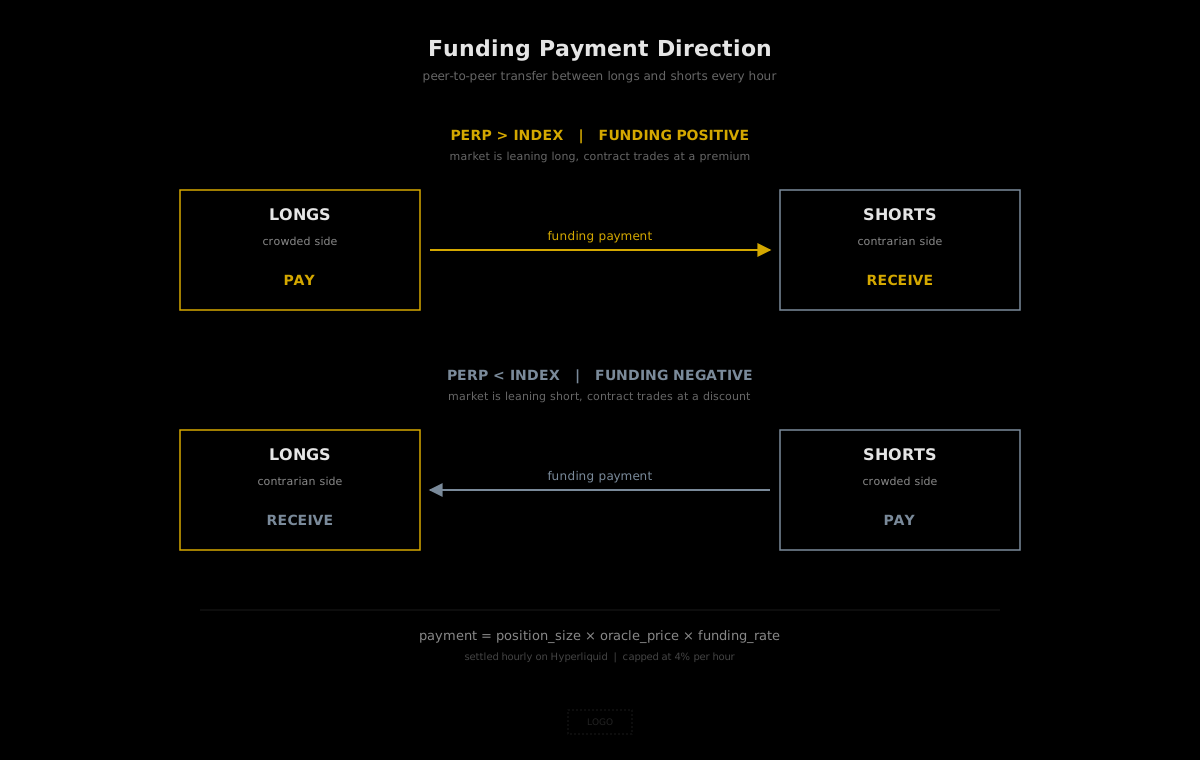
A perpetual funding rate is a periodic payment between long and short positions on a perpetual futures contract that keeps the contract price aligned with the underlying spot or oracle price. When the perp trades above the index, longs pay shorts. When the perp trades below, shorts pay longs. The size of the payment scales with how far the perp price has drifted from the index over the funding window.
The mechanism exists because perps have no expiry. A traditional futures contract converges to spot at settlement, but a perpetual swap has no settlement date, so it needs an artificial force pushing the contract price back toward the index whenever it drifts. That force is funding. If too many traders are crowded long and the perp is trading at a premium, longs pay an ongoing cost to maintain the position, which discourages more longs and incentivizes shorts to step in and arbitrage the gap.
Funding is the price of holding a position against the crowd. If you are long when most of the market is short, the market pays you to be there. If you are long when the market is also long, you pay for the privilege.
This is the part most newcomers miss: funding is not a fee charged by the exchange. It is a peer-to-peer transfer between traders. Hyperliquid does not collect funding payments. It debits one side of the book and credits the other.
How Hyperliquid funding actually works
Hyperliquid's funding mechanism differs from a typical centralized exchange in three concrete ways: payment frequency, cap, and the formula used to compute the rate. Each one matters for how you read and trade funding on the venue.
Hourly settlement. Funding on Hyperliquid is paid every hour . CEXes like Binance, OKX, and Bybit settle every 8 hours, three times per day. Hyperliquid settles 24 times per day. The actual rate is computed on an 8-hour cycle, with each hourly payment equal to one-eighth of the full rate, so the per-hour cost is comparable in magnitude to a CEX 8-hour print divided by eight, but it lands on your balance much more frequently.
4% per hour cap. Funding on Hyperliquid is capped at 4% per hour , which is intentionally less restrictive than CEX caps. In practice you almost never see funding anywhere near that ceiling, but it exists so that during extreme dislocations the contract has a strong mean-reverting force. The cap is the "circuit breaker" version of what funding can do in a panic, not what it normally does.
Premium index plus interest rate component. The funding rate formula on Hyperliquid is F = Average Premium Index (P) + clamp(interest rate - P, -0.0005, 0.0005) . The premium index is computed from the impact price difference divided by the oracle price, sampled across the funding window. The interest rate component is fixed at 0.01% per 8 hours, or 0.00125% per hour, which annualizes to roughly 11.6% APR paid to shorts .
The clamp on the interest rate adjustment is what keeps the rate honest. The premium component dominates when the market is leaning hard one way, and the interest rate adjustment is a small constant force pushing the rate toward shorts in the absence of a premium. Add them together and you get a number that prices both speculative imbalance and the basic cost of carry on dollar collateral against a crypto asset.
Payment math. Your funding payment per interval is position_size * oracle_price * funding_rate . The notional uses the oracle price, not the mark price, which means the funding bill on a $100k position at 0.01% per hour is $10 per hour regardless of where the perp is trading relative to the index at that exact second.
How to read funding as a sentiment signal
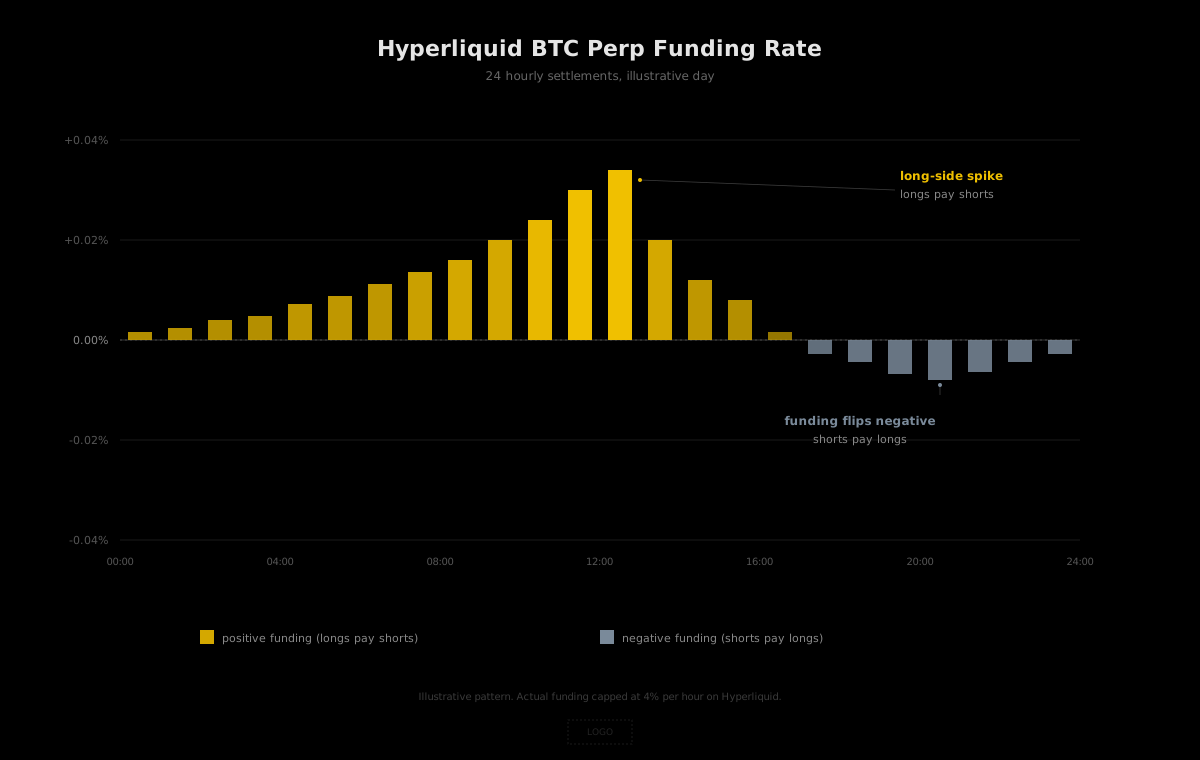
Funding is a price, and like any price it carries information. The level tells you how hard one side of the market is leaning. The change tells you whether that lean is intensifying or unwinding. Used together, the two read like a real-time positioning gauge for the venue.
Persistently positive funding means longs have been crowded for long enough that the contract has been trading at a premium and the market keeps charging longs to stay there. This is bullish sentiment, but it also means longs are paying to hold their bias and any failed rally will trigger position trimming as the carrying cost compounds. The deeper and longer the positive funding, the more crowded the long side, and the more vulnerable the trade is to a long squeeze.
Persistently negative funding is the mirror image. Shorts are crowded, the contract is trading at a discount, and the market is paying shorts to be there. This is bearish sentiment, but it also means a single bid wave can trigger a short squeeze because the entire short side is paying to maintain a bias that has not been working.
Funding flipping signs is more interesting than the level itself. If funding has been positive for two days and suddenly turns negative, the market has rotated. Either the longs capitulated, the shorts arrived, or both. That kind of regime change inside a single day is one of the cleanest "something is changing" signals the perp market produces.
Spikes near the cap are emergency signals. If funding pushes toward 1% per hour or beyond, the contract is dislocated by a lot relative to the index and the funding mechanism is at full force trying to drag it back. These almost never persist for more than an hour or two, and the resolution usually involves a fast move in the perp price toward the index. Treat extreme funding as a warning, not an entry.
A good rule of thumb: funding is most useful at extremes and least useful in the middle. A funding rate of 0.005% per hour tells you almost nothing. A funding rate of 0.04% per hour for twelve hours straight is the market screaming about positioning.
Funding rate arbitrage basics
Funding rate arbitrage is the practice of holding offsetting long and short positions across different venues or different instruments to capture the funding payment without taking directional risk. The classic version is a cash-and-carry trade: long spot, short perp, collect the funding when funding is positive. You earn the funding rate on the short perp leg, and the long spot leg hedges the directional exposure.
The math is straightforward in principle. If BTC perp funding on Hyperliquid is averaging 0.02% per hour, a hedged short perp position earns roughly 0.48% per day, or about 175% APR in raw terms. That number does not survive contact with reality. The actual return is reduced by spot borrow costs (if you do not own the underlying), exchange fees, slippage on entry and exit, and the risk that funding flips negative while you are still in the trade. The realistic edge is much smaller than the headline number, and it is concentrated in periods when funding is genuinely elevated rather than the normal sub-0.01% baseline.
A few variations are worth knowing about:
- Cross-venue arb: Long perp on the cheap venue, short perp on the expensive venue. Captures the funding spread between exchanges. Works when one venue has structurally higher funding because of unique flow, like a launch period or a specific market event.
- Cross-instrument arb: Long perp, short dated future of the same asset. Captures the basis between perp funding and the dated future curve. Less common in crypto than in tradfi but exists for the largest assets.
- Funding mean reversion: Take the opposite side of a funding extreme on a single venue, betting that the rate will normalize. This is not arbitrage in the strict sense, it is a directional bet on funding mean reversion, and it carries real risk.
The boring truth is that pure funding arb is not a get-rich-quick strategy. It is a steady carry trade that only pays well when funding is genuinely dislocated and you have the infrastructure to enter and exit cleanly. Most retail attempts at funding arb fail because the slippage and fees eat the edge before the funding payment lands.
Common mistakes traders make with funding
Most of the costly mistakes around funding come from misreading what the rate actually means and what it is telling you. Here are the patterns that come up most often.
Treating funding as a fee instead of a signal. Funding is a real cost on your P&L if you carry positions overnight, but it is also an information stream about positioning. Traders who only look at funding when they get a settlement notification are reading the rate too late. By the time you notice you paid 0.2% on your long, the positioning that produced that bill is already in the market.
Chasing high-funding plays for the carry. If a small-cap perp is showing 1% per hour funding, the temptation is to short it for the carry and let the funding pay you. The reason funding is 1% per hour is usually that the price is moving against the short side fast enough to overwhelm the carry. The funding looks juicy on a screenshot and brutal on a fill.
Ignoring the cap. The 4% per hour cap means funding cannot fully price extreme dislocations on its own. When you see funding pinned near a high level for several hours, the market is telling you the imbalance is bigger than the funding rate is allowed to express. The rate has already saturated. The price is doing the rest of the work.
Comparing CEX 8h funding to Hyperliquid 1h funding directly. A CEX print of 0.03% per 8 hours is not the same as a Hyperliquid print of 0.03% per hour. Always normalize to the same period before comparing rates across venues. Hyperliquid's hourly cadence makes the rate look smaller per print but it is paid eight times more often.
Reading funding in isolation. Funding tells you that one side is paying. It does not tell you who is paying. A persistently positive funding rate could be retail piling into longs at a top, or it could be institutional traders positioning ahead of a catalyst. Without information about who is on each side of the book, the funding rate alone is half a signal.
That last point is the bridge to the next section, because Hyperliquid is the one venue where you can actually answer the "who is paying" question.
Combining funding with cohort positioning
Funding tells you that one side is leaning. Cohort positioning tells you which side that is, broken out by trader profile. On Hyperliquid you can pull both in a single API call and get a much sharper read on the market than funding or positioning alone.
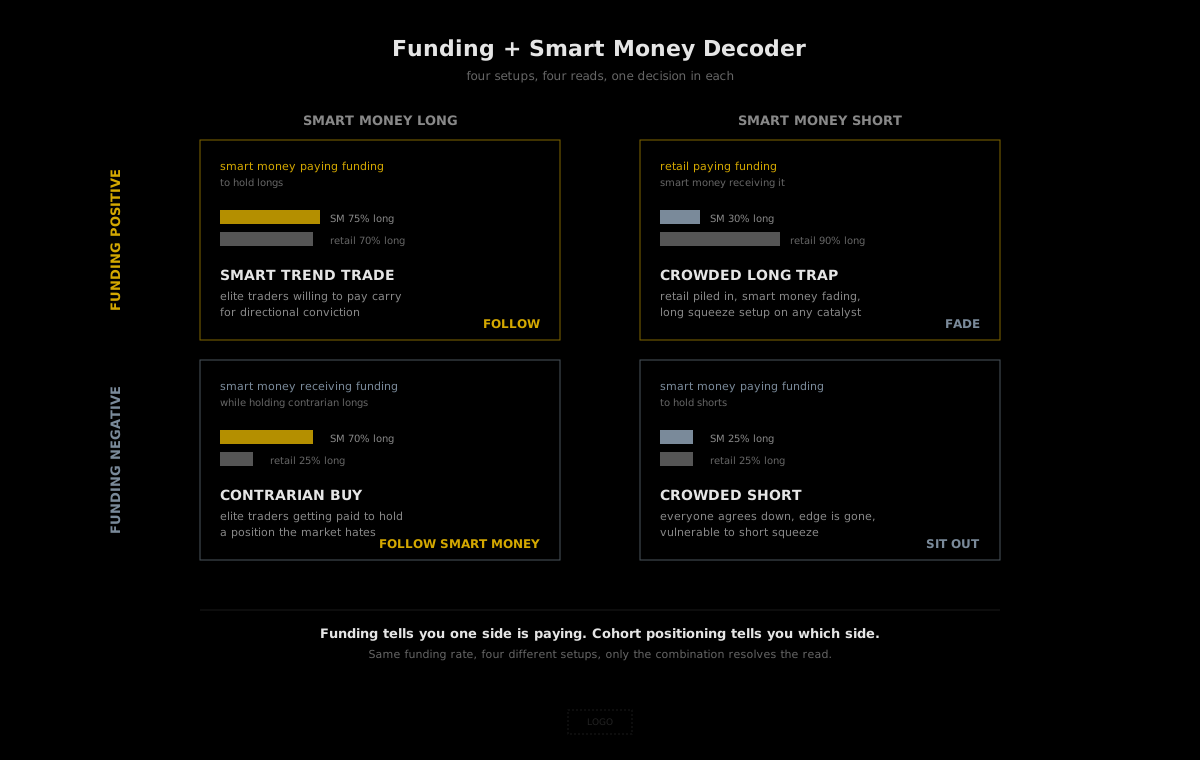
The simplest version of the combined read is this: when funding is elevated and the most profitable cohort is on the side paying funding, the crowded trade is probably the smart trade. When funding is elevated and the least profitable cohort is on the side paying funding, the crowded trade is probably the wrong side. Same funding rate, two opposite implications, only cohort data can tell you which one you are looking at.
A worked example. Imagine BTC perp on Hyperliquid is showing positive funding of 0.025% per hour, well above the baseline. Pulling cohort positioning from HyperTracker's /cohort/metrics endpoint shows that the top PnL cohort is 75% long and the bottom PnL cohort is 80% long. Both segments agree, both are paying funding, and the trade is fully crowded. This is a setup that historically resolves with a long squeeze when any catalyst hits.
Now imagine the same funding rate but the cohort breakdown shows the top PnL cohort at 60% long while the bottom PnL cohort is 90% long. Funding is positive because the aggregate book is leaning long, but the source of that lean is concentrated in the wrong segment. The smart money is leaning long but moderately, and retail is over-positioned. This is the kind of setup where you want to follow the smart money side cautiously and watch for retail capitulation as a confirming signal.
Reverse the example. Funding is sharply negative, top PnL cohort is 70% short, bottom PnL cohort is 75% long. The smart money is paying funding to hold a short, retail is paying funding through the carry on a directional spot exposure, and the divergence between the two cohorts is the read. Historically, when the most profitable cohort is willing to pay carry to hold a contrarian position, that position is worth listening to.
Funding plus cohorts is the closest thing to a "who is on which side" map that perpetual futures markets produce. Neither piece alone tells the whole story. Together they answer the question that aggregate open interest can never answer on its own.
A simple Python read of funding plus cohorts
Here is the smallest end-to-end script that pulls funding and cohort positioning for BTC on Hyperliquid via HyperTracker's API and prints the combined read.
import requests

API_BASE = "https://ht-api.coinmarketman.com/api/external"
headers = {"Authorization": "Bearer YOUR_JWT_TOKEN"}

# 1. Latest funding rate for BTC
funding = requests.get(
    f"{API_BASE}/funding/latest",
    headers=headers,
    params={"coin": "BTC"}
).json()

# 2. Cohort positioning for BTC
cohorts = requests.get(
    f"{API_BASE}/cohort/metrics",
    headers=headers,
    params={"coin": "BTC"}
).json()

top_pnl = next(c for c in cohorts if c["segmentId"] == "pnl_top")
bottom_pnl = next(c for c in cohorts if c["segmentId"] == "pnl_bottom")

top_long_pct = top_pnl["longNotional"] / top_pnl["totalNotional"]
bottom_long_pct = bottom_pnl["longNotional"] / bottom_pnl["totalNotional"]

rate = funding["fundingRate"]
print(f"BTC funding (1h): {rate:+.4%}")
print(f"Top PnL cohort:    {top_long_pct:>6.0%} long")
print(f"Bottom PnL cohort: {bottom_long_pct:>6.0%} long")

if rate > 0 and top_long_pct < 0.5 < bottom_long_pct:
    print("Setup: positive funding, smart money short, retail long. Crowded long.")
elif rate < 0 and top_long_pct > 0.5 > bottom_long_pct:
    print("Setup: negative funding, smart money long, retail short. Crowded short.")
else:
    print("Setup: cohorts aligned with funding direction.")
Free tier on HyperTracker allows 100 requests per day, which is enough to run this kind of read every 15 minutes on a single asset and still have headroom for experimentation. No credit card required.
Closing thoughts
Funding is one of the most underrated signals in perpetual futures trading. Most traders see it as a number in a column, pay it when they have to, and never use it as an input to their actual decisions. The traders who do use it treat it as a real-time sentiment gauge, a directional cost they price into entries and exits, and occasionally a source of carry trade edge when the market gets dislocated enough.
Hyperliquid makes funding more interesting than a CEX in a few ways. The hourly cadence means rates resolve faster and dislocations cannot persist as long. The fully transparent onchain order book makes it possible to see who is paying funding, not just how much, which is the missing piece on a centralized venue. And the cohort layer on top of raw positioning lets you separate the smart money side of the carry from the retail side. None of that is exotic. It is just funding, treated as the data stream it actually is.
Start with the basics. Watch the rate. Notice when it diverges from price action. Layer in cohort positioning when you want a sharper read. Every hour, Hyperliquid prints the exact price of being wrong. The traders who read it stop paying it.