Hyperliquid Liquidations Explained: How to Read the Heatmap and Avoid Cascades
By CMM Team - 11-Apr-2026
Hyperliquid Liquidations Explained: How to Read the Heatmap and Avoid Cascades
Somewhere on Hyperliquid right now, a leveraged long is sitting fifty basis points away from the price that will close it automatically, wipe out its collateral, and hand it to the HLP vault. The trader who opened it told themselves the risk was acceptable and has no idea how close to the edge they actually are. Multiply that by a few hundred positions clustered at the same price level and you have the fuel for the next cascade.
Every cluster on a Hyperliquid liquidation heatmap is a specific price at which a few hundred traders will panic at exactly the same second. Read the map and you know which prices those are before the panic starts.
This guide walks through what actually happens when a Hyperliquid position gets liquidated, how the HLP vault backstop works, how to read a liquidation heatmap, why one liquidation cascades into more, how leverage changes the distance between your entry and your liquidation price, the mistakes that quietly cost traders their accounts, and how to combine liquidation clusters with cohort positioning to find the setups worth avoiding or fading. By the end, the liquidation feed will look less like random noise and more like a map of where the market's patience is about to run out.
What actually happens when a position gets liquidated
A liquidation is triggered when your position's margin falls below the maintenance margin required to keep it open. The maintenance margin on Hyperliquid is half of the initial margin at max leverage for the asset in question, which varies from 3x to 40x depending on the market . That translates to a maintenance margin of 1.25% on a 40x leverage asset and 16.7% on a 3x leverage asset . Fall below that threshold and the protocol takes over.
The exact liquidation price is deterministic. Hyperliquid uses the formula liq_price = price - side * margin_available / position_size / (1 - l * side), where l = 1/MAINTENANCE_LEVERAGE and side is +1 for longs and -1 for shorts . There is no discretion and no room to negotiate. The price moves against you, margin drops, and when it hits the calculated threshold the position closes.
What happens next depends on liquidity. The protocol first tries to close the position as a regular market order. If the book is deep enough to absorb it, the position exits normally and any leftover collateral stays in the trader's account. If the book is too thin, or the position is large enough to overwhelm available liquidity, the backstop takes over. Positions above 100,000 USDC are partially liquidated in chunks: only 20% of the position is sent as a market liquidation order at a time, with a 30-second cooldown before the next chunk .
The mechanism is deterministic. The only thing that isn't deterministic is where a few hundred other traders have placed their own liquidation prices, and whether the market is about to reach all of them at once. That is the part worth knowing about.
How Hyperliquid liquidations specifically work
Three things make Hyperliquid's liquidation mechanism worth understanding in its own right, separate from the generic concept.
The HLP vault is the backstop. When a position cannot close cleanly through the market, it gets handed to the liquidator vault, which is a component strategy of HLP (Hyperliquid Liquidity Provider) . Any profit from backstop liquidations flows directly to HLP depositors. There are no third-party liquidator bots racing for the same positions. The protocol takes the other side, prices it with its own logic, and passes the P&L to the community vault. This is structurally different from most perp DEXes where a network of keeper bots competes for liquidation incentives.
No clearance fee. Hyperliquid charges no explicit fee on liquidations . CEXes typically charge 0.5% to 1.5% of the position as a liquidation fee on top of the loss. On Hyperliquid the cost is purely the market impact of the forced close plus the protocol's maintenance margin buffer. For normal market-close liquidations, any remaining collateral after the forced close is returned. For backstop liquidations (positions too large for the book), the maintenance margin is not returned to the user . That buffer becomes HLP's edge for taking on the position.
Cross vs isolated changes the blast radius. If you run cross margin and one of your positions gets liquidated, all of your cross positions and cross margin transfer to the liquidator, not just the one that blew up . Isolated margin contains the damage: only the isolated position and its isolated margin transfer, while any cross positions and cross margin stay untouched . For beginners running multiple positions, this is the single most important setting on the platform. Cross margin is efficient when things are going well and catastrophic when they are not.
How to read a liquidation heatmap
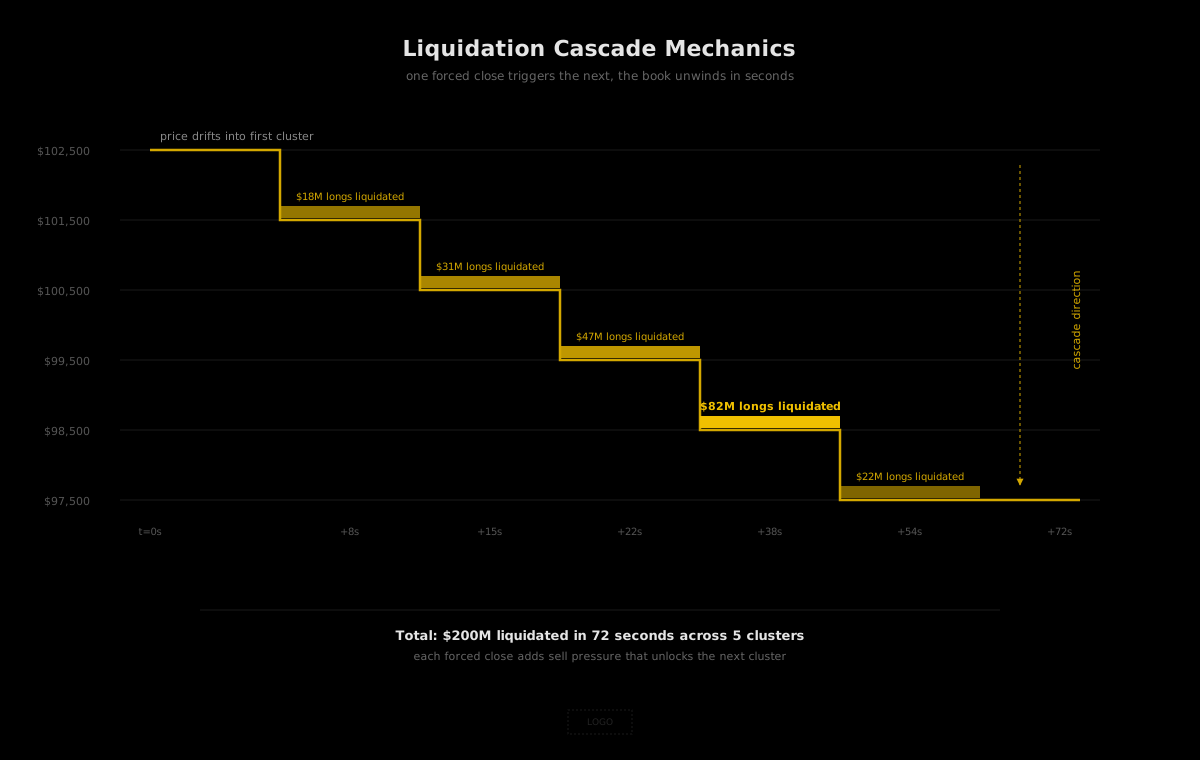
A liquidation heatmap is a visualization of where leveraged positions are clustered by price. The horizontal axis is price, the vertical axis is either notional value or position count, and the color intensity marks how concentrated the liquidity-to-be-taken is at each level. Hot zones represent price levels where a lot of leveraged money will be forced to close if price reaches them. Cool zones are price levels where not much is at risk.
The useful read is always the same: find the nearest hot zone in the direction price is moving. That is the next magnet. Price in crypto does not move through clusters of forced selling gently. It accelerates into them, because the forced closes themselves add to the move. A heatmap tells you which levels are going to behave like gravity wells if the market gets close.
Three patterns are worth recognizing when you stare at these visualizations:
- Symmetric clusters on both sides of price mean the market is balanced on leverage. Neither side has a clear gravity well. Price can drift either way without finding an obvious cascade trigger.
- Asymmetric cluster on one side only means one direction has a lot more leveraged fuel than the other. A single push in that direction can unlock the cluster and produce a fast, one-sided move.
- Stacked clusters at progressively closer price levels are the textbook cascade setup. Once the first cluster triggers, the forced selling that results takes price into the next cluster, which triggers, and so on until the book finds a level where nothing is clustered.
The heatmap is a map of where the market's patience ends. It does not tell you which way price will go next. It tells you what happens if price gets to a particular level, which is a much more useful piece of information than the same number painted on the chart as a flat line.
Why one liquidation triggers more: the cascade
A cascade is not a mystery. It is pure mechanical feedback. Here is the sequence.
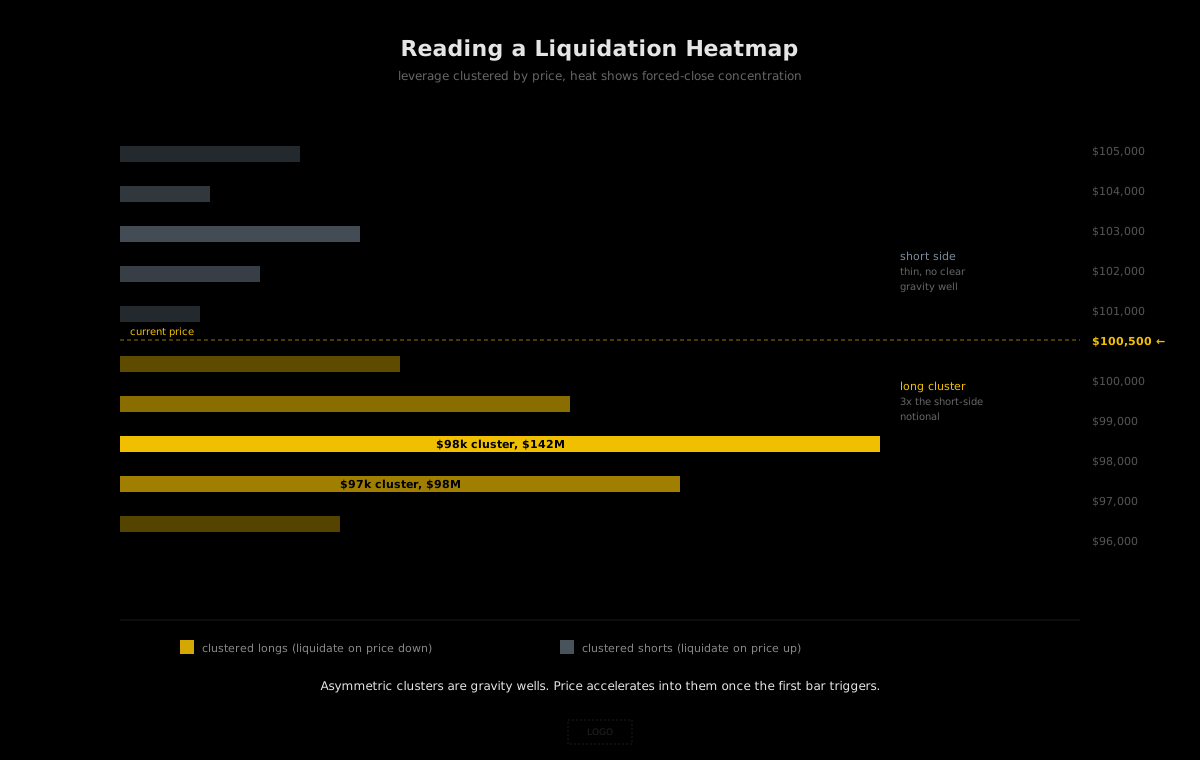
Price moves against a cluster of leveraged longs. The first positions inside the cluster hit their liquidation thresholds and the protocol force-closes them. Force-closing a long is the same as selling into the book, which adds supply and pushes price further in the same direction. That next tick down takes the next set of positions, slightly less leveraged than the first, to their own liquidation thresholds. They close. More supply hits the book. Price moves again.
This loop continues until the book finds a level where there are no more clustered liquidations waiting. The entire cascade can take seconds, and in the worst cases it can clear hundreds of millions of dollars in leveraged positions in under a minute. The speed is not the protocol trying to be aggressive. It is the fact that each closed position makes the next one more likely to close, and nothing in the mechanism is designed to pause the loop once it starts.
The only thing that stops a cascade is the book thickening out. Eventually the forced selling runs into patient bid liquidity that is willing to step in and absorb the supply. When that happens, the cascade ends and price often snaps back partway to wherever it started. The round trip on a violent liquidation move can be 3% to 8% in the space of two minutes, with 80% of the damage done in the first 30 seconds. Traders who understand this pattern can sometimes catch the bounce. Most traders who try, get caught in the next wave.
The leverage tax: how liquidation distance changes with leverage
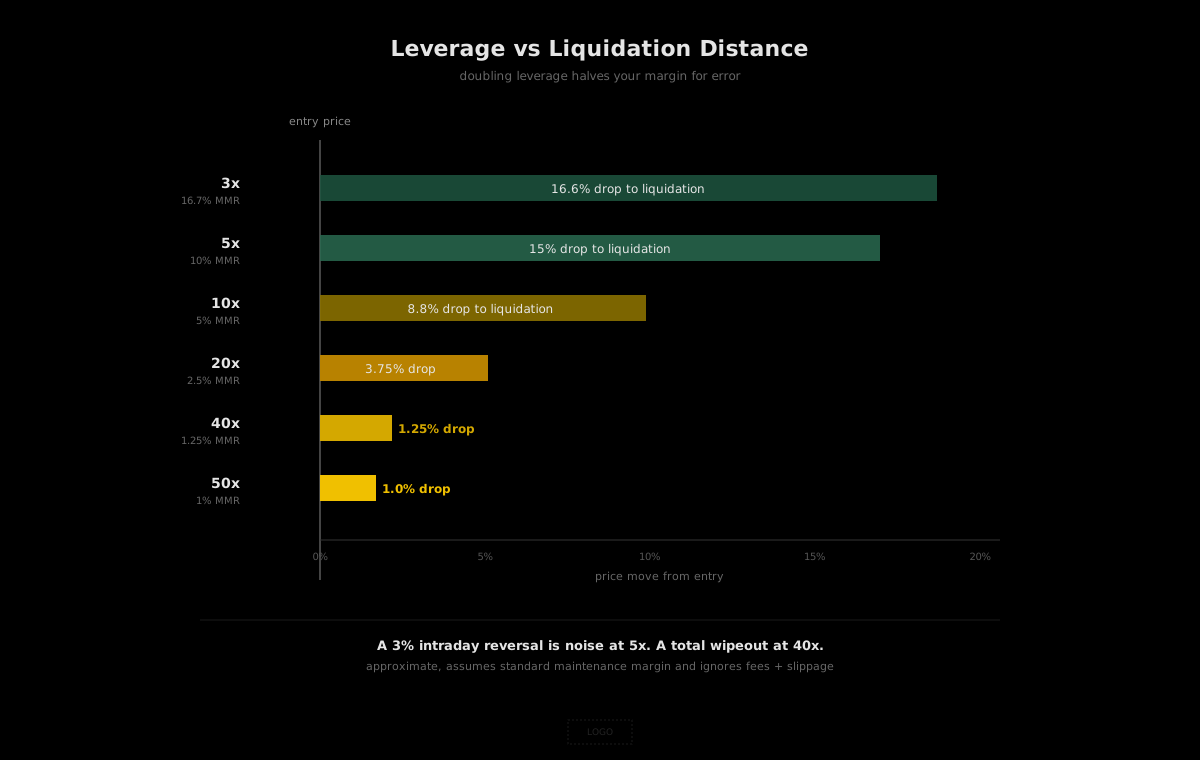
This is the part most new traders underestimate. Leverage is not a linear amplifier. It is a nonlinear compression of your liquidation distance. Doubling your leverage does not double your P&L exposure. It halves the distance between your entry and your liquidation price.
At 5x leverage on a 1.25% maintenance margin asset, a long position gets liquidated at roughly 18.75% below entry. At 10x, the liquidation distance drops to roughly 8.75%. At 20x it is 3.75%. At 40x it is only 1.25%. These are the rough numbers before fees and slippage; the actual distance is slightly tighter once you account for the book impact of the forced close.
What this means in practice: a 40x long on BTC gets liquidated by any move that would not even trigger an alert on a 5x position. A 3% intraday reversal is a completely ordinary piece of market noise on a 5x book. On a 40x book it is a total wipeout. Leverage feels like free money going in. The cost is paid entirely at the tail.
Common mistakes traders make around liquidations
The costly mistakes are consistent across accounts and they are all avoidable.
Running cross margin with uncorrelated positions. Cross margin collapses into one pool. If you are long BTC and short ETH under cross margin and BTC rips, the ETH short's profits cushion the BTC long. That is the upside. The downside is that if the BTC long hits its liquidation threshold, the entire cross account liquidates, including the profitable ETH short. The efficient case and the catastrophic case are the same setting.
Trusting the liquidation price shown at entry. The liquidation price at the moment you open a position is calculated from your current margin, position size, and leverage. It is not static. As your unrealized P&L changes, so does your liquidation price. A losing position eats into margin, which tightens the liquidation price. Traders who anchor to the liquidation price shown at entry routinely discover it has moved ten percent closer by the time they actually need to know where it is.
Ignoring the heatmap above your position. If you are long and there is a thick cluster of leveraged longs liquidating just below your entry, you are essentially front-running a cascade with your own position. Any move down to that cluster will unlock it, the cascade will drive price through your own liquidation level, and you will be part of the fuel for someone else's short.
Leveraging up into the funding rate. If funding is strongly positive, longs are already crowded. Adding leverage to that side is double-crowding. You are paying carry to hold a position that is also sitting in the market's thickest liquidation cluster. Funding and liquidation heatmaps point in the same direction most of the time. When they both scream crowded, that is the worst possible moment to add leverage.
Ignoring the 100k cooldown rule. Positions above 100k USDC get partially liquidated in 20% chunks with 30-second cooldowns between them. For a large position in a fast move, this means the first chunk can print a much better fill than the last chunk. Large traders who do not understand this end up watching their position close at progressively worse prices as the cooldown ticks down and the book keeps sliding.
Every one of these mistakes has the same root cause: the trader is looking at their own position in isolation instead of reading the rest of the book. Fix that and most of the rest fixes itself.
Combining liquidation clusters with cohort positioning
Liquidation heatmaps tell you where the fuel is. Cohort positioning tells you whose fuel it is. Put them together and you have the cleanest risk map Hyperliquid produces.
The useful pattern is divergence. When a heavy liquidation cluster sits at a specific price level and the top PnL cohort is positioned toward that cluster (paying funding, building size, holding exposure), the cluster is smart money's cluster. It will probably hold. Smart money is generally right about what levels the market will respect, and they are less likely to cluster leverage at a level that is about to blow up.
When the same heavy cluster is composed mostly of the bottom PnL cohort, the cluster is a retail cluster and the market is much more likely to push through it. Retail is typically the last cohort to size up into a trend, and their liquidation levels are often the exact prices at which the market turns around. The cascade through a retail cluster is one of the cleanest setups for a short-term fade: wait for price to punch through, let the cascade clear, and enter against the panic once the book thickens again.
Pulling cohort positioning and a rough liquidation risk score for an asset is a two-call operation on HyperTracker's API. The /liquidation-risk endpoint returns an asset-level score for how much leveraged exposure is stacked and how close it is to current price. The /cohort/metrics endpoint returns the breakdown by behavioral segment. Overlay the two and you know not just where the cluster is but who owns it.
import requests

API_BASE = "https://ht-api.coinmarketman.com/api/external"
headers = {"Authorization": "Bearer YOUR_JWT_TOKEN"}

coin = "BTC"

# 1. Asset-level liquidation risk
liq = requests.get(
    f"{API_BASE}/liquidation-risk",
    headers=headers,
    params={"coin": coin},
).json()

# 2. Cohort positioning to see who is exposed
cohorts = requests.get(
    f"{API_BASE}/cohort/metrics",
    headers=headers,
    params={"coin": coin},
).json()

top_pnl = next(c for c in cohorts if c["segmentId"] == "pnl_top")
bottom_pnl = next(c for c in cohorts if c["segmentId"] == "pnl_bottom")

top_long_pct = top_pnl["longNotional"] / top_pnl["totalNotional"]
bottom_long_pct = bottom_pnl["longNotional"] / bottom_pnl["totalNotional"]

score = liq["riskScore"]
print(f"{coin} liquidation risk: {score}")
print(f"Top PnL cohort:    {top_long_pct:>6.0%} long")
print(f"Bottom PnL cohort: {bottom_long_pct:>6.0%} long")

if score > 70 and bottom_long_pct > top_long_pct + 0.2:
    print("High risk cluster owned by retail. Cascade fade setup on a push.")
elif score > 70 and top_long_pct > bottom_long_pct + 0.1:
    print("High risk cluster owned by smart money. Cluster probably holds.")
else:
    print("Risk not concentrated. No clean setup from this combination.")
Free tier on HyperTracker allows 100 requests per day, which is enough to monitor one asset on a 15-minute schedule and still leave headroom for ad-hoc checks.
Closing thoughts
Liquidations are the part of trading that feels random when you are new and deterministic when you have read enough of them. Every single liquidation on Hyperliquid has a price calculated in advance, a vault taking the other side, a cohort of traders on the losing end, and a ripple into the book that the next position will have to absorb. Nothing about it is mysterious. The only question is whether you are looking at the map before you put on the trade or after.
Watch the heatmap. Respect cross margin. Remember that leverage halves your distance every time you double it. And if you want to know whose clusters are about to break, look at who owns them.
Every cluster on the heatmap is a pile of traders who told themselves the risk was acceptable. The best trade you can make on any given day is not being in the cluster.