
Hyperliquid Prediction Markets Go Permissionless: What Perp Traders Get
By CMM Team - 20-Jul-2026
Hyperliquid Prediction Markets Go Permissionless: What Perp Traders Get
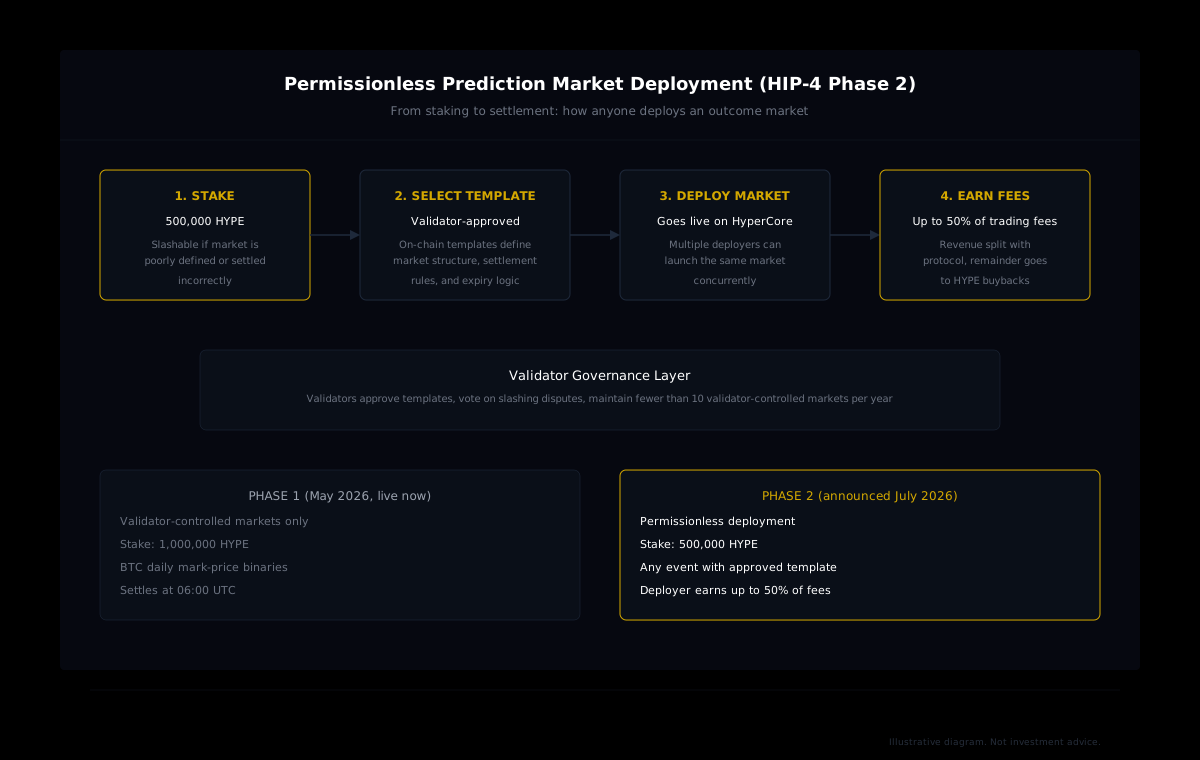
Hyperliquid just announced that anyone can deploy a prediction market on its platform, no approval required, just a 500,000 HYPE stake and a validator-approved template. That's HIP-4 Phase 2, and it turns a protocol already processing hundreds of billions in perps volume into a prediction market venue competing directly with Kalshi's over $30 billion monthly machine.
The timing matters. Kalshi just posted over $30 billion in June trading volume, fueled by the FIFA World Cup. Polymarket hit $10.8 billion the same month. And prediction market monthly volume has surged from under $5 billion in mid-2025 to nearly $24 billion by April 2026. Hyperliquid is entering this race with something no competitor offers: a unified margin account where perps, spot, and outcome contracts share the same collateral pool.
For traders already on Hyperliquid, HIP-4 Phase 2 is the most significant expansion since HIP-3 brought traditional assets to the DEX. Here's what it changes, what it means for positioning, and how analytics shift when prediction markets live alongside perpetual futures.
From Validator-Controlled to Permissionless
HIP-4 launched on Hyperliquid's mainnet on May 2, 2026, initially with validator-controlled binary markets. The first contracts were daily Bitcoin mark-price binaries settling at 06:00 UTC. Creating a market required staking 1 million HYPE tokens, and only validator-approved events were eligible.
Phase 2, announced today, drops the barrier. The staking requirement falls to 500,000 HYPE. Deployers earn up to 50% of the trading fees their markets generate. Multiple users can launch the same market concurrently, creating competition on execution quality. And the validator-controlled markets will continue, but Hyperliquid expects "ideally, there will be fewer than 10 of them per year."
The deployment process works through on-chain templates approved by validators. Deployers select a template, stake their HYPE, and the market goes live on HyperCore, the same execution environment that powers Hyperliquid's perpetual futures. If validators determine a market was poorly defined or settled incorrectly, the stake gets slashed.
Why the Unified Margin Architecture Matters
The structural advantage isn't fees (though zero-to-open helps). It's that prediction markets, perpetual futures, and spot positions all share the same collateral pool on Hyperliquid.
On Kalshi, you deposit funds to trade prediction markets. On Polymarket, you deposit to a separate platform. On Binance, your perps margin sits in a different account from your spot holdings. Hyperliquid unifies all three. A trader long BTC perps can simultaneously hold a prediction position on, say, whether BTC closes above a certain price, all from the same account, against the same collateral.
This matters for capital efficiency. Instead of splitting a $100,000 portfolio across three platforms to trade perps, spot, and outcomes, a trader on Hyperliquid deploys all of it in one place. Cross-margining means gains on one position offset losses on another in real time, which reduces the amount of capital sitting idle on platforms you're not actively using.
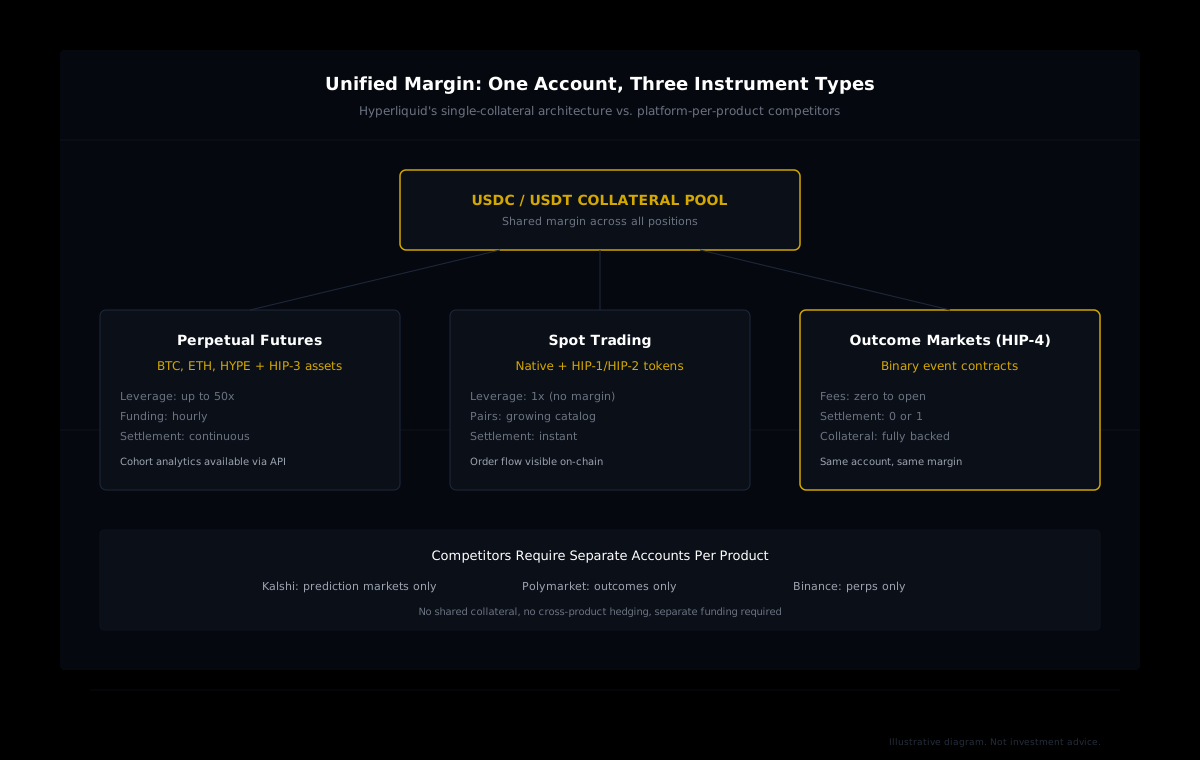
Key distinction: HIP-4 outcome contracts settle to either 0 or 1, fully collateralized in USDC. Perpetual futures have continuous funding rates and no expiry. Holding both from the same margin account creates hedging combinations that require multiple platform accounts elsewhere.
The Fee Structure: Zero to Open, Fees on Close
Under HIP-4, opening a prediction market position costs nothing. Fees apply only when closing a position or at settlement. For comparison, Polymarket currently charges up to 2% on winning bets.
This isn't charity. Zero entry fees lower the barrier to taking a position, which drives volume. And volume is what makes markets liquid enough to attract larger traders who care about execution quality. It's the same playbook Hyperliquid used with perps: undercut fees, build liquidity, then compete on product depth rather than price alone.
For perp traders, the fee dynamics create an interesting asymmetry. You can open a prediction hedge at zero cost, and only pay if you're right (at settlement) or if you decide to close early. That's a fundamentally different cost structure from taking an offsetting perps position, where you're paying funding every hour regardless of outcome.
Prediction Markets Hit Record Scale
Hyperliquid isn't entering a niche market. It's entering one of the fastest-growing segments in all of finance.
In Q1 2026, prediction market trading volume hit $25.7 billion in March alone, with Kalshi leading at $13.1 billion and Polymarket at $10.6 billion. By June, Kalshi crossed $30 billion in a single month, driven by FIFA World Cup betting. Open interest across all prediction platforms continues to climb, with Kalshi and Polymarket holding the vast majority of outstanding contracts.
$30B+ Kalshi June volume
$10.8B Polymarket June volume
~5x Monthly volume growth, mid-2025 to Apr 2026
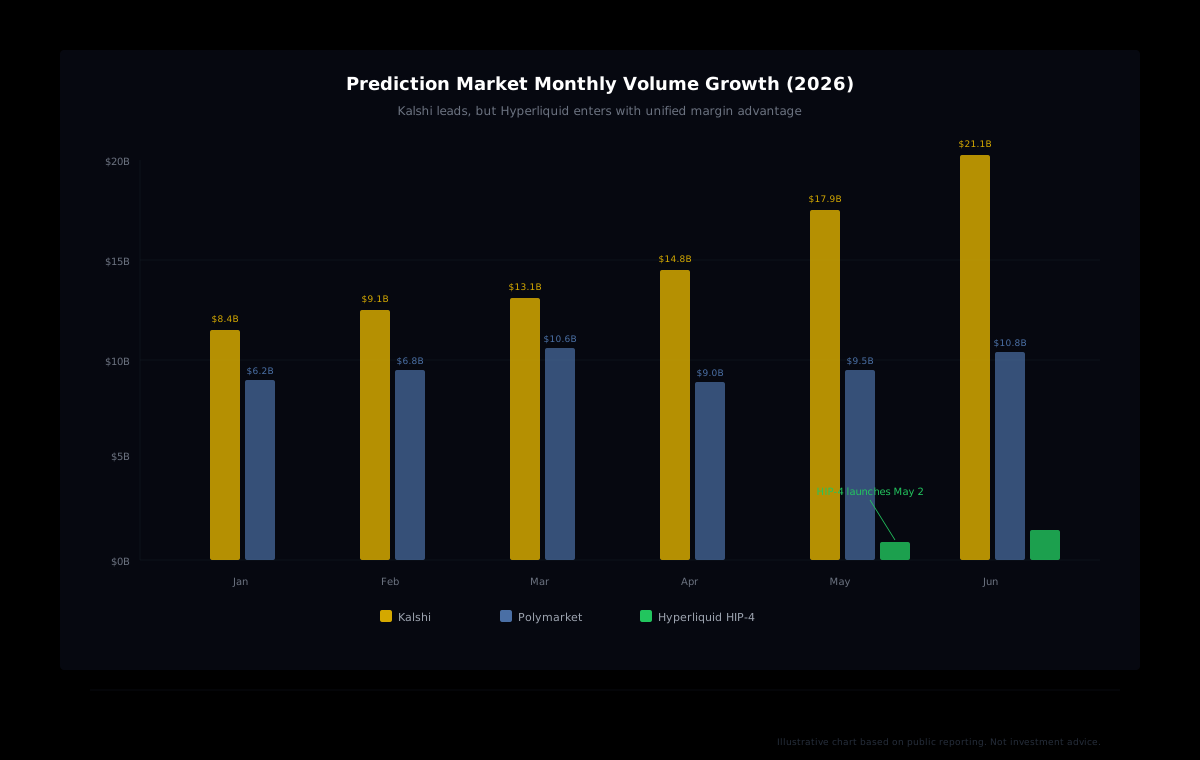
The competitive landscape looks like two layers. Kalshi dominates the regulated U.S. market with CFTC oversight and fiat rails, drawing heavy sports betting volume (over 80% of its monthly totals). Polymarket leads on-chain with crypto-native markets. Hyperliquid sits in a different position entirely: a derivatives exchange that happens to also support prediction markets, rather than a prediction market platform trying to add derivatives.
The Kalshi Partnership Angle
Here's the twist most coverage misses. The relationship between Hyperliquid and Kalshi isn't purely adversarial. Reports in early 2026 pointed to collaboration between the two platforms on developing on-chain prediction market infrastructure, with Kalshi's crypto team contributing to the design process.
Kalshi operates under CFTC regulation in the United States. Hyperliquid restricts U.S. users. They serve different geographic and regulatory markets, which means a Kalshi partnership could eventually bring regulated prediction market liquidity into Hyperliquid's on-chain execution layer, or vice versa. Think of it less as Hyperliquid versus Kalshi and more as two sides of a bridge: one regulated, one permissionless, potentially connected at the settlement layer.
For perp traders, this matters because the prediction market venue they're using is being built with input from the market leader. That's a credibility signal that traditional prediction platforms don't carry when they try to bolt on crypto features.
What Changes for Perp Traders
If you're already trading perpetual futures on Hyperliquid, HIP-4 adds a new instrument type to your existing account. No new deposits. No separate platform. Same collateral. Here are the practical shifts:
Hedging with Outcome Contracts
Suppose you're long ETH perps heading into a major protocol upgrade. You can open a prediction position on the upgrade's success or failure as a hedge, from the same margin balance. If the upgrade fails and ETH drops, your prediction position pays out while your perp takes the hit. The net result is a more controlled risk profile, built from one account.
Event-Driven Trading Surface
Perps track continuous prices. Prediction markets capture discrete events: will BTC close above a level by a specific date, will a regulatory decision go one way or the other, will a protocol launch on schedule. These are different types of bets that unlock strategies perps alone can't express. A trader can combine a directional perps view with a time-bound outcome position for a more nuanced expression of their thesis.
Cohort Behavior Across Instrument Types
This is where analytics get interesting. With HyperTracker's cohort data, you can already see how different trader segments position on perps: what Money Printer wallets (all-time PnL above +$1M) are doing with BTC exposure, whether Leviathan accounts ($5M+ in equity) are building or unwinding. As HIP-4 markets mature, the same on-chain transparency will apply to prediction positions. The same wallet that's loading BTC longs might simultaneously be shorting a "BTC above $150K by December" outcome contract, revealing a nuanced view that price data alone can't show.
Our data tracks 16 behavioral cohorts across Hyperliquid, eight by wallet size and eight by all-time PnL. When prediction market activity becomes visible through the same cohort lens, it adds an entirely new dimension to smart money tracking. You're not just seeing what wallets are buying. You're seeing what they think will happen, and when.
Builder Economics: A New Revenue Model
Phase 2 creates a builder opportunity alongside the trading opportunity. Anyone who stakes 500,000 HYPE can deploy markets and earn up to 50% of the trading fees those markets generate. The remaining fees flow to the protocol, where the Assistance Fund directs a significant share of trading fee revenue into open-market HYPE purchases.
This is a meaningful incentive for prediction market specialists, analytics firms, and trading communities to launch markets on Hyperliquid. If you know that a particular event (a token launch, a regulatory decision, a macroeconomic data release) will attract trading interest, deploying a market around it becomes a revenue play, backed by the same execution infrastructure that handles Hyperliquid's perps volume.
Arthur Hayes put it bluntly: "HIP-4 will quickly become a dominant prediction market because of Hyperliquid's large user base, much cheaper trading fees, and very robust tech infrastructure."
Tracking the Shift with Cohort Analytics
For builders and analysts, HIP-4 expands the surface area of on-chain intelligence. Our API already covers 16 trader cohorts, order flow snapshots, liquidation risk scoring, and leaderboard rankings across Hyperliquid perps. As outcome markets grow, the same analytical framework applies: which cohorts are active in prediction markets, how does their positioning correlate with their perps exposure, and what does the divergence between the two reveal about market sentiment.
Consider a scenario where Leviathan wallets are aggressively long BTC perps but simultaneously buying "BTC below $100K" outcome contracts. That kind of divergence, visible only on a unified-margin platform where both instruments are on-chain, tells a more complete story than either signal alone.
Track Smart Money Across Perps and Beyond
HyperTracker's API gives you 16 behavioral cohorts, order flow analytics, and liquidation risk scoring across Hyperliquid. Start with the free tier (100 calls/day) or build production analytics from $179/mo.
The Bigger Picture
Prediction markets are no longer a niche crypto experiment. They're a multi-billion-dollar asset class attracting institutional capital, ETF products, and regulatory attention. Hyperliquid's entry with permissionless deployment, zero-fee opening, and unified margin is a structural play: rather than competing on any single market's liquidity, it competes on the capital efficiency of trading outcomes alongside everything else.
For perp traders, HIP-4 Phase 2 isn't something to watch from the sidelines. It's a new instrument in the same account, against the same collateral, from the same protocol that has steadily captured a growing share of global perpetual futures open interest. The question isn't whether prediction markets belong on a perp DEX. Hyperliquid just made it the default.