Hyperliquid Referral Leaderboard: Who Actually Onboards Traders
By CMM Team - 09-Oct-2026
Hyperliquid Referral Leaderboard: Who Actually Onboards Traders
Most exchanges grow through ad spend, influencer deals, and listing announcements. Hyperliquid grows through wallets. Every new user on the platform arrived because a specific wallet or builder code referred them, and the protocol records that relationship on-chain. The Referrals (24h) tile on the leaderboards page turns that record into a live scoreboard, ranking the wallets and builders bringing new traders to Hyperliquid right now.
What makes this interesting is how concentrated the distribution is. On a given day, a handful of entries account for the vast majority of new referrals. Sometimes a single anonymous wallet refers more users in 24 hours than well-known builder codes do in a week. The leaderboard tells you who is onboarding the exchange, how the balance between wallets and protocol-level builders shifts over time, and what that distribution reveals about where Hyperliquid's growth actually comes from.
What you will learn: How Hyperliquid's referral system works at the protocol level, what the leaderboard dashboard shows, what the top-of-board distribution means, and how builder analytics connect the referral picture to trading behavior.
How Hyperliquid referrals work at the protocol level
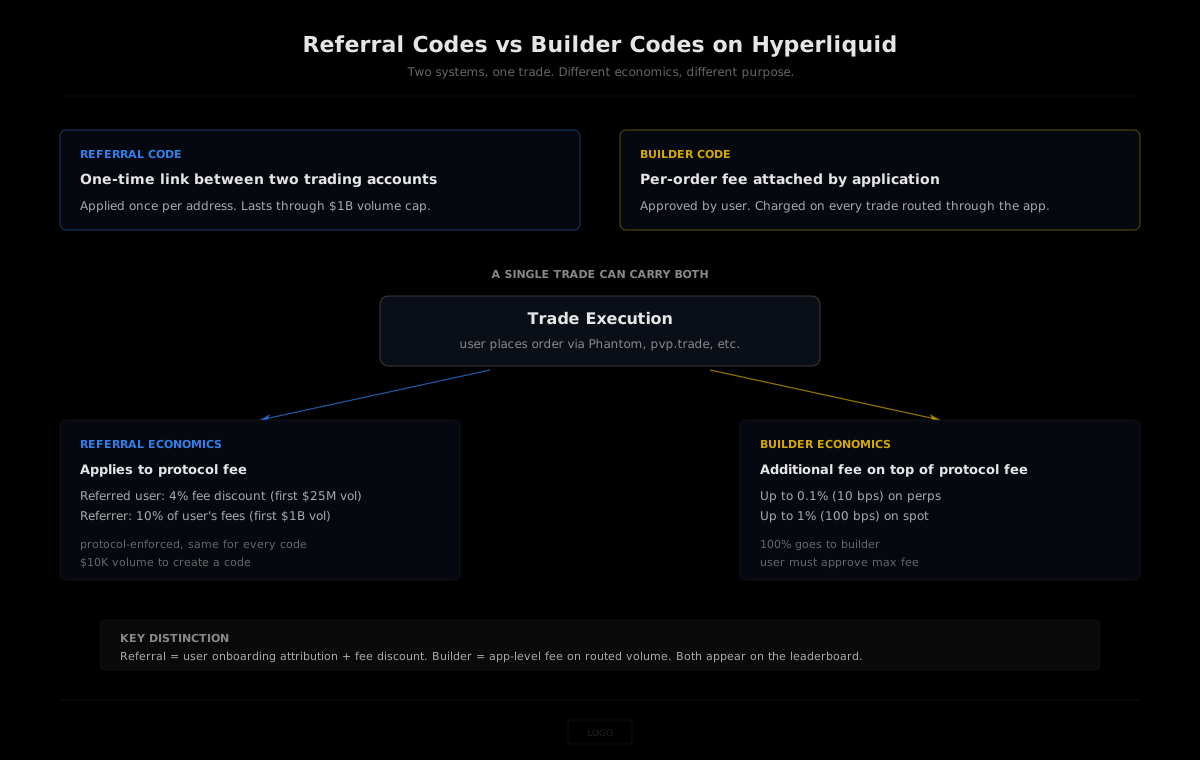
Hyperliquid's referral system sits on-chain, which means every referral relationship is recorded as part of the protocol state rather than in an internal database. A referrer creates a code after reaching $10,000 in personal trading volume. New users can apply a code before their first trade through a join link or by entering it manually on the referrals page.
The economics are fixed by the protocol. A referred user receives a 4% discount on trading fees for their first $25 million in volume . The referrer earns 10% of the referred user's fees, less the discount, through the referred user's first $1 billion in volume . Those numbers are the same regardless of which code a user applies. There is no tiered referral commission, no negotiated rate. The protocol enforces one set of economics for everyone.
Builder codes are a separate mechanism, and the distinction matters. A builder code is a per-order fee that application developers attach to trades routed through their interface. Wallets like Phantom or trading platforms like pvp.trade use builder codes to monetize volume that flows through their front end. A builder code can coexist with a referral code on the same trade: the referral discount applies to the protocol fee, while the builder fee is an additional charge approved by the user. The referral leaderboard captures both, because both drive user onboarding, but the economic model behind each is different.
What the referral leaderboard dashboard shows
The Referrals (24h) tile on the HyperTracker leaderboards page ranks wallets and builders by new users referred in the last 24 hours. Each row shows a wallet address or builder code name and the count of new users that entered Hyperliquid through that referral path in the rolling window.
The board resets on a rolling basis, so it reflects current onboarding momentum rather than cumulative history. A builder code that referred 10,000 users over the past year but zero today will not appear. A wallet that referred 500 users in the last day will rank near the top. That design makes the leaderboard a velocity metric: it answers "who is driving growth right now" rather than "who has driven the most growth ever."
On a typical day, the top entry on the board refers several hundred new users. Below the top five, the count drops sharply, often to double digits. The shape of the distribution is worth paying attention to, because it reveals how concentrated onboarding is. A few wallets and builders carry a disproportionate share of the new-user flow.
A snapshot from the board
To make this concrete, here is what the leaderboard looked like on October 13, 2026. The top entry was an anonymous wallet (witty-paper-engine as its display name) with 668 new referrals in 24 hours. Phantom followed at 614. Invo came in third at 269, and Trust Wallet fourth at 187. These four entries alone accounted for the majority of new-user onboarding for that day.
Two things stand out in that snapshot. First, an unnamed wallet outpaced every major builder code. Second, the gap between #1 (668) and #4 (187) is more than 3x, which means the distribution is steep even among the top performers. Understanding who these top referrers are, and what kind of users they bring, is where the leaderboard becomes more than a scoreboard.
The all-time builder picture
The 24-hour leaderboard shows velocity, but the all-time builder data tells a structural story about which applications have driven the most cumulative onboarding on Hyperliquid.
Figures as of July 2026, from HyperTracker's builder leaderboard.
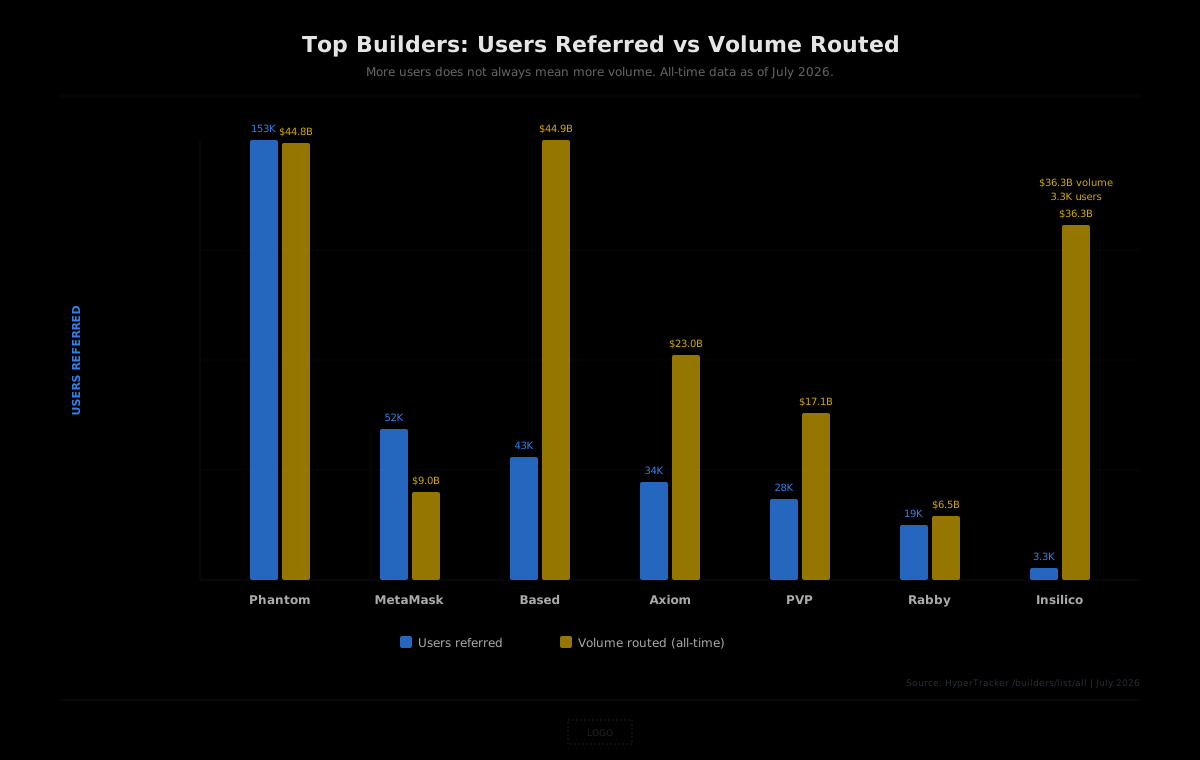
| Builder | Users Referred | All-Time Revenue | Volume Routed | | --- | --- | --- | --- | | Phantom | 153,128 | $23.6M | $44.8B | | Based | 42,967 | $15.2M | $44.9B | | MetaMask | 52,534 | $8.1M | $9.0B | | PVP | 28,223 | $8.0M | $17.1B | | Insilico | 3,339 | $3.7M | $36.3B | | Axiom | 34,093 | $2.4M | $23.0B | | Rabby | 19,031 | $1.5M | $6.5B |
Phantom leads in user count by a wide margin: over 153,000 users referred, which is more than 3x the next-closest builder (MetaMask at 52,534). But the user-count ranking does not match the revenue ranking. Based, with less than a third of Phantom's referred users, generated $15.2M in all-time revenue on nearly identical volume ($44.9B). That gap tells you something: Based's users trade more volume per capita than Phantom's, which means the two builders are onboarding different populations.
The most extreme version of this pattern is Insilico. With only 3,339 users, it routed $36.3B in total volume, more than Phantom, MetaMask, and PVP combined on a per-user basis. Insilico's users are high-frequency or high-size traders, likely algorithmic. This is the opposite profile from Phantom, which onboards retail users at scale.
What the distribution tells you
The referral leaderboard, read alongside builder analytics, reveals three patterns about Hyperliquid's growth.
Wallets are the primary onboarding channel
Phantom and MetaMask alone have referred over 200,000 users to the exchange. Wallet integrations are the front door for most new users, not the exchange's own marketing. This is structurally different from centralized exchanges, where the exchange controls the onboarding funnel through its own app and website. On Hyperliquid, the onboarding funnel is distributed across third-party wallets and trading interfaces, and the referral leaderboard makes that distribution visible.
Anonymous wallets punch above their weight
The October 13 snapshot showed an anonymous wallet (witty-paper-engine) at #1 with 668 referrals in 24 hours, ahead of Phantom at 614. Anonymous referrers appear regularly near the top of the daily board. Some are likely KOLs with large audiences using personal referral codes. Others could be bots or automated referral flows. The leaderboard does not distinguish between organic and synthetic referrals, which is worth keeping in mind when reading the numbers.
User count and user quality are different metrics
A builder that onboards 150,000 users is valuable for network effects and liquidity breadth. A builder that onboards 3,000 users who trade $36 billion is valuable for volume depth and fee revenue. The referral leaderboard shows you the first number. Builder analytics, specifically volume per user and revenue per user, show you the second. Reading both together gives you the full picture of which builders are driving meaningful exchange growth.
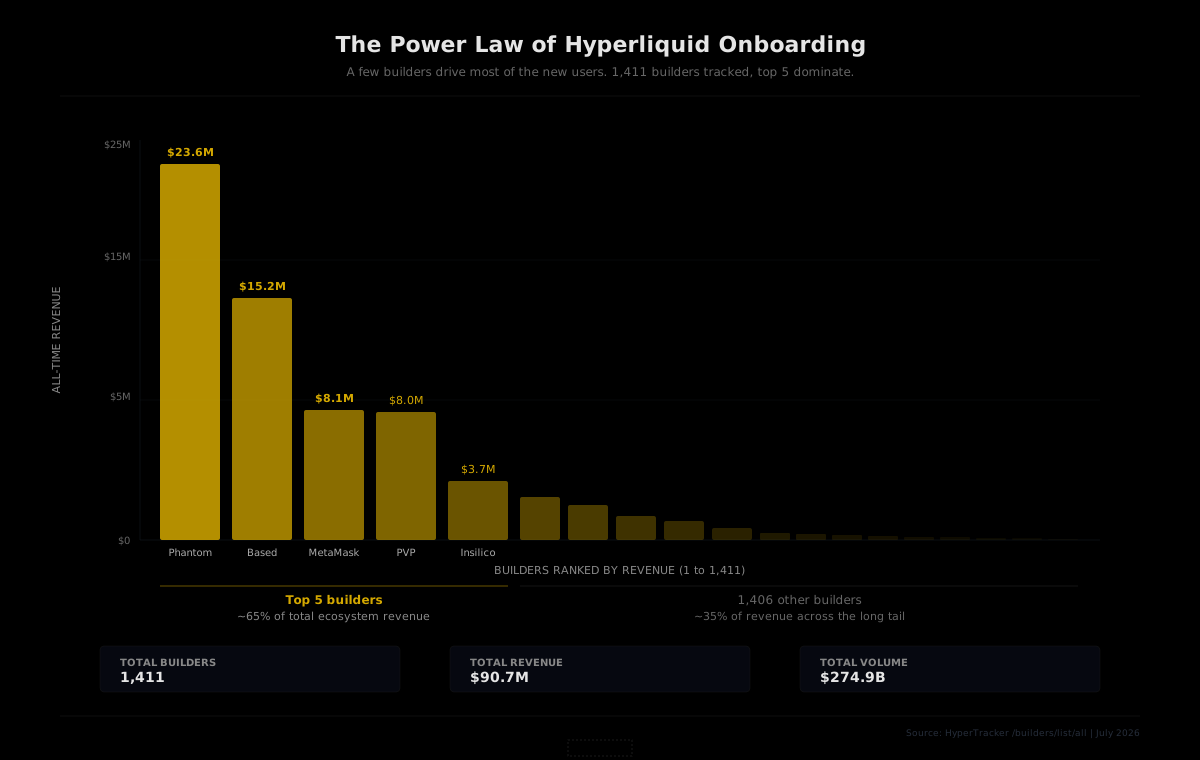
Across all 1,411 builders tracked in HyperTracker's database, total all-time revenue stands at over $90 million on roughly $275 billion in routed volume. The top 5 builders account for the majority of that revenue, which means the builder economy on Hyperliquid, like the referral leaderboard itself, follows a steep power-law distribution.
How builder analytics connect to the referral board
The referral leaderboard on the dashboard is a real-time view of onboarding velocity. To understand what happens after onboarding, you need our builder analytics layer. HyperTracker exposes several endpoints that let you query builder data programmatically.
The /builders/list/timeframe/{timeframe} endpoint returns every builder on Hyperliquid for a given period (24h, 7d, 30d, or all-time), ranked by revenue, with previous-period comparisons. The /builders/{builder}/profile endpoint gives you a full profile for a single builder: identity, revenue, fee rates, and analytics across time windows. And /builders/{builder}/users returns the wallets that traded through a builder code, sortable by PnL, volume, builder fee paid, or equity.
These endpoints let you answer questions the leaderboard alone cannot. Which builder's referred users have the highest win rates? Which builder's users generate the most liquidation risk? When a new wallet appears at the top of the daily referral board, what does its user base look like in terms of cohort composition?
Our 16 trader cohorts (8 by account size, 8 by all-time PnL) classify every wallet on Hyperliquid into behavioral segments. Because the same classification applies to wallets referred through any builder code, you can connect referral onboarding data to trading behavior data. A builder that primarily onboards Shrimp-tier wallets ($0-$250 equity) tells a different growth story than one that onboards Whale-tier wallets ($500K-$1M equity). The referral leaderboard shows you who is bringing new users. Cohort data shows you what kind of users they are bringing.
Track builder performance and referral patterns
HyperTracker's builder analytics endpoints let you query referral data, user composition, and volume attribution for every builder on Hyperliquid. Free tier available (100 requests per day, no credit card).
Reading the board like a trader
The referral leaderboard is most useful when you treat it as a leading indicator rather than a standalone metric. A spike in referrals through a specific builder code often precedes a surge in trading activity on the exchange. If a major wallet integration starts onboarding hundreds of new users daily, the liquidity profile of Hyperliquid is about to shift, especially on retail-heavy pairs where new users tend to concentrate.
For builders, the leaderboard is a competitive intelligence tool. It tells you which onboarding channels are growing, which are declining, and where the gaps are. If Phantom is consistently dominating the daily referral count, that signals the wallet-based onboarding funnel is working. If anonymous wallets are regularly competing with major builders, that signals there is organic referral demand that formal builder programs have not yet captured.
For traders interested in smart money tracking, our builder data adds a layer of context to cohort positioning. When you see Leviathan-tier wallets ($5M+ equity) accumulating on a specific asset, knowing whether those wallets arrived through an institutional builder code or an anonymous referral changes how you interpret the signal. Institutional flow through a known builder is more likely to be systematic. Anonymous flow could be anything from a single large trader to a coordinated group.
The referral leaderboard, combined with builder analytics and cohort intelligence, gives you a view of Hyperliquid's growth engine that the price chart alone never will. Who is arriving, how they arrived, and what they do after they get here: that is the loop that turns referral data into tradable context.
The bottom line
Every user on Hyperliquid got there through a referral path. The leaderboard makes that path visible. What it reveals is a growth model fundamentally different from centralized exchanges: third-party wallets and builders own the onboarding funnel, anonymous wallets compete with major protocols for daily referral counts, and the distribution of users across builders tells you as much about the exchange's future liquidity as any volume chart. The board updates every day. The question is whether you are reading it.