Hyperliquid vs Kalshi: What Builder Code Data Reveals
By CMM Team - 22-Jul-2026
Hyperliquid vs Kalshi: What Builder Code Data Reveals
Two platforms, built for entirely different markets, are now racing toward the same finish line. Hyperliquid started with perpetual futures and expanded into prediction markets through HIP-4. Kalshi started with event contracts and just launched its CFTC-approved BTCPERP, a Bitcoin perpetual futures product. Both are converging on a single vision: one account, multiple asset classes, unified collateral.
The question for builders and traders is which platform has the infrastructure to win. And the most revealing signal is one that Kalshi does not have at all: builder codes. Hyperliquid's builder code system is an on-chain fee attribution layer that lets third-party applications earn revenue on every trade they route. The ecosystem around it has generated over $40 million in total developer revenue, with roughly 40% of daily active users now trading through third-party frontends. That is the kind of developer adoption metric that separates a trading venue from a platform.
This article breaks down what builder code analytics reveal about Hyperliquid's competitive moat, how the convergence with Kalshi reshapes the landscape for perp traders, and why builder momentum is the metric to watch as prediction markets and perpetual futures merge into a single product category.
The convergence: perps and predictions collide
Until early 2026, perpetual futures and prediction markets lived in separate worlds. Perps were the domain of crypto-native exchanges. Prediction markets belonged to platforms like Kalshi and Polymarket, where traders bet on elections, weather, and economic data releases. The audiences overlapped, but the products did not.
That changed in May 2026 when Hyperliquid launched HIP-4 on mainnet, introducing binary outcome contracts that settle based on real-world events. The first market was a daily Bitcoin mark-price binary. The structural advantage was immediate: traders could hold perps, spot positions, and event contracts in the same account, against the same collateral pool. No bridging between platforms. No separate margin accounts. One wallet does it all.
Kalshi moved from the opposite direction. After years as a CFTC-regulated prediction market, Kalshi received approval for BTCPERP on May 29, 2026, a Bitcoin perpetual futures contract that went live on June 3. For the first time, a U.S.-regulated prediction market exchange was offering the same product class that offshore crypto exchanges had dominated.
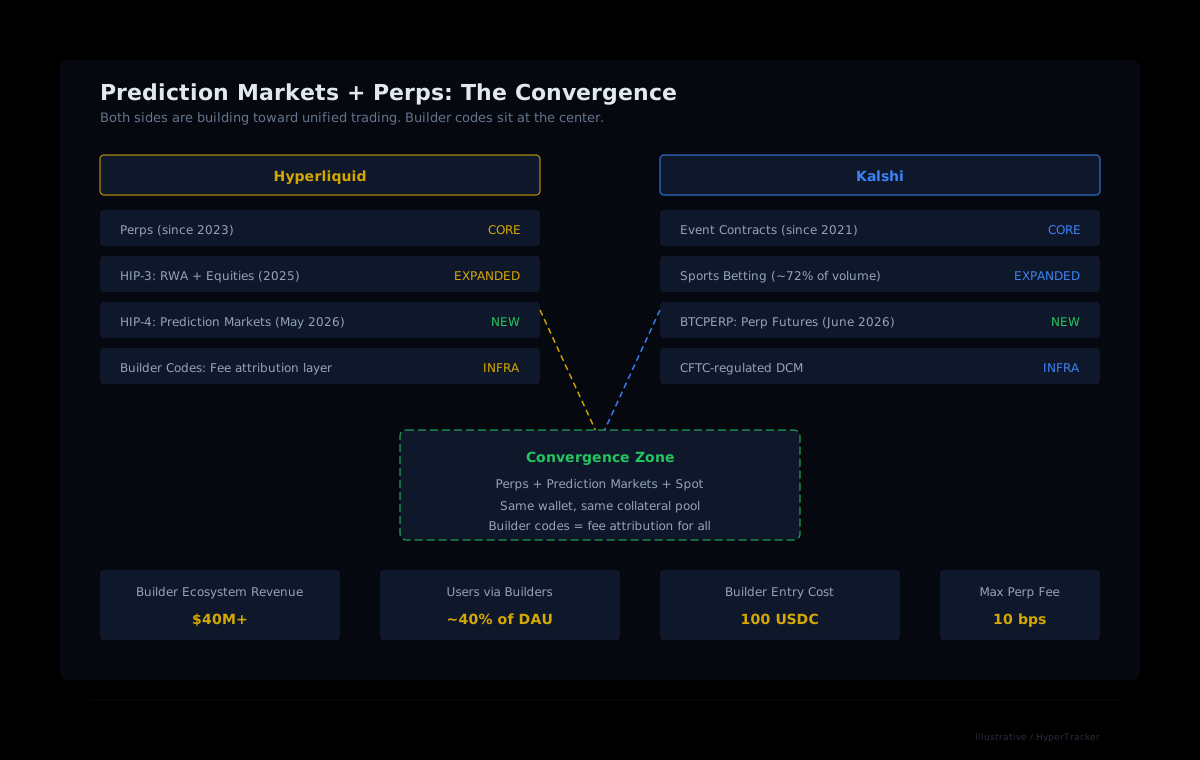
The convergence is real. Both platforms now offer overlapping products. But the underlying architecture could not be more different, and that difference shows up most clearly in how each platform relates to third-party developers.
Builder codes: Hyperliquid's developer moat
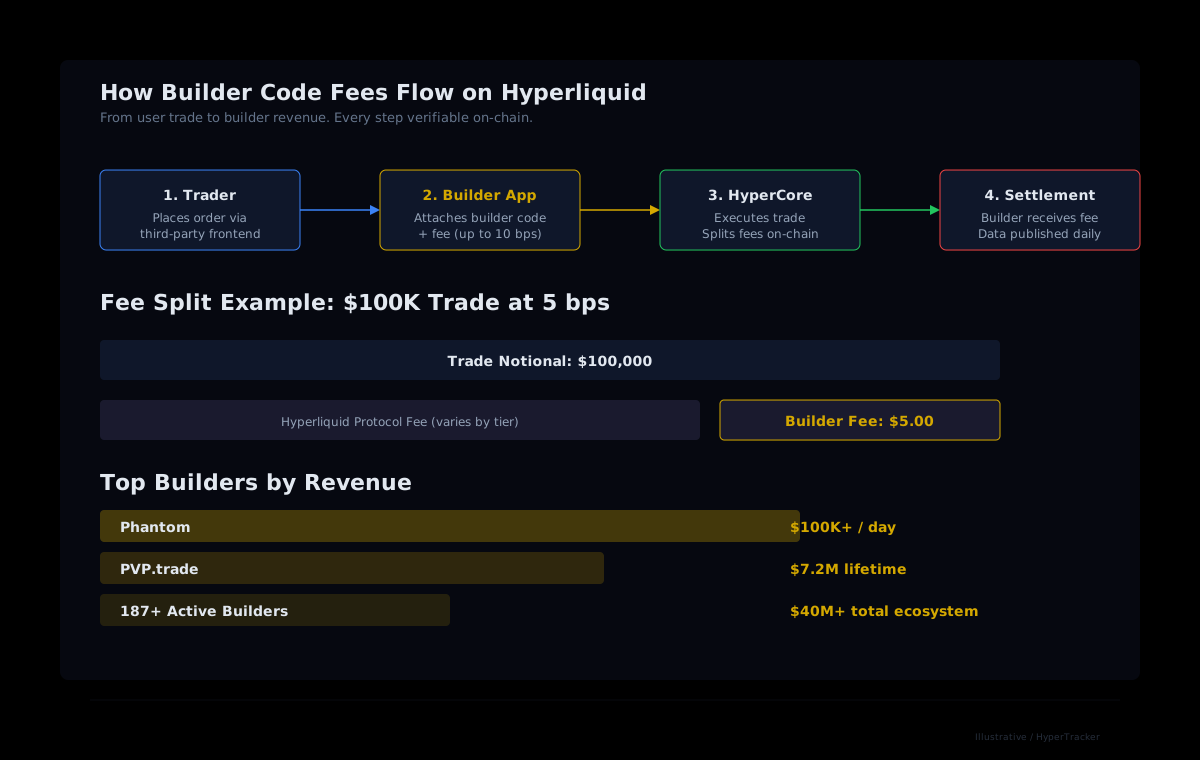
Builder codes are Hyperliquid's on-chain fee attribution mechanism. Any application that routes orders through HyperCore can attach a builder code and collect a fee of up to 10 basis points on perps or up to 1% on spot, per order. The user approves a maximum builder fee for each builder, can revoke permissions at any time, and every transaction is logged and published daily in compressed format.
The barrier to entry is minimal: 100 USDC in a Hyperliquid perpetuals account. That is it. Compare this to the 500,000 HYPE token lock (roughly $31.7 million at recent prices) required to deploy a HIP-4 prediction market. Builder codes are the low-barrier flywheel that feeds the high-barrier ecosystem.
The numbers tell the story. Phantom wallet alone earns over $100,000 per day from Hyperliquid trades routed through its interface. PVP.trade has generated $7.2 million in lifetime builder code revenue. When third-party applications can generate that kind of revenue by routing orders, they have every incentive to build deeper integrations, better UIs, and more sophisticated trading features on top of Hyperliquid.
Kalshi has no equivalent system. Its distribution model is centralized: Kalshi builds the interface, Kalshi acquires the users, Kalshi keeps the fees. That works well for a regulated exchange focused on compliance and institutional credibility. But it means Kalshi is competing for developers with zero economic incentive for those developers to build on its platform.
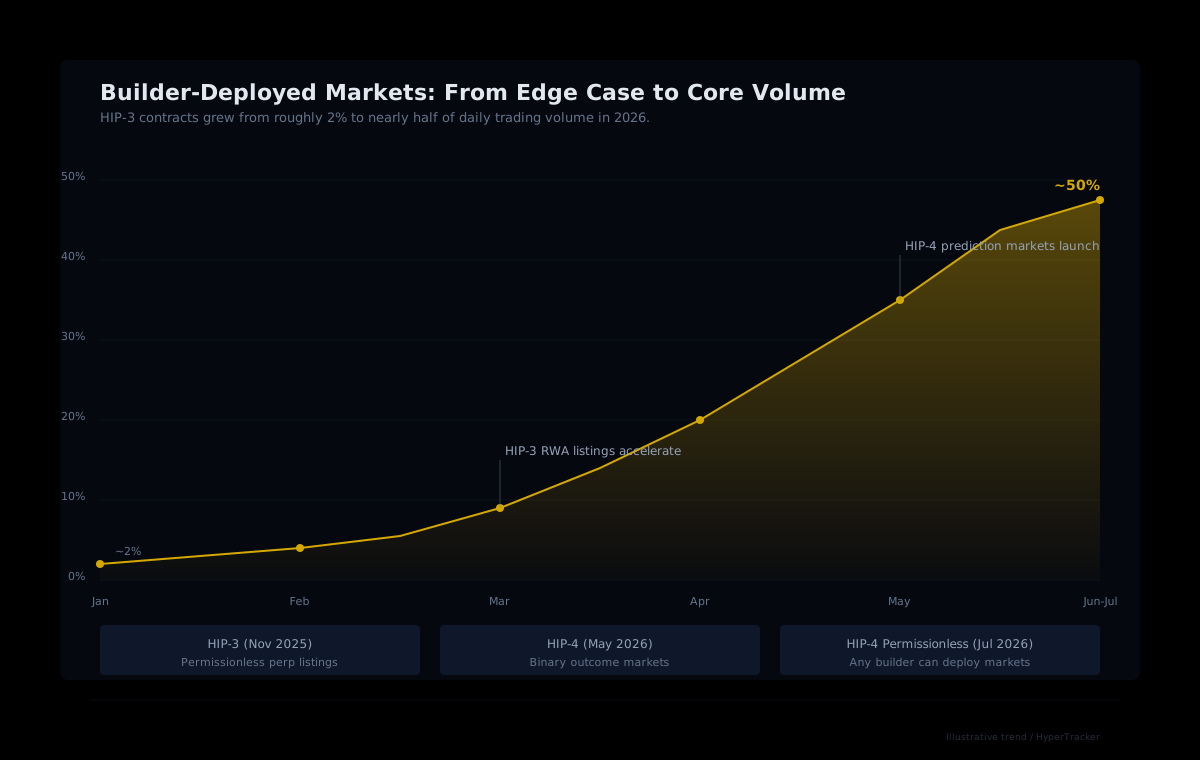
From 2% to nearly half: the HIP-3 growth curve
Builder-deployed contracts on Hyperliquid have followed an exponential adoption curve. At the start of 2026, contracts created through HIP-3 (which allows permissionless perp listings for tokenized equities, commodities, and other assets) accounted for roughly 2% of Hyperliquid's perpetual trading volume. By mid-2026, that share had climbed toward half of daily trading volume.
That trajectory matters because it shows that external builders are not just participating in the ecosystem. They are becoming the ecosystem. When builders deploy new markets (Tesla perps, gold futures, CPI outcome contracts), those markets generate volume that accrues to the builders through their codes. The more markets they deploy, the more volume flows through builder-attributed channels, which drives revenue, which attracts more builders.
HIP-4 extends this model to prediction markets. Each deployer can create outcome markets with up to 100 outcomes and receive up to a 50% fee share from the markets they operate. The economics are different from builder codes on perps (higher barrier, higher reward), but the underlying principle is the same: let third parties build the product surface while the protocol provides the infrastructure.
Where Kalshi holds the advantage
Builder codes and developer ecosystems are not the only competitive dimension. Kalshi holds structural advantages that Hyperliquid cannot easily replicate.
The most significant is regulatory status. Kalshi is a CFTC-designated contract market (DCM), which means it operates within the U.S. regulatory framework for derivatives trading. The BTCPERP approval was not just a product launch: it was the first time a federal regulatory agency explicitly authorized perpetual futures on a U.S.-regulated exchange. That opens the door to institutional capital that cannot legally trade on offshore venues.
Kalshi also dominates prediction market volume. In April 2026, Kalshi commanded a 62% market share, up from 55% in January, driven largely by sports betting, which accounts for roughly 72% of its volume. Polymarket is second. Hyperliquid is the newcomer, and while its early HIP-4 markets showed strong initial activity, the platform is still building out its event catalog.
The trade-off is clear. Kalshi offers regulatory legitimacy and institutional access. Hyperliquid offers developer economics and composability. For builders deciding where to deploy, the choice depends on whether they value a permissionless fee layer (Hyperliquid) or a regulated, compliance-first environment (Kalshi).
Why builder analytics matter for traders
If you trade perps on Hyperliquid, builder code data is not just developer infrastructure. It is a market-structure signal.
When builder-attributed volume rises, it typically means more applications are routing orders through Hyperliquid, which increases liquidity depth and tightens spreads. When builder volume concentrates on specific assets (say, tokenized equity perps through HIP-3 or outcome markets through HIP-4), that concentration tells you where developer and user attention is focused. A sudden spike in builder-attributed volume on a new HIP-3 listing often precedes retail discovery of that market.
Our data through HyperTracker's builder analytics endpoints lets you track these patterns programmatically. The /builders/list/timeframe/{timeframe} endpoint ranks all builders by revenue across 24h, 7d, 30d, or all-time windows. The /builders/{builder}/fills endpoint breaks down volume by asset, side, and time window. Together, they give you a real-time map of where third-party applications are driving flow.
This kind of intelligence is uniquely available on Hyperliquid because builder codes make the flow visible. On centralized exchanges, you cannot distinguish whether volume came from the native interface, a third-party API integration, or a market maker. On Hyperliquid, every builder-routed trade is attributed, logged, and queryable.
The prediction market angle for HyperTracker builders
HIP-4's permissionless deployment (announced July 19, 2026) means any builder who can stake 500,000 HYPE can now deploy prediction markets on Hyperliquid. The builder locks the tokens for six months and gets to define market schemas covering resolution time, oracle source, and challenge windows.
For builders already earning revenue through perp-focused builder codes, HIP-4 opens a second revenue stream. A trading interface that currently routes perp orders can add outcome market access to the same frontend. The user trades both product types from the same wallet, and the builder earns fees on both.
HyperTracker's builder analytics endpoints cover this new surface area. The /builders/{builder}/profile endpoint provides a comprehensive profile for a single builder address, including identity, fee rates, and analytics broken down by period. As HIP-4 markets generate volume, that volume flows through the same builder code attribution system, so the analytics carry over.
Track Builder Code Activity with HyperTracker
Our builder analytics API gives you ranked builder leaderboards, revenue time-series, fill decomposition by asset, and user attribution. Whether you are building a trading interface or analyzing market structure, the data is one API call away.
What comes next in the convergence
The Hyperliquid-Kalshi convergence is still in its early stages. Kalshi has announced plans to roll out perpetual contracts on additional cryptocurrencies beyond Bitcoin, and Hyperliquid's HIP-4 permissionless deployment is just beginning to attract market deployers. Both platforms are building toward the same end state: a unified trading venue where perps, spot, and event contracts coexist.
The competitive dynamics will likely hinge on three factors. First, liquidity: whichever platform achieves deeper order books across the full product suite will attract the most volume. Second, developer adoption: Hyperliquid's builder code economics create a self-reinforcing cycle that Kalshi has not yet matched. Third, regulation: Kalshi's DCM status is a moat against any DeFi protocol that wants to serve U.S. institutional capital.
For traders monitoring both platforms, the actionable insight is to watch builder code metrics as a leading indicator of platform momentum. When builder-attributed volume grows, it means developers are voting with their code. That signal has historically preceded broader user adoption on Hyperliquid, and with HIP-4 expanding the builder surface to prediction markets, the feedback loop is accelerating.
The platforms started from different places. They are heading toward the same destination. Builder codes are the compass that shows you who is getting there faster.