Hyperliquid's Regulation Playbook: Transparency as Offense
By CMM Team - 17-May-2026
Hyperliquid's Regulation Playbook: Transparency as Offense
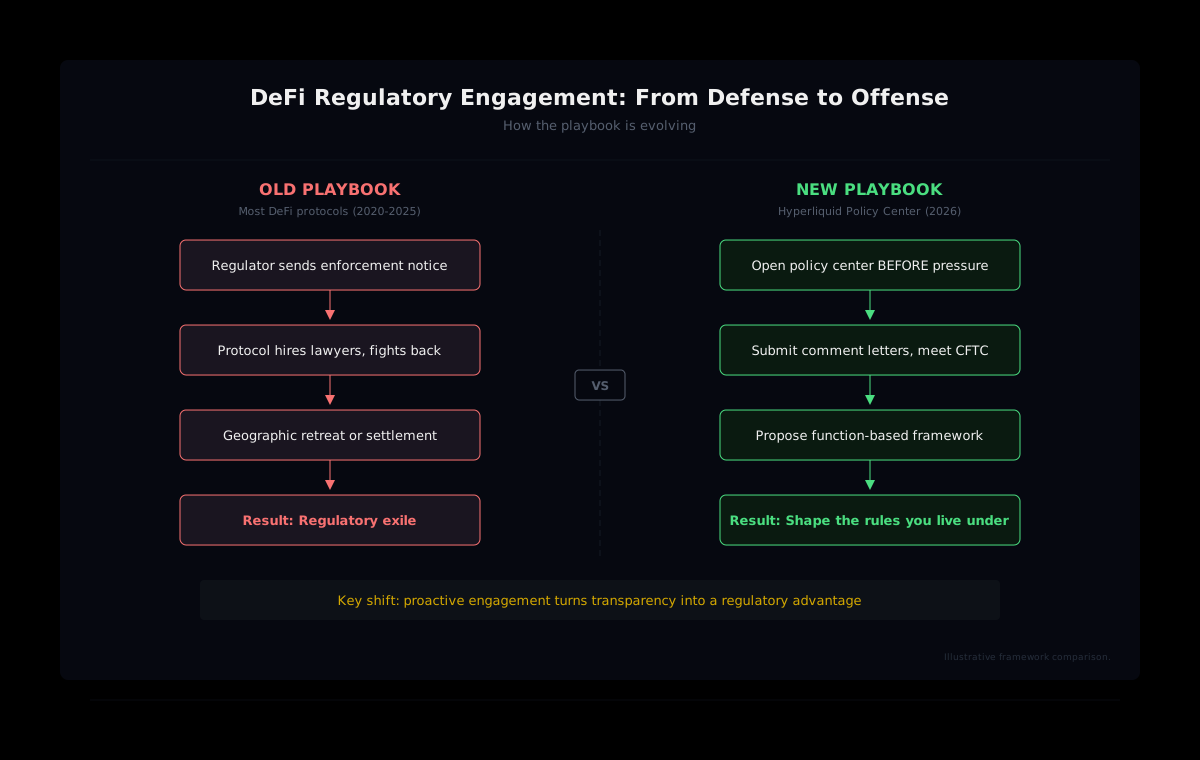
Most DeFi protocols respond to regulatory pressure with silence, legal posturing, or geographic retreat. Hyperliquid opened a policy center in Washington, D.C. and started writing comment letters to the CFTC. That choice, to engage regulators proactively rather than avoid them, could reshape how onchain derivatives platforms operate in the United States for the next decade.
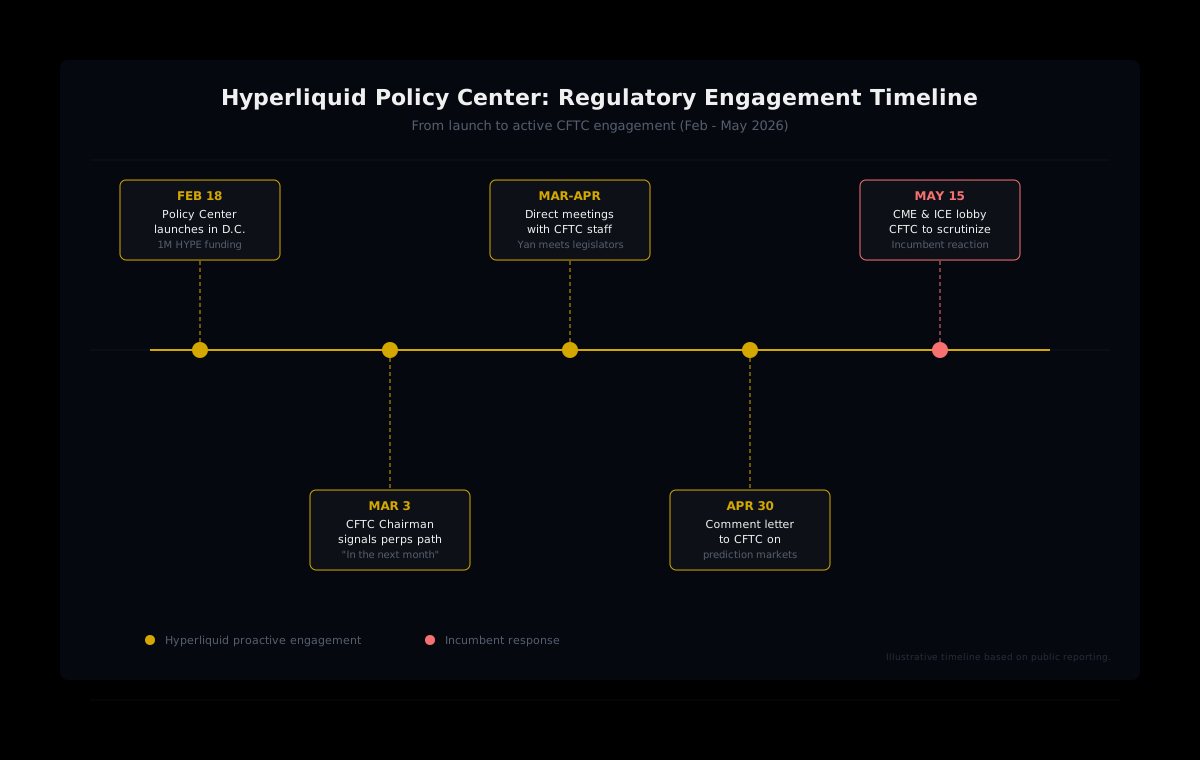
The Hyperliquid Policy Center launched on February 18, 2026, funded by a donation of 1 million HYPE tokens from the Hyper Foundation. Its CEO is Jake Chervinsky, a veteran crypto policy lawyer who previously led policy at the Blockchain Association and the venture firm Variant. The founding team includes policy counsel Brad Bourque (formerly Sullivan & Cromwell) and policy director Salah Ghazzal (previously Variant).
This is serious infrastructure. Sullivan & Cromwell alumni do not join meme-tier operations. The hiring signals that Hyperliquid is treating regulatory engagement as a core strategic function, the same way traditional exchanges treat lobbying: as a competitive moat.
The three-part playbook
After three months of operation, the Policy Center's strategy has taken clear shape. It runs along three tracks, each reinforcing the others.
Track 1: Reframe the transparency argument
When CME Group and ICE lobbied the CFTC to scrutinize Hyperliquid in mid-May 2026, the Policy Center's response flipped the opacity argument. Rather than defending against claims of manipulation risk, they attacked the premise: onchain markets are more transparent than traditional ones, not less.
Hyperliquid Policy Center: "Hyperliquid's transparency serves as a strong deterrent for misconduct and facilitates surveillance, detection, and investigation by regulators and law enforcement."
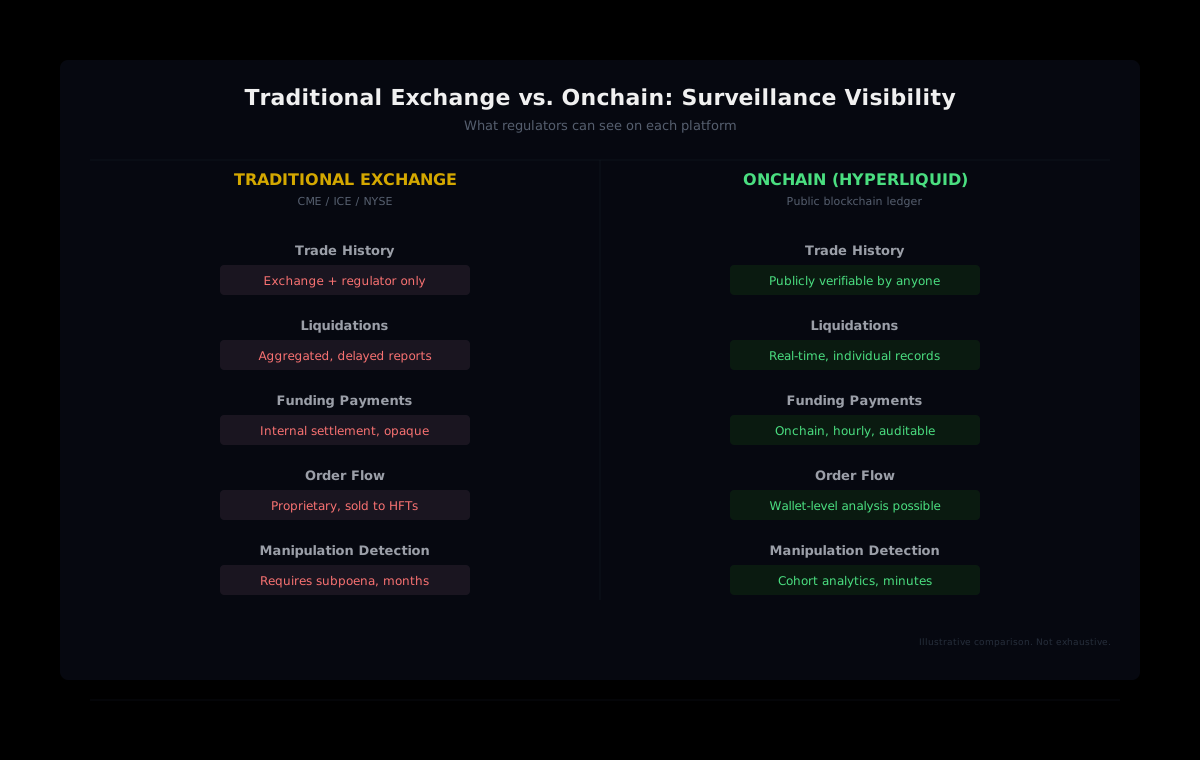
This is a calculated framing choice. CME and ICE run opaque matching engines where only the exchanges and their regulators can see the full order flow. On Hyperliquid, every trade, every liquidation, and every funding payment is publicly verifiable on-chain. The Policy Center argues that this makes Hyperliquid "a uniquely hostile environment for insider trading or price manipulation." If regulators care about surveillance, the onchain ledger is a better tool than anything CME provides.
Track 2: Shape the rules before they are written
The second move is proactive rulemaking engagement. On April 30, the Policy Center submitted a formal comment letter to the CFTC responding to an Advance Notice of Proposed Rulemaking (ANPRM) on prediction markets. The letter made three specific asks:
- Function-based regulation: Rules should regulate what a market does, not how it is structured. A decentralized prediction market that provides the same price discovery and risk management functions as a centralized one should face equivalent, not additional, regulatory requirements.
- Explicit U.S. access path: American participants should have a legal way to access decentralized prediction markets, with clear compliance requirements.
- Don't entrench centralized assumptions: New rules should not assume that a single exchange operator must sit at the center of every market. Settlement and surveillance mechanics designed for traditional intermediaries should not be forced onto decentralized protocols.
The prediction markets letter is a Trojan horse. Every argument about function-based regulation applies equally to perpetual futures, which is the Policy Center's flagship issue. By establishing the principle that decentralized markets deserve regulation tailored to their architecture (rather than shoehorned into 1930s-era exchange law), the Policy Center is building precedent that feeds directly into the perpetual derivatives debate.
Track 3: Build relationships before crises arrive
The Policy Center has held direct meetings with the CFTC regarding a legal pathway for U.S. retail participation on Hyperliquid. Co-founder Jeff Yan has met with U.S. legislators to discuss the CLARITY Act framework. These are not reactive meetings called after enforcement threats. They began months before the CME/ICE lobbying push, which means Hyperliquid already had relationships in place when the incumbent exchanges started making noise.
This sequencing matters enormously. When CME executives walk into a CFTC meeting to argue that Hyperliquid is a dangerous, unregulated casino, the commissioners across the table have already spoken with Chervinsky's team. They have already read the Policy Center's position papers. The narrative that Hyperliquid is an anonymous, reckless operation becomes harder to sustain when the CFTC's own staff has been briefed on onchain market mechanics by former Sullivan & Cromwell lawyers.
Why function-based regulation changes the game
The "function-based" framing deserves closer examination because it has implications far beyond Hyperliquid.
Current U.S. derivatives law assumes a specific market structure: a designated contract market (DCM) with a centralized operator, centralized clearing, and identity-verified participants. If Hyperliquid wants to register as a DCM, it would need to fundamentally alter its architecture. Chervinsky has acknowledged this directly, calling it a "tougher legal lift" than centralized platforms like Kalshi or Polymarket.
Function-based regulation offers a different path. Instead of asking "is this entity a registered exchange?", regulators would ask "does this market provide price discovery, risk management, and fair access?" If the answer is yes, the market gets regulated based on what it does, regardless of whether a centralized operator sits in the middle.
CFTC Chairman Michael Selig has been moving in this direction. In March 2026, he announced plans to create a framework for perpetual futures in the United States "in the next month or so". His stated motivation: recapturing liquidity that has migrated to offshore exchanges. The CFTC also launched "Project Crypto" in coordination with the SEC to align federal supervision of crypto asset markets.
The Policy Center's comment letters are designed to shape how that framework gets built. If perpetual futures regulation adopts function-based principles, Hyperliquid does not need to become a traditional exchange. It needs to demonstrate that its onchain architecture delivers the same functional outcomes: transparent pricing, accessible markets, and verifiable settlement.
The competitive subtext
Understand what is happening from CME's and ICE's perspective. These are exchanges with combined annual earnings exceeding $5 billion. They have spent decades building regulatory moats: compliance infrastructure, lobbying relationships, and a legal framework that makes it nearly impossible for new competitors to enter their market without spending years and hundreds of millions on registration.
Hyperliquid is bypassing all of that. It does not need a clearing house because settlement is onchain. It does not need trade surveillance technology because the blockchain is the surveillance system. It does not need KYC infrastructure because (for now) it operates outside U.S. jurisdiction. Every layer of cost that incumbents carry as competitive moat, Hyperliquid replaces with protocol design.
The timing is revealing. Hyperliquid launched its Policy Center three months before CME and ICE started their lobbying campaign. By the time the incumbents moved to offense, the Policy Center had already submitted regulatory comments, met with CFTC staff, and established its framing. The traditional exchanges are playing catch-up on the regulatory narrative, which is the opposite of what they expected when they started making phone calls.
What this means for builders and traders
If Hyperliquid's regulatory strategy succeeds, the implications extend to everyone building on or trading onchain derivatives.
A legal U.S. on-ramp for onchain perps. This is the biggest prize. Right now, U.S. retail and institutional capital cannot legally access Hyperliquid's markets. If the CFTC creates a function-based framework (or grants some form of innovation exemption), that changes overnight. U.S.-based quant funds, market makers, and retail traders who currently route through offshore structures would have a compliant path. More capital entering the ecosystem means more liquidity, tighter spreads, and deeper markets for everyone.
Onchain analytics become compliance infrastructure. If regulators accept that public blockchains provide superior surveillance compared to traditional matching engines, then tools that analyze onchain activity shift from "trading edge" to "regulatory infrastructure." Cohort analytics that classify wallets by behavior become a compliance layer. Order flow analysis becomes the onchain equivalent of trade surveillance.
Our data classifies every Hyperliquid wallet into 16 behavioral cohorts: 8 by portfolio size (from Shrimp under $250 to Leviathan above $5M) and 8 by all-time PnL (from Money Printer above +$1M to Giga-Rekt below -$1M). As regulatory frameworks develop around onchain transparency, this type of behavioral classification becomes increasingly valuable for understanding market structure, not just for trading, but for demonstrating to regulators that onchain markets can be monitored effectively.
Monitor onchain market structure as regulation evolves
HyperTracker's API classifies every Hyperliquid wallet into 16 behavioral cohorts. Track how market composition shifts as regulatory clarity brings new capital onchain. One API call, 5-minute refresh, starting at $179/mo.
Precedent for every DeFi protocol. Hyperliquid's Policy Center is doing something no other DeFi protocol has attempted at this scale: proactively proposing regulatory frameworks rather than waiting for enforcement. If the function-based approach gains traction at the CFTC, it creates a template that lending protocols, DEXes, and stablecoin issuers can follow. The playbook shifts from "avoid regulators" to "write the rules you want to live under."
The risk: co-option versus clarity
The optimistic read is that Hyperliquid gets regulated on favorable terms and unlocks U.S. capital. The pessimistic read is that regulation domesticates the protocol, strips its advantages, and turns it into a slower version of a centralized exchange with extra compliance overhead.
Chervinsky has acknowledged this tension. He describes perpetual derivatives as "a superior financial product to a future or an option" and argues that DeFi will "take over finance". That is not the language of someone planning to fold Hyperliquid into the existing system. But regulatory engagement always involves compromise, and the specifics of any framework will determine whether onchain protocols retain their architectural advantages or surrender them for access.
The test will come in the implementation details. Does "function-based regulation" mean Hyperliquid can operate with pseudonymous participation as long as it provides onchain surveillance tools? Or does it mean Hyperliquid must build traditional KYC gates that contradict its permissionless design? The difference between those two outcomes is the difference between a protocol that scales globally and one that becomes a niche compliance product for U.S. institutions.
No formal regulatory action has been announced. The CFTC is still in its comment-gathering phase. But the Policy Center has made its position clear: it expects the CFTC to develop a "tailored regulatory framework for on-chain derivatives platforms," not a retrofit of existing rules.
The real story of onchain derivatives regulation is not about whether Hyperliquid gets scrutinized. Every serious financial platform eventually does. The story is about who writes the rules, and right now, the protocol that the incumbents called a "systemic risk" is the one sitting at the table drafting the framework. That is what offense looks like.