
Saylor Buys the Dip. Smart Money Buys the Perp.
By CMM Team - 18-May-2026
Saylor Buys the Dip. Smart Money Buys the Perp.
Every Monday morning, crypto Twitter holds its breath. Michael Saylor posts a chart. An SEC 8-K lands. The buy size is revealed. And within days, Bitcoin perp funding rates, open interest, and cohort positioning shift in ways that are almost formulaic at this point.
Strategy now holds 843,738 BTC as of May 17, 2026, roughly 4% of Bitcoin's entire circulating supply. The most recent purchase was 24,869 BTC for approximately $2.01 billion. That single week of buying exceeded the entire Q1 accumulation of every other corporate treasury buyer combined. For perp traders, these filings are no longer just news. They are a weekly catalyst with observable, repeatable patterns in derivatives positioning.
This article breaks down the playbook: how treasury buy announcements create a window for perp entries, which cohort signals confirm or deny the trade, and where the edge disappears once the crowd catches on.
The Monday Filing Cycle
Strategy's buying rhythm has become predictable infrastructure for the Bitcoin market. The company files SEC Form 8-K disclosures every Monday morning, revealing the previous week's BTC purchases. The pattern is so consistent that an entire cottage industry of on-chain trackers, Bitcoin Magazine tweet alerts, and X accounts exists solely to front-run or react to these filings.
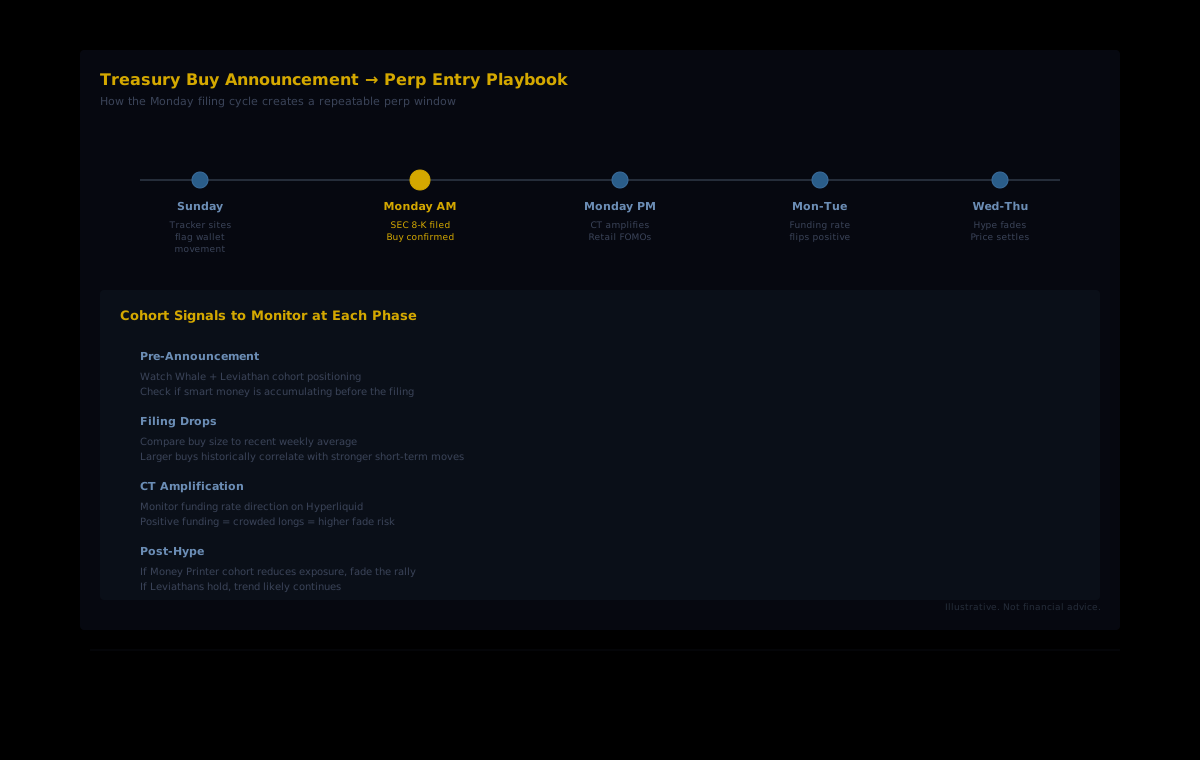
The cycle typically unfolds like this:
- Sunday evening: On-chain trackers flag wallet movements consistent with prior Strategy purchases. Speculation begins on CT.
- Monday pre-market: The 8-K drops. Buy size is confirmed. Crypto media runs the headline.
- Monday through Tuesday: CT amplifies the narrative. Retail traders pile into longs. Funding rates on BTC perps shift.
- Wednesday through Thursday: The hype fades. Price either holds or gives back the Monday pop. Smart money has already positioned.
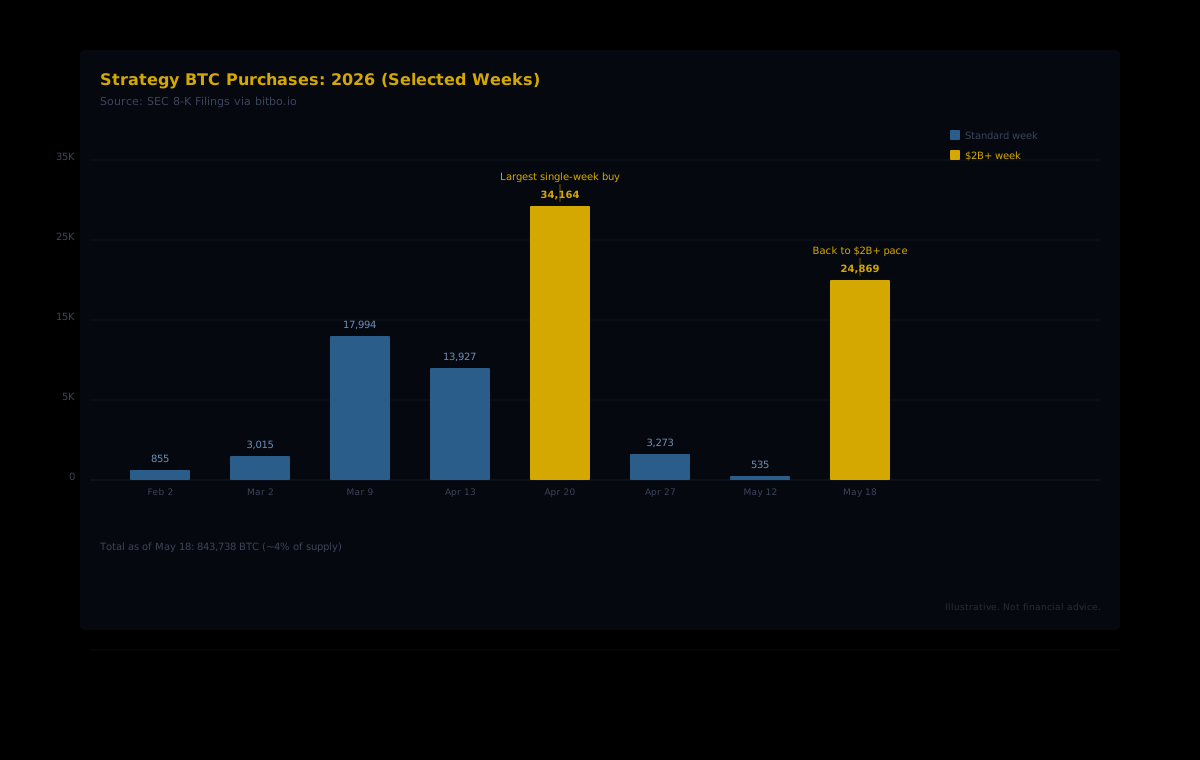
The buy sizes vary dramatically. On April 20, Strategy purchased 34,164 BTC for about $2.54 billion at an average of $74,395 each. Two weeks later, the purchase shrank to just 535 BTC for $43 million. The size of the buy matters because bigger purchases generate larger narrative momentum and more aggressive derivative positioning from retail.
Why Treasury Buys Move the Perp Market
Corporate treasury purchases are spot buys. Strategy acquires actual Bitcoin through OTC desks, which means the purchases themselves do not directly touch perpetual futures order books. So why do perps react?
The mechanism is narrative-driven, and it works through three channels:
Sentiment shift. A $2 billion Monday filing changes the mood on CT within minutes. Traders who were cautious on Sunday are opening leveraged longs by Monday afternoon. This sentiment shift is measurable: funding rates on Hyperliquid and other perp venues tend to tick positive within hours of a large filing.
Short squeeze pressure. If the market carries a large short position heading into Monday (which has been common in 2026, with funding negative for extended stretches), a confirmed treasury buy creates squeeze dynamics. Shorts cover, which pushes price higher, which triggers more short liquidations. The filing itself is just a spark. The derivatives positioning is the powder keg.
Front-running and reflexivity. Because the cycle is predictable, sophisticated traders position in advance. Some buy perps on Sunday night before the filing. Others sell into the Monday pop. This creates a reflexive loop: the more predictable the cycle becomes, the more it gets arbitraged, and the smaller the edge becomes for latecomers.
Reading the Buy Size
The single most useful variable from a Monday 8-K is the buy size relative to recent weeks. Strategy's 2026 purchases have ranged from 535 BTC to 34,164 BTC in a single week. The pattern is telling:
| Week | BTC Bought | Approx. USD | Market Reaction | | --- | --- | --- | --- | | Feb 2 | 855 | $75M | Minimal (small buy during crash) | | Mar 9 | 17,994 | ~$900M | Significant momentum shift | | Apr 20 | 34,164 | $2.54B | Largest single-week buy. Strong rally | | May 12 | 535 | $43M | Muted. Market read it as a pause | | May 18 | 24,869 | ~$2.01B | Back to large-buy pace |
Weeks with purchases above $1 billion tend to generate several days of bullish momentum in Bitcoin perps. Weeks with sub-$100M purchases are often treated as a pause signal. The market reads smaller buys as evidence that Strategy is conserving capital or that its preferred stock issuance pipeline (STRC, STRD, STRK, STRF) is slowing.
The Cohort Confirmation Layer
This is where the edge separates from the noise. A Monday filing tells you what Saylor did. Our cohort data tells you what everyone else is doing in response.
HyperTracker classifies every wallet on Hyperliquid into 16 behavioral cohorts: eight by account size (from Shrimp at $0-$250 to Leviathan at $5M+) and eight by all-time PnL (from Money Printer at +$1M to Giga-Rekt at below -$1M). The cohort with the best historical track record is Money Printer: wallets that have made over $1 million in cumulative profit. When Money Printers and Smart Money cohorts are adding long exposure before or during a treasury buy week, it confirms the trade. When they are reducing exposure or going short despite a large filing, the divergence is a warning.
Bullish Confirmation Setup
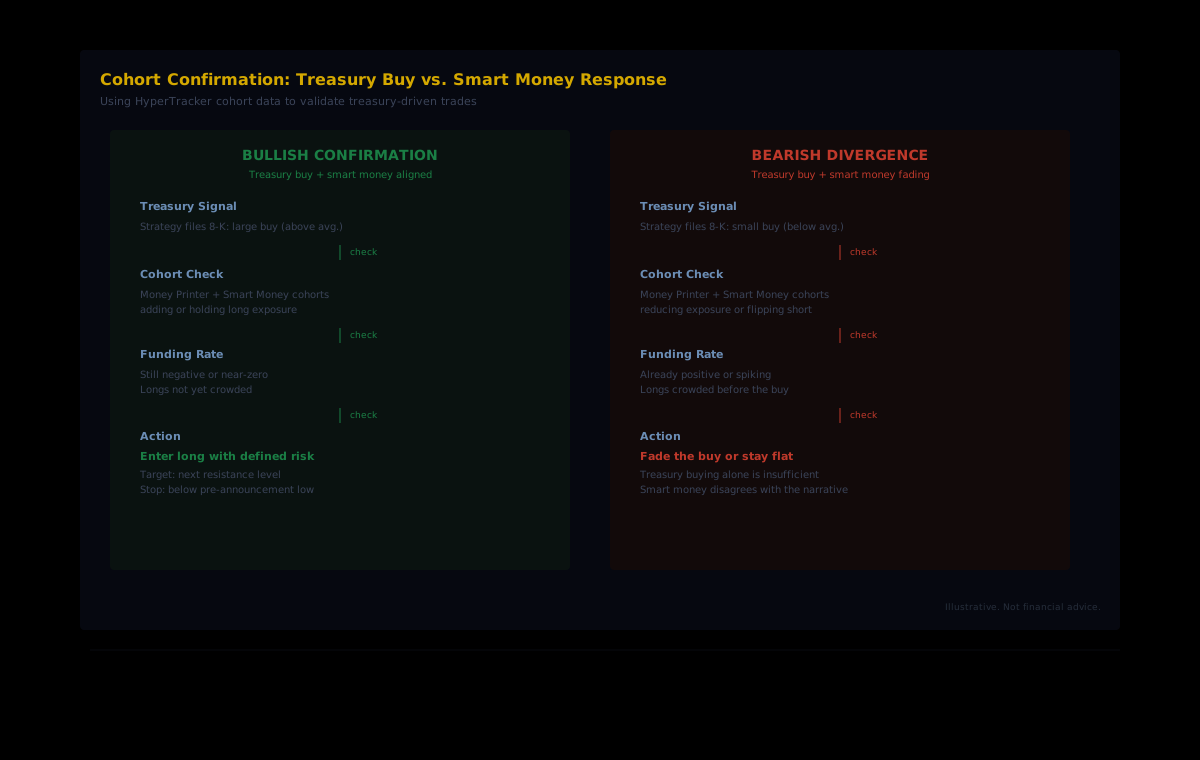
The highest-conviction perp trade around a treasury buy happens when three conditions align:
- Large buy confirmed (above the recent weekly average)
- Money Printer and Smart Money cohorts are adding or holding long exposure on Hyperliquid
- Funding rate is negative or near-zero, meaning longs are not yet crowded
When all three conditions are present, the trade has both a catalyst (the filing) and confirmation (smart money is positioned in the same direction). The negative funding rate means you are getting paid to hold the position, which reduces carry cost even if the move takes a few days to materialize.
Bearish Divergence Setup
The danger zone is when a large filing drops but the cohort data disagrees. If Money Printers are reducing BTC exposure or flipping net short on Hyperliquid while CT celebrates the Monday headline, the divergence suggests the treasury buy is already priced in. Retail is late. Smart money is taking the other side.
This setup is common after a string of large buy weeks. By the third or fourth consecutive billion-dollar filing, the market starts to expect it, which means the informational edge of the filing itself is nearly zero. The move has already happened in anticipation.
Funding Rate as a Timing Filter
Funding rates on Bitcoin perpetual futures are the single best real-time gauge of crowd positioning. On Hyperliquid, funding settles hourly (unlike centralized exchanges that typically settle every eight hours), which gives perp traders faster feedback on whether a position is getting crowded.
The practical rule: if funding is already significantly positive before Monday's filing, the long side is crowded. A large buy announcement may produce a brief spike, but the crowded positioning increases the odds of a quick fade as latecomers get squeezed by the funding drag.
Conversely, if funding has been negative heading into a large filing week, the short side is exposed. The treasury buy announcement becomes the catalyst for a short squeeze. Shorts cover, price rises, funding flips positive, and the cycle resets.
This is observable on Hyperliquid's BTC perp, where hourly funding gives a higher-resolution view of positioning shifts compared to eight-hour snapshots on CEX venues.
When the Edge Disappears
Treasury buy trading is not a perpetual alpha source. The edge decays for several reasons:
Predictability breeds arbitrage. The more consistently the market reacts to Monday filings, the earlier traders position. Eventually the entire move happens on Sunday night, and the Monday filing itself becomes a "sell the news" event.
Buy size normalization. Strategy has been buying for years. The market's surprise threshold keeps rising. A $500 million buy that would have moved markets in 2024 barely registers now. Only outlier sizes (the $2.54 billion April 20 week, for instance) generate meaningful new positioning.
The "never sell" narrative crack. In May 2026, Saylor told investors that Strategy would "probably sell some Bitcoin to fund a dividend". He later framed this as a tactic aimed at short sellers, but the market took note. If corporate treasury flows can reverse, the one-directional assumption behind the trade weakens. Perp traders who built strategies around permanent buying pressure now need to account for potential selling pressure too.
Copycat collapse. The corporate BTC treasury trade was supposed to be a movement. In practice, it consolidated around a single player. Strategy copycats like Nakamoto have seen share prices plummet more than 99%. When the broader treasury bid disappears and only one buyer remains, the market's sensitivity to that buyer's pace increases. A week where Strategy buys less than expected can trigger outsized negative reactions.
Building This Into a Repeatable Process
For traders who want to incorporate treasury signals into their perp strategy, the process is straightforward:
- Track the filing calendar. Strategy's 8-Ks drop Monday mornings. Set an alert for SEC EDGAR filings under MSTR. You can also follow @strategy on X, since Saylor almost always posts the orange dot chart on Sunday.
- Compare buy size to the trailing four-week average. If this week's purchase is significantly above average, the narrative impact will be larger. If it is below, expect a muted reaction or a "pause" interpretation.
- Check cohort positioning before the filing. Use HyperTracker's cohort endpoints to see whether Money Printer and Smart Money wallets are adding long exposure on BTC perps. Alignment with the treasury buy is the confirmation signal.
- Read the funding rate. Negative or near-zero funding going into a large buy week is the most favorable setup. Positive funding means the crowd is already long, which limits upside and increases fade risk.
- Define your exit before you enter. Treasury-driven moves are typically short-lived. If the catalyst has been absorbed and cohort positioning reverses, the trade is over. Take your stop and wait for the next cycle.
Monitor Smart Money in Real Time
HyperTracker's API gives you cohort-level positioning data across 16 behavioral segments on Hyperliquid. See what Money Printers, Leviathans, and Smart Money wallets are doing before and after every treasury filing.
The Bigger Picture
Corporate Bitcoin treasuries have introduced a new variable into derivatives markets that did not exist three years ago. A single company's Monday filing can shift funding rates, trigger short squeezes, and reset market positioning across every perp venue. For traders who understand the mechanics, these filings create repeatable setups. For those who chase the headline without checking the underlying data, they create traps.
The gap between those two outcomes is information. Cohort data tells you whether smart money is aligned with the treasury buyer or fading it. Funding rates tell you whether the crowd has already priced in the move. Together, these signals turn a noisy weekly headline into a structured trading process.
Saylor buys the spot. The edge is in knowing whether to buy the perp.