Reading Hyperliquid Funding Rates as a Positioning Signal, Not a Cost
By CMM Team - 15-May-2026
Reading Hyperliquid Funding Rates as a Positioning Signal, Not a Cost
Most traders treat funding rates as a fee. Something they pay or receive while holding a perpetual futures position, mentally classified alongside trading fees and slippage as a cost of doing business. That framing isn't wrong, but it misses what funding rates actually are: a real-time poll about market positioning. Every funding rate calculation answers a specific question — is the perpetual contract trading above or below spot, and by how much — and that answer encodes everything the market currently thinks about leverage, sentiment, and crowding.
If you trade on Hyperliquid, the funding rate stream is one of the cleanest positioning signals you have access to. It's free, public, updates hourly, and on a venue with wallet-level transparency, you can cross-reference it against cohort-level positioning to understand who is driving the imbalance, not just that there is one.
This article reframes funding rates from a cost line into a strategic input. You'll see how Hyperliquid's specific funding mechanics differ from centralized exchanges, why the hourly cadence matters, and how to combine funding rate data with cohort analytics to identify when a positioning extreme is a setup versus a trap.
What funding rates actually measure
A perpetual futures contract is a synthetic instrument designed to track spot price without ever expiring. The mechanism that keeps perpetual prices anchored to spot is the funding rate — a periodic payment from one side of the market to the other, calibrated to compress any gap between perp and spot prices.
When the perpetual contract trades above spot (a "premium"), funding turns positive. Long positions pay short positions. The economic effect is to make holding longs more expensive over time, discouraging new longs and incentivizing shorts to come in and arbitrage the gap. When the perpetual trades below spot (a "discount"), funding turns negative. Shorts pay longs. The reverse logic applies.
The depth and persistence of funding rates encode two pieces of information:
-
Directional positioning bias. A persistently positive funding rate means the perpetual is trading above spot, which means buying pressure on perps exceeds buying pressure on spot. That's directional information — the leveraged side of the market is biased long.
-
Crowding intensity. The magnitude of the funding rate measures how much premium or discount has built up. A funding rate of +0.01% per 8 hours is a slight bias. A funding rate of +0.1% per 8 hours is a meaningful crowding signal. Longs are paying real money to maintain exposure, which means the trade has become expensive to hold and the marginal new long has weaker conviction than the existing longs.
When you read funding rate data this way, every funding period is a snapshot of where the leverage is, how aggressive it is, and how stable the positioning is likely to be.
Hyperliquid's funding mechanics: hourly, not 8-hourly
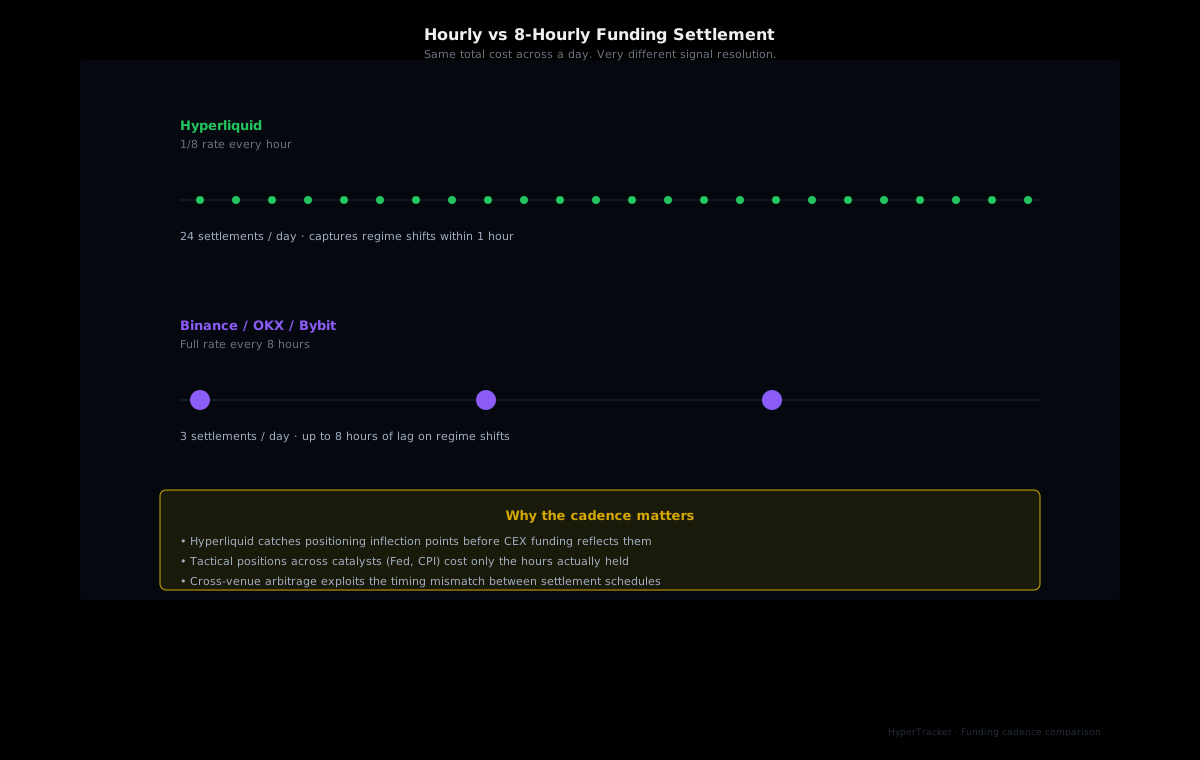
The biggest difference between Hyperliquid funding and centralized exchange funding is cadence. Binance, OKX, Bybit, and most centralized perp venues settle funding every 8 hours. Hyperliquid settles every hour at 1/8 the rate.
In one sense, this is just a different sampling resolution of the same underlying signal. Over a full day, both venues average out to roughly the same total funding cost for the same level of premium or discount. But the higher resolution has practical consequences:
Faster price discovery during regime shifts. When the market suddenly flips from net-long to net-short bias, Hyperliquid's hourly settlement reflects that within an hour. CEX-style 8-hour settlement smooths over short-term shifts and reflects them with up to 8 hours of lag. For traders watching funding rates as a positioning signal, the hourly cadence catches inflection points before they're visible elsewhere.
Shorter cost-of-carry for tactical positions. If you want to hold a position only across a few hours of a specific catalyst (a Fed announcement, a CPI print, a token unlock), the hourly funding cadence means you only pay funding for the hours you actually held the position. On an 8-hour cadence, opening 7 hours before a settlement and closing right after means you pay the full 8-hour rate for 1 hour of exposure.
Different arbitrage dynamics. Hyperliquid's hourly settlement creates more frequent, smaller funding payments flowing constantly between longs and shorts. Cross-venue arbitrage between Hyperliquid and CEXes has to account for the timing mismatch. Funding at Binance settles every 8 hours, on Hyperliquid every hour, and the difference creates exploitable carry opportunities for traders who model both schedules.
Reading funding extremes: setup or trap?
The most common mistake retail traders make with funding rate data is treating extremes as automatic mean-reversion signals. The logic goes: funding is very positive, the market is over-leveraged long, so we should short and wait for the squeeze. Sometimes that works. Often it doesn't, because funding can stay extreme for far longer than a small account can stay solvent.
The better question isn't "is funding extreme?" but "who is on each side of this trade?"
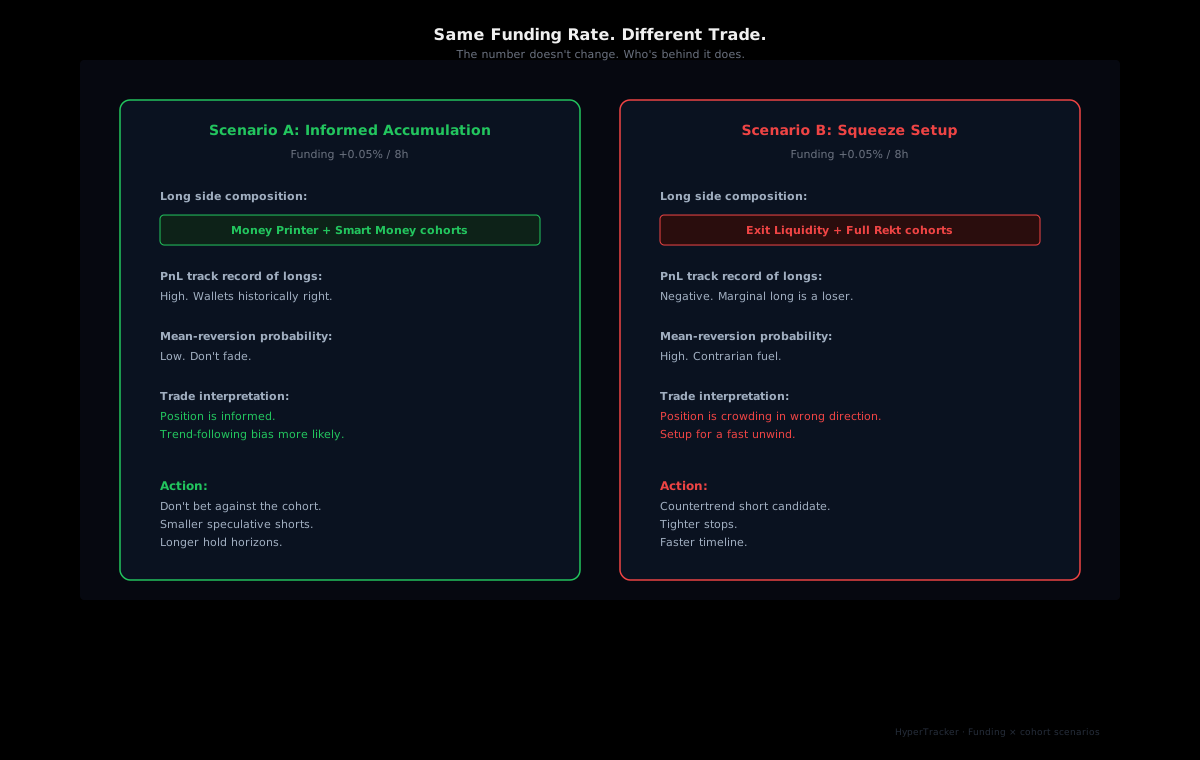
This is where cohort data on Hyperliquid changes the game. Funding rates tell you the aggregate balance of positioning. Cohort positioning tells you the composition. Two scenarios look identical at the funding-rate level but mean very different things in practice.
Scenario A: Funding is sustainably positive at +0.05% per 8 hours. The long side is dominated by the Smart Money and Money Printer cohorts. Wallets with strong all-time PnL. Mean-reversion is a low-probability bet because the wallets driving the trade have a track record of being right. This is not a squeeze setup. This is informed accumulation.
Scenario B: Funding is at the same +0.05% per 8 hours. The long side is dominated by Exit Liquidity and Full Rekt cohorts. Wallets with negative all-time PnL. The mean-reversion case is much stronger because the marginal long is statistically a loser. The funding extreme is a crowding signal in the unprofitable direction. This is a squeeze setup.
Same funding rate. Same positioning bias. Completely different trade. The signal in the funding number alone can't distinguish these scenarios. The signal becomes actionable when you layer in cohort context.
Building a positioning signal from funding + cohorts
Here's a practical framework for using funding rate data as positioning intelligence on Hyperliquid, rather than just an accounting cost.
Step 1: Track funding rate persistence, not just current level. A funding rate of +0.05% that's been positive for 12 consecutive hours is a stronger signal than one that just flipped positive in the last hour. Persistence indicates positioning is sticky and conviction is high.
Step 2: Cross-reference with cohort positioning at the time of the funding extreme. Use the HyperTracker API to pull cohort-level long/short ratios for the asset. If the high-PnL cohorts (Money Printer, Smart Money) are net long on a positive-funding asset, the position is informed. If the low-PnL cohorts (Semi-Rekt, Full Rekt) dominate the long side, the position is contrarian fuel.
Step 3: Calibrate position sizing to the signal quality. A funding extreme aligned with high-PnL cohort positioning warrants smaller speculative positions and longer hold periods. A funding extreme dominated by low-PnL cohorts warrants larger countertrend positions with tighter stops, because the squeeze (if it comes) is faster.
Step 4: Track cohort migration through the funding cycle. As funding extremes mature, watch whether high-PnL cohorts are reducing or increasing exposure. A cohort that was net long and is now reducing exposure is taking profits at the funding extreme. A signal that the position is exhausting itself.
Where this falls apart
A few caveats worth naming directly.
Funding rate data is venue-specific. Hyperliquid's funding rates reflect Hyperliquid positioning. If the bulk of leverage on a given asset sits on Binance, Bybit, or OKX, the Hyperliquid funding signal will be muted relative to the actual market-wide positioning. For BTC, ETH, and SOL, Hyperliquid funding is a meaningful but partial signal. For long-tail HIP-3 markets, Hyperliquid funding is essentially the only signal.
Cohort-level positioning data exists for Hyperliquid only. The cross-reference framework above works because our data classifies every wallet on Hyperliquid into 16 cohorts. On CEX venues, this kind of wallet-level cohort breakdown isn't available. So the funding-plus-cohorts framework is a Hyperliquid-specific edge. It's one of the structural advantages of trading on a transparent on-chain venue.
Short-term funding extremes can have technical drivers unrelated to conviction. Large delta-hedged structures, basis trades, and market-maker positioning can create funding extremes that have nothing to do with directional conviction. The cohort breakdown helps distinguish these. If a funding extreme is dominated by a single Leviathan-sized wallet that's running market-neutral, the cohort data flags it as a technical position rather than a directional bias.
API access
The same HyperTracker API that exposes cohort positioning also exposes Hyperliquid funding rate data. You can pull the current funding rate for any asset, historical funding rate time series, and cohort-level positioning at any point in time. Combining these queries lets you build the funding-plus-cohorts framework programmatically — for backtesting, for real-time alerts, or for systematic strategies that trade funding extremes filtered by cohort composition.
# Pull current funding rate + cohort positioning for BTC
funding = api.get("/funding/btc/current")
cohorts = api.get("/cohorts/positioning/btc")

# Filter: only act when high-PnL cohorts are NOT driving the trade
if funding["rate"] > 0.0003:  # positive funding extreme
    money_printer_long = cohorts["money_printer"]["long_ratio"]
    if money_printer_long < 0.4:  # Money Printers are not the longs
        # Squeeze setup — contrarian short candidate
        ...
Start with the free tier (100 requests/day) to test the framework on a few assets. Paid tiers unlock cohort positioning queries and historical funding data for backtesting.
Get funding + cohort intelligence on Hyperliquid →
The bigger framing
Funding rates have always carried positioning information. That's literally what they're designed to measure. What's changed is that Hyperliquid's wallet-level transparency makes it possible to decompose aggregate funding into cohort-attributed positioning. You're no longer reading a single number that says "the leveraged market is long." You're reading a multi-dimensional signal that says "the leveraged market is long, and these specific kinds of wallets are driving it, with this much persistence."
That's a qualitatively different data product than what perpetual futures markets used to offer. Most traders are still consuming the old format. A single funding number, treated as a cost. The ones who learn to read it as a positioning signal with cohort context have an information advantage that compounds every funding cycle.
The signal is free. The cohort data is one API call away. The traders who connect them are getting paid in two currencies: the funding flow they harvest from being on the right side of crowded trades, and the alpha they generate from understanding the composition of those trades before everyone else.