Wall Street Called the CFTC on Hyperliquid. It Might Backfire.
By CMM Team - 16-May-2026
Wall Street Called the CFTC on Hyperliquid. It Might Backfire.
CME Group and ICE, the two largest traditional futures exchanges in the world, just did something they rarely do: they asked a federal regulator to go after a competitor by name. According to a Bloomberg report published May 15 (as reported by CoinDesk and crypto.news), executives from both exchanges have been lobbying the CFTC and members of Congress to force Hyperliquid into a U.S. registration framework. Their argument: that Hyperliquid's anonymous, 24/7 perpetual futures trading could distort global commodity benchmarks.
The subtext is simpler. Hyperliquid is eating their lunch, and it is happening faster than anyone predicted.
Oil perpetual contracts on Hyperliquid went from daily turnover of a few million dollars to exceeding $700 million in April, a surge that coincided with the Iran conflict and caught the attention of traditional commodities desks. The growth in Hyperliquid's HIP-3 markets, which offer synthetic exposure to stocks and commodities on-chain, puts the platform in direct competition with products that CME and ICE have monopolized for decades. And for the first time, those incumbents are fighting back publicly.
The complaint: manipulation and sanctions risk
ICE's Senior Vice President for Futures, Trabue Bland, put the argument plainly: "It's all about benchmark integrity. If there's something that could impact that, completely outside of anyone's oversight, I think that's problematic."
The specific concerns, according to Bloomberg's reporting, are threefold:
- Market manipulation: Hyperliquid's pseudonymous trading environment could allow coordinated actors to move prices on oil perps, which in turn could influence spot benchmarks.
- Sanctions evasion: Without traditional KYC, state-backed entities could theoretically trade oil exposure outside the reach of U.S. enforcement.
- Benchmark distortion: If Hyperliquid's oil volumes grow large enough, they argue the platform could distort global price discovery on regulated futures.
CFTC Chairman Michael Selig acknowledged the concern directly, noting that Hyperliquid "could end up influencing the spot market price or the futures market price on our registered platforms."
Hyperliquid's response: transparency is the point
The Hyperliquid Policy Center, led by veteran crypto policy lawyer Jake Chervinsky, fired back swiftly. Their counterargument flips the incumbents' framing: onchain markets are more transparent, not less.
George Godsal, Hyperliquid Platform Spokesman: "Every trade, every liquidation, and every funding payment is publicly verifiable in a way that no traditional exchange can match."
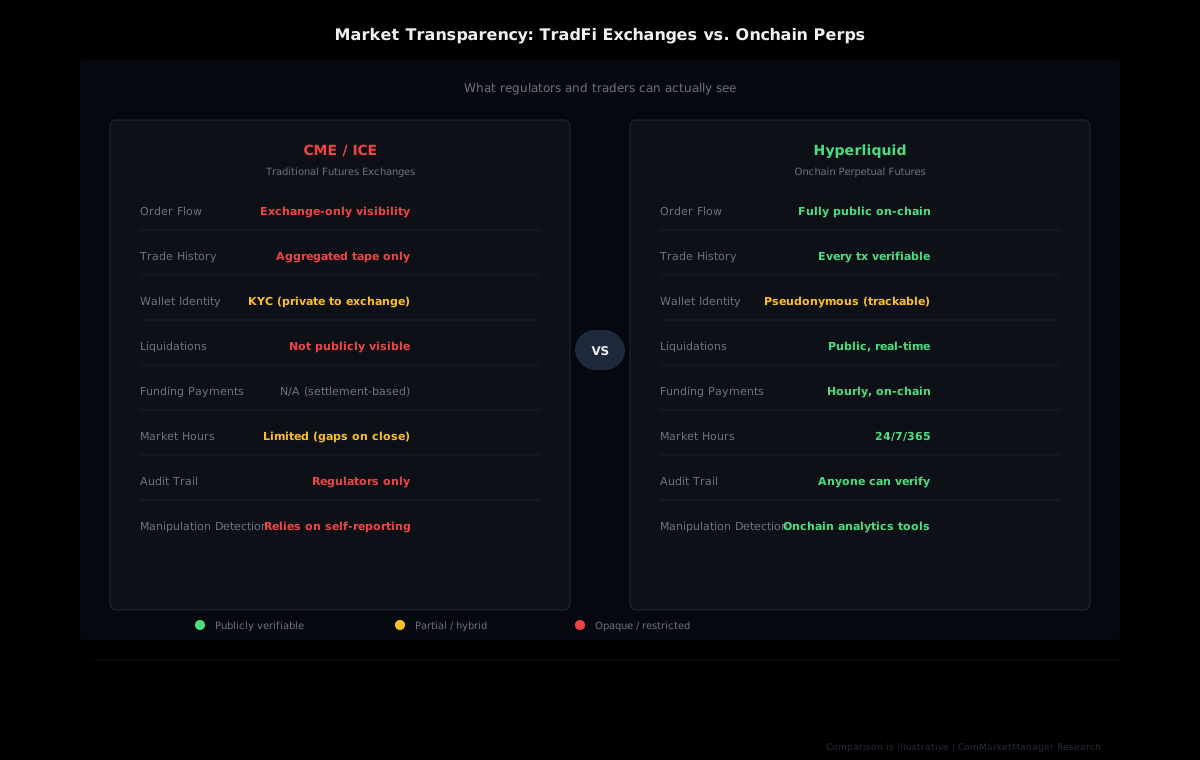
The Policy Center called the concerns "unfounded" and argued that Hyperliquid's complete on-chain record of every transaction makes it "a uniquely hostile environment for insider trading or price manipulation." They also noted that "U.S. law is not currently tailored for derivatives markets on public blockchains like Hyperliquid," which is less a defense and more an invitation for regulators to build something new rather than shoehorn DeFi into 1930s-era exchange law.
This framing matters because it attacks the incumbents' premise directly. CME and ICE run opaque matching engines where only the exchanges themselves (and their regulators) can see the full order flow. Hyperliquid publishes everything. If the question is "where is manipulation harder to detect," the answer is not obvious in CME's favor.
The timing tells the real story
Here is where things get interesting. Both CME and ICE are currently facing parallel investigations by the CFTC and the Department of Justice regarding oil futures trades that were executed on their platforms shortly before federal policy announcements. The lobbying push against Hyperliquid coincides with their own regulatory scrutiny, which makes the "benchmark integrity" framing look less like public service and more like competitive strategy.
Meanwhile, consider the growth trajectory that triggered this reaction:
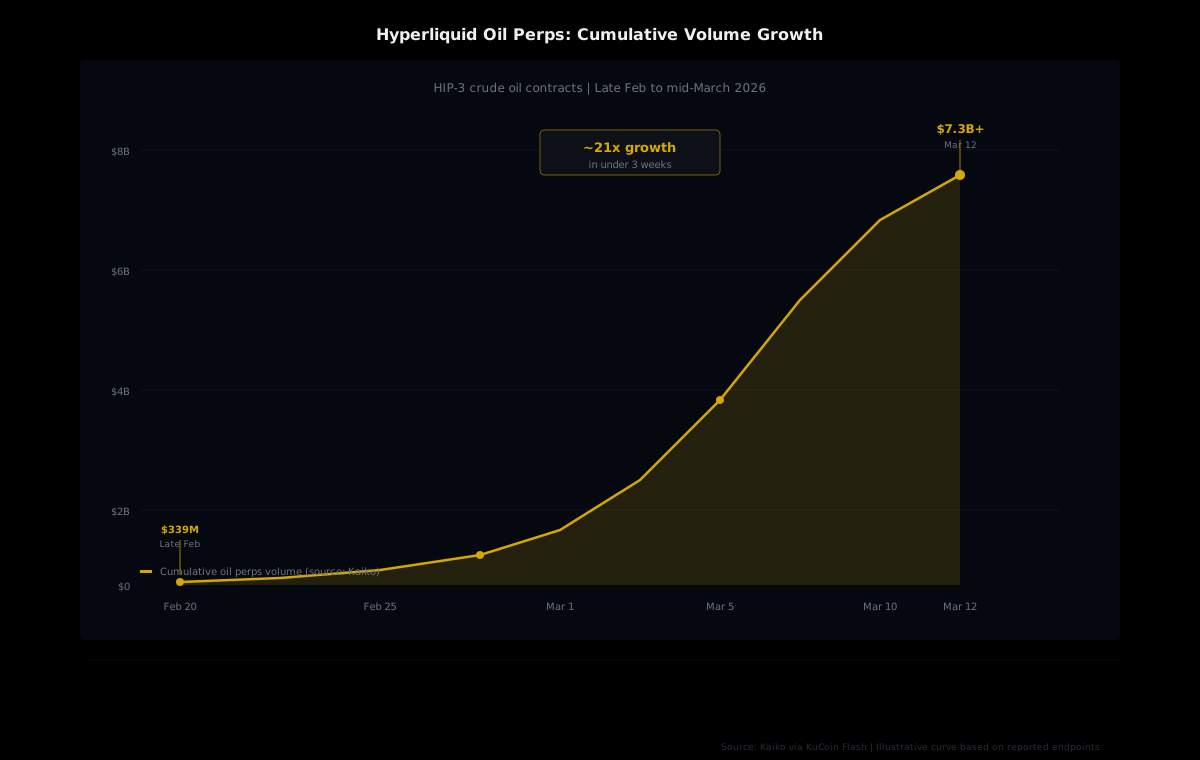
Hyperliquid's crude oil perps alone went from $339 million in cumulative volume in late February to over $7.3 billion by March 12, according to cryptocurrency intelligence provider Kaiko. That kind of exponential ramp in a product that directly competes with CME's WTI contract and ICE's Brent contract explains the urgency of the lobbying push far better than any abstract concern about "benchmark integrity."
Why registration might actually help Hyperliquid
CME and ICE are pushing for Hyperliquid to register with the CFTC. On the surface, this sounds like a weapon: registration imposes compliance costs, KYC requirements, and trade monitoring obligations. For a pseudonymous DeFi protocol, that should be a death sentence.
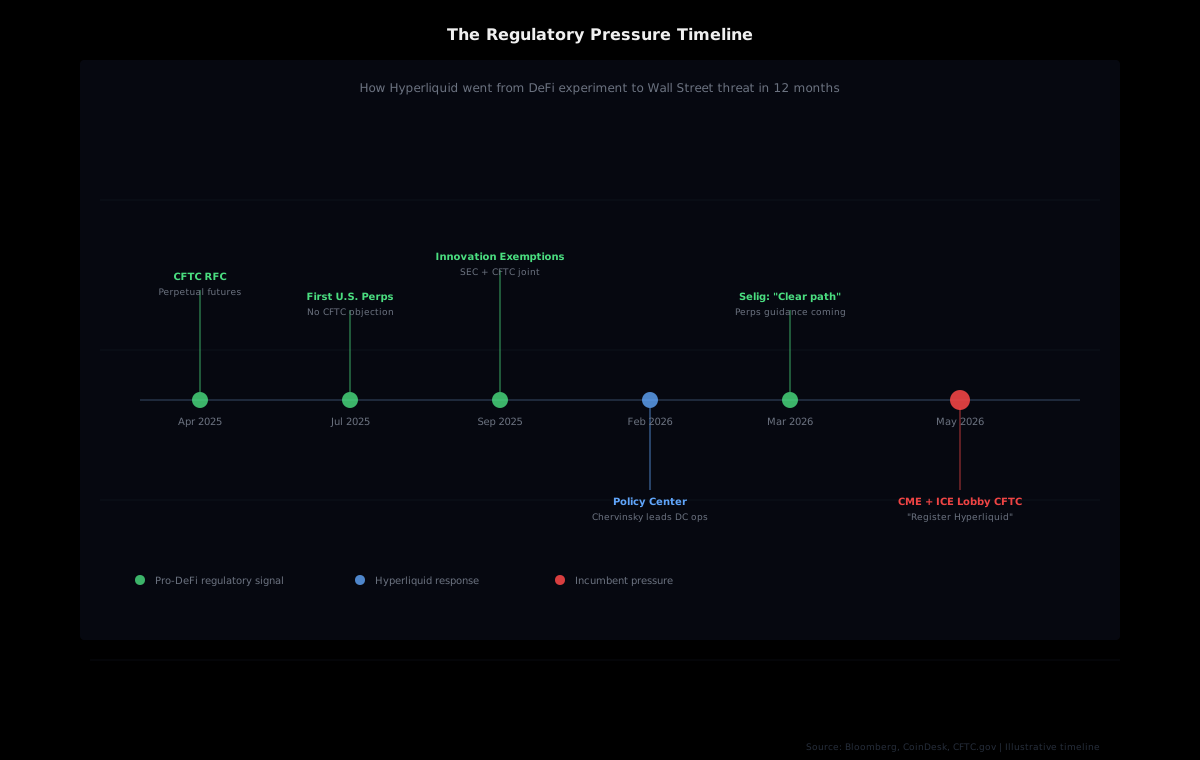
But consider the alternative framing. CFTC Chairman Selig has been moving since March 2026 to create a legal path for perpetual futures in the United States. His agency issued a Request for Comment on perpetual derivatives in April 2025, allowed the first U.S. perpetual futures contracts to begin trading in July 2025 without objection, and in September 2025 the SEC and CFTC jointly announced they were considering "innovation exemptions" for DeFi derivatives trading.
If Hyperliquid achieves some form of regulated status (whether full registration or through one of these innovation exemptions), it gains something CME and ICE cannot easily replicate: regulatory legitimacy combined with on-chain transparency. A registered Hyperliquid could serve U.S. institutional capital that currently cannot touch it. The addressable market expands dramatically, and the on-chain audit trail becomes a feature rather than a concession.
In other words, the incumbents might be handing Hyperliquid the one thing it was going to have trouble getting on its own: a regulated on-ramp for the world's largest capital pool.
What this means for traders and builders
For anyone building on Hyperliquid or trading its markets, this regulatory skirmish is actually bullish signal dressed as threat. Several dynamics are in play:
Volume validation. CME and ICE do not lobby the CFTC over platforms they consider irrelevant. The fact that both exchanges are spending political capital on this fight signals that Hyperliquid's commodity perps volumes are large enough to register on institutional radar. When Wall Street takes you seriously enough to call a regulator, you are past the "niche DeFi experiment" phase.
Regulatory clarity accelerates. Whether through adversarial pressure or through Hyperliquid's own Policy Center engagement, this conflict forces the CFTC to define rules faster. Ambiguity helps nobody. Clear rules (even restrictive ones) let builders plan around constraints rather than guess.
On-chain advantage sharpens. Every claim CME makes about opacity and manipulation risk actually strengthens the case for on-chain analytics. If regulators decide Hyperliquid needs monitoring, the protocol's public ledger makes it infinitely easier to monitor than any traditional dark pool or OTC desk. Tools that analyze on-chain flow, like cohort analytics that classify every wallet's behavior, become regulatory infrastructure rather than just trading edge.
Our data already classifies every Hyperliquid wallet into 16 behavioral cohorts (8 by size, 8 by all-time PnL). When commodity traders from TradFi start positioning on Hyperliquid's oil perps, those wallets become visible in the cohort structure. You can watch new capital cohorts form in real time, track whether the oil volume growth is driven by large or small accounts, and observe whether historically profitable wallets are leading or following the flow.
Track the institutional flow into onchain perps
HyperTracker's API classifies every Hyperliquid wallet into 16 behavioral cohorts. As commodity traders move onchain, watch which cohorts are leading the volume surge. One API call, 5-minute refresh, starting at $179/mo.
The precedent that matters
The last time a major asset class migrated from traditional venues to a new platform, the incumbents tried the same playbook. Stock exchanges lobbied against electronic communication networks (ECNs) in the late 1990s. The SEC considered restricting them. Instead, regulation forced transparency, ECNs thrived, and the incumbents eventually acquired what they could not kill (NYSE buying Archipelago, Nasdaq buying INET).
The parallels are not perfect. DeFi has unique challenges around compliance and enforcement. But the structural dynamic is identical: incumbents using regulation as a competitive moat while a more transparent alternative grows beneath them. The incumbents' combined earnings last year exceeded $5 billion. Hyperliquid is projected to generate over $1 billion in earnings this year. The gap is closing fast enough to justify panic, and panicked incumbents tend to make moves that accelerate rather than prevent the transition.
No formal regulatory action has been announced. Hyperliquid continues operating with its Singapore base. The Policy Center continues engaging the CFTC directly. And the oil perps volumes keep growing.
CME and ICE just told the world that onchain perps are a serious threat to their business model. That is the most credible endorsement Hyperliquid could have asked for, and it came from the last people who wanted to give it.