
Inside the HYPE Rich List: Who Holds What and How to Track It
By CMM Team - 13-Oct-2026
Inside the HYPE Rich List: Who Holds What and How to Track It
HYPE launched without a single VC allocation. No exchange deals, no insider pre-sales. The genesis airdrop handed 31% of the total one-billion supply to roughly 94,000 early users, which makes the token's holder distribution unusually transparent by DeFi standards. But transparency only matters if you know where to look.
The top of the HYPE rich list tells a story about protocol design, not just wealth concentration. Four protocol-controlled entities dominate the rankings, and understanding what each one does (and why its balance changes) gives you a real edge when evaluating the token's supply dynamics. This article breaks down who holds what, why it matters, and how to monitor large holders using HyperTracker's dashboard and API.
The Four Protocol Entities That Dominate Holdings
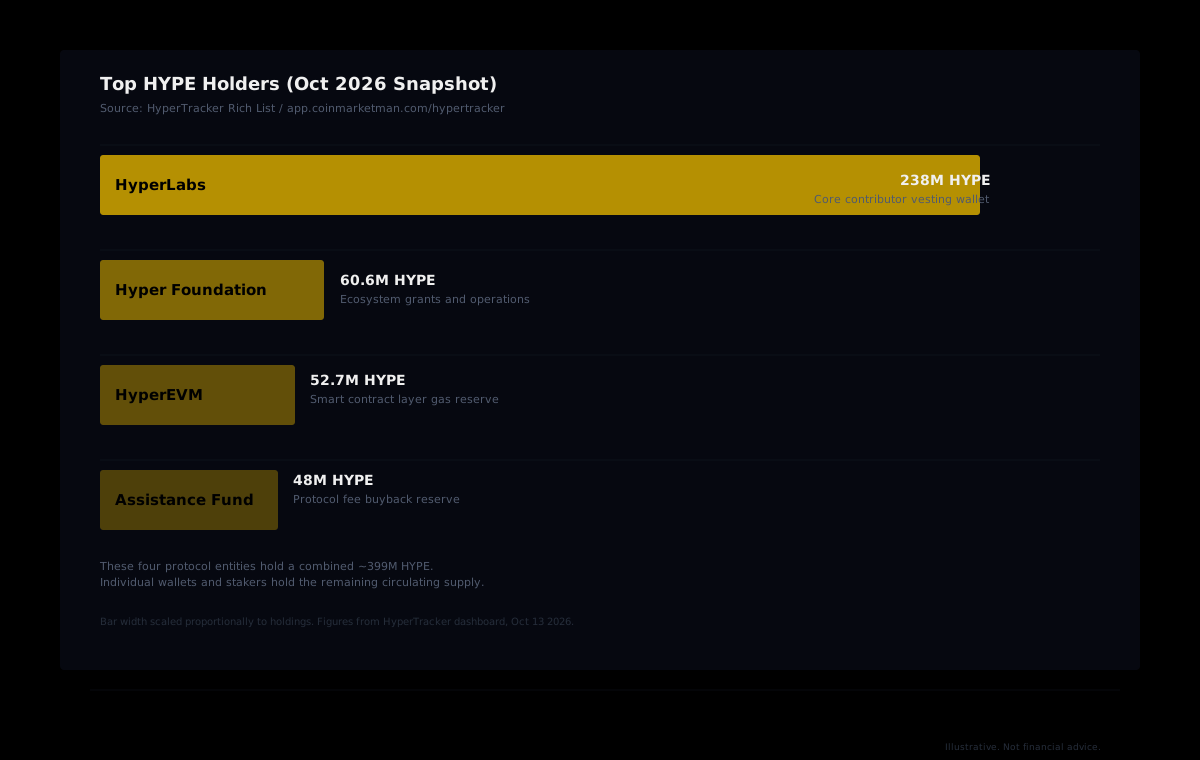
When you open the HYPE Rich List on HyperTracker's Leaderboards page, the top slots are not individual traders. They are protocol wallets, each with a specific function in the Hyperliquid ecosystem. Here is what each one holds as of mid-October 2026, pulled from the HyperTracker dashboard:
- HyperLabs: 238M HYPE
- Hyper Foundation: 60.6M HYPE
- HyperEVM: 52.7M HYPE
- Assistance Fund: 48M HYPE
Combined, these four entities hold roughly 399 million HYPE. That is a significant fraction of the circulating supply, so understanding what each wallet does is essential context for anyone watching the token's trajectory.
HyperLabs (Core Contributor Vesting)
The largest holder by a wide margin. HyperLabs represents the core contributor allocation, which accounts for 23.8% of the total one-billion supply. These tokens vest over approximately two years starting in January 2026, with roughly 9.9 million HYPE unlocking each month. When you see the HyperLabs balance decline on the rich list, it usually means another monthly vesting tranche has been released.
Hyper Foundation
Funded with 6% of the total supply, this wallet supports ecosystem grants, development funding, and operational expenses. The Foundation's spending rate matters because it signals how aggressively the protocol is investing in growth. A shrinking balance here typically correlates with active grant disbursements or strategic deployments.
HyperEVM
HYPE serves as the native gas token on HyperEVM (Chain ID 999), functioning like ETH on Ethereum. The HyperEVM wallet holds the reserve that funds smart contract interactions on Hyperliquid's EVM-compatible layer. As on-chain activity grows, gas consumption draws down this reserve, making the balance a rough proxy for HyperEVM adoption.
Assistance Fund
This is the protocol's buyback engine. Trading fees and stablecoin yield accrue to the Assistance Fund, which automatically buys HYPE from the open market. The fund's balance fluctuates constantly because it is both receiving inflows from fees and spending them on buybacks. A rising Assistance Fund balance can indicate accumulating demand pressure that has not yet been deployed.
Beyond Protocol Wallets: The Community Distribution
The protocol entities get attention because of their size, but the real story of HYPE is community ownership. Roughly 70% of the total supply was earmarked for the community, split across the genesis airdrop (31%, or about 310 million tokens), future rewards and emissions (38.9%), and a small grants allocation.
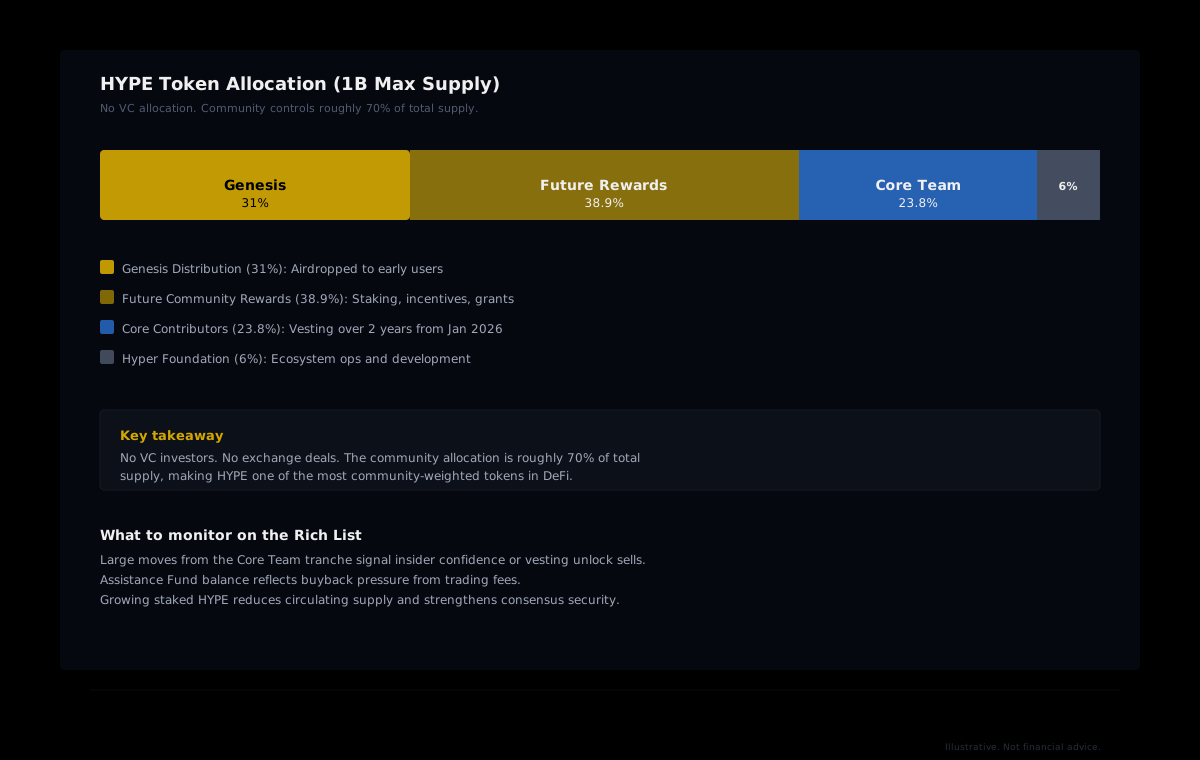
The genesis airdrop went to roughly 94,000 addresses based on trading activity on the platform, with no VC investors, no exchange listings deals, and no market maker allocations in the mix. That is unusual. Most token launches in DeFi reserve 20-40% for venture capital. Hyperliquid's founders self-funded the project and kept the entire supply distribution pointed at users.
This means when you look at the HYPE rich list below the protocol entities, you are seeing organic accumulation. Wallets that accumulated through trading rewards, staking, or secondary market purchases. Tracking these individual holders is where the signal lives for traders.
Staking and Its Impact on Supply
HYPE is not just a speculative token. It secures Hyperliquid's HyperBFT consensus through delegated proof-of-stake. Validators need a minimum 10,000 HYPE self-delegation, and delegators can stake with a one-day lockup and seven-day unstaking queue.
At around 400 million HYPE staked, the current reward rate sits at approximately 2.37% annually. Rewards follow a dynamic formula inversely proportional to the square root of total staked HYPE, which means the APY decreases as more tokens get staked, creating a natural equilibrium.
On the rich list, staked tokens appear separately from liquid balances. The /hype/holders endpoint returns both totalAmount and stakedAmount for each address, so you can distinguish between holders who are passively staking and those keeping their HYPE liquid for active use. A wallet converting a large liquid balance to staking signals a longer time horizon. A validator reducing their self-delegation could signal the opposite.
How to Read the Rich List on the Dashboard
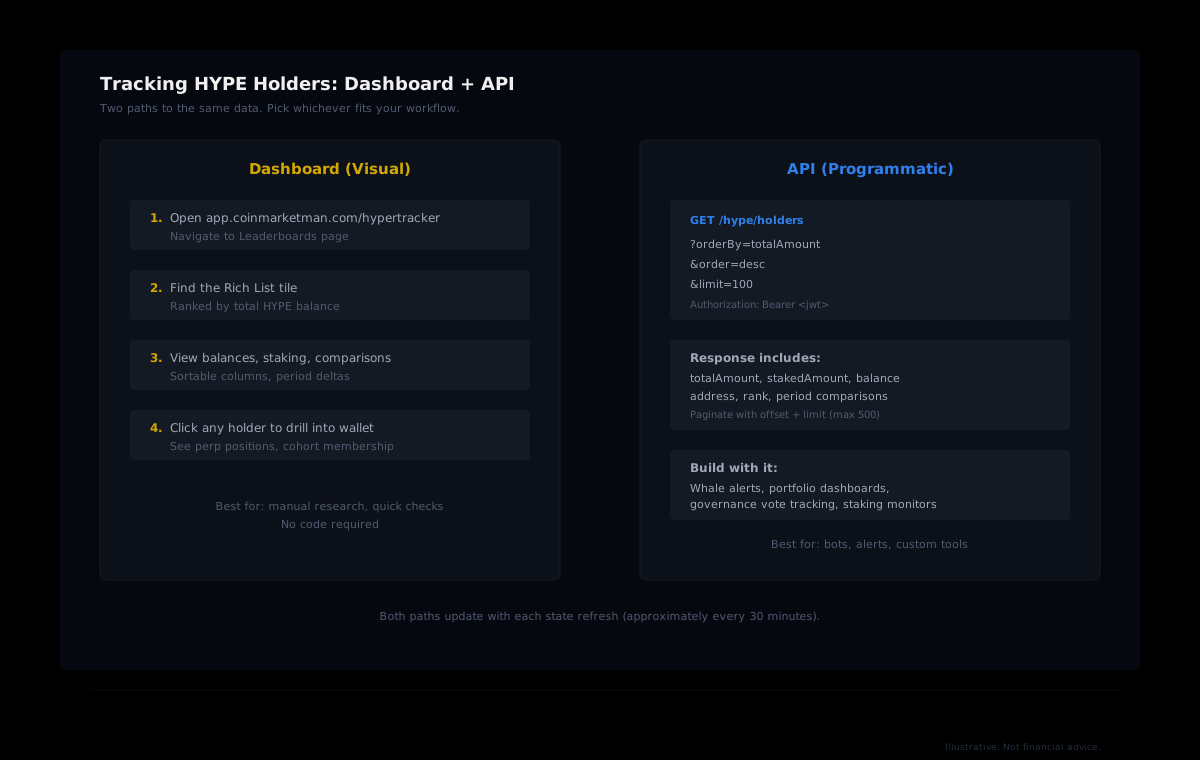
The quickest way to check HYPE holders is through the HyperTracker dashboard. Navigate to the Leaderboards page and look for the Top HYPE Holders and Rich List tiles. The interface shows:
- Total HYPE balance per address (staked + liquid)
- Staked amount as a separate column
- Period comparisons showing balance changes over time
- Sortable columns so you can rank by total holdings, staking amount, or recent changes
Clicking any holder drills into their wallet profile, where you can see their perp positions, cohort membership (which of HyperTracker's 16 behavioral cohorts they belong to), open positions, and trade history. That cross-referencing is where the rich list becomes actionable: you can see whether a large HYPE holder is also actively trading perps, sitting idle, or delegating to a specific validator.
Tip: The rich list updates with each Hyperliquid state refresh, approximately every 30 minutes. If you need to track changes more precisely, the API gives you the same data programmatically.
Querying Holders Programmatically with the API
For builders and analysts who want to automate holder tracking, HyperTracker exposes the GET /hype/holders endpoint. A single call returns the full ranked list of HYPE holders with balances, staking breakdowns, and period-over-period comparisons.
GET /hype/holders?orderBy=totalAmount&order=desc&limit=100

Authorization: Bearer <your_jwt_token>
The response includes items (array of holder objects) and totalCount. Each holder object contains the address, total HYPE amount, staked amount, liquid balance, rank, and comparison fields. Paginate with offset and limit (max 500 per page).
Four Ways to Use the Holders Endpoint
The endpoint is simple, but the applications get interesting quickly:
- Whale alerts. Poll every 30 minutes, diff against the previous snapshot, and fire a notification when a top-50 holder's balance changes by a significant amount. The endpoint's comparison fields make the delta calculation straightforward.
- Staking monitors. Track the ratio of staked to liquid HYPE across the top 100 holders. A sudden shift from staking to liquid across multiple wallets could signal validators preparing for an event.
- Governance analysis. Since HYPE is also a governance token, mapping holder concentration helps you understand voting power distribution. Combine
/hype/holderswith/walletsto see each holder's cohort membership and trading activity. - Portfolio dashboards. If you are building a Hyperliquid-focused analytics tool, the rich list is a natural feature to surface alongside perp positions, order flow, and cohort data from HyperTracker's other endpoints.
Signals to Watch on the Rich List
Not all balance changes are created equal. Here is what experienced holders look for when monitoring the HYPE rich list:
| Signal | What It Might Mean | Where to Find It |
| --- | --- | --- |
| HyperLabs balance drops | Monthly vesting unlock released to core team | Rich List, top holder row |
| Assistance Fund balance spikes | Fee revenue accumulating faster than buybacks deploy | Rich List, fund entity row |
| New address enters top 50 | Large accumulation event or OTC transfer | Rich List period comparison |
| Staked-to-liquid ratio shifts across many wallets | Validators repositioning, potential governance vote incoming | API /hype/holders stakedAmount field |
| Foundation wallet accelerates spending | New grants or ecosystem investments being deployed | Rich List, Foundation entity row |
The key insight is that protocol entity movements are usually predictable (vesting schedules, buyback cycles), while individual wallet movements carry the real surprise factor. Combining both gives you a more complete picture of supply dynamics than either one alone.
Putting the Rich List in Context
HYPE's distribution model stands out because the community owns roughly 70% of the supply, and there is no VC overhang waiting to sell. The genesis distribution went entirely to users, and the future emissions pool is designed for staking rewards and community incentives rather than insider liquidity.
That means when you see large movements on the rich list, you are mostly watching organic holder behavior, protocol mechanics, or staking dynamics. There is no locked VC tranche about to cliff-unlock and flood the market (the only scheduled unlocks are the core contributor vesting, which is transparent and visible on the rich list itself).
For builders, the /hype/holders endpoint provides a clean way to integrate this data into custom tools. For manual researchers, the dashboard's Rich List tile gives you the same information with zero code. Either way, the data refreshes with each Hyperliquid state update, roughly every 30 minutes.
Track HYPE Holders in Real Time
The Rich List tile on HyperTracker's Leaderboards page shows every major holder, their staking positions, and period comparisons. For programmatic access, the API starts at $179/mo.
The rich list shows you who holds the tokens. HyperTracker's cohort analytics show you what they are doing with them. When you layer holder concentration with live positioning and order flow, wallet balances stop being static numbers and start telling you where the market is actually headed.