
JPMorgan's Deposit Token Hits Ethereum. What It Means for Perp Liquidity.
By CMM Team - 19-Oct-2026
JPMorgan's Deposit Token Hits Ethereum. What It Means for Perp Liquidity.
JPMorgan just put a bank deposit on Ethereum mainnet. A tokenized representation of actual dollars sitting in a JPMorgan account, living on the same chain where Uniswap settles swaps and Hyperliquid perps clear margin. The token is called JPM Coin (ticker: JPMD), and it launched today through Kinexys, JPMorgan's blockchain payments division.
If you trade perps on-chain, the event itself does not change your next trade. JPM Coin is permissioned, restricted to institutional clients who pass JPMorgan's KYC checks, and cannot circulate through open DeFi protocols. But the gravity it represents matters. When the largest bank in the United States commits to settling $7 billion a day in transactions on Ethereum-compatible infrastructure, the downstream effects on liquidity, collateral depth, and institutional participation in derivatives markets are worth paying attention to.
What JPMorgan actually shipped
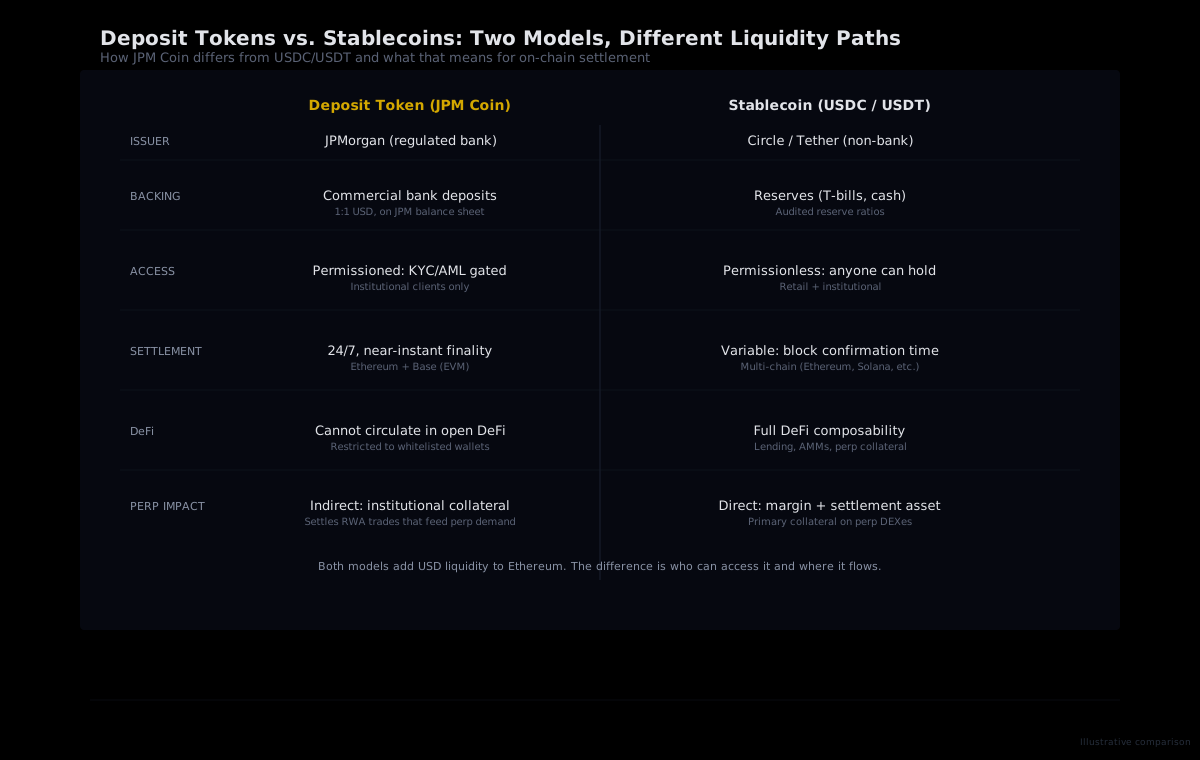
JPM Coin is a tokenized claim on commercial bank deposits held at JPMorgan, pegged 1:1 to the US dollar. Unlike stablecoins issued by non-bank entities (Circle's USDC, Tether's USDT), JPM Coin represents actual bank deposits on JPMorgan's balance sheet. The distinction matters: JPM Coin is commercial bank money backed by JPMorgan's balance sheet.
The token first went live on Base (Coinbase's Ethereum L2) in November 2025 after a pilot phase that began in June 2025. Today's expansion brings it to Ethereum mainnet, giving approved institutional clients peer-to-peer transfer capability across the full EVM ecosystem.
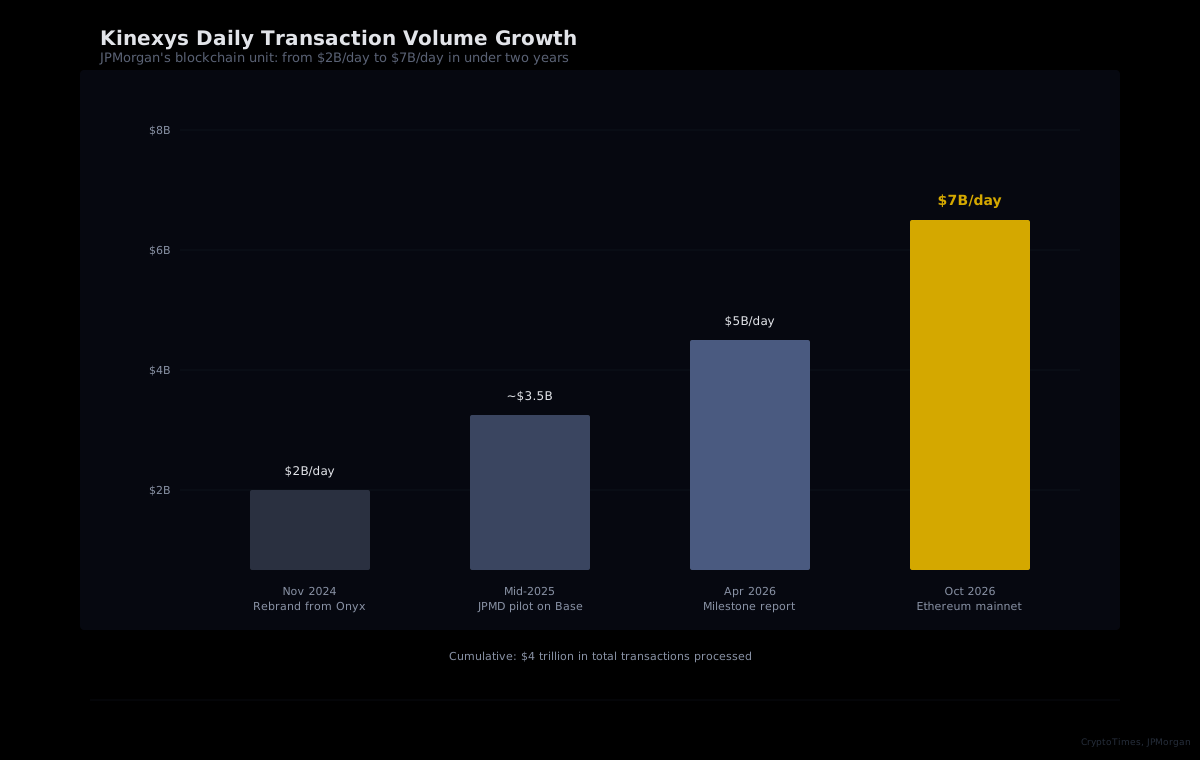
Kinexys (rebranded from JPMorgan's Onyx unit in November 2024) has grown from $2 billion per day to $7 billion per day in under two years. That 3.5x growth rate tells you something about institutional demand for blockchain-based settlement. The bank also launched two tokenized money-market funds on Ethereum: the first in December 2025, the second (JLTXX) in May 2026.
Deposit tokens are not stablecoins (and the difference matters)
The crypto ecosystem already has over $100 billion in stablecoins circulating across public chains. So why should anyone care about a bank deposit token that cannot even be used in Aave or Uniswap?
Because they solve different problems. Stablecoins are permissionless digital cash. Anyone can hold USDC, use it as margin on a perp DEX, deposit it into a lending pool, or swap it on an AMM. That openness is their strength. Deposit tokens are permissioned institutional money. JPM Coin can only move between whitelisted wallets that have passed JPMorgan's compliance checks.
The difference shapes their liquidity paths. Stablecoins flow directly into DeFi. Deposit tokens flow into institutional settlement rails, tokenized asset markets, and collateralization layers that sit adjacent to DeFi. Both add USD-denominated value to Ethereum, but through different doors.
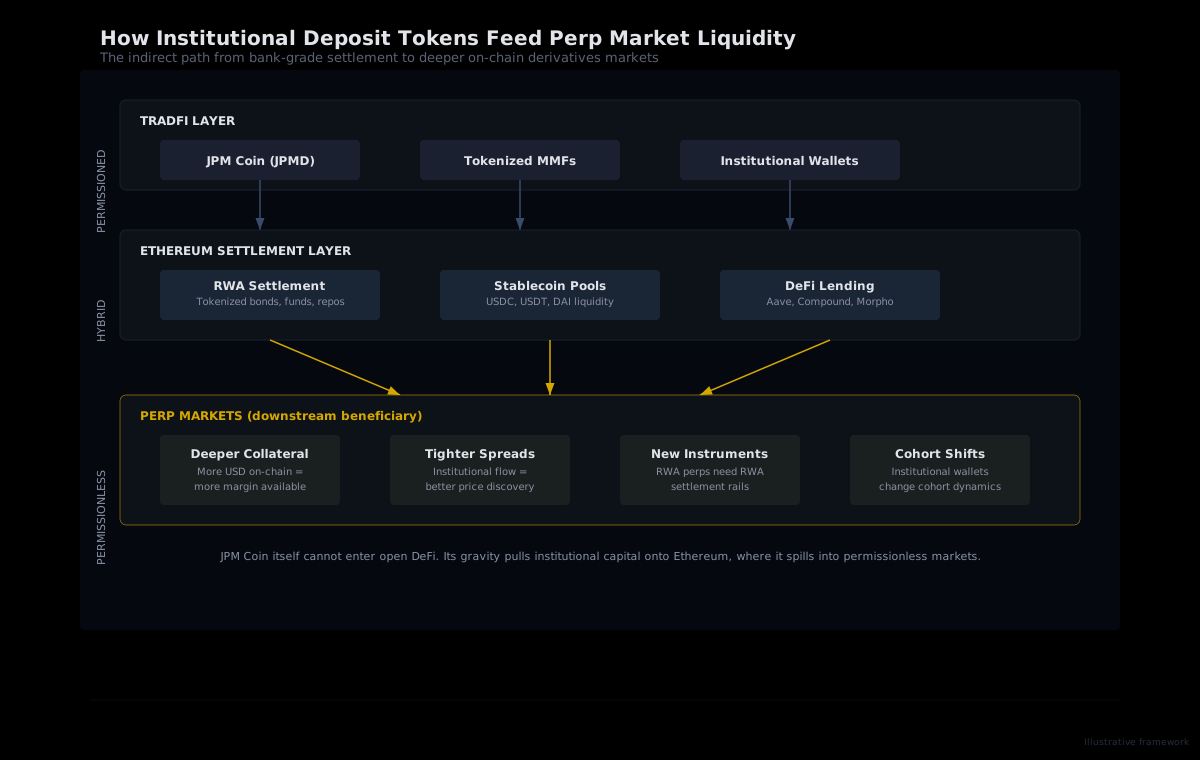
For perp traders, the interesting part is the second-order effect. Institutions settling RWA trades through deposit tokens (bonds, repos, fund shares) create demand for the Ethereum settlement layer. That demand pulls more institutional capital onto the chain, which eventually spills into the broader liquidity pool that perp markets draw from. The connection is indirect but real: more institutional settlement activity on Ethereum means a deeper base layer of capital that perp markets can tap.
The institutional liquidity pipeline into perps
Think about the flow of capital. JPMorgan's institutional clients use JPM Coin to settle trades in tokenized assets on Ethereum. Those clients now have on-chain infrastructure. They have wallets, they understand EVM settlement, and they have compliance-approved pathways for moving money on public blockchains. Once that infrastructure exists, the friction for those same institutions to participate in other on-chain markets drops significantly.
This is already visible in the RWA ecosystem. Ethereum hosts more than 3,000 tokenized asset projects and roughly $16.9 billion in RWA value. Hyperliquid has supported RWA-linked perps (HIP-3 assets like equities and commodities) since launch. As the pool of institutions comfortable with on-chain settlement grows, the natural next step is for some portion of that capital to flow into on-chain derivatives for hedging, speculation, or yield strategies.
The path looks like this: institutional deposit token settlement feeds Ethereum's base layer liquidity. That liquidity supports stablecoin pools, lending markets, and DeFi collateral layers. Those layers, in turn, feed the margin and settlement infrastructure that on-chain perp exchanges rely on. JPM Coin does not plug directly into a perp DEX. It plugs into the ecosystem that makes perp DEXes viable at scale.
What perp traders should actually watch
JPM Coin's launch is a signal worth tracking. You cannot buy or sell it, and its direct impact on today's perp market is zero. But it sits within a pattern that affects the liquidity environment you trade in.
Ethereum TVL and stablecoin inflows
Ethereum currently hosts roughly $50 billion in DeFi TVL. Institutional settlement activity adds gravitational pull. Watch for spikes in stablecoin minting and DeFi TVL that correlate with tokenized asset settlement milestones. More stablecoins on Ethereum means more potential margin for perp markets.
RWA perp demand
Hyperliquid already lists equity and commodity perps through HIP-3. As more institutions tokenize assets on Ethereum and settle through deposit tokens, demand for hedging instruments on those same assets grows. RWA perps could see volume increases that trace back to the same institutional adoption cycle JPM Coin represents.
Cohort composition shifts
Institutional capital entering on-chain markets changes the composition of traders. When larger, compliance-conscious wallets start showing up in perp markets, their behavior patterns differ from retail traders. They tend to size positions more conservatively, use lower leverage, and hold positions longer. Our data on Hyperliquid's 16 behavioral cohorts (eight by account size, eight by all-time PnL) can surface these shifts as they happen. A growing share of Whale ($500K-$1M), Tidal Whale ($1M-$5M), or Leviathan ($5M+) wallets in the positioning data could signal that institutional-grade capital is finding its way into on-chain derivatives.
Multi-bank tokenized deposit networks
JPMorgan is not alone. Reports indicate that JPMorgan, Citi, Bank of America, Wells Fargo, and over a dozen other banks are planning a shared network for tokenized deposits. If that materializes, the institutional liquidity thesis for Ethereum becomes much larger than any single bank's deposit token. A multi-bank settlement network on public blockchains could accelerate the capital pipeline into on-chain derivatives by an order of magnitude.
The bigger picture: TradFi rails meeting DeFi liquidity
The crypto industry has spent years talking about institutional adoption. Most of that talk focused on ETFs, custody solutions, and regulated exchanges. Deposit tokens represent something different: institutions building native blockchain infrastructure for their core business operations (payments, settlement, collateral management) on the same chains where DeFi protocols operate.
Emma Landriault, global head of Kinexys Labs, framed it directly: crypto firms could use JPMD for blockchain payments, while financial institutions could use it to settle trades and post collateral. That collateral function is the bridge. When institutional collateral settles on Ethereum, the chain's total economic weight increases, which benefits every protocol and market that depends on deep, liquid settlement infrastructure.
For on-chain perp markets, the implications unfold over quarters, not days. But the direction is clear. Hyperliquid already processes billions in daily perp volume on its own chain. As the Ethereum settlement layer gains institutional mass, the capital base that feeds into on-chain derivatives deepens. That means tighter spreads, more margin available, and a broader range of instruments that can sustain liquid markets.
Watch institutional capital move through Hyperliquid's cohorts
HyperTracker classifies every wallet on Hyperliquid into 16 behavioral cohorts by account size and all-time PnL. As institutional liquidity flows into on-chain perp markets, you can track the shift in wallet composition, cohort positioning, and smart money behavior through one API.
The trade is patience
JPM Coin is not going to show up in your funding rate calculations tomorrow. It is not going to change your stop placement or your leverage this week. What it does is validate the thesis that public blockchains are becoming the settlement layer for institutional finance, and that shift has real consequences for the depth and structure of on-chain derivatives markets over time.
The bank that called Bitcoin a fraud is now settling dollar deposits on Bitcoin's neighbor chain. If that is not a liquidity signal, nothing is.