
Prediction Markets on Hyperliquid: What Builders Should Ship First
By CMM Team - 16-Oct-2026
Prediction Markets on Hyperliquid: What Builders Should Ship First
Prediction markets just had the biggest year in crypto history, and most of that volume ran through two platforms. Kalshi and Polymarket combined for nearly $24 billion in monthly volume by April 2026, driven by sports betting and macro events. Then Hyperliquid launched HIP-4 on May 2, and the game changed for builders.
HIP-4 turns prediction markets into composable on-chain infrastructure. Binary outcome contracts that settle to 0 or 1 in USDC, sharing the same order book, the same margin engine, and the same data endpoints as Hyperliquid's perpetual futures. On its first day, the product logged 6.05 million contracts in notional volume. Small next to Kalshi's roughly 546 million contracts that same day, but enough to prove traders would use event contracts inside a perp-native environment.
Five months later, permissionless deployment is live. Builders are deploying markets from validator-approved templates. The question is no longer whether prediction markets work on Hyperliquid. It is what to build on top of them. Here are five products that make sense right now, and how HyperTracker's cohort data fits into each one.
HIP-4 in 60 seconds
HIP-4 adds outcome contracts to HyperCore, Hyperliquid's on-chain central limit order book. Each outcome is a binary contract priced between 0.001 and 0.999, representing the implied probability of an event. If the event happens, the contract settles at 1. If it does not, it settles at 0. Settlement is in USDC, and contracts are fully collateralized with no leverage and no liquidation risk.
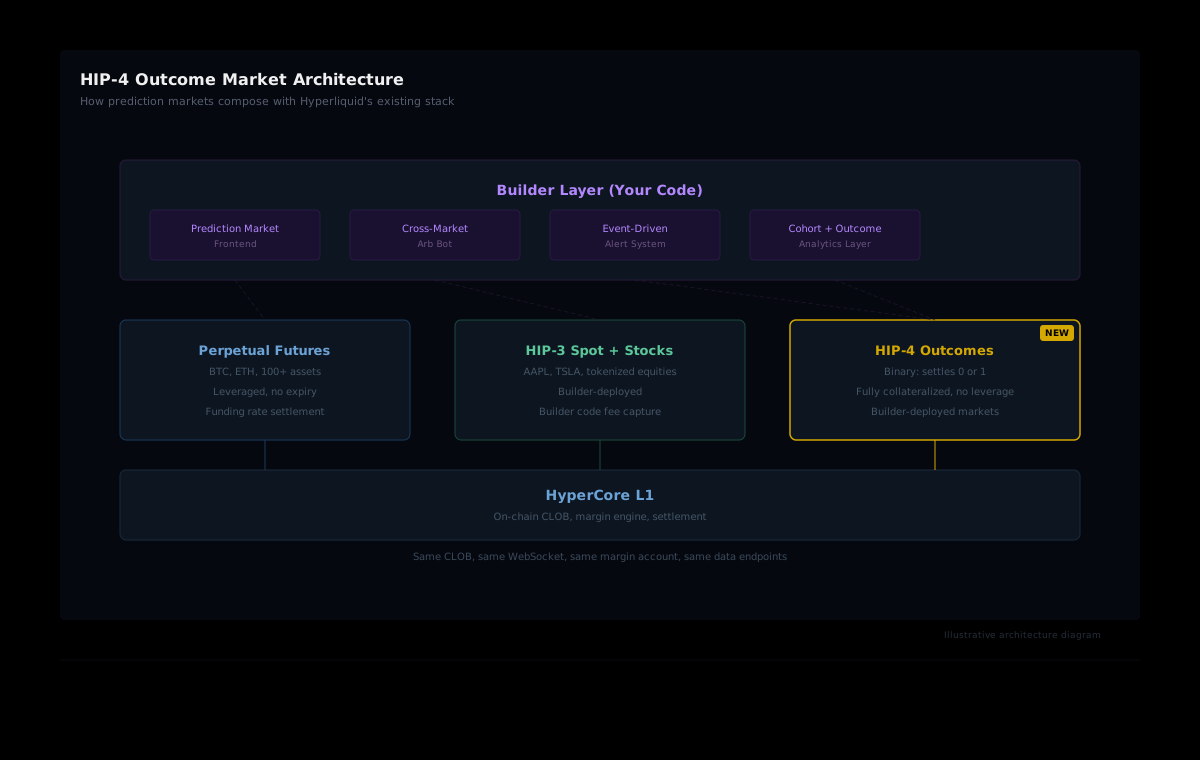
The key architectural decision: HIP-4 outcomes live alongside perpetual futures and HIP-3 spot assets on the same infrastructure. Same WebSocket streams, same margin account, same builder code system. That composability is the builder opportunity. On Polymarket, prediction markets are a standalone product. On Hyperliquid, they are a primitive you can combine with perps, spot, and portfolio margin.
The prediction market landscape builders are entering
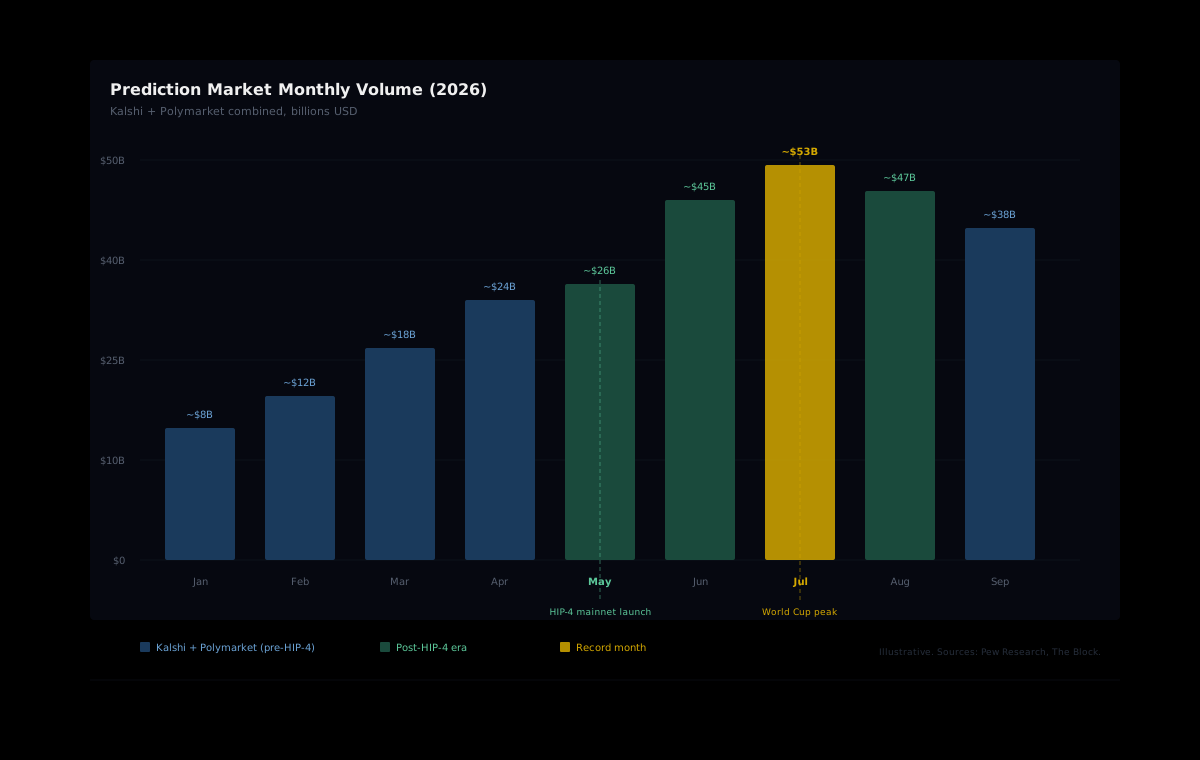
The broader prediction market industry hit unprecedented scale in 2026. Monthly combined volume on Kalshi and Polymarket rose from under $5 billion in mid-2025 to nearly $24 billion by April 2026. The 2026 FIFA World Cup accelerated things further: combined monthly volume more than doubled from roughly $25.7 billion in May to approximately $53 billion in July, according to Pew Research Center analysis of data from The Block.
Kalshi emerged as the volume leader, posting roughly $5.42 billion in taker volume in April 2026 alone, surpassing Polymarket's $1.99 billion for the first time. Sports betting dominated: it accounted for the majority of Kalshi's volume, especially during the World Cup months.
Hyperliquid's entry is different from both incumbents. Polymarket is a standalone prediction market platform on Polygon. Kalshi is a regulated US exchange. Hyperliquid is a perp-native L1 that bolted on prediction markets as a composable primitive. That distinction shapes the builder opportunity: you are building on infrastructure where traders already have margin, positions, and liquidity, rather than asking them to onboard to a new platform.
From curated markets to permissionless deployment
HIP-4 launched in two phases. The first was a curated release on May 2 with official markets, primarily recurring daily Bitcoin price binaries. The first available market asked whether BTC would exceed a specific price by a target date, and it attracted over 6.05 million contracts and thousands of unique traders on day one.
The second phase arrived on August 29, 2026, when permissionless deployment went live. Outcome.xyz became the first permissionless HIP-4 builder, staking 500,000 HYPE (worth approximately $42 million at the time) as collateral and launching 28 prediction markets that generated $1.16 million in cumulative volume within two days.
The staking requirement is steep: 500,000 HYPE with a six-month lock. That stake can be slashed through validator votes if markets are poorly defined or incorrectly settled. But it also means every builder who deploys has meaningful skin in the game, which filters out low-quality market spam. Teams like Skew and trade.xyz have signaled interest in the ecosystem, and the SDK tooling is maturing: the @perps/hip4 TypeScript SDK provides typed modules for events, market data, trading, and auth with zero runtime dependencies.
Five products worth building right now
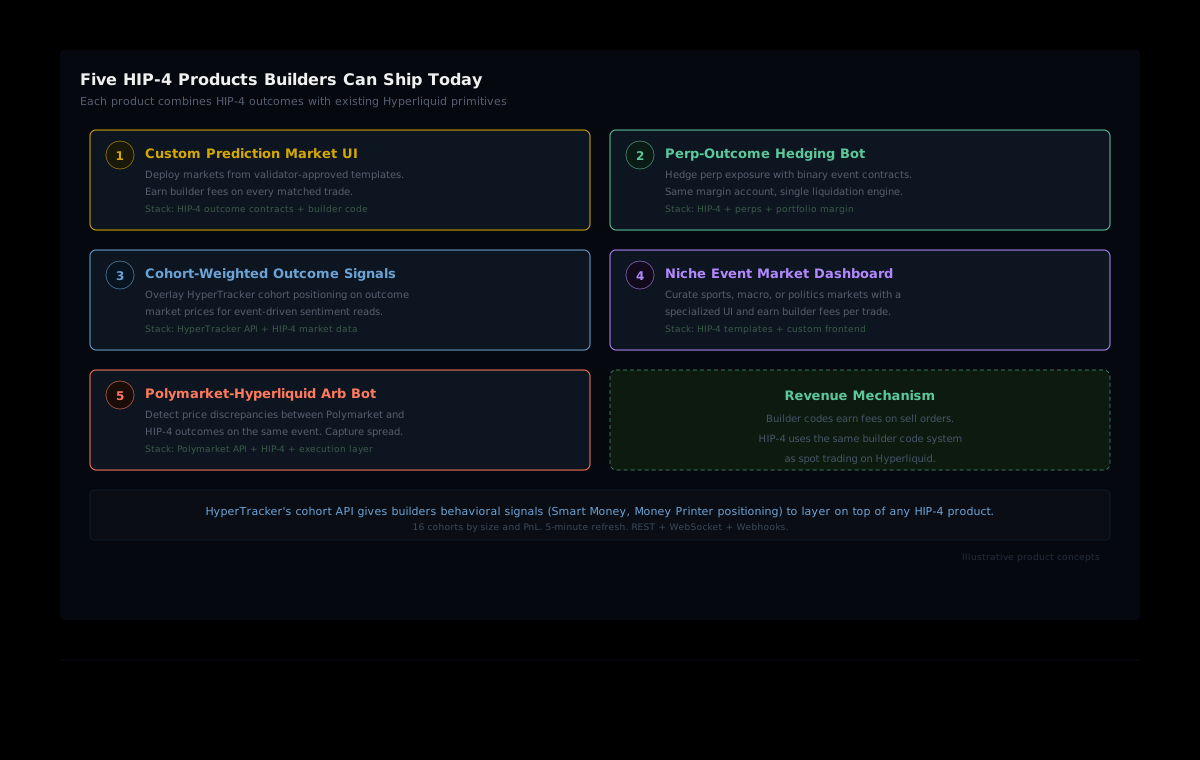
The composability between HIP-4 outcomes, perpetual futures, and HyperTracker's cohort analytics creates product opportunities that do not exist on standalone prediction platforms. Here are five that make sense today.
1. Niche event market frontend
The most straightforward builder play: deploy outcome markets from validator-approved templates and build a specialized frontend around a specific vertical. Sports, macro economics, crypto governance, AI milestones. The builder code system means you earn fees on every matched sell order, the same revenue mechanism that exists for HIP-3 spot markets. The first 28 markets from Outcome.xyz covered crypto price touches, Fed policy outcomes, and index milestones. Plenty of verticals remain untouched.
2. Perp-outcome hedging engine
Because HIP-4 outcomes share the same margin account as perps, builders can create hedging products that pair leveraged perp positions with binary event contracts. Imagine a tool that automatically opens a "BTC below $80K by Friday" outcome position as a hedge whenever a user's long BTC perp position exceeds a certain notional size. The portfolio margin system already understands both position types. The builder just needs to wire the logic.
3. Cohort-weighted outcome signals
This is where HyperTracker's data becomes directly useful. Our API classifies every wallet on Hyperliquid into 16 behavioral cohorts, eight by account size (from Shrimp under $250 to Leviathan at $5M+) and eight by all-time PnL (from Giga-Rekt below negative $1M to Money Printer above $1M). When a major event is approaching, like a Fed rate decision or an ETF approval deadline, the positioning of Smart Money and Money Printer cohorts on outcome markets tells you something about informed conviction.
A builder could create a dashboard that overlays cohort positioning data from HyperTracker's API onto HIP-4 outcome market prices. When Money Printers are buying "Yes" on a rate cut outcome while lower-PnL cohorts are selling, that divergence is a signal worth surfacing. Our cohort metrics refresh every 5 minutes, fast enough to track positioning shifts as events unfold.
4. Cross-market arbitrage bot
The same event often has contracts on Polymarket, Kalshi, and now HIP-4. Price discrepancies between platforms create arbitrage opportunities. A builder could run a bot that monitors the same question across platforms and captures the spread when prices diverge beyond a threshold. The Unchained report noted that approximately 3.3% of Polymarket users already trade on Hyperliquid, generating roughly 12% of Polymarket's volume. That overlap means cross-platform liquidity already exists.
5. Structured prediction products
HIP-4 supports multi-outcome questions where exactly one outcome settles to "Yes." Builders can combine multiple related outcomes into structured products: tournament brackets, cascading event trees, or conditional prediction chains. The World Cup produced dozens of match and champion markets. A builder could package these into a structured product that represents a full tournament thesis, hedged with perp positions on related assets.
Why cohort data matters for prediction markets
Prediction markets are probability markets. The price of a "Yes" contract on "BTC above $90K by December" is the market's implied probability of that event occurring. But whose probability? On Polymarket, you see a single price and have no idea whether it reflects informed traders or recreational bettors.
HyperTracker's cohort classification changes that equation. Because every Hyperliquid wallet is categorized by both account size and all-time trading performance, builders can decompose a market price into weighted components. If a "Yes" contract is trading at 0.65 and Money Printer wallets (with over $1M in cumulative profits) are net long while Exit Liquidity wallets (with $0 to negative $10K in lifetime PnL) are net short, the implied probability for informed traders is higher than the headline price suggests.
This kind of decomposition is not possible on Polymarket or Kalshi. It requires wallet-level behavioral classification, which is exactly what HyperTracker provides. The /cohort-metrics endpoint returns net positioning by cohort for any asset on Hyperliquid, and since HIP-4 outcomes share the same data infrastructure, cohort positioning data is available for outcome markets too.
Build prediction market intelligence with HyperTracker
Our API gives you 16 behavioral cohorts, real-time positioning data, and the order flow analytics to build informed prediction market products on Hyperliquid. Start with the free tier and upgrade to Pulse ($179/mo) for 50K requests and 5-minute cohort refresh.
The builder economics
Deploying HIP-4 markets requires a 500,000 HYPE stake. That is a serious capital commitment, but it buys something valuable: the right to deploy markets from validator-approved templates without individual governance votes. Each market you deploy earns builder fees on matched trades, and the staking mechanism ensures market quality because your collateral is at risk if you deploy garbage.
For builders who cannot meet the staking requirement, the analytics layer is still wide open. You do not need to deploy markets to build products on top of them. Outcome market data flows through the same WebSocket streams and REST endpoints as perp data. A cohort-weighted prediction signal dashboard, a cross-market arb bot, or an event-driven alert system all consume HIP-4 data without requiring a builder stake. They just need the data infrastructure, which is where HyperTracker's API fills the gap between raw market data and actionable intelligence.
The fee structure also favors builders at this stage. Opening positions costs nothing. Fees on closing are roughly half the spot rate, and maker rebates do not apply to outcomes. That low-friction environment is intentional: Hyperliquid is subsidizing early liquidity to bootstrap the ecosystem, the same playbook that made HIP-3 tokenized equities viable.
The bottom line
Prediction markets crossed $53 billion in monthly volume in July 2026. Hyperliquid is the only platform where those markets compose with perpetual futures, tokenized equities, and behavioral cohort intelligence in one margin account. HIP-4 is live, permissionless deployment is live, and the SDK tooling is ready.
The builders who move first will capture the same structural advantage that early perp market builders captured on Hyperliquid in 2025. The infrastructure is there. The question is who ships first.