The Prediction Market Edge Kalshi Can't Match (And How to Build It)
By CMM Team - 17-Oct-2026
The Prediction Market Edge Kalshi Can't Match (And How to Build It)
Prediction markets hit a record $188 billion in volume during Q3 2026, nearly 70% above the previous quarter. Kalshi drove most of that growth. But every dollar traded on Kalshi is a blind bet: you can see the order book for the outcome contract, and that's it. You can't see what whales are doing on the underlying asset. You can't see whether smart money is aggressively long BTC when a "BTC above $100K by Friday" contract trades at $0.40.
On Hyperliquid, you can. Because HIP-4 outcome markets share a matching engine with perpetual futures, you can query cohort positioning on the underlying perp and overlay that intelligence onto your outcome trades. That's the edge this article teaches you to build: a Python bot that reads smart money signals from HyperTracker's cohort API and uses them to find mispriced prediction markets on Hyperliquid.
Why Prediction Markets Need an Intelligence Layer
On Kalshi, a "BTC above $80K" contract is a standalone instrument. The price reflects what other prediction market traders think, informed by whatever research each individual brings. Some watch charts. Some read headlines. Most are guessing.
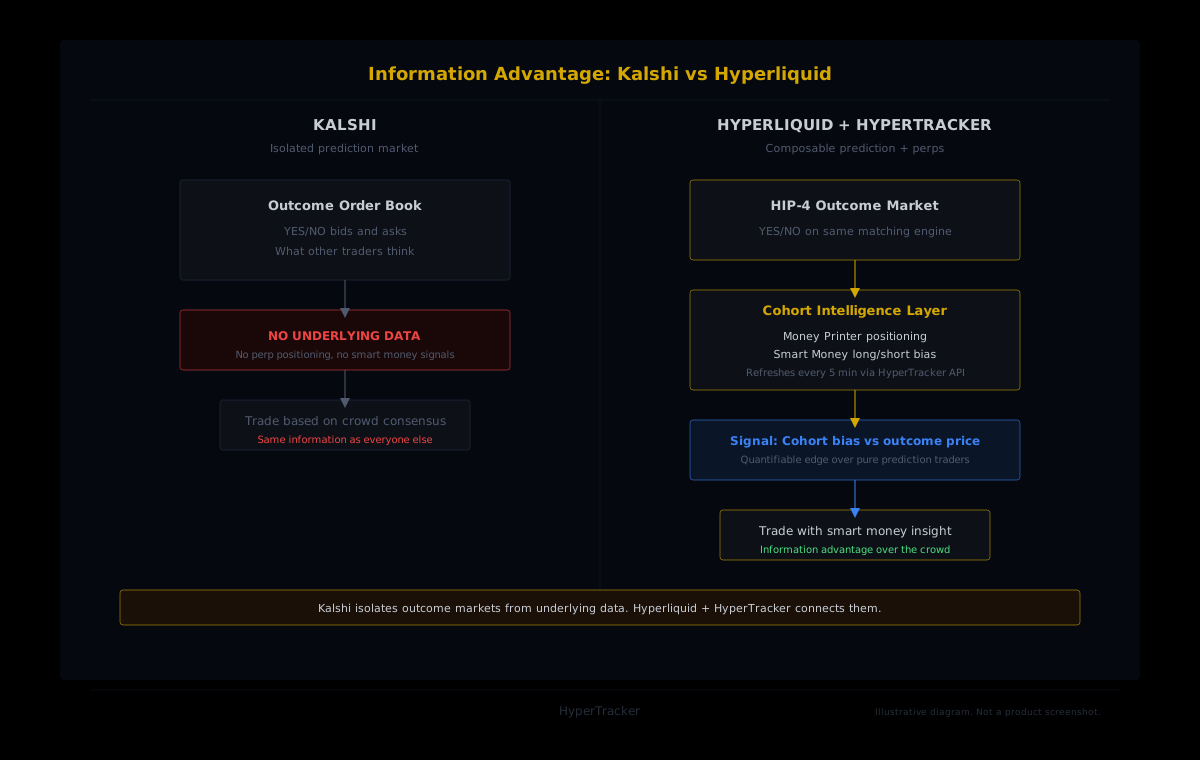
On Hyperliquid, that same bet lives on the same chain as the BTC-USDC perpetual, which means you can directly observe what every size and performance cohort is doing on the underlying asset before you place your outcome trade. If Money Printers (wallets with over $1M in all-time profit) are building aggressive long positions on BTC perps while a "BTC above $85K" YES token trades at $0.35, that's a quantifiable signal that the market is underpricing the outcome.
This asymmetry exists because Hyperliquid is the only major prediction market platform where outcome contracts and perpetual futures share a single matching engine and settlement layer. Kalshi, Polymarket, and Drift BET all run outcome markets in isolation. HIP-4 launched on Hyperliquid mainnet on May 2, 2026, and since August 29, 2026, builders staking 500,000 HYPE can deploy markets from validator-approved templates, making it permissionless infrastructure rather than a curated product.
The Kalshi Regulatory Problem, and Why It Matters for Builders
Kalshi's dominance comes with a regulatory asterisk. In September 2026, the 6th US Circuit Court of Appeals in Cincinnati ruled that states can regulate prediction markets, rejecting Kalshi's attempt to exempt event contracts from state gambling laws. Washington, Michigan, Nevada, and Massachusetts have already blocked Kalshi from operating. The 9th Circuit sided with state regulators too, while the 3rd Circuit went the other way, creating a circuit split that could land at the Supreme Court.
For builders, this regulatory patchwork means Kalshi's API could lose access to markets overnight in any given state. On-chain prediction markets face no such jurisdiction-by-jurisdiction risk. If you're building a prediction market bot, building on infrastructure that can't be geo-fenced by a state attorney general is a structural advantage.
Hyperliquid's HIP-4 has its own growing pains. It recorded $317 million in cumulative volume over its first five months, with $51 million in September. That's a fraction of Kalshi's weekly $19 billion. But the volume gap is also the opportunity: thinner markets mean wider spreads, and wider spreads mean more profit per trade for a bot that has better information than the crowd.
Architecture of a Cohort-Informed Prediction Bot
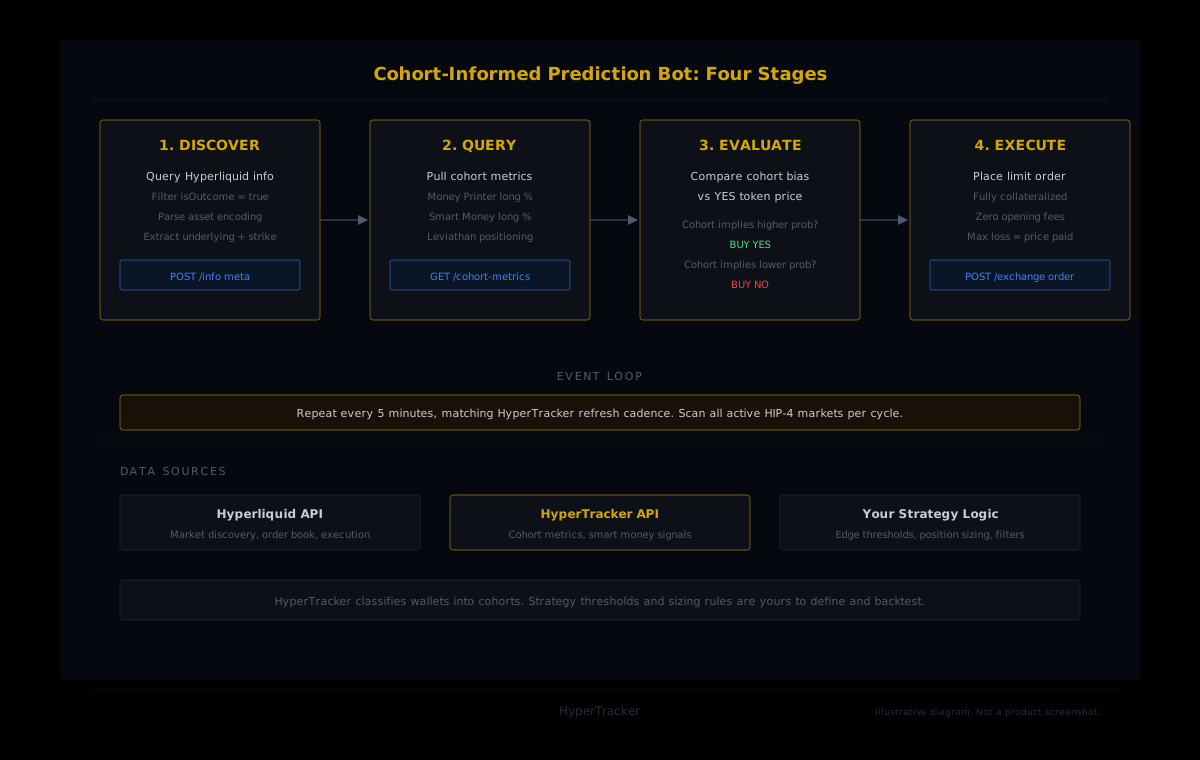
The bot has four components. First, it discovers active HIP-4 markets by querying Hyperliquid's info endpoint for outcome assets. Second, it pulls cohort positioning data from HyperTracker's API for the underlying asset (usually BTC or ETH). Third, it evaluates whether the YES/NO token price is misaligned with cohort sentiment. Fourth, it places an order when the signal crosses a threshold you define.
Here's the discovery step. Every HIP-4 asset follows a naming convention that encodes the underlying asset, the strike price, and the expiry date:
import requests, json

# Discover active HIP-4 outcome markets
info = requests.post("https://api.hyperliquid.xyz/info",
    json={"type": "meta"}).json()

outcome_markets = [
    asset for asset in info["universe"]
    if asset.get("isOutcome", False)
]

for m in outcome_markets[:5]:
    print(f"{m['name']}  szDecimals={m['szDecimals']}")
The naming convention uses a format like BTC-80000-30OCT26, which means "Will BTC exceed $80,000 by October 30, 2026?" Each market has both YES and NO tokens, and the order book is merged: a YES buy at price p is a NO sell at 1-p.
Pulling Cohort Signals from HyperTracker
Once you've identified a BTC outcome market, the next step is querying HyperTracker's cohort metrics endpoint to see what each trader segment is doing on BTC perps. Our data classifies every wallet on Hyperliquid into one of 16 behavioral cohorts: eight by account size (from Shrimp at $0-$250 to Leviathan at $5M+) and eight by all-time PnL (from Money Printer at +$1M to Giga-Rekt at below -$1M).
import os

HT_TOKEN = os.environ["HYPERTRACKER_API_KEY"]
HT_BASE  = "https://ht-api.coinmarketman.com/api/external"

def get_cohort_bias(coin: str) -> dict:
    """Fetch cohort positioning for a coin's perp market."""
    resp = requests.get(
        f"{HT_BASE}/cohort-metrics",
        headers={"Authorization": f"Bearer {HT_TOKEN}"},
        params={"coin": coin}
    )
    resp.raise_for_status()
    return resp.json()

btc_cohorts = get_cohort_bias("BTC")

# Focus on high-signal cohorts
for cohort in btc_cohorts.get("data", []):
    name = cohort["cohortName"]
    if name in ["Money Printer", "Smart Money", "Leviathan", "Tidal Whale"]:
        print(f"{name}: bias={cohort.get('bias')}, "
              f"longPct={cohort.get('longPercent')}")
The cohorts that carry the most signal for prediction market trades are the PnL-based winners: Money Printer (wallets with over $1M cumulative profit) and Smart Money ($100K-$1M). When these cohorts shift to aggressive long or short positioning on the underlying, they're expressing a directional view backed by a track record of being right. Our data refreshes every 5 minutes, which means you're seeing positioning shifts well before they show up in price.
Why PnL cohorts matter more than size cohorts for prediction markets. A Leviathan ($5M+ account) could be a market maker who is delta-neutral. A Money Printer ($1M+ lifetime profit) has a proven track record of directional calls. For binary outcome trades, the PnL cohorts give you a cleaner signal because they filter for wallets that have historically been right about direction.
The Signal: When Cohort Bias Disagrees with Outcome Price
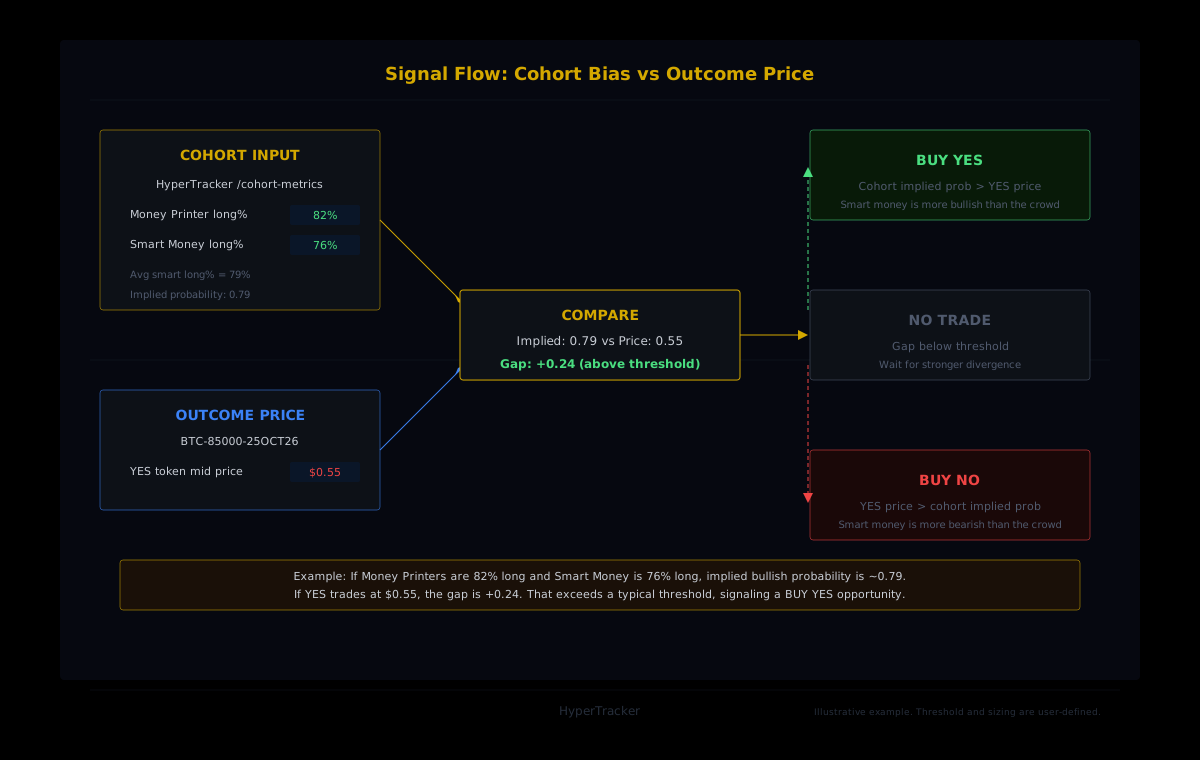
The core logic is straightforward. If smart money cohorts are strongly long on BTC perps and the YES token on a "BTC above $X" market trades below what the cohort data implies, the outcome market is underpricing the event. You buy YES. If smart money is aggressively short and YES trades above implied fair value, you buy NO.
def evaluate_signal(cohort_data: dict, yes_price: float) -> str:
    """
    Compare cohort positioning against outcome market price.
    Returns 'buy_yes', 'buy_no', or 'no_trade'.
    """
    # Extract Money Printer + Smart Money long percentages
    smart_cohorts = [c for c in cohort_data.get("data", [])
                     if c["cohortName"] in ["Money Printer", "Smart Money"]]

    if not smart_cohorts:
        return "no_trade"

    avg_long_pct = sum(
        c.get("longPercent", 50) for c in smart_cohorts
    ) / len(smart_cohorts)

    # Convert long percentage to implied probability
    # 80% long across smart cohorts ≈ 0.80 implied bullish probability
    implied_prob = avg_long_pct / 100

    # Define your edge threshold (illustrative, tune via backtesting)
    EDGE_THRESHOLD = 0.15  # example only

    if implied_prob - yes_price > EDGE_THRESHOLD:
        return "buy_yes"
    elif yes_price - implied_prob > EDGE_THRESHOLD:
        return "buy_no"
    else:
        return "no_trade"
A few things to keep in mind. The EDGE_THRESHOLD value above is illustrative. In practice you would backtest different thresholds against historical cohort data and outcome market settlements to find the level that produces positive expected value for your specific strategy. HyperTracker offers roughly 4 weeks of coin-level cohort history and about 6.5 months of fills data, so there's enough depth to validate a hypothesis before risking capital.
Placing Orders on HIP-4 Markets
Once the signal fires, placing an order on a HIP-4 market uses the same exchange API as placing a perp trade. The key difference is that outcome assets are fully collateralized (no margin, no liquidation) and fees are currently zero for outcome markets.
from eth_account import Account
import eth_abi

# Order placement (simplified, production code needs nonce management)
wallet = Account.from_key(os.environ["PRIVATE_KEY"])

def place_outcome_order(asset_name: str, is_buy: bool,
                        price: float, size: float):
    """Place a limit order on a HIP-4 outcome market."""
    order = {
        "a": asset_name,       # e.g. "BTC-80000-30OCT26"
        "b": is_buy,           # True for YES buy, False for NO buy
        "p": str(price),       # Price in USDC (0.01 to 0.99)
        "s": str(size),        # Number of contracts
        "r": False,            # reduce_only
        "t": {"limit": {"tif": "Gtc"}}
    }

    # Sign and send via Hyperliquid's exchange endpoint
    action = {"type": "order", "orders": [order], "grouping": "na"}
    # ... signing logic omitted for brevity
    resp = requests.post("https://api.hyperliquid.xyz/exchange",
        json={"action": action, "signature": sig, "nonce": nonce})
    return resp.json()
Since HIP-4 positions are fully collateralized, risk management looks different from perp trading. Your maximum loss on any outcome trade is the price you paid for the contract. If you buy YES at $0.35, you risk $0.35 per contract to make $0.65 if the event occurs. There's no margin call and no liquidation engine to worry about. This makes prediction market bots simpler to manage from a risk perspective, though you still need to track capital allocation across multiple concurrent markets.
Tying It All Together: The Event Loop
A production bot runs this logic on a schedule. Every five minutes (matching HyperTracker's refresh cadence), it scans active outcome markets, pulls fresh cohort data for each underlying asset, evaluates signals, and places or cancels orders. Here's the skeleton:
import time

def run_bot():
    while True:
        # 1. Discover active outcome markets
        markets = discover_outcome_markets()

        for market in markets:
            underlying = market["name"].split("-")[0]  # "BTC"

            # 2. Pull cohort positioning
            cohort_data = get_cohort_bias(underlying)

            # 3. Get current YES price from the order book
            yes_price = get_mid_price(market["name"])

            # 4. Evaluate signal
            signal = evaluate_signal(cohort_data, yes_price)

            if signal == "buy_yes":
                place_outcome_order(market["name"],
                    is_buy=True, price=yes_price + 0.01,
                    size=calculate_position_size())
            elif signal == "buy_no":
                place_outcome_order(market["name"],
                    is_buy=False,
                    price=(1 - yes_price) + 0.01,
                    size=calculate_position_size())

        # 5. Wait for next refresh cycle
        time.sleep(300)  # 5 minutes

if __name__ == "__main__":
    run_bot()
The calculate_position_size() function is where you implement your own risk parameters. Because outcome contracts have bounded payoffs ($0 to $1), position sizing is more about capital allocation across markets than leverage management. You might allocate a fixed fraction of your bankroll per market or scale size by the magnitude of the cohort-implied edge.
Builder tip: HyperTracker's webhook delivery (available on Flow and Stream tiers) can push cohort positioning updates directly to your bot instead of polling on a schedule. This eliminates the 5-minute loop and lets you react to cohort shifts as they happen.
What This Looks Like at Scale
A single-market demo is useful for understanding the mechanics, but the real power of this approach comes from running it across every active HIP-4 outcome market simultaneously. As of mid-October 2026, HIP-4 had 228 active markets across crypto, sports, and macro categories. Crypto markets (BTC and ETH outcomes) are the natural starting point because cohort data maps directly to the underlying perp. But as HIP-4 expands into more exotic categories, the same pattern applies anywhere the underlying has a corresponding perp on Hyperliquid.
The structural advantage compounds over time. Kalshi and Polymarket both trade enormous volume, with Kalshi processing $19 billion in a single recent week and Polymarket running $3.7 billion. But neither platform gives you programmatic access to what the best-performing wallets are doing on the underlying asset. That intelligence gap is what makes the cohort overlay strategy viable, and it's a gap that exists by design because Kalshi and Polymarket don't share infrastructure with a perpetual futures exchange.
Build Your Prediction Market Edge
HyperTracker's API gives you 16 behavioral cohorts, order flow signals, and liquidation risk scores for every asset on Hyperliquid. Free tier gets you 100 requests/day to start prototyping.
The Bottom Line
Prediction markets are booming, with Q3 2026 volume hitting $188 billion across all platforms. Kalshi owns most of that pie. But owning volume and owning the information advantage are two different things. Every trader on Kalshi stares at the same order book with the same information set. On Hyperliquid, you can see what Money Printers, Leviathans, and Smart Money wallets are doing on the underlying perp, and you can programmatically convert that intelligence into outcome trades.
The code in this article is a starting point. The real work is backtesting your thresholds, tuning your position sizing, and deciding which cohort signals carry the most weight for different market types. Our data gives you the raw intelligence. The strategy is yours to build.