Long/Short Ratio: What It Actually Tells You (And What It Doesn't)
By CMM Team - 25-Apr-2026
Long/Short Ratio: What It Actually Tells You (And What It Doesn't)
Open Coinglass on any random day, scroll to the long/short ratio panel for BTC perps, and you will see a number hovering somewhere around 1.0. Sometimes 1.07. Sometimes 0.94. The chart looks busy, the colors are bright, and traders quote it constantly: "L/S ratio is at 1.12, retail is over-leveraged long, time to short." A few hours later the ratio is back to 1.03 and the trade idea has evaporated. If you have ever felt that the L/S ratio "doesn't really work as a signal," there is a reason. The aggregate version of it is structurally rigged to mean-revert, and the people who actually use L/S as an edge are not looking at a single number.
This piece walks through why the aggregate long/short ratio you see on most dashboards is a weak signal, what the mechanics force it to do, and what does work instead. The short version: cohort-level L/S, where you split the same data by wallet tier, is where the real information lives. By the end of this you should have a clear rule for when to ignore an L/S reading, when to take one seriously, and how to use it as either a confirming or contrarian indicator.
The short version: aggregate L/S sits near 1.0 by construction. Cohort L/S, where you compare Whale-tier wallets against Fish-tier wallets on the same coin, is where the signal lives. A 70/30 split between the smart end and the retail end of the distribution is actionable. A 1.05 reading on the exchange-wide chart is not.
The problem with the L/S ratio you've been watching
The standard long/short ratio chart on most crypto dashboards is built one way: take every long position open on the exchange in a given perp, divide by every short position open on the same perp, and plot the result. It is simple and intuitive, and that is the whole problem. By treating the entire market as one bucket, you lose the only thing that would make the number useful, which is who is positioned where.
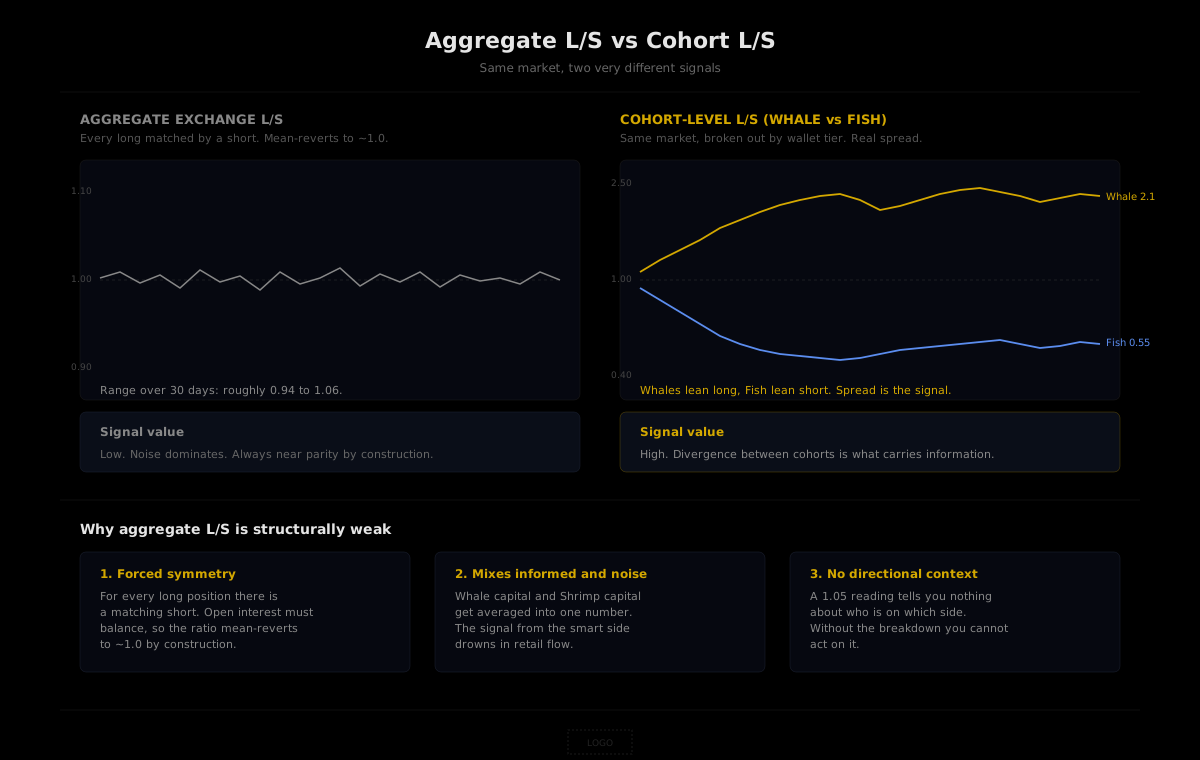
Look at the actual range over a typical 30-day window for BTC perps. The aggregate L/S ratio rarely strays outside roughly 0.94 to 1.06. That is a 12-point band, most of which is probably noise from sampling intervals and reporting differences across venues. When the ratio briefly touches 1.10, it almost always returns to the band within hours. There are mechanical reasons for that, and we should walk through them, because once you see the mechanics you stop treating mean reversion as a signal and start treating it as gravity.
Why aggregate L/S mean-reverts
Perpetual futures are a closed system. Every long position on a perp contract has an exact short on the other side, because contracts are created in pairs at the moment of fill. Open interest measures notional outstanding, and notional long always equals notional short. That is not a market quirk, it is bookkeeping. So if your "long/short ratio" is really notional long divided by notional short, the answer is mathematically 1.0 every second of every day.
What dashboards actually plot is something narrower. Most show the ratio of accounts holding long positions to accounts holding short positions, sometimes weighted by position size. That breaks the strict 1.0 identity, because one whale on the short side can offset hundreds of small accounts on the long side. But the gravitational pull is still toward parity, because the offsetting positions have to exist somewhere. If retail piles in long, that flow has to be absorbed by someone going short, which mechanically pushes the count back toward balance.
Add three more reasons aggregate L/S fails as a standalone signal:
- Forced symmetry. The notional balance constraint means any large move on one side has to be absorbed by the other side. Mean reversion is structural, not informational.
- Mixed signal. The number averages capital across every wallet on the exchange. A Whale taking a contrarian short is worth more than a hundred small longs in dollar terms, but the standard chart counts them all the same or barely differentiates.
- No directional context. A reading of 1.05 looks bullish on a green day and bearish on a red day. The number itself does not tell you who is on which side, so you end up reading it through whatever bias you already have.
This is why "the L/S ratio is at 1.12, time to fade retail" almost never works as a clean trade. The 1.12 reading is too small to be meaningful, and even if it were, you have no idea whether the people pushing it long are the ones you should be fading or the ones you should be following.
The signal that does work: cohort-level L/S
The fix is not to abandon long/short data. The fix is to break it up. If you split the same wallet-level positions by tier, the picture changes completely. On Hyperliquid we classify every wallet on the exchange into 16 cohorts: 8 by perp equity (Shrimp, Fish, Dolphin, Apex Predator, Small Whale, Whale, Tidal Whale, Leviathan) and 8 by all-time PnL (Money Printer, Smart Money, Consistent Grinder, Humble Earner, Exit Liquidity, Semi-Rekt, Full Rekt, Giga-Rekt). When you compute long share per cohort instead of one global number, the spread between cohorts is the signal.
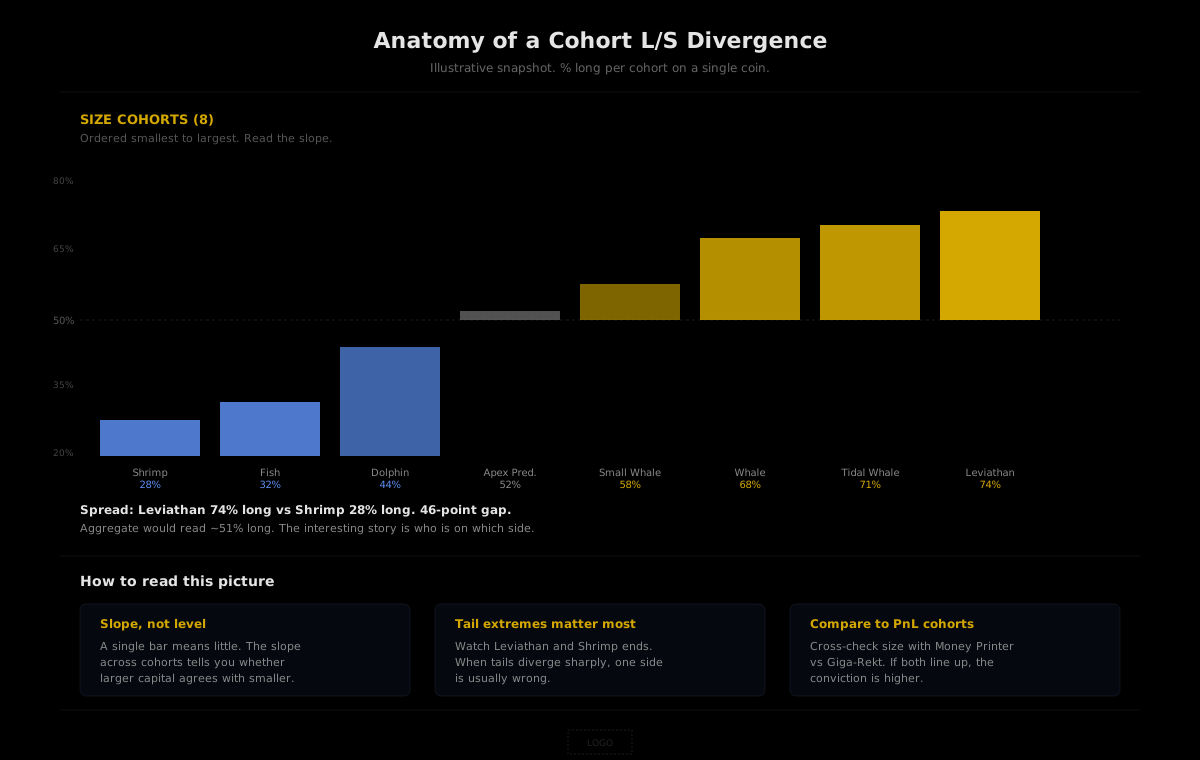
Here is the intuition. The aggregate ratio is the average of all sixteen cohort L/S readings, weighted by capital. Averages hide divergence. If Whales are 70% long and Fish are 30% long, the average might still print near 1.0, and you will see nothing on the standard chart. But the underlying market is anything but balanced. One end of the distribution is heavily long, the other end is heavily short, and they cannot both be right.
Our data refreshes every five minutes, which is fast enough to catch cohort divergences as they build. It is not real-time streaming and we do not pretend otherwise, but for a position-sizing decision rather than a market-making one, five minutes is plenty. The interesting reads are not minute-to-minute jitter, they are 30-point spreads that hold for hours.
A worked example: Whales long, Fish short
Take a snapshot from a hypothetical BTC market on a quiet afternoon. The aggregate L/S ratio sits at 1.04. On Coinglass, this looks like a complete non-event. You scroll past it.
Now break the same data into our 16 cohorts. The size axis tells one story:
- Shrimp: 28% long
- Fish: 32% long
- Dolphin: 44% long
- Apex Predator: 52% long
- Small Whale: 58% long
- Whale: 68% long
- Tidal Whale: 71% long
- Leviathan: 74% long
The PnL axis tells the same story from a different angle:
- Money Printer: 72% long
- Smart Money: 66% long
- Consistent Grinder: 61% long
- Humble Earner: 54% long
- Exit Liquidity: 41% long
- Semi-Rekt: 35% long
- Full Rekt: 31% long
- Giga-Rekt: 26% long
Both axes point the same way. Larger wallets and historically profitable wallets are leaning long. Smaller wallets and historically unprofitable wallets are leaning short. That is the kind of read where the L/S data is doing real work. The aggregate number told you nothing. The cohort breakdown told you that smart capital and dumb capital are sitting on opposite sides of the same trade, and you can build a thesis from there.
The numbers above are illustrative, not a recommendation, and the actual reading on any given day depends on the coin, the regime, and the prior catalyst. The point is the shape of the picture, not the specific values.
Reading L/S as a contrarian or confirming indicator
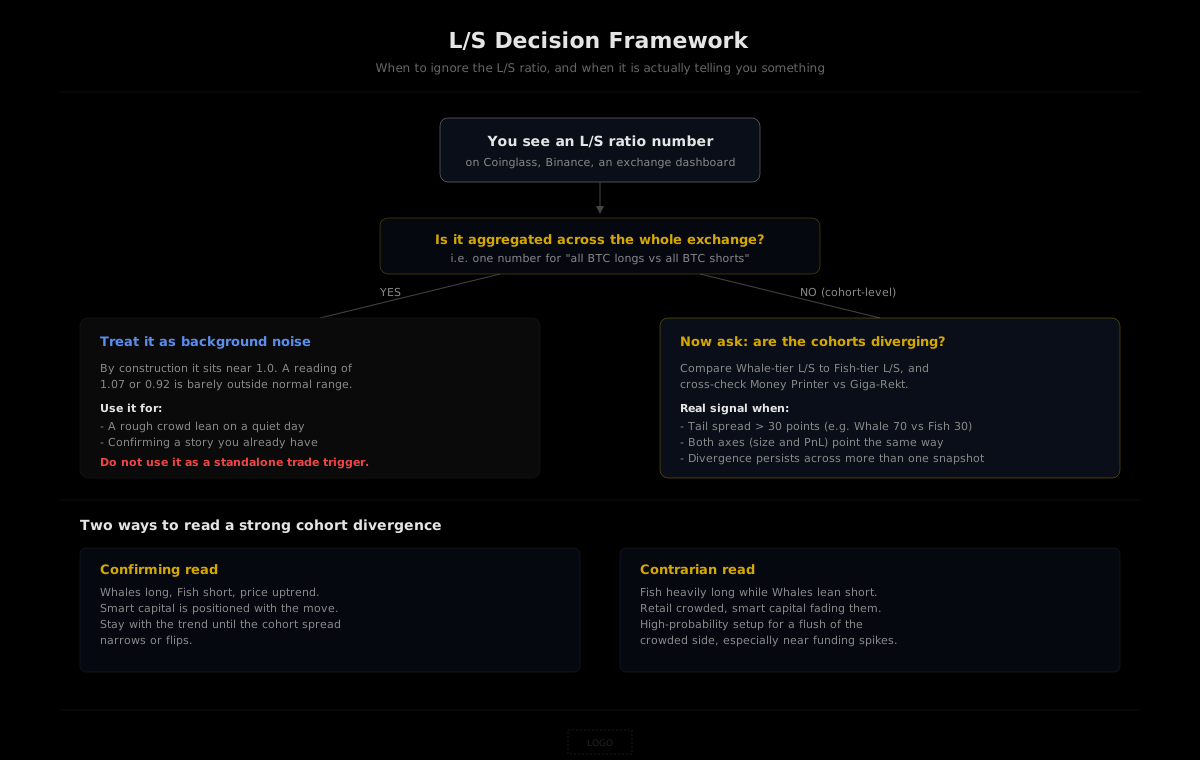
Once you are looking at cohort L/S, the ratio becomes a flexible tool rather than a single buy-or-sell light. Two reads dominate.
Confirming. Whales lean long, Fish lean short, price is in an uptrend. The smart end of the distribution is positioned with the move and retail is fading it. This is a "stay in the trend" read. You hold positions on the same side as the larger cohorts until the spread narrows or flips. The trade ends when the cohort divergence ends, not when the price prints a particular candle.
Contrarian. Fish are heavily long, Whales are leaning short, funding is elevated and positive. The crowded side is paying to hold a position that the smart end of the distribution is fading. This is the classic "retail is the exit liquidity" setup, and on Hyperliquid the funding payment makes the cost of being on the wrong side hourly and visible. When the flush comes, the long side gets hit, funding mean-reverts, and the ratio resets.
The trick is knowing which read applies. A simple working rule: when the larger cohorts agree with the prevailing trend, treat the L/S as confirming. When the larger cohorts disagree with the crowd, treat the L/S as a contrarian setup. The cross-check is the PnL axis. If Money Printer and Smart Money cohorts agree with the size-based read, the conviction is higher. If they disagree, you have a noisier picture and the trade is probably not there.
How to query cohort L/S on Hyperliquid
If you want to pull this data programmatically rather than eyeball it on a dashboard, the cohort endpoints on the HyperTracker API are the entry point. The base URL is https://ht-api.coinmarketman.com/api/external and auth is JWT bearer.
The minimum-viable call is the cohort metrics endpoint, which returns long share, position size, and equity for each cohort on a given coin:
curl -H "Authorization: Bearer $HT_TOKEN" \
  "https://ht-api.coinmarketman.com/api/external/cohorts/metrics?coin=BTC"
From there, the L/S spread is arithmetic. Pull long share for the Whale and Fish cohorts, subtract, and watch the time series. A persistent 30-point spread is the threshold we use as a starting point in our own work, and you can tune it tighter or wider depending on the asset and the regime.
Pulse plan ($179/mo) gets you 50,000 requests per month against the cohort endpoints, which is enough to poll every five minutes across a basket of coins. The free tier is enough to test the shape of the data on one or two assets before you commit. Historical depth on per-coin cohort metrics is currently around four weeks, with deeper history on positions and fills if you need to backfill behavior beyond that window.
Common mistakes traders make with L/S data
A few patterns we see repeatedly, both on social and in our own client conversations.
Treating 1.10 as extreme. It is not. Aggregate L/S regularly oscillates in a tight band, and a 10% departure from parity is normal. If you want to use the aggregate for anything, set your threshold much wider, or stop using it altogether and look at cohorts.
Reading L/S without funding context. Hyperliquid funding settles every hour, which means a crowded long position is paying or receiving funding 24 times a day. When the L/S spread is wide and funding is paying the crowded side handsomely, the unwind risk is meaningfully higher than when funding is neutral. Always pair L/S with funding when you size a contrarian play.
Confusing position size with direction. A Whale being 70% long does not mean every Whale is long with their full equity. It means 70% of the cohort's net positioning sits on the long side. The cohort can be partly hedged, partly directional, and the headline number compresses both. Treat it as a directional bias signal, not a leverage signal.
Acting on a single snapshot. Cohort divergences that print and disappear in one polling interval are usually data artifacts, not real shifts. Wait for at least two to three consecutive snapshots showing the same divergence before you put weight on it. Our data refreshes every five minutes, so a real read takes 15 minutes to confirm. That is fast enough for the kind of trade decisions L/S is good for, and slow enough to filter noise.
Ignoring the PnL axis. The size axis tells you who has capital. The PnL axis tells you who has historically known what they are doing with it. When the two axes agree, the read is much stronger. When they disagree, you are looking at a crowded smart-money trade that has not yet worked, or a retail crowd that is correct for the moment, and either way the conviction is lower.
Pull cohort L/S data directly
The HyperTracker API gives you long share, position size, and equity for all 16 cohorts across every Hyperliquid perp, refreshed every 5 minutes. Pulse plan ($179/mo) covers 50,000 requests, free tier (100/day) is enough to test before committing.
The number was always there
Aggregate long/short ratio is not wrong. It is just thin. The data behind it is rich, the math behind it is sound, and the chart behind it is honest about what it shows. The mistake is treating one summary number as a signal when the underlying distribution is the entire point. Hyperliquid is on-chain, every wallet's position is verifiable, and breaking that population into cohorts is the difference between watching a thermometer that always reads 70 degrees and watching a weather map. The ratio you have been watching has been mean-reverting to 1.0 for a reason. The signal you have been looking for has been sitting in the spread between Whales and Fish all along.