
North Korea Hit Binance for $6.3B. Hyperliquid Didn't Blink.
By CMM Team - 02-Nov-2026
North Korea Hit Binance for $6.3B. Hyperliquid Didn't Blink.
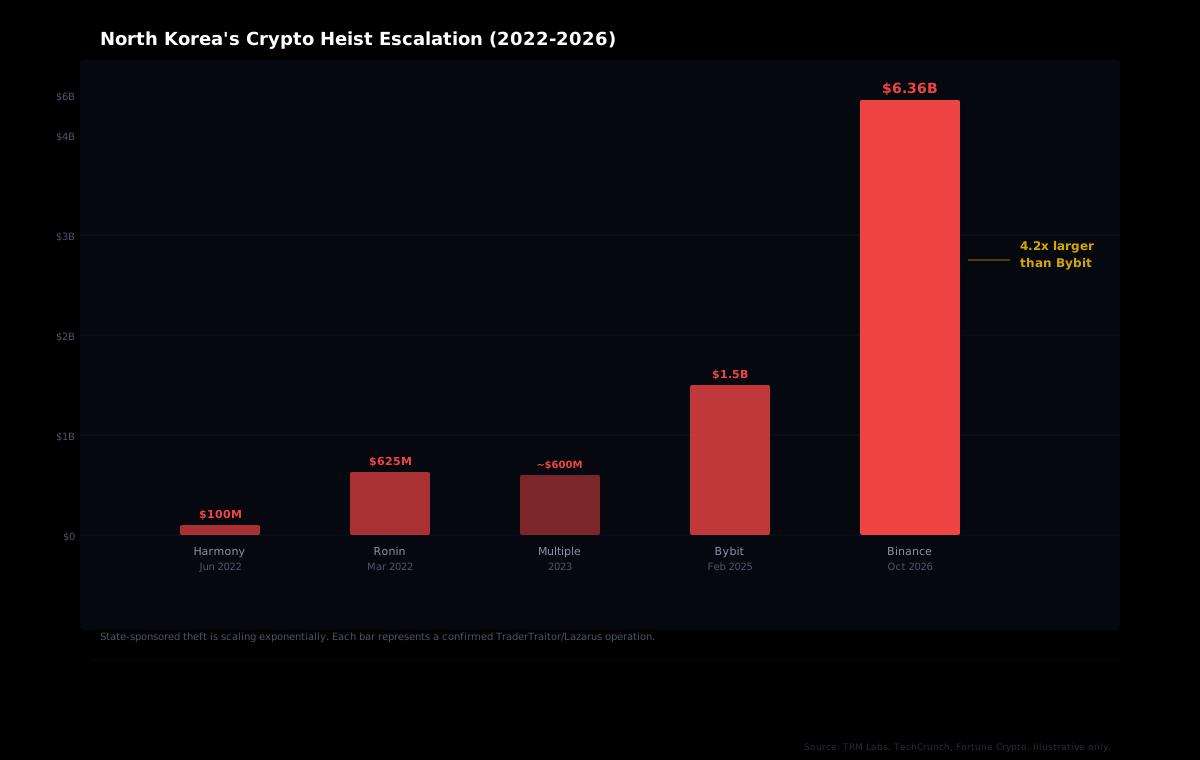
A nation-state just robbed the world's largest crypto exchange in broad daylight. On October 29, 2026, North Korea's TraderTraitor unit drained approximately $6.36 billion from Binance's hot wallets across ten blockchains in roughly 20 minutes. The attack was four times larger than the $1.5 billion Bybit hack from February 2025, which TraderTraitor also carried out. It was the biggest crypto theft in history.
Meanwhile, on Hyperliquid, nothing happened. No withdrawal freeze. No emergency fund deployment. No panicked Discord announcement. The protocol kept producing blocks and settling trades because there was no custodial honeypot to target. The architecture simply doesn't have one.
This isn't a story about one bad day at one exchange. It's about a pattern that keeps getting bigger, and why traders who settle on self-custody perpetual DEXs sit outside its blast radius entirely.
How a Single Laptop Unlocked $6.36 Billion
The attack started with social engineering. According to Binance and blockchain analytics firm TRM Labs, the hackers compromised a software engineer's laptop to gain access to the exchange's hot wallet signing infrastructure. From there, TraderTraitor used a technique involving EIP-7702 delegation to convert an Ethereum hot wallet into a sweeper contract using 50 pre-signed authorizations. On other chains, standard signed transfers did the rest.
The preparation began at least 36 hours before the theft, with attackers funding operator wallets through Tornado Cash. The first transfers hit the XRP Ledger at 20:05 UTC. By 20:24 UTC, the Ethereum hot wallet was already empty. Bitcoin and Tron transfers followed at 20:20 UTC.
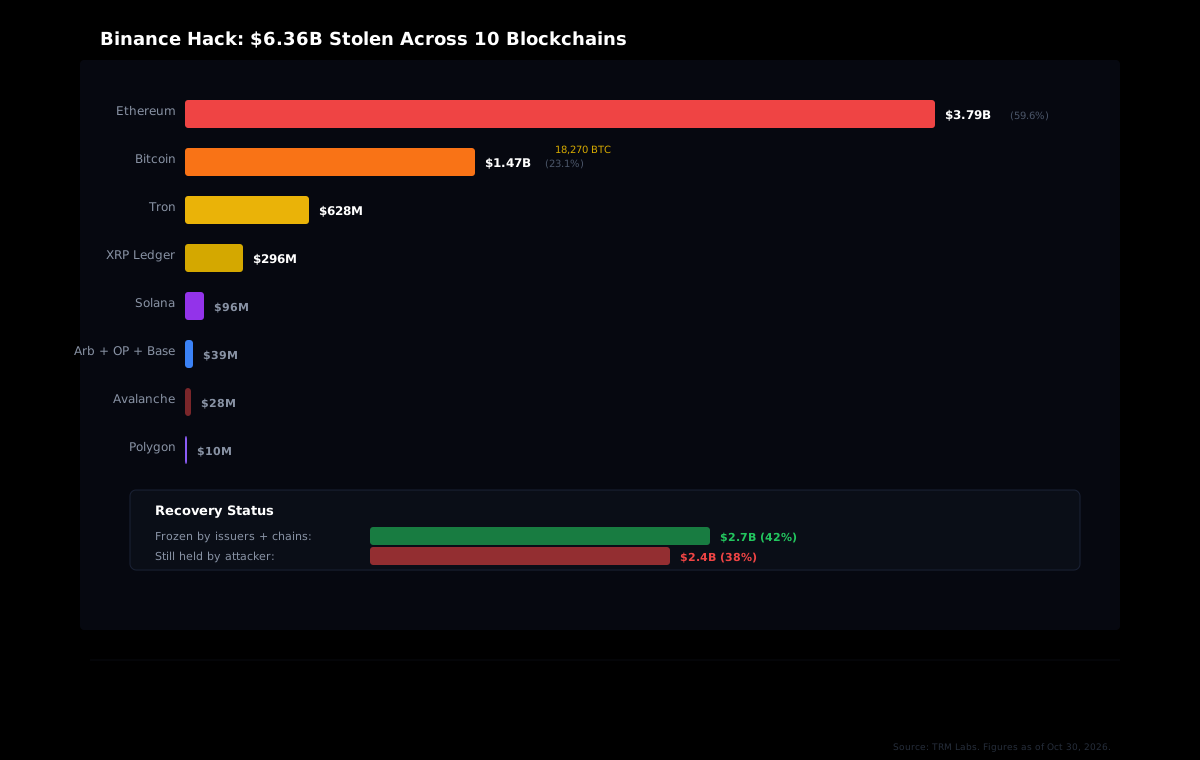
The blockchain breakdown tells the story of scale: $3.79 billion on Ethereum, $1.47 billion in Bitcoin (18,270 BTC), and the remainder spread across Tron, XRP Ledger, Solana, Arbitrum, Avalanche, Optimism, Base, and Polygon.
Within hours, stablecoin issuers scrambled to contain the damage. Tether froze funds at 21:25 UTC, Circle at 21:18 UTC. In total, roughly $2.7 billion was frozen. But as of late October, the attacker still controlled approximately $2.4 billion, including over 420,000 ETH.
North Korea's Industrial-Scale Crypto Theft Operation
The Binance hack wasn't a one-off. It was the latest and largest operation in a decade-long industrialization of state-sponsored crypto theft. North Korea's Lazarus Group and its subunit TraderTraitor have turned cryptocurrency hacking into a systematic revenue program, with proceeds funding the regime's weapons development.
The trajectory is staggering. TraderTraitor stole $1.5 billion from Bybit in February 2025. The same network was linked to the $625 million Axie Infinity Ronin bridge exploit in 2022. Each operation has been bigger than the last, and the methods keep evolving. The Binance attack combined familiar hacking tactics with what investigators called "extraordinary speed and automation."
A UN Security Council panel of experts reported in March 2024 that Lazarus Group is "very active in the Russian Federation" and retains access to Russian systems. Cybersecurity researchers found in 2025 that the group had routed internet traffic through servers in Khasan, a Russian village on the North Korean border. The geopolitical infrastructure behind these attacks is growing more sophisticated, along with the technical execution.
The pattern reveals something important for traders. State-sponsored hackers don't pick targets randomly. They target centralized honeypots: exchanges that pool billions of dollars in hot wallets behind a small number of signing keys. The bigger the honeypot, the more attractive the target. Binance held more custodial assets than any other exchange, which made it the largest prize on the board.
Why Custodial Exchanges Are Permanent Targets
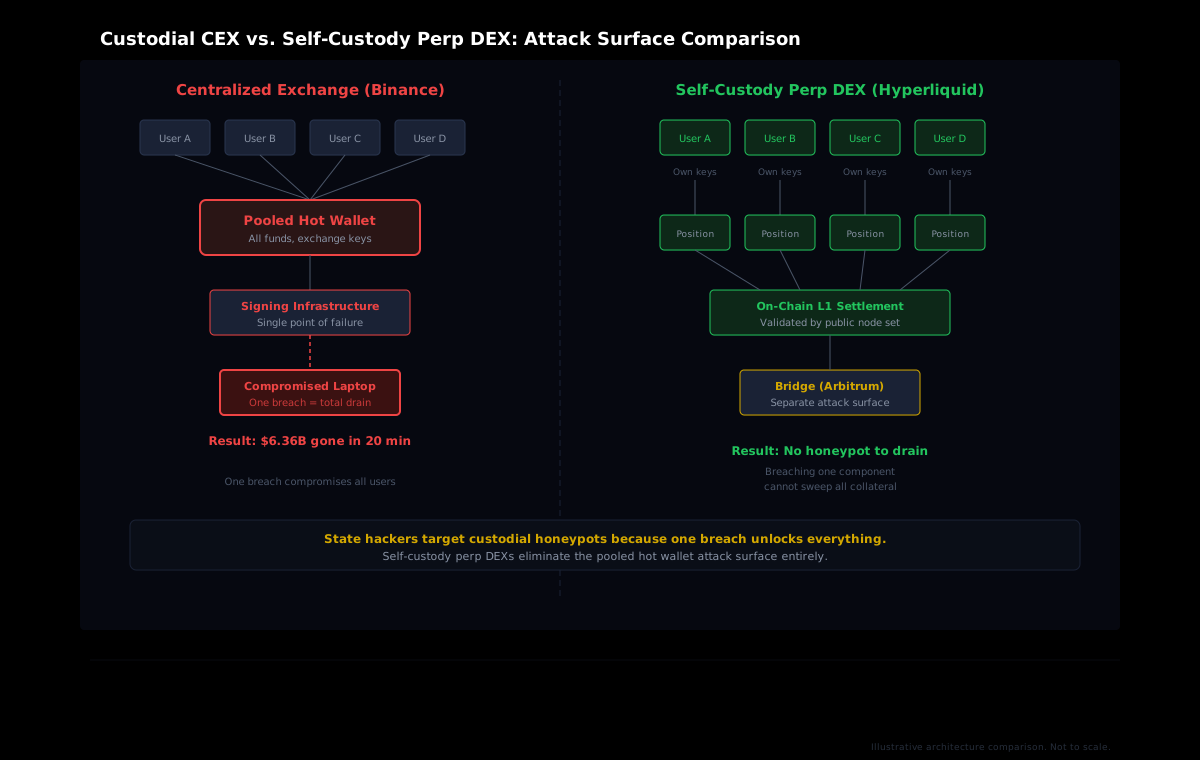
The custodial model creates a structural vulnerability that can't be patched with better security practices. When an exchange holds customer funds in pooled wallets controlled by the exchange's keys, every dollar becomes part of a single target. The attacker doesn't need to compromise thousands of individual wallets. They need one signing infrastructure, one compromised employee, one set of credentials.
Binance responded quickly to the crisis. Co-CEO Richard Teng announced that the exchange had reserved over $6.34 billion of company funds to cover the incident, drawing from internal reserves to repurchase tokens and replenish user balances. The exchange replenished 90% of the losses and planned to reopen withdrawals within days.
That response is admirable. It's also a symptom of the underlying problem. The fact that an exchange needs a multi-billion-dollar emergency fund proves that the custodial model carries existential risk. Binance can afford to make users whole this time, but the architecture that allowed a 20-minute drain of $6.36 billion remains unchanged. The next TraderTraitor operation will target the same type of infrastructure.
The U.S. Treasury sanctioned the Lazarus Group in 2019. The FBI identified TraderTraitor as responsible for the Binance hack within 48 hours. Law enforcement attribution is getting faster, but it hasn't slowed the operations down. Attribution doesn't recover funds that have already been mixed through Tornado Cash and converted across chains.
The Hyperliquid Architecture: No Honeypot, No Target
Hyperliquid runs a purpose-built Layer 1 blockchain where every order, fill, and settlement is validated on-chain by a public validator set. When you trade perpetual futures on Hyperliquid, your USDC collateral sits in the protocol's smart contracts, bridged from Arbitrum. You sign your own orders with your own keys. The exchange never takes custody of your funds.
There is no pooled hot wallet. There is no signing infrastructure that a single compromised laptop can unlock. The attack vector that drained $6.36 billion from Binance simply doesn't exist on Hyperliquid's architecture.
This distinction became viscerally real for traders on October 29. While Binance suspended withdrawals and scrambled to freeze stolen assets, Hyperliquid processed trades continuously. HYPE, the protocol's native token, rose while most of the crypto market fell in the post-hack panic. Much of that price action was driven by the ICE/NYSE partnership announced the same day, but the contrast in operational continuity was stark: one platform was in crisis mode, the other was business as usual.
Hyperliquid isn't immune to all risks. Validator concentration (the top five Hyper Foundation validators hold roughly 49% of stake), bridge security, and smart contract vulnerabilities are real concerns. But those are fundamentally different attack surfaces than a custodial exchange's pooled hot wallet. A bridge vulnerability might affect a specific mechanism. It can't sweep every user's collateral in a single 20-minute operation the way Binance's signing infrastructure was compromised.
Self-custody doesn't mean zero risk. It means you're exposed to protocol risk (smart contracts, validators, bridges) instead of custodial risk (pooled hot wallets, exchange insolvency). The Binance hack proved which of those two risk profiles has the larger blast radius.
What Smart Money Did During the Panic
Every major market shock creates a window where positioning data becomes disproportionately valuable. The hour after the Binance hack confirmed on October 29 was one of those windows. Leveraged longs got wiped across every major exchange. Funding rates inverted. Open interest collapsed. But inside that chaos, experienced traders were already repositioning.
This is where on-chain analytics on a transparent perp DEX like Hyperliquid becomes a genuine edge. Because every position, every fill, and every liquidation on Hyperliquid is on-chain and verifiable, you can watch cohort behavior in near-real time. Which wallet segments were closing longs during the panic? Which cohorts were opening fresh shorts? Which were accumulating through the dip?
Our data classifies every wallet on Hyperliquid into one of 16 behavioral cohorts, eight by position size (from Shrimp under $250 to Leviathan above $5M) and eight by all-time PnL (from Money Printer above $1M profit to Giga-Rekt below $1M in losses). That classification doesn't change during a crisis. It becomes more useful, because the divergence between how experienced and inexperienced traders react is exactly where alpha lives.
During sharp selloffs, the historical pattern on Hyperliquid has been consistent: higher-PnL cohorts (Money Printer, Smart Money, Consistent Grinder) tend to reduce exposure earlier or hedge faster, while lower-PnL cohorts tend to hold longer and absorb more liquidation risk. The specific positioning data from any given event is available through the HyperTracker dashboard and API.
Building on the Exchange That Doesn't Get Hacked
For developers building trading infrastructure, the Binance hack crystallizes a choice that was already becoming obvious. If you're building a trading bot, a portfolio tracker, an alerts system, or an analytics dashboard, do you want to build on a platform where a state-sponsored hacking group can freeze all operations in 20 minutes? Or do you want to build on one where the protocol kept processing blocks through the largest theft in crypto history?
The answer shapes your architecture, your uptime guarantees, and your users' trust. Builders on Hyperliquid don't need to worry about custodial exchange downtime cascading into their products. The data keeps flowing because the chain keeps running.
HyperTracker's API gives builders access to the same cohort intelligence, order flow data, and liquidation risk metrics that power our dashboard. Sixteen behavioral cohorts. Rolling 5-minute snapshots. Position data going back months. All from an exchange that processes every trade on-chain, where the custody model makes a Binance-style drain structurally impossible.
Track Smart Money on the Exchange That Doesn't Have a Hot Wallet
HyperTracker gives you cohort analytics, order flow, and liquidation risk data on Hyperliquid. Every wallet classified. Every position on-chain. Start with our free tier.
The Shift Is Already Happening
The Binance hack will accelerate a migration that was already underway. Standard Chartered's analyst team noted after the hack that decentralized exchanges stand to benefit as investors reassess the risks of keeping assets on centralized platforms. That assessment aligns with what the data has been showing for months: perp DEX market share has been climbing steadily, and each major CEX security incident pushes another cohort of traders toward self-custody.
The ICE/NYSE partnership with trade[XYZ] to bring Hyperliquid perpetual markets to U.S. retail traders, announced on the same day as the Binance hack, adds institutional gravity to the migration. The convergence of a record-breaking custodial failure and a major traditional finance endorsement of on-chain perp trading is the kind of inflection point that reshapes market structure.
North Korea's hackers will keep targeting centralized honeypots. That's not speculation. It's their operating model, refined across a decade of increasingly large operations. The question for traders and builders isn't whether the next state-sponsored hack will happen, but whether they'll still have funds sitting in the blast radius when it does.
Hyperliquid didn't blink on October 29 because it had nothing to blink about. The protocol produced blocks. Traders traded. The architecture held. That's the entire point.