
One Cent on the Dollar: What Drift's Recovery Means for Perp Traders
By CMM Team - 03-Oct-2026
One Cent on the Dollar: What Drift's Recovery Means for Perp Traders
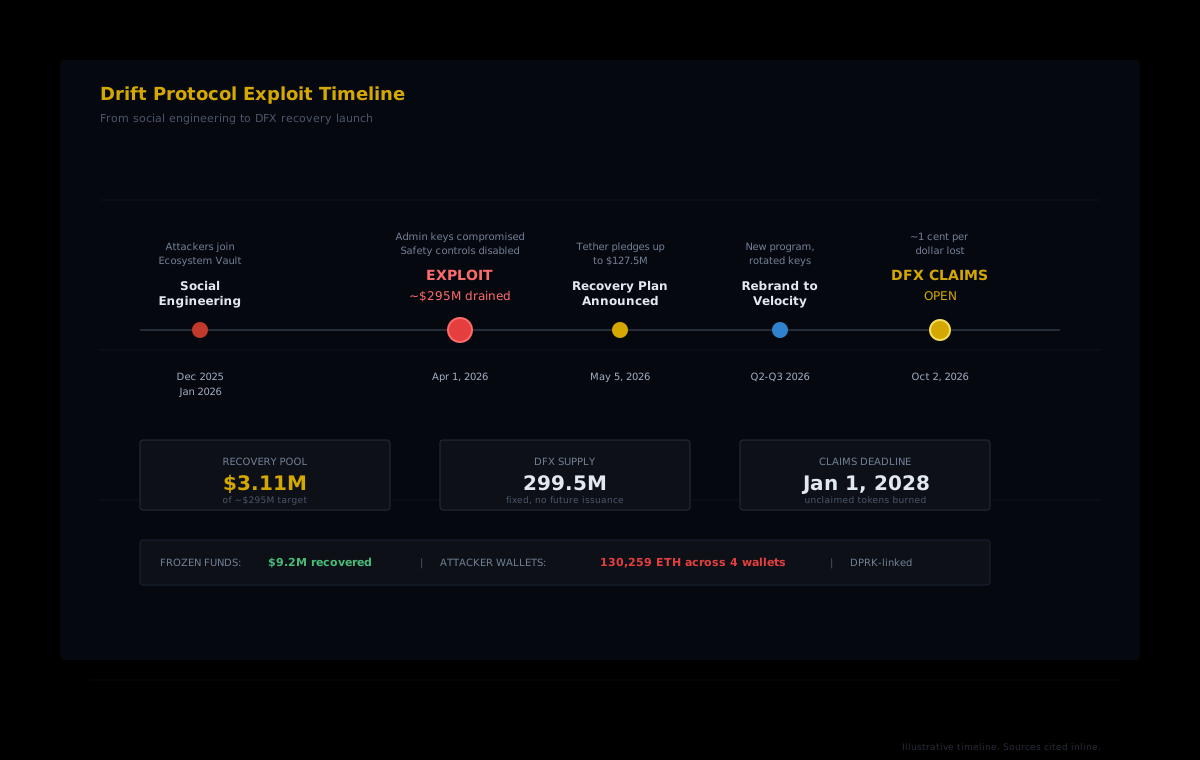
Six months after losing roughly $295 million to a North Korea-linked exploit, Drift's recovery program launched on October 2 with a payout rate that stings: about one cent for every dollar lost.
If you traded perps on a single DEX in April and woke up to find your collateral gone, the math is simple. You lost everything and got back roughly 1%. The lesson is harder to absorb: platform risk does not care how good your trade was.
This article breaks down what happened at Drift, how the DFX recovery token actually works, and what perp traders should be doing right now to avoid the same outcome on any venue. The goal is practical: a framework for spreading risk across platforms so that no single exploit can wipe you out.
What Happened at Drift
On April 1, 2026, attackers drained approximately $295 million from Drift Protocol, Solana's largest perpetual futures DEX at the time. The attack did not exploit a smart contract bug. Instead, it targeted Drift's governance layer through a months-long social engineering campaign that compromised admin access and disabled safety controls.
Blockchain forensics firm Mandiant attributed the exploit to a North Korea state-affiliated threat actor. The stolen assets were bridged to Ethereum, where 130,259 ETH remains concentrated across four attacker wallets. About $9.2 million has been frozen so far.
The attack underscores something that traders often forget: governance risk is protocol risk. A hardware wallet protects assets under your direct control. It does nothing for collateral deposited into a protocol whose admin keys have been compromised. The distinction matters, because perp traders by definition must deposit margin into the venue to trade.
The DFX Recovery Token: How It Works
Drift (now rebranded as Velocity) issued a recovery token called DFX to affected users. The mechanics are straightforward but carry a twist that rewards patience over urgency.
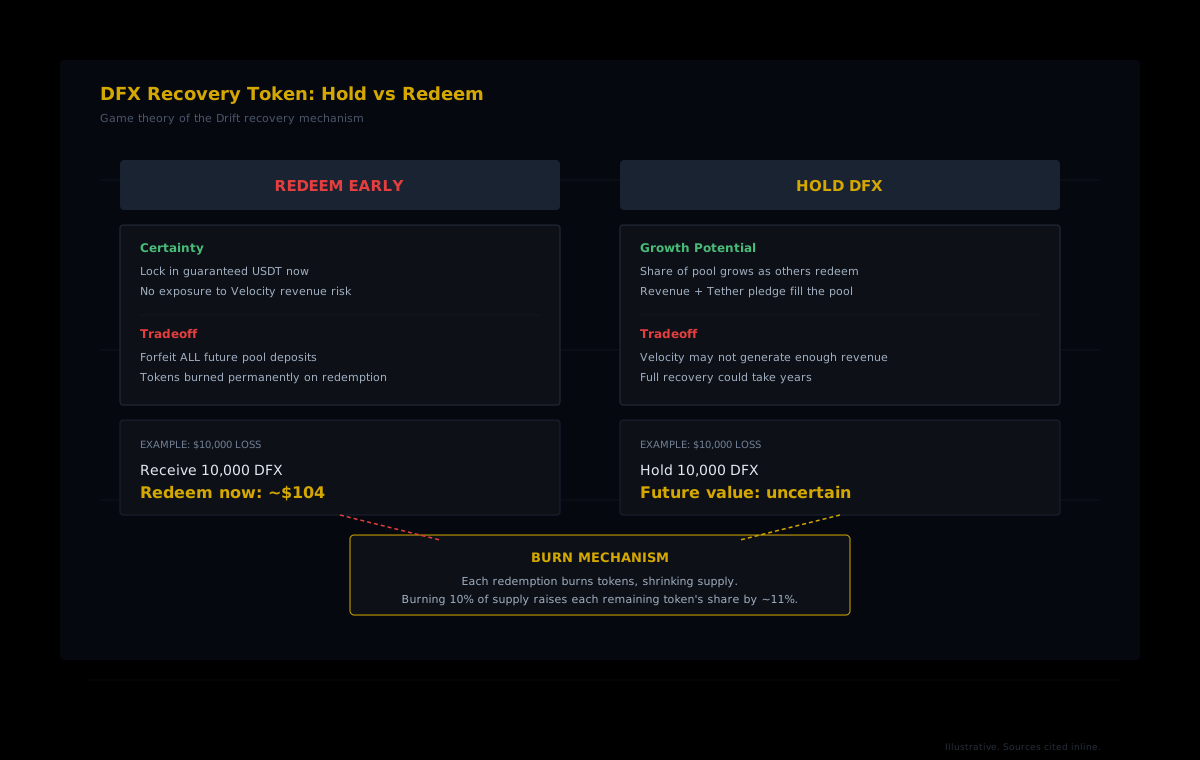
Each affected wallet received one DFX token per dollar of verified loss. At launch on October 2, the recovery pool held approximately 3.11 million USDT, giving each token a redemption value of roughly 0.0104 USDT. That is the one-cent-on-the-dollar figure. The total DFX supply is fixed at 299.5 million tokens with no future issuance planned.
Where the money comes from
The recovery pool has three funding sources. Tether has pledged up to 127.5 million USDT, strategic partners have committed up to $20 million, and Velocity's net protocol revenue will replenish the pool at tiered rates: 60% on the first $30,000 daily, 70% between $30,000 and $100,000, and 90% on revenue above $100,000.
The hold-or-redeem game theory
Every DFX redemption burns the tokens permanently, which shrinks the denominator and increases the pro-rata claim for remaining holders. Drift's own documentation notes that burning 10% of supply increases each remaining token's future share by approximately 11%. Early redeemers get certainty but forfeit all claims to future pool deposits. Late redeemers get a larger share of a growing pool, but they carry the risk of Velocity failing to generate sufficient revenue.
Claims close January 1, 2028. After that date, unclaimed DFX tokens are burned permanently.
Why Platform Risk Matters More Than Trade Risk
Perp traders spend enormous energy on entry signals, leverage sizing, and liquidation thresholds. But the Drift exploit exposed a category of risk that sits upstream of all those decisions: the platform itself going down and taking your collateral with it.
This is true regardless of venue type. Centralized exchanges carry custodial risk (FTX proved that in 2022). DEXs carry smart contract and governance risk (Drift proved it in 2026). The common thread is that deposited margin is vulnerable to a failure mode you cannot hedge with a stop loss.
The Drift exploit was the largest DeFi hack of 2026. It drained over half the protocol's total value locked in under an hour. No trader had time to withdraw.
The question is not whether the next exploit will happen. It is whether your trading setup can survive one. The answer depends on how you distribute capital across venues, how much margin you leave idle in any single protocol, and how quickly you can shift to an alternative.
Building a Multi-Venue Backup Plan
The core idea is simple: never concentrate all trading capital in a single venue. In practice, executing this requires thinking through venue selection, capital allocation, and monitoring.
Step 1: Choose venues across different architectures
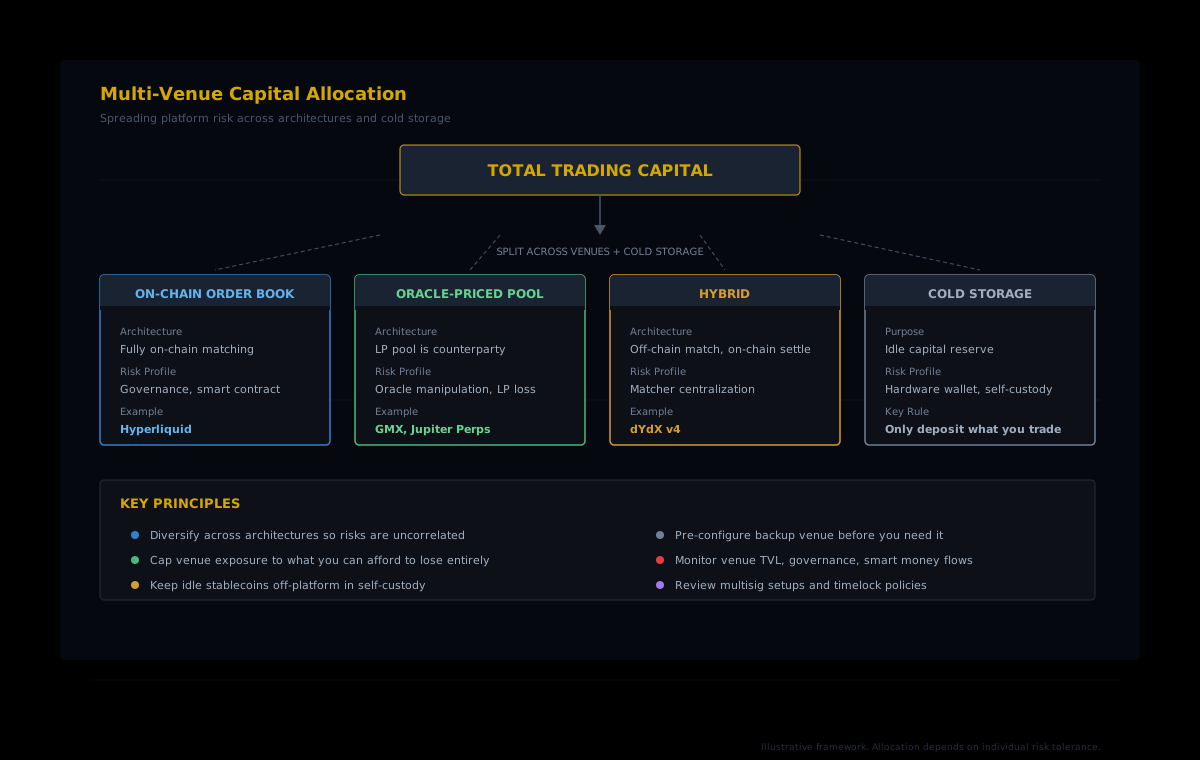
Perp DEXs fall into three broad architectural categories, and each carries a different risk profile:
| Architecture | How It Works | Key Risk | Example | | --- | --- | --- | --- | | On-chain order book | Bids/offers matched on-chain, counterparty is another trader | Governance and smart contract exploits | Hyperliquid | | Oracle-priced pool | LP pool is the counterparty, price set by oracle | Oracle manipulation, LP adverse selection | GMX, Jupiter Perps | | Hybrid (off-chain match, on-chain settle) | Matching happens off-chain, settlement on-chain | Centralization of the matcher | dYdX v4 |
Spreading capital across architectures means that a vulnerability in one design (say, an oracle manipulation attack on a pool-based DEX) does not threaten funds held on an order-book venue. The risks are uncorrelated by construction, which is the whole point of diversification.
Step 2: Size your venue exposure deliberately
The simplest rule is to cap the amount of capital at any single venue to a fraction you can afford to lose entirely. If losing everything on one platform would end your trading career, you have too much there. Move the excess to cold storage or spread it to a second venue.
Think of it like position sizing, but for platforms instead of trades. The same discipline that prevents a single liquidation from blowing your account should prevent a single exploit from doing the same.
Step 3: Keep idle collateral off-platform
Drift users who had funds sitting in vaults they were not actively using lost them alongside active traders. The lesson: withdraw margin you are not using. If you trade BTC perps and keep a large USDC balance parked on the same DEX "for later," that parked balance carries full platform risk for zero return.
Move idle stablecoins to self-custody. Deposit only what you need for your current positions and a reasonable buffer for drawdowns.
Step 4: Monitor venue health, not just your positions
Smart traders already watch their PnL, funding rates, and liquidation prices. After Drift, you should also monitor the venues themselves. Key signals include:
- TVL changes: A sudden drop in total value locked can signal trouble before an exploit becomes public.
- Governance activity: Unusual admin transactions or multisig changes are red flags. Many Drift users could have noticed irregular governance activity in the weeks before the exploit.
- Smart money flows: If experienced wallets start pulling funds from a venue, pay attention. Cohort-level data can surface this pattern before it shows up in aggregate metrics.
- Audit and security updates: Protocols that stop publishing audit reports or delay security patches are quietly accumulating risk.
What Cohort Data Reveals About Venue Risk
One signal that matters for venue risk assessment is the behavior of experienced traders. When Money Printer wallets (all-time PnL above $1M) begin reducing exposure on a platform while lower-performing cohorts hold steady, it can indicate that sophisticated participants are seeing something the broader market is not.
Our data tracks 16 behavioral cohorts on Hyperliquid, split by account size and all-time performance. This kind of intelligence is useful beyond trade signals. If the wallets with the strongest track records start pulling collateral, that is a data point worth acting on, regardless of what the price chart says.
Track Smart Money Flows Across Hyperliquid
HyperTracker's API classifies every wallet on Hyperliquid into one of 16 behavioral cohorts by size and all-time PnL. Query cohort positioning, liquidation risk, and order flow snapshots. Free tier available.
The Bigger Picture: Perp DEX Security in 2026
Drift was not an isolated incident. It was the largest DeFi exploit of the year, but it sits within a broader pattern. As perp DEX volume has grown, so has the incentive for sophisticated attackers to target these venues. The economics are simple: where leverage concentrates collateral, exploits concentrate payoffs.
The industry response has been encouraging. Velocity (the rebranded Drift) plans to deploy an entirely new program at a fresh address with fully rotated keys, implement timelocks on sensitive administrative operations, and remove the durable-nonce attack surface that enabled the original exploit. Other protocols are following suit with similar security upgrades.
But waiting for protocols to fix themselves is not a risk management strategy. The traders who survived the Drift exploit with their portfolios intact were the ones who had capital spread across multiple venues, kept idle collateral in self-custody, and treated platform selection as a risk management decision, not a loyalty commitment.
Checklist: Your Multi-Venue Backup Plan
Here is a concrete checklist you can work through this week:
- Audit your venue concentration. List every platform where you hold collateral. If any single platform holds the majority of your trading capital, rebalance.
- Diversify across architectures. Use at least two perp DEXs with different underlying designs (for example, an on-chain order book and an oracle-priced pool).
- Withdraw idle margin. If you have stablecoins sitting on a DEX that are not backing open positions, move them to self-custody.
- Monitor venue health. Set up alerts for TVL changes, governance transactions, and smart money outflows on your primary venues.
- Have a "Plan B" venue pre-configured. Create accounts and test deposits on your backup venue before you need it. In a crisis, you want to be moving funds, not reading documentation.
- Review protocol governance. Check multisig setups, timelock durations, and admin key policies. Prefer venues with longer timelocks and higher signing thresholds.
None of this guarantees safety. But it converts a catastrophic scenario (total loss) into a painful but survivable one. That is the same logic behind position sizing, applied one level up.
Final Thought
One cent on the dollar. That is what Drift's recovery program is paying right now, and even with Tether's pledge and revenue contributions, full recovery could take years. The traders who lost $295 million did not make bad trades. They made a single concentration decision, and it cost them everything they had on that platform.
The perp DEX ecosystem is stronger and more varied than it was a year ago. Hyperliquid, dYdX, GMX, Jupiter Perps, and a growing set of newer venues give traders real choice across chains and execution models. Use that choice. Spread your capital. Monitor your venues the way you monitor your positions. The next exploit will happen. Make sure it cannot wipe you out.