
Your Perps Tools Already Work on HIP-4 Prediction Markets
By CMM Team - 02-Oct-2026
Your Perps Tools Already Work on HIP-4 Prediction Markets
Hyperliquid shipped prediction markets in May 2026, and most builders barely noticed. The feature landed as HIP-4, a new asset class on the same CLOB engine that already runs perpetuals and spot. Same WebSocket feeds. Same REST endpoints. Same order-signing flow. If your bot already trades Hyperliquid perps, it already knows most of what HIP-4 needs.
That is the part worth paying attention to. Prediction markets are growing fast across crypto, with sector-wide volume reaching $113.8 billion in the second quarter of 2026 alone. But where Polymarket built a standalone system on Polygon, Hyperliquid made outcome markets a native extension of its existing exchange infrastructure. For builders who already have Hyperliquid integrations, this changes the effort calculation from "build a new integration" to "add a filter for a new asset type."
This article walks through the technical specifics: how HIP-4 markets work, what changes in your code, what stays identical, and where the builder economics sit after the permissionless deployment update.
How HIP-4 Outcome Markets Work
HIP-4 markets are binary YES/NO contracts that settle to 0 or 1 in USDC. Each market poses a question: "Will BTC touch $70,000 by October 1?" or "Will the Fed cut rates in November?" Traders buy YES or NO positions using USDC as collateral, and the market price at any moment represents the implied probability of the outcome.
Prices range from 0.001 to 0.999 and the two sides maintain a complementary relationship: YES mid plus NO mid approximates 1.0. When the event resolves, the winning side settles to 1 USDC per unit and the losing side settles to 0.
The critical architectural choice is that these markets live in HyperCore alongside perpetuals and spot, sharing the same CLOB infrastructure. Settlement uses a linearly interpolated HyperCore mark price around the settlement timestamp to reduce manipulation risk.
HIP-4 vs HIP-3: Same Engine, Different Rules
If you've built on Hyperliquid's perpetuals (HIP-3), the conceptual shift to HIP-4 is smaller than it sounds. The underlying engine is identical. The differences are in the trading rules, and they simplify things.
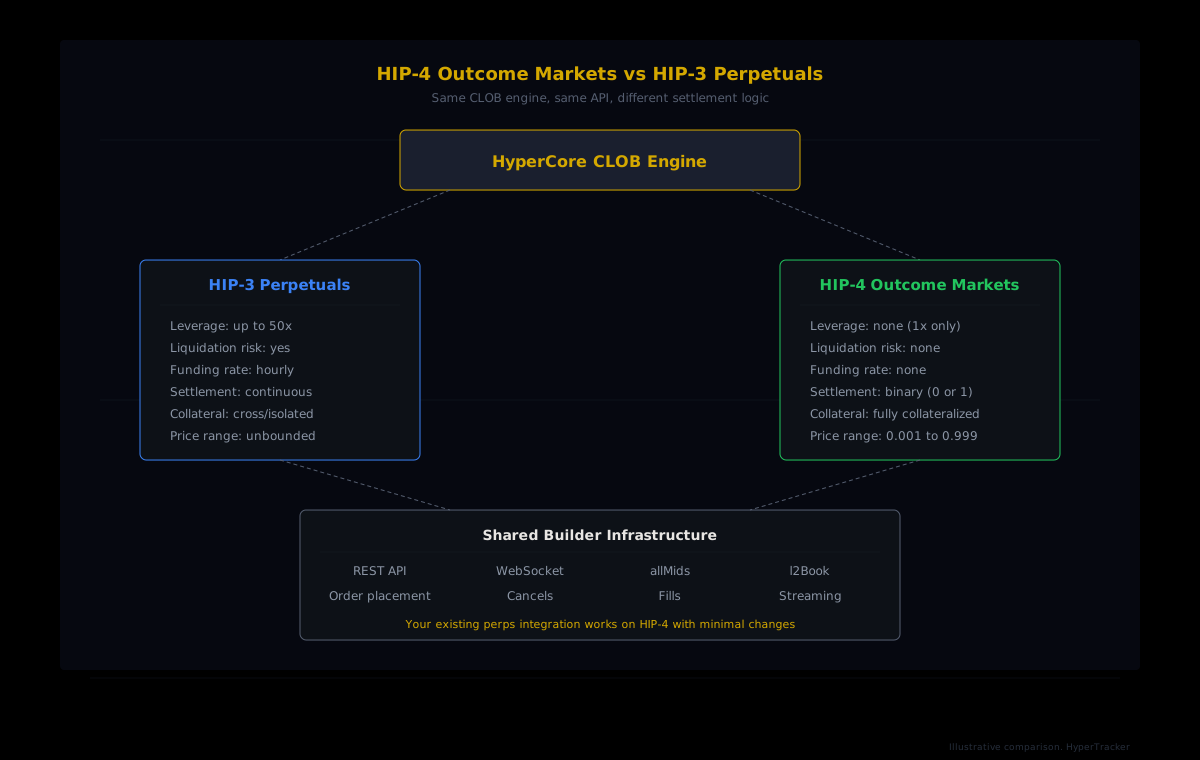
| Feature | HIP-3 Perpetuals | HIP-4 Outcome Markets | | --- | --- | --- | | Leverage | Up to 50x | None (1x only) | | Liquidation risk | Yes | None | | Funding rate | Hourly | None | | Settlement | Continuous | Binary (0 or 1 at expiry) | | Collateral | Cross or isolated margin | Fully collateralized in USDC | | Price range | Unbounded | 0.001 to 0.999 | | Size decimals | Varies by asset | 0 (whole integers only) | | Open fee | Standard maker/taker | Zero |
The simplification is significant for builders. No leverage means no margin engine to manage. No liquidations means no risk of cascading position closures. No funding rate means one fewer data stream to track. Your bot logic gets shorter because HIP-4 strips out the complexity layers that make perps engineering hard.
What Changes in Your Code (and What Doesn't)
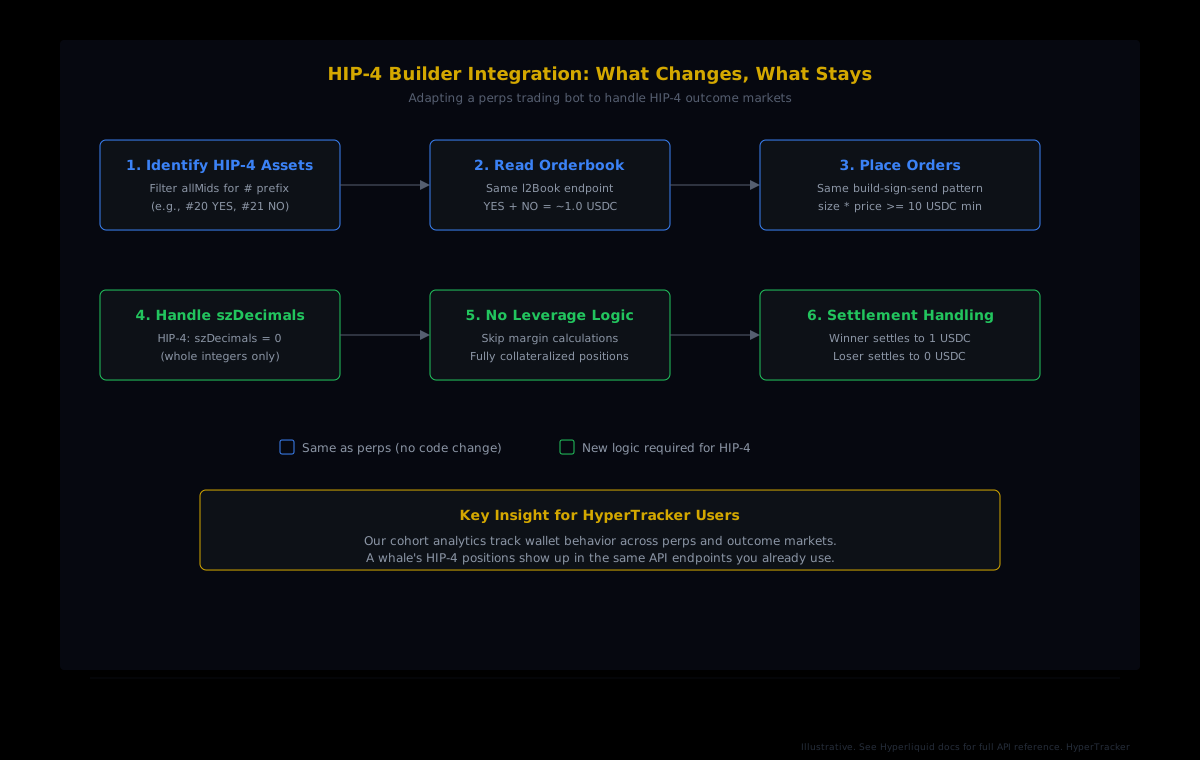
The good news: if your Hyperliquid integration already handles order placement via the REST API, reads the l2Book for orderbook data, and subscribes to WebSocket fills, most of that code works on HIP-4 with zero modification.
What stays the same
- Order placement: Same build-sign-send pattern through the REST API
- Orderbook:
l2Bookreturns HIP-4 market depth in the same format - Price feeds:
allMidsincludes HIP-4 assets alongside perps - WebSocket feeds: Same
wss://api.hyperliquid.xyz/wsendpoint for live updates - Cancels and modifies: Identical API calls
What you need to change
- Asset identification: HIP-4 assets use a
#prefix encoding. Each side appears as a numbered coin, for example#20for YES and#21for NO, derived from the formulaN = 10 * outcomeIndex + sideIndex. FilterallMidsfor the#prefix to isolate outcome markets. - Size handling: All HIP-4 orders require whole integer sizes (
szDecimals = 0) and must satisfysize * price >= 10. - Remove leverage logic: Skip any margin calculations or leverage settings. Positions are fully collateralized at entry.
- Settlement awareness: Build logic to handle expiry. Unlike perps, these positions have a defined end date when the outcome resolves to 0 or 1.
Early Traction and Volume
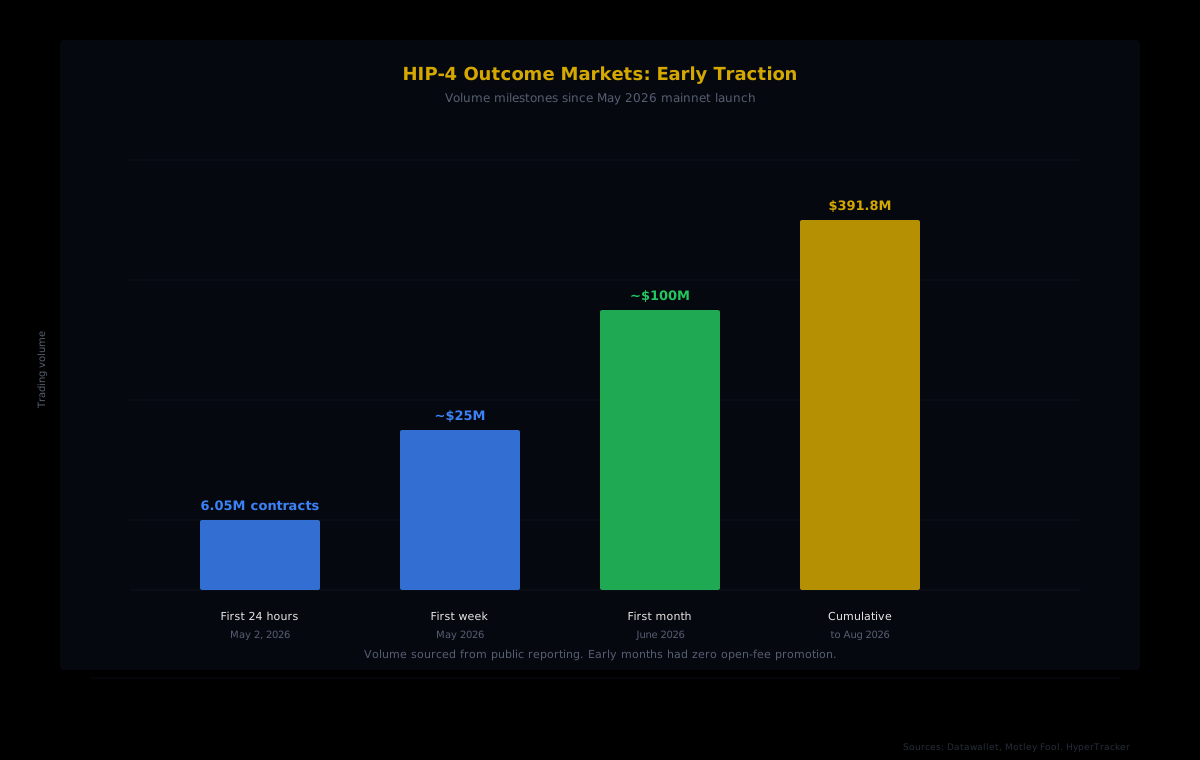
HIP-4 launched on mainnet on May 2, 2026 and the first 24 hours produced 6.05 million contracts in trading volume. The first week saw roughly $25 million in total volume, climbing to approximately $100 million across the first full month, when opening fees were set at zero.
By August 2026, cumulative outcome market volume had reached $391.8 million since launch. For context, Hyperliquid's perpetual futures handled $2.7 billion on a single day (July 27), which puts outcome markets at roughly 0.7% of the platform's perps throughput. Early, but growing.
The first standalone market crossed $50 million in just 14 days. Market types have expanded from simple price-touch binaries to daily binaries, price buckets, macro prints (CPI, Fed rates), sports outcomes, and multi-outcome questions.
Permissionless Deployment: The Builder Play
The initial HIP-4 launch required validator approval for every new market. That changed on August 29, 2026, when Hyperliquid opened permissionless deployment. Now anyone can create an outcome market, but with a significant barrier to entry.
Deployers must stake 500,000 HYPE, which at recent prices represents a substantial commitment. That stake is locked for at least six months, and validators can slash some or all of it if they determine a market was poorly defined or settled incorrectly. The stake cannot double-count toward an existing HIP-3 perpetual DEX deployment.
In return, builders receive up to 50% of trading fees from their markets. Outcome.xyz became the first permissionless deployer, staking the required HYPE and opening 28 markets covering crypto price touches, Fed policy outcomes, and index milestones.
Why This Matters for Existing Hyperliquid Builders
The strategic value of HIP-4 for Hyperliquid builders goes beyond the technical simplicity. Three dynamics are worth tracking.
Unified trading experience
Because HIP-4 markets share the same CLOB engine as perps, traders can hedge a directional perps position with an outcome market position in the same account, using the same collateral. A builder who already surfaces perps data can add prediction market probabilities as a complementary signal. "What does the market think the probability of BTC hitting $90K is?" pairs naturally with "What are the Money Printer cohort's current BTC positions?"
New data dimensions
Outcome markets generate a distinct type of market intelligence. Implied probabilities, volume by market category, and settlement patterns all create builder opportunities. Our cohort analytics already track wallet behavior across the platform. A Whale cohort member placing large YES bets on a Fed rate cut market tells you something about macro positioning that their perps book alone does not.
Market creation as a business
The permissionless deployment model means prediction markets become a builder-addressable business line. If you can identify what questions traders want to bet on, you can create the market and earn half the fees. The 2026 World Cup, for example, generated dozens of match and championship outcome markets. Builders who moved early on sports, macro, and crypto milestone markets captured real fee revenue.
Tracking HIP-4 Activity with Our Cohort Data
Here is where HyperTracker fits in. Our 16 behavioral cohorts, eight by wallet size and eight by all-time PnL, classify every wallet on Hyperliquid. That classification does not stop at perps. When a Smart Money cohort wallet (all-time PnL between $100K and $1M) starts placing large positions in HIP-4 outcome markets, that activity flows through the same API endpoints you already query.
Builders using our cohort analytics can cross-reference prediction market positioning against perps positioning. If the Money Printer cohort (all-time PnL above $1M) is simultaneously long ETH on perps and buying YES on an "ETH touches $4,000 by November" outcome market, that is a high-conviction signal you would miss by looking at either market in isolation.
Track Smart Money Across Perps and Prediction Markets
HyperTracker's 16 behavioral cohorts classify every Hyperliquid wallet by size and all-time PnL. See where the money is moving, across both perps and HIP-4 outcome markets, through a single API.
Getting Started with HIP-4
If you already have a Hyperliquid perps integration, your path to HIP-4 is a focused afternoon of work. Here is the sequence.
- Query
outcomeMetato fetch all active HIP-4 market definitions - Filter
allMidsfor symbols with the#prefix to get live prices - Read
l2Bookfor any outcome market symbol (same endpoint, same format as perps) - Adjust order sizing to whole integers and verify
size * price >= 10 - Remove leverage logic from your order construction (positions are fully collateralized)
- Add settlement handling to account for market expiry and binary payoff
The Hyperliquid testnet environment supports HIP-4 markets for development, so you can validate your integration before committing real capital.
Prediction markets on Hyperliquid are not a separate product. They are a new row in the same spreadsheet your bot already reads. The builders who treat them that way will integrate faster, and the ones who layer cohort intelligence on top will trade them smarter.