One Cent Per Dollar: What Drift's Recovery Means for Perp DEX Traders
By CMM Team - 03-Nov-2026
One Cent Per Dollar: What Drift's Recovery Means for Perp DEX Traders
On October 1, Drift opened its DFX recovery-claim window. Users who lost funds in the protocol's $295 million April exploit can now claim one DFX token per verified dollar of loss. The redemption value at launch: roughly 0.0104 USDT per token. That's about one cent for every dollar stolen.
Let that sink in. Six months after one of the largest DeFi exploits in history, affected traders can withdraw approximately 1% of what they lost. The recovery pool held about 3.1 million USDT against roughly $295.4 million in verified losses. Full recovery, if it happens at all, could take nearly eight years.
This isn't an article about feeling sorry for Drift users. It's about what every perpetual futures trader should understand about platform risk, insurance models, and why your choice of venue matters more than your choice of leverage.
How the Drift Exploit Happened
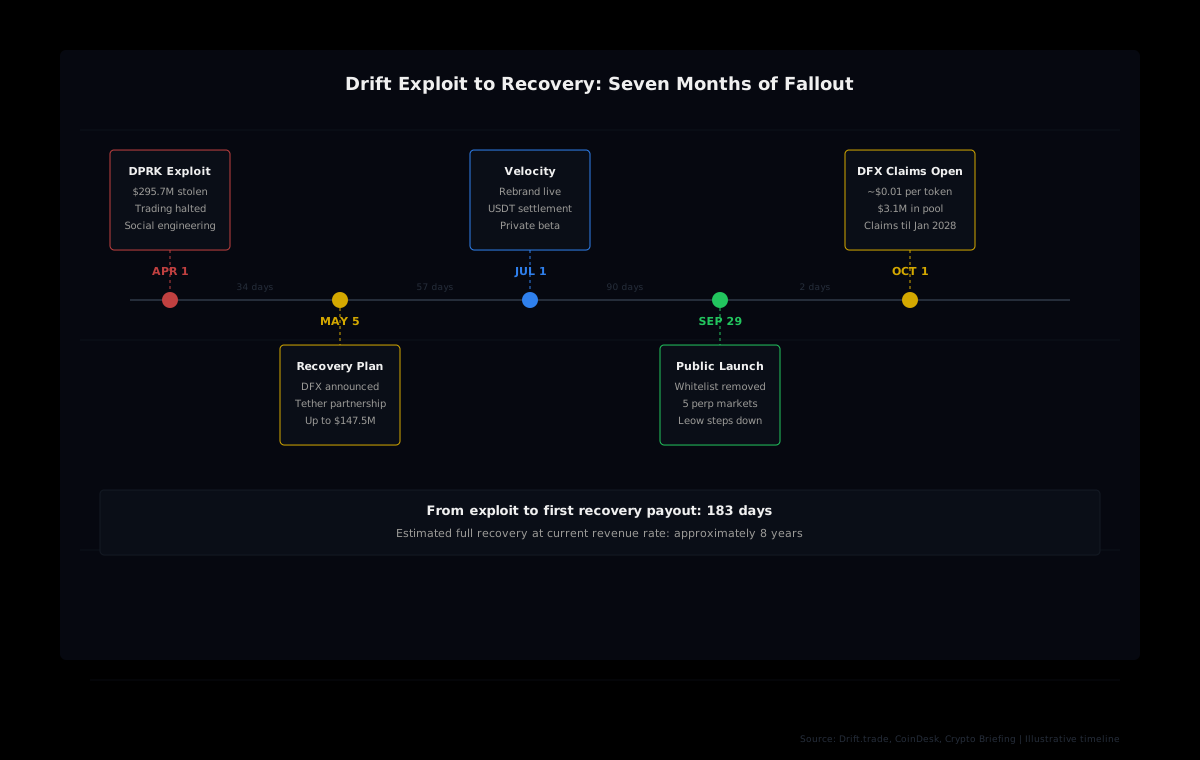
The April 1 attack on Drift wasn't a smart contract vulnerability. It was social engineering at a state level. Forensic firm Mandiant attributed the breach to a DPRK-affiliated threat actor who spent months building relationships with platform contributors before compromising transaction approval systems.
The total stolen: $295,706,374.93 in user assets, including $159.3 million in JLP tokens, $71.4 million in USDC, $11.3 million in cbBTC, and $10.4 million in SOL. The protocol suspended trading and borrowing immediately. Within weeks, the attacker had moved approximately 130,259 ETH across four wallets.
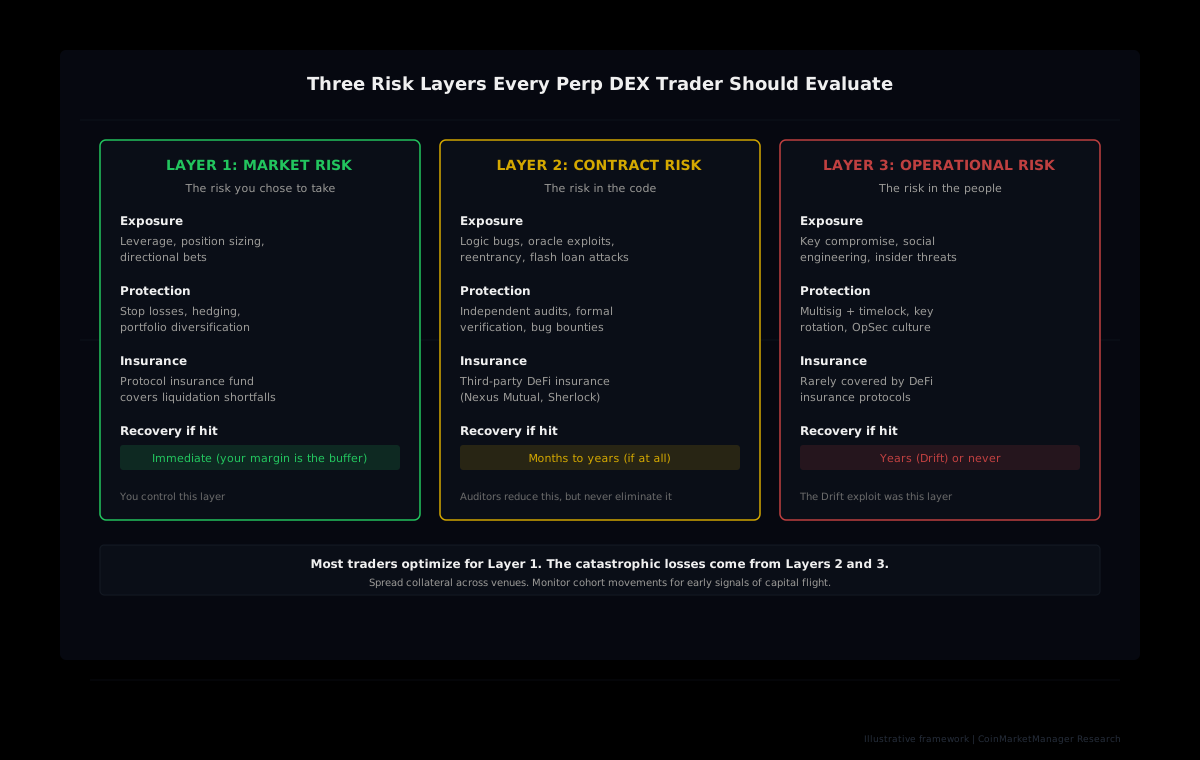
The important detail for perp traders: this wasn't a liquidation engine failure or an oracle manipulation. It was an operational security breach. The smart contracts themselves held up, but the people with signing authority were compromised. That's a risk that exists at every centralized and decentralized venue, and no amount of audit coverage eliminates it entirely.
The DFX Recovery Token, Explained
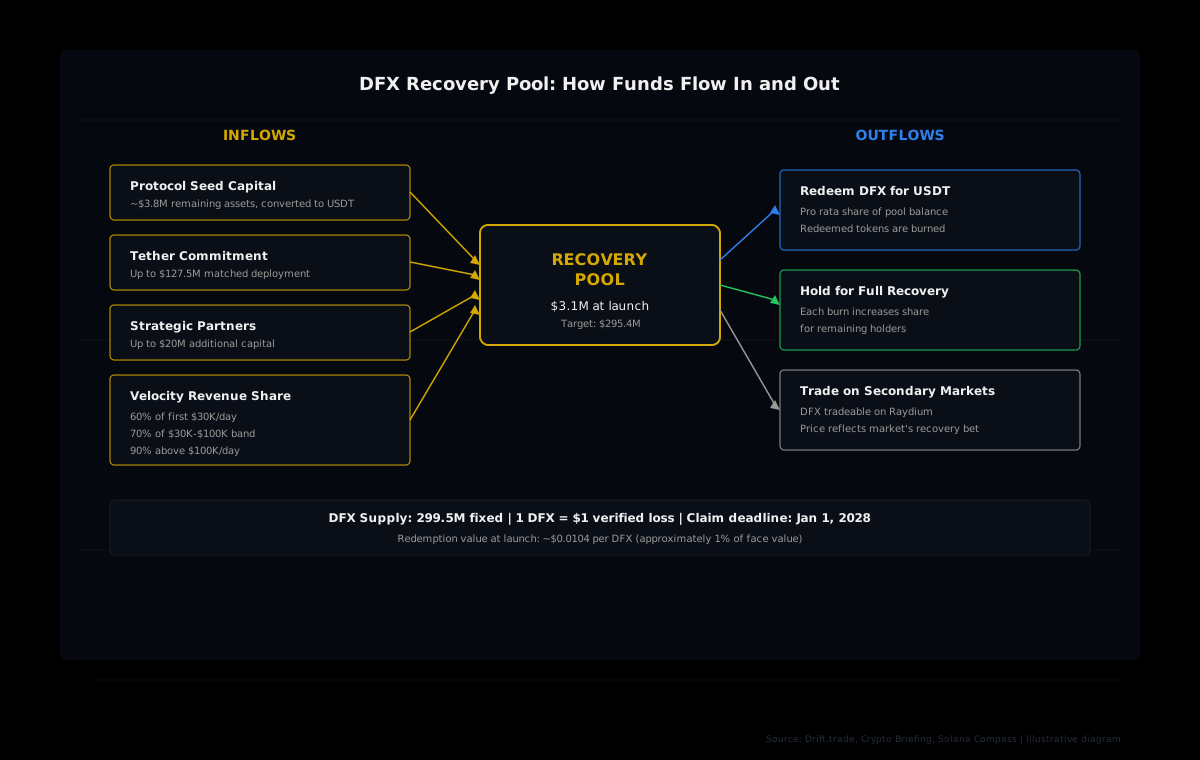
Drift's recovery model centers on DFX, a standard SPL token on Solana with a fixed supply of 299.5 million. Each token represents one dollar of verified loss. The tokens are transferable, which means affected users can hold them, redeem them against the recovery pool, or sell them on secondary markets like Raydium.
The recovery pool collects funds from three sources. First, Drift seeded it with roughly $3.8 million in remaining protocol assets, converted to USDT. Second, Tether committed up to $127.5 million in matched deployment to support the relaunch and recovery. Third, strategic partners pledged up to $20 million.
Ongoing revenue from the relaunched protocol (now called Velocity) also feeds the pool. Net trading fees split three ways: 15% to the insurance fund, 15% to vAMM capital, and 70% as net protocol revenue. Of that revenue, the recovery pool takes a graduated cut: 60% of the first 30,000 USDT each day, 70% of revenue between 30,000 and 100,000 USDT, and 90% of anything above 100,000 USDT.
The Early Redemption Trade-Off
Here's where the mechanism gets interesting for traders. DFX holders can redeem once the pool exceeds $5 million, but redeeming early means forfeiting your claim to future pool growth. If you redeem at one cent per dollar today, you're done. If you hold, and the pool eventually reaches full parity, your tokens are worth face value.
There's a built-in incentive for patient holders, too. When tokens get redeemed and burned, the remaining supply shrinks, which increases each surviving token's share of future deposits. As Drift noted, if 10% of DFX supply were redeemed and burned, each remaining token would receive roughly 11% more of subsequent deposits.
The claim window closes January 1, 2028. Any unclaimed DFX after that deadline gets permanently burned.
Why This Matters Beyond Drift
DeFi exploits are accelerating. Between January and March 2026 alone, fifteen protocols lost $137.7 million to exploits, with an overall recovery rate of just 6.5%. The Drift hack dwarfs all of them combined. And recovery, when it comes at all, takes years.
For perpetual futures traders specifically, the lesson is sharper. You're not just risking your position. You're risking your collateral. A bad trade costs you your margin. A protocol exploit costs you everything you deposited, regardless of whether your trades were profitable.
How Perp DEX Insurance Models Differ
Every perp DEX handles risk differently. Understanding the model matters because when things go wrong, the insurance architecture determines whether you lose a position or lose your entire deposit.
| Platform | Insurance Model | Fund Source | Backstop | | --- | --- | --- | --- | | Hyperliquid | HLP vault + Insurance Fund | Liquidation proceeds (protocol-owned) | Auto-Deleveraging (ADL) | | dYdX v4 | Insurance Fund + permissionless liquidators | Trading fees + liquidation penalties | Socialized losses | | Drift/Velocity | Insurance Fund + vAMM backstop | Trading fees + liquidation penalties | ADL | | Jupiter Perps | JLP pool (LP-funded) | LP deposits + fees | Pool absorbs losses |
A key distinction: Hyperliquid's insurance fund is protocol-owned, built from liquidation proceeds rather than user deposits. The Drift exploit, by contrast, hit user deposits directly because the attacker compromised operational access, bypassing the insurance layer entirely.
Insurance funds protect against market risk (liquidation shortfalls, cascade events). They do not protect against operational risk (key compromise, social engineering, insider threats). Drift's DFX model is essentially a protocol-level IOU for operational failure, funded by future revenue. That's a fundamentally different kind of protection than a liquidation backstop.
Five Questions to Ask Before You Deposit
Drift's recovery model makes a useful framework for evaluating any perp venue. Before you move meaningful capital onto a platform, consider these questions:
- Who controls the signing keys? Multisig with timelock is the minimum. Drift has since moved to dedicated signing devices with timelocked administrative actions. Ask whether your venue of choice had these controls before an incident forced the upgrade.
- What does the insurance fund actually cover? Most insurance funds cover liquidation shortfalls during extreme volatility. Almost none cover protocol-level exploits. Know the difference.
- How large is the insurance fund relative to open interest? A fund that represents a fraction of a percent of total OI provides limited protection in a cascade scenario.
- Has the protocol been audited, and by whom? Drift's relaunch required two independent audits. Audits reduce smart contract risk, but the Drift exploit wasn't a contract bug. Audits are necessary, but they only cover one layer of risk.
- What's the recovery path if the worst happens? Drift's DFX model is more transparent than most. Many protocols have no formal recovery plan at all. If a venue can't articulate what happens to your collateral in a worst-case scenario, that silence is your answer.
The Velocity Relaunch and What Changed
Drift didn't just issue recovery tokens and move on. The protocol rebuilt from scratch and relaunched as Velocity, a leaner perps-only venue settled in USDT rather than USDC. The rebranding became effective July 1, 2026, with a private beta in July, public beta in September, and the whitelist removed on September 21.
The structural changes address the specific attack vector. The durable-nonce mechanism central to the April breach has been eliminated. Program keys were rotated. Ancillary products like Isolated Markets and Amplify were shut down. The result is a smaller attack surface: five perp markets at up to 20x leverage, settled in USDT, with SOL, wBTC, wETH, ZEC, and USDT as collateral.
Drift co-founder Cindy Leow stepped down from the rebuilt exchange on September 29, handing leadership to a new team. Whether Velocity can rebuild trust and volume remains an open question. The protocol's 2025 revenue of $19 million gives a rough baseline, but the competitive landscape has shifted. Hyperliquid now commands roughly 58% of all tracked perp DEX volume, and the market has more options than it did a year ago.
What This Means for Your Trading Setup
Platform risk is the risk most traders ignore. You spend hours backtesting entry signals and optimizing leverage tiers, and then deposit everything onto a single venue without evaluating its security architecture. Drift's users did nothing wrong as traders. Their positions may have been perfectly managed. They still lost nearly everything.
The practical takeaways are straightforward. Spread collateral across venues, because diversification applies to platform risk just as it applies to positions. Monitor protocol health indicators like insurance fund ratios, audit histories, and team operational security practices. And track what smart money is doing, because professional traders evaluate venue risk as part of their process, and their positioning across platforms can signal where sophisticated capital feels safest.
Drift's DFX model is, in some ways, a best-case outcome for a major exploit. The team stayed, built a recovery framework, secured partner commitments, and relaunched. Most protocols that lose $295 million simply disappear. That doesn't make one cent per dollar acceptable. It makes it a reminder that in perp trading, the venue is part of the position.
Track Smart Money Across Hyperliquid
See how 16 behavioral cohorts are positioning in real time. From Shrimp to Leviathan, Money Printer to Giga-Rekt. One API call gives you the intelligence layer that takes months to build from scratch.