
Phantom Earned $23M on Hyperliquid. Here's Who Else Is Cashing In.
By CMM Team - 28-Oct-2026
Phantom Earned $23M on Hyperliquid. Here's Who Else Is Cashing In.
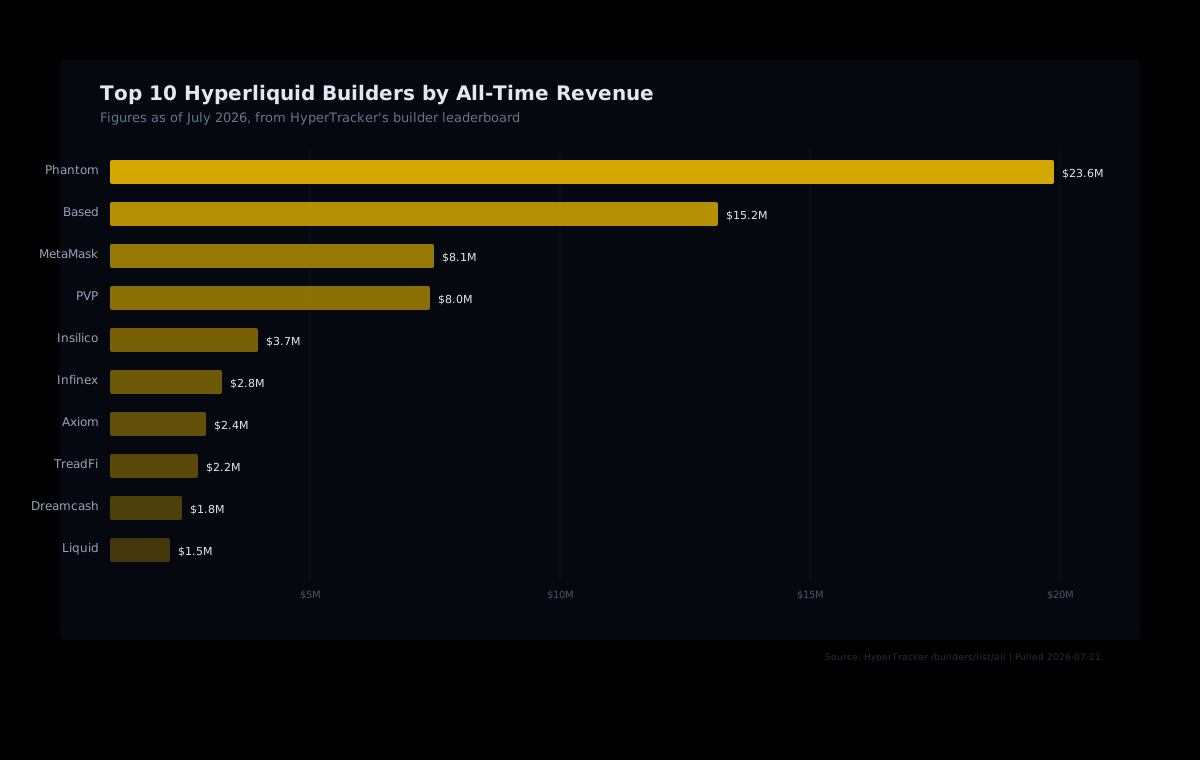
Phantom's Hyperliquid integration has earned $23.6 million in builder code fees. No token launch. No subscription model. Just a wallet that routes every perps trade through a builder code, collecting a fraction of each fill.
Figures as of July 2026, from HyperTracker's builder leaderboard.
That's the standout number, but the leaderboard tells a deeper story. Hyperliquid's builder code program has paid over $90 million to 1,411 registered builders, routing $274.9 billion in total volume through third-party frontends. Hyperliquid itself confirmed that over 100 teams have integrated via builder codes.
But revenue is concentrated. The top five builders capture roughly 65% of all fees, while hundreds of smaller builders split the rest. This article breaks down who's earning what, which strategies actually work, and what the revenue-per-user numbers reveal about builder economics on Hyperliquid.
How Builder Codes Work
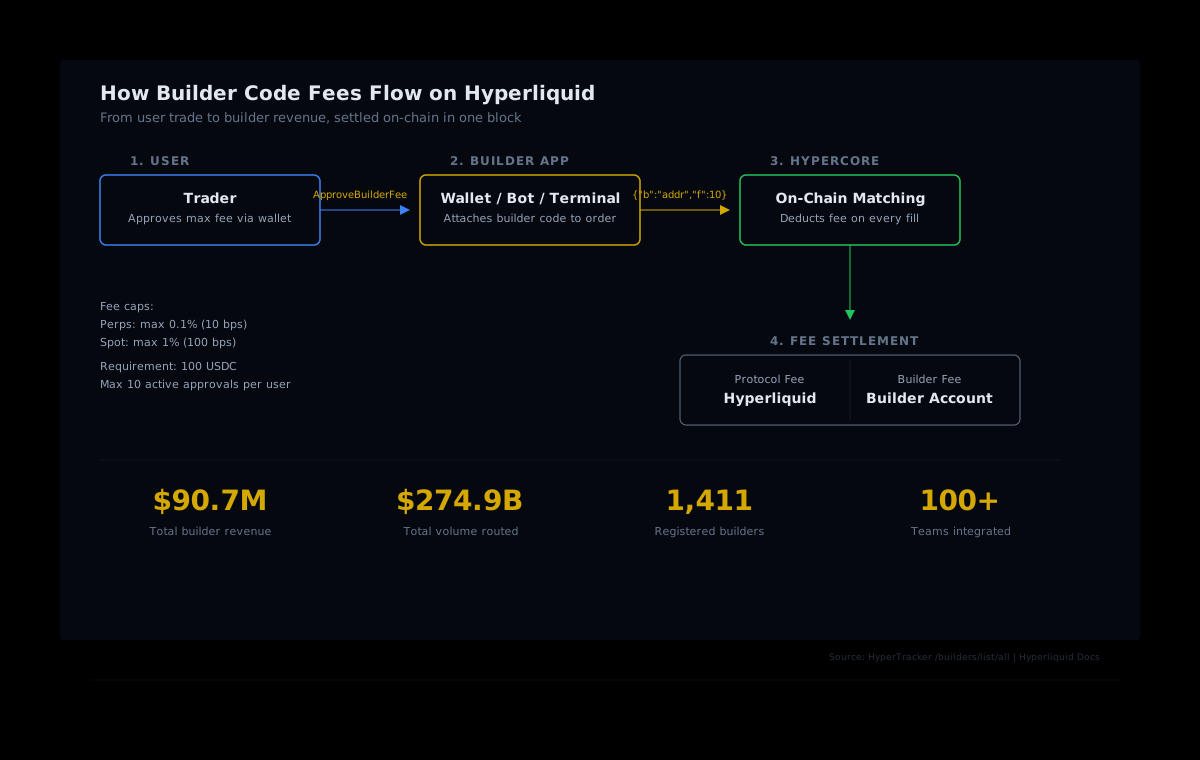
Builder codes are Hyperliquid's native revenue-sharing mechanism for third-party applications. When a user trades through an external app (a wallet, bot, or terminal), the app attaches a builder code to each order. On every fill, HyperCore deducts a small fee from the trader and credits it to the builder's on-chain account. Settlement happens in the same block as the trade itself.
The fee parameter f is expressed in tenths of a basis point. So f=10 equals 1 basis point (0.01%), while the maximum is 10 basis points (0.10%) for perpetuals and 100 basis points (1.00%) for spot trades. These fees stack on top of Hyperliquid's standard trading fees. The builder earns the full surcharge.
Users approve a maximum builder fee for each builder address via the ApproveBuilderFee action, signed by their main wallet. Each user can hold at most 10 active builder code approvals at a time, and they can revoke any approval whenever they want. The consent model is explicit and on-chain.
Becoming a builder requires 100 USDC in a Hyperliquid perpetuals account. That's the entire barrier to entry. A solo developer running a Telegram bot can start earning the same day a company like Phantom does.
The Top 15 Builder Leaderboard
The raw numbers paint a clear picture of where builder code revenue concentrates. Here are the top 15 builders by all-time revenue, pulled directly from our builder leaderboard endpoint:
| Rank | Builder | Revenue | Volume | Users | Joined | | --- | --- | --- | --- | --- | --- | | 1 | Phantom | $23.6M | $44.8B | 153,128 | Jun 2025 | | 2 | Based | $15.2M | $44.9B | 42,967 | Jun 2025 | | 3 | MetaMask | $8.1M | $9.0B | 52,534 | Aug 2025 | | 4 | PVP | $8.0M | $17.1B | 28,223 | Jul 2024 | | 5 | Insilico | $3.7M | $36.3B | 3,339 | Jul 2024 | | 6 | Infinex | $2.8M | $5.2B | 9,283 | Aug 2025 | | 7 | Axiom | $2.4M | $23.0B | 34,093 | Jan 2025 | | 8 | TreadFi | $2.2M | $11.1B | 4,835 | Apr 2025 | | 9 | Dreamcash | $1.8M | $7.6B | 11,215 | Jun 2025 | | 10 | Liquid | $1.5M | $3.2B | 9,499 | Jun 2025 | | 11 | Rabby | $1.5M | $6.5B | 19,031 | Aug 2025 | | 12 | Mass | $1.5M | $2.5B | 1,054 | Jun 2025 | | 13 | Okto | $790K | $3.7B | 8,702 | Apr 2024 | | 14 | Defiapp | $780K | $5.5B | 8,183 | Mar 2025 | | 15 | Minara AI | $775K | $2.6B | 4,933 | Dec 2025 |
Phantom's Playbook: Distribution First
Phantom leads the leaderboard with $23.6 million in all-time builder revenue from 153,128 users and $44.8 billion in volume. Hyperliquid congratulated Phantom on reaching $20M in builder code revenue in under a year, calling out that "users can trade 200+ markets in the Phantom app, including crypto, indices, commodities, and more."
Phantom didn't build a new user base for Hyperliquid perps. It already had millions of active wallets across Solana and EVM chains. Adding perps trading inside the existing wallet meant users could open leveraged positions without installing another app or bridging to a new chain. Phantom charges a 0.05% builder fee on perps, which more than doubles the cost of a base-tier taker fill. For Phantom's user base, the convenience trade-off is worth it.
The lesson is structural. Phantom isn't the best trading terminal on Hyperliquid. It's the wallet millions of people already use. Embedded distribution beats purpose-built features when the friction cost of switching apps is higher than the builder fee.
Based and PVP: Trading-Native Revenue
Based sits at No. 2 with $15.2 million in revenue on nearly identical volume to Phantom ($44.9 billion), but with a third of the user count (42,967 users). That math reveals a core difference: Based's users trade significantly more per capita. Where Phantom routes casual mobile trades, Based attracts active traders who size into positions and trade frequently.
PVP (rank 4, $8.0 million) follows a similar pattern. Its 28,223 users generate $17.1 billion in volume, because PVP.trade is a dedicated trading terminal designed for power users. Advanced order types, better charting, and a social trading layer keep users coming back. PVP was also one of the earliest builders on Hyperliquid, integrating in July 2024, which gave it a head start on user acquisition before wallet integrations entered the picture.
Revenue Per User: The Hidden Metric
Total revenue tells you who's big. Revenue per user tells you who's efficient. When you divide each builder's all-time revenue by their unique user count, the leaderboard reshuffles dramatically.
Mass leads at $1,395 per user, generating $1.5 million from just 1,054 users. That's the signature of an institutional or high-frequency integration where a small number of accounts drive outsized volume. Insilico follows at $1,113 per user, with 3,339 users trading $36.3 billion in volume. Insilico's volume-to-user ratio is the highest on the entire leaderboard, suggesting its users are running systematic strategies that churn significant notional.
Compare that to Phantom's $154 per user or MetaMask's $153. The wallets win on raw scale, but their per-user monetization is an order of magnitude lower than specialized platforms. This isn't a criticism. Wallets are playing the volume game, and the math works because their distribution is so large.
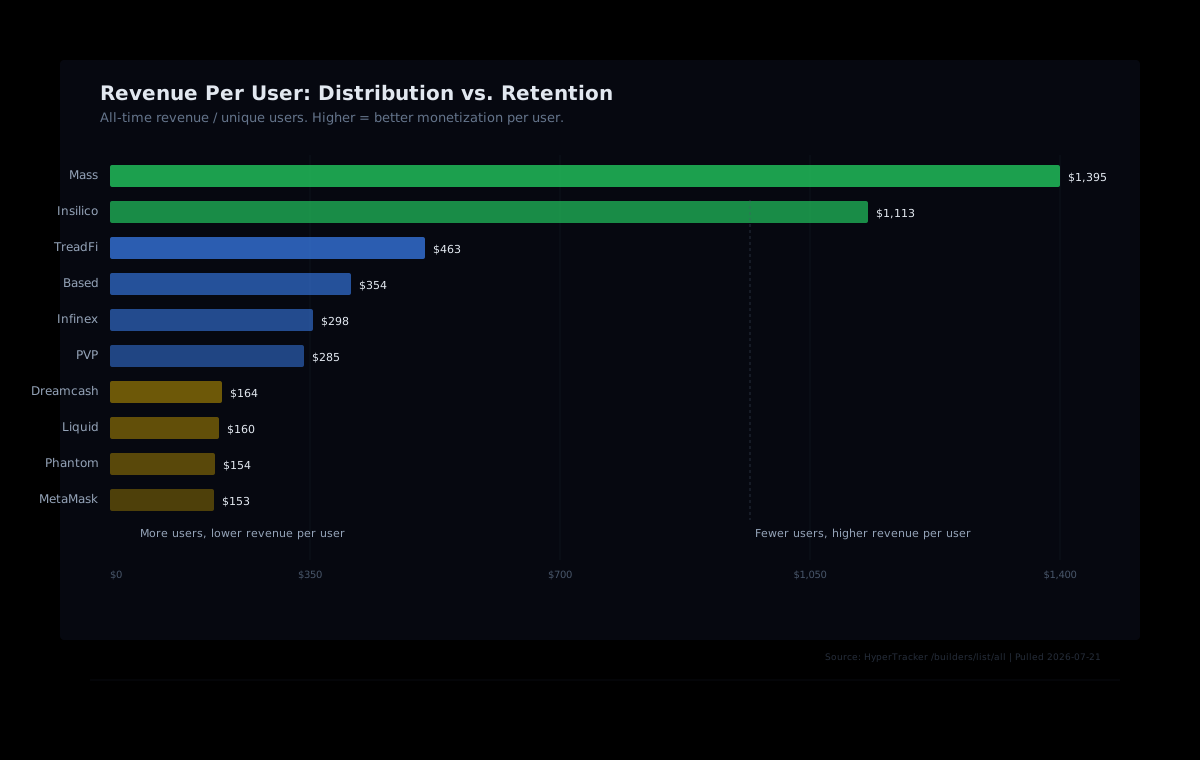
Two viable strategies emerge from the data. Wallets and aggregators win by routing massive user bases through a small per-trade fee. Specialized platforms win by attracting fewer, higher-value users who trade large and trade often. Both models can produce millions in annual revenue.
What the Volume Numbers Reveal
Look at Axiom: $2.4 million in revenue from $23.0 billion in volume and 34,093 users. Working backwards from the revenue and volume, the math suggests a fee rate of roughly 1 basis point, well below Phantom's 5 basis points. Axiom captures volume by charging less, likely routing DEX aggregation flows where users are price-sensitive and will switch apps to save a fraction of a basis point.
TreadFi ($2.2 million, $11.1 billion volume) and Dreamcash ($1.8 million, $7.6 billion volume) sit in the mid-tier, each generating meaningful revenue from distinct product angles. TreadFi's 4,835 users deliver $463 in revenue per user, making it the third most efficient builder on a per-user basis. That profile points to a product that retains serious traders.
Rabby (rank 11) is worth noting as the second major wallet integration after Phantom. With $1.5 million in fees from 19,031 users, Rabby shows that the wallet playbook scales beyond Phantom's early lead, albeit at a smaller scale so far. MetaMask at rank 3 tells the same story from the institutional angle, with 52,534 users generating $8.1 million in builder revenue since its August 2025 launch.
Builder Economics: What Makes a Sustainable Business
The builder code program pays out when trades fill. That means builder revenue is directly correlated with trading volume, which means it's correlated with market volatility. Builders need to plan for that cyclicality.
A few patterns distinguish sustainable builder businesses from one-hit integrations:
- Retention drives compounding. Builder codes persist per order, and users don't automatically stay with a builder across sessions. The builders generating consistent revenue are the ones where users choose to return: wallets they use daily, terminals with better tooling, bots that automate strategies they'd execute manually anyway.
- Fee rate is secondary to volume. Axiom proves you can generate millions at lower fee rates if volume is high enough. Phantom proves you can charge more if your distribution is large enough that users won't switch. The winning fee rate depends on your product's stickiness.
- Early entry helps, but isn't decisive. PVP and Insilico joined in mid-2024, giving them a head start. But Phantom and Based both launched in June 2025 and quickly overtook most early entrants. Product quality and distribution matter more than timing.
Minara AI at rank 15 ($775K in revenue) is the youngest builder in the top 15, joining in December 2025. Its presence signals that new builders can still break into the top tier, especially with differentiated products like AI-powered trading tools.
Track the Leaderboard Yourself
Our builder leaderboard data comes from the HyperTracker API. The /builders/list endpoint returns revenue, volume, user counts, and metadata for every registered builder on Hyperliquid. You can query by timeframe (daily, weekly, monthly, all-time) to track momentum shifts as new builders enter and existing ones compound their user bases.
If you're building on Hyperliquid or tracking builder economics for investment analysis, the leaderboard data is available starting at the Free tier (100 requests/day) and scales up through Pulse ($179/mo) for production polling.
Track Hyperliquid Builder Economics in Real Time
Our builder leaderboard API gives you revenue, volume, and user counts for every builder code on Hyperliquid. One endpoint. All the data.
Where Builder Revenue Goes Next
Builder code revenue recently surpassed $100 million in total payouts, up from the $90.7 million captured in our July snapshot. That trajectory has accelerated as more wallets and terminals integrate Hyperliquid's perps engine.
The next wave of builder revenue will likely come from three places. First, additional wallet integrations following the Phantom and MetaMask playbook. Every major non-custodial wallet is now evaluating a Hyperliquid builder code, because the revenue model is proven and the integration effort is minimal. Second, AI-powered trading tools that route automated strategies through builder codes. Minara AI's rapid ascent in the rankings hints at this trend. Third, institutional frontends that embed Hyperliquid liquidity into professional trading interfaces, similar to what MetaMask has started.
For builders, the math is clear. For traders, the builder fee is the cost of convenience. And for anyone watching Hyperliquid's ecosystem grow, the builder leaderboard is one of the best real-time indicators of where distribution and product quality actually concentrate.