
Record Bitcoin Supply in Loss: How Smart Money Is Responding
By CMM Team - 25-Jun-2026
Record Bitcoin Supply in Loss: How Smart Money Is Responding
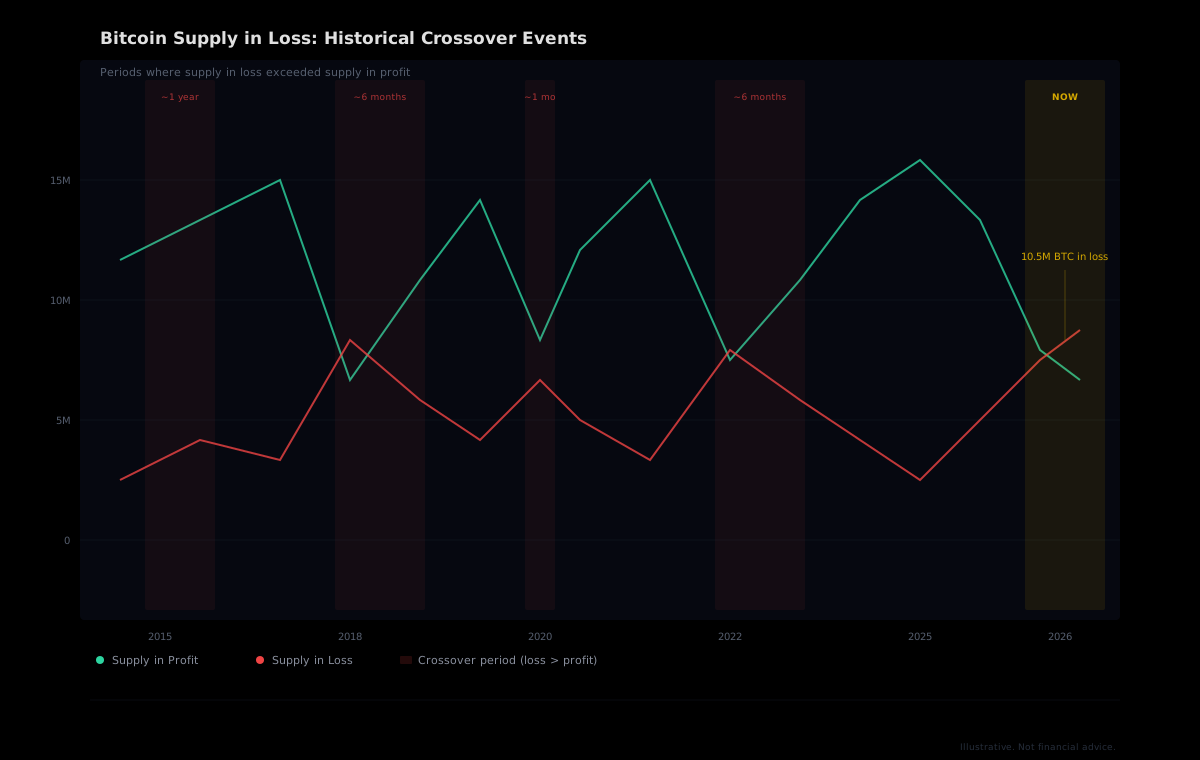
More than half of all Bitcoin in circulation is now held at a loss. For the first time this cycle, the amount of BTC underwater has crossed above the amount held in profit, with roughly 10.5 million BTC sitting below their last-moved price against 9.8 million still in the green.
This crossover has only happened a handful of times in Bitcoin's history, and each prior occurrence coincided with a bear market bottom. In 2015 the supply-in-loss majority lasted almost a year. In 2019 it held for roughly six months. The March 2020 flash crash compressed it to about a month. The 2022 bear market saw approximately six months of the same.
But the aggregate on-chain number tells you the market is stressed. It does not tell you who is stressed and who is quietly positioning. That second question is where cohort data changes the entire read.
What the supply-in-loss metric actually measures
Supply in loss counts every BTC whose last on-chain movement happened at a price higher than the current spot price. If you bought (or received) BTC at $90,000 and the market is now at $62,000, those coins are "in loss." They have not been realized, meaning you have not sold them, but on paper you are underwater.
The mirror metric, supply in profit, counts every BTC last moved at a price below current spot. When these two lines cross, it means the majority of coins in circulation were acquired at prices above where the market trades today.
This is not a theoretical threshold. Historically, the crossover has been one of the most reliable contrarian signals in Bitcoin on-chain analysis because it captures the exact moment aggregate pain peaks. The logic: when the majority of holders are underwater, the selling pressure from those who would capitulate has largely already happened. The remaining holders are either unable to sell (lost keys, long-term commitment) or unwilling to sell (strong conviction). The supply that could create downside pressure has been exhausted.
What triggered this crossover
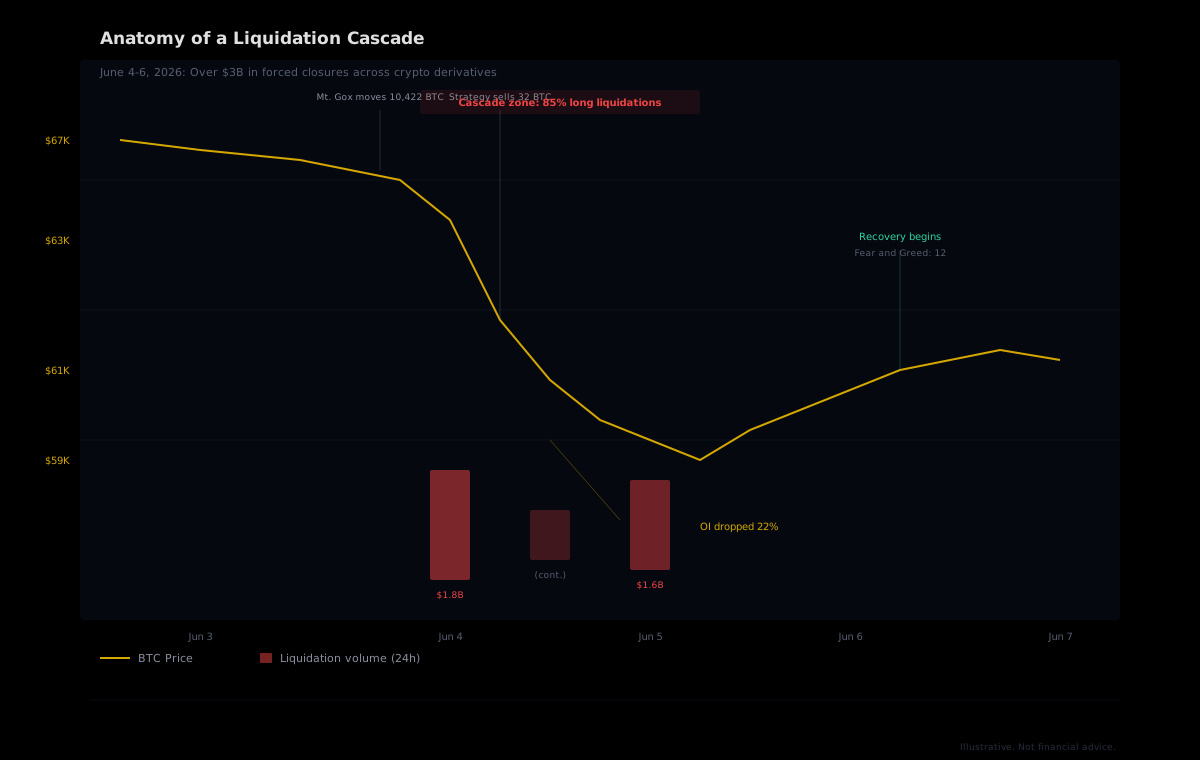
Bitcoin fell from roughly $67,000 to a cycle low of $59,100 between June 4 and June 6, 2026. The move was violent because multiple catalysts stacked on top of each other within 48 hours.
Mt. Gox's estate moved 10,422 BTC worth approximately $739 million to new wallets ahead of its October 2026 creditor repayment deadline. Strategy (formerly MicroStrategy) disclosed it had sold 32 BTC for the first time in years, a symbolic break from its accumulation-only policy. U.S.-listed Bitcoin ETFs had been bleeding capital for 13 consecutive days, with cumulative outflows reaching $4.33 billion.
The result: over $3 billion in leveraged positions were forcibly closed across crypto derivatives markets between June 4 and 6, with June 4 alone recording roughly $1.8 billion and June 6 adding another $1.6 billion. On June 4, long positions accounted for roughly 85% of BTC-specific liquidations.
Why aggregate metrics miss the real story
The 10.5 million BTC number sounds alarming, and it is. But it tells you the same thing as "the market went down a lot." It does not tell you whether the people holding those losing positions are seasoned traders with conviction or retail latecomers who bought the top.
That distinction matters because bear market bottoms do not form when everyone is in pain. They form when the right people are in pain, specifically the participants who will capitulate, while the participants who will accumulate start building positions. The aggregate supply-in-loss crossover captures the macro inflection. Cohort-level data captures the micro behavior that confirms whether it is real.
On Hyperliquid, every perpetual futures position is on-chain and verifiable. Our data classifies every wallet into one of 16 behavioral cohorts based on account size (8 tiers from Shrimp to Leviathan) and all-time PnL (8 tiers from Giga-Rekt to Money Printer). This means you can look at the supply-in-loss crossover and then check: are the Money Printers adding exposure? Are the Exit Liquidity wallets panic-closing?
How profitable cohorts behave during capitulation
Money Printer wallets (over $1M in cumulative perp PnL) and Smart Money wallets ($100K to $1M in cumulative PnL) have a history of counter-cyclical behavior. When aggregate on-chain metrics flash maximum pain, these cohorts tend to be on the other side of the trade.
The mechanism is straightforward. Profitable traders have survived previous drawdowns. They have the psychological and capital reserves to buy when others are forced to sell. During liquidation cascades, they get better entries because the selling is not driven by voluntary decision-making. It is driven by margin calls.
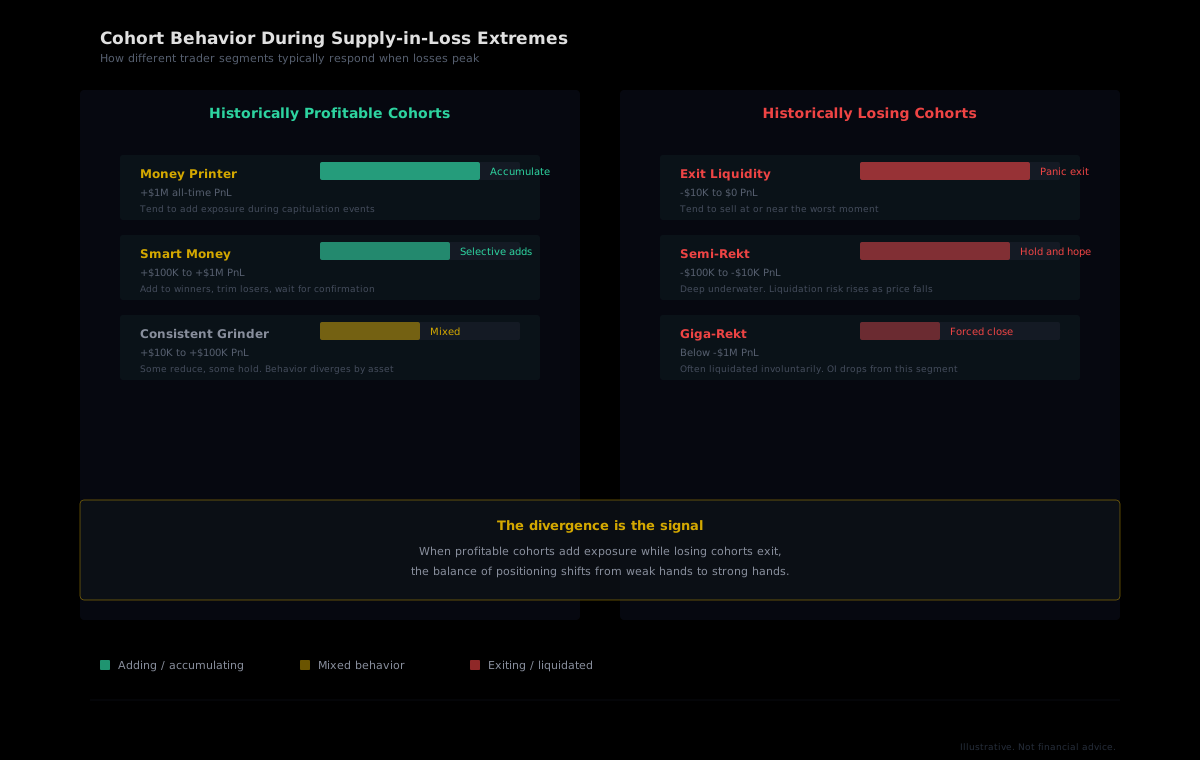
This creates a measurable divergence. When the profitable cohorts' aggregate OI is flat or rising while the losing cohorts' OI is dropping, it signals a transfer of positioning from weak hands to strong hands. The market's total OI may be falling (because more positions are closing than opening), but the composition of who holds the remaining positions shifts dramatically.
What to query
If you are building against our API, the per-cohort position metrics endpoint gives you exactly this breakdown. Query the Money Printer cohort (segment ID 8) and the Giga-Rekt cohort (segment ID 15) for BTC, then compare their OI trends over the same window. A widening gap, where Money Printer OI holds steady or rises while Giga-Rekt OI collapses, is the strongest confirmation signal you can get alongside the on-chain supply-in-loss crossover.
The open interest read
Total open interest across the crypto derivatives market dropped 22% during the June 4-6 cascade. That is the aggregate wipeout. But again, aggregate OI tells you how much was flushed, which is not as useful as knowing whose positions were flushed.
In a liquidation cascade driven by overleveraged longs (as the roughly 85% long liquidation ratio on June 4 confirms), the OI that disappears overwhelmingly belongs to the most vulnerable positions: high leverage, small margin buffers, concentrated in a single direction. These tend to cluster in the less profitable cohorts. Wallets with lower all-time PnL run higher leverage on average because they are trying to recover losses. Wallets with strong track records tend to use more conservative leverage because they are protecting gains.
When OI drops 22% but the composition of remaining OI shifts toward better-performing cohorts, the market is actually healthier after the flush than before it. The leverage has been cleaned out. The surviving positions have wider margin buffers and more experienced managers.
The drop itself is not the signal. The change in who holds the remaining positions is the signal.
Funding rates as a confirmation layer
After a liquidation cascade, funding rates typically flip or compress toward zero. On Hyperliquid, funding is calculated hourly, so the adjustment happens faster than on centralized exchanges that use 8-hour intervals.
When funding goes deeply negative (shorts paying longs), it means the remaining market participants are overwhelmingly positioned short, expecting further downside. This is meaningful because if the leveraged long positions have already been liquidated and the remaining market is betting on more downside, the question becomes: who is left to sell?
Combining funding rate direction with cohort OI composition gives you a layered read. Negative funding plus Money Printer cohort OI rising is the strongest contrarian setup: the market is paying you to be long while the most profitable participants are adding exposure. Negative funding with all cohorts reducing OI is a different picture entirely, suggesting the pain is broad-based and may not be finished.
Building an alert around this framework
The conceptual framework, supply-in-loss crossover plus cohort divergence plus funding rate confirmation, translates directly into something you can automate. Using HyperTracker's API, you can build a monitoring system that watches for convergence across these three signals.
The query logic is straightforward. Pull cohort position metrics for segments 8 (Money Printer) and 15 (Giga-Rekt) at regular intervals using the /cohort-position-metrics endpoint. Track their OI deltas over rolling windows. When Money Printer OI is stable or increasing across multiple consecutive snapshots while Giga-Rekt OI is declining, flag the divergence.
Layer in funding rate data from the /funding-rates endpoint. If the divergence coincides with deeply negative funding, the setup gains conviction. You can pipe these signals into a webhook or any alerting system to get notified when the pattern emerges across the assets you trade.
# Pseudocode: cohort divergence monitor
money_printer = get_cohort_oi(segment_id=8, asset="BTC")
giga_rekt = get_cohort_oi(segment_id=15, asset="BTC")

mp_delta = money_printer.current - money_printer.previous
gr_delta = giga_rekt.current - giga_rekt.previous

if mp_delta >= 0 and gr_delta < 0:
    funding = get_funding_rate(asset="BTC")
    if funding < -0.001:
        alert("Cohort divergence + negative funding on BTC")
See which cohorts are moving right now
HyperTracker's API classifies every Hyperliquid wallet into 16 behavioral cohorts by size and all-time PnL. Query per-cohort position metrics, funding rates, and liquidation risk in one call. Start free, scale to $179/mo for production workloads.
What this setup does not tell you
The supply-in-loss crossover is a bottoming signal, historically. It is not a timing signal. In 2015, the crossover lasted nearly a year before the market convincingly reversed. In 2022, it held for about six months. The crossover tells you the market is in the zone where bottoms historically form. It does not tell you the bottom is today.
Similarly, cohort divergence confirms that positioning is shifting from weak to strong hands. It does not guarantee the shift is complete. Strong hands can absorb further losses if the macro backdrop deteriorates further. The signal improves your read. It does not give you a price target or a date.
The value is in combining these layers, on-chain supply metrics, per-cohort OI composition, and funding rate context, into a framework that tells you more than any single metric alone. When all three align, history says you are closer to the bottom than the top. When they conflict, the picture is muddier and patience is warranted.
Over half the Bitcoin supply is underwater. The leveraged longs have been flushed. The question that matters now is not how much pain exists in the aggregate. It is whether the wallets with the strongest track records are quietly building positions through the noise, or sitting on the sidelines. That is the signal worth watching.