Richard Heart's Arrest Crashed HEX 64%. Founder Risk Is the Trade.
By CMM Team - 15-Oct-2026
Richard Heart's Arrest Crashed HEX 64%. Founder Risk Is the Trade.
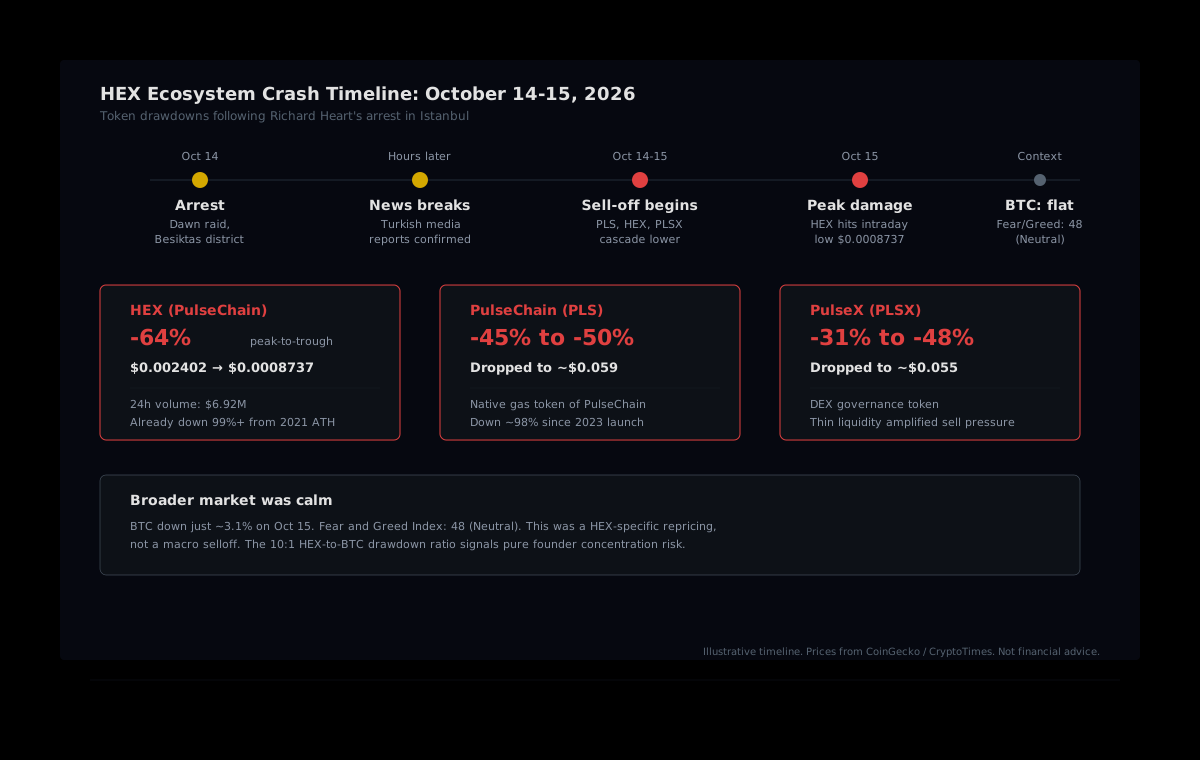
Richard Heart was arrested in Istanbul on October 14, 2026. Within hours, HEX on PulseChain fell from $0.002402 to an intraday low of $0.0008737, a peak-to-trough decline of roughly 64%. PulseChain's native token dropped 45% to 50%. PulseX lost 31%. Bitcoin, meanwhile, was down roughly 3.1% on the same day.
The CoinMarketCap Fear and Greed Index sat at 48. Neutral. This was not a macro flush. This was one ecosystem repricing around one man, with a 10:1 drawdown ratio between HEX and Bitcoin. The episode is the clearest live demonstration of founder concentration risk in crypto this year, and it holds lessons for anyone trading or building on perpetual futures platforms like Hyperliquid.
This article breaks down what happened, why tokens tied to a single personality carry structural fragility, and how cohort analytics can help traders and builders read these situations before, during, and after the crash.
The Istanbul Dawn Raid
Turkish police and the National Intelligence Organization (MIT) detained Heart at a residence in Istanbul's upscale Besiktas district. His wife was also taken into custody. Officers seized $4 million in cash, 64 luxury watches (53 Rolex, 11 Patek Philippe), firearms, ammunition, crypto mining equipment, and encrypted cold storage wallets.
The arrest followed an Interpol Red Notice issued at Finland's request in December 2024. The primary charge is aggravated tax fraud involving an alleged hundreds of millions of euros in unpaid taxes between 2020 and 2024. Finnish authorities have also sought Heart in connection with an alleged assault.
Heart, whose legal name is Richard James Schueler, was previously charged by the SEC in 2023 with raising more than $1 billion through unregistered securities offerings across HEX, PulseChain, and PulseX. The complaint alleged at least $12 million was misappropriated for luxury items, including a 555-carat black diamond called "The Enigma." That case was dismissed in February 2025 for lack of U.S. jurisdiction, and the SEC chose not to appeal. Wednesday's detention stems from Finland's investigation, a separate legal theory in a different jurisdiction.
Why the Token Crashed Harder Than the Market
HEX's 24-hour trading volume spiked to $6.92 million as holders rushed to exit. But the sell-off exposed a structural problem that goes deeper than one arrest. HEX was already down more than 99% from its 2021 peak near $0.44. PulseChain's gas token had shed roughly 98% since its 2023 launch.
What drove the crash was not new information about the protocol's code or its on-chain mechanics. Nothing changed technically. What changed was the legal standing of the person the token's narrative runs through. The market priced Heart's jeopardy as directly material to the token's value, because for projects like HEX, the founder is the value proposition.
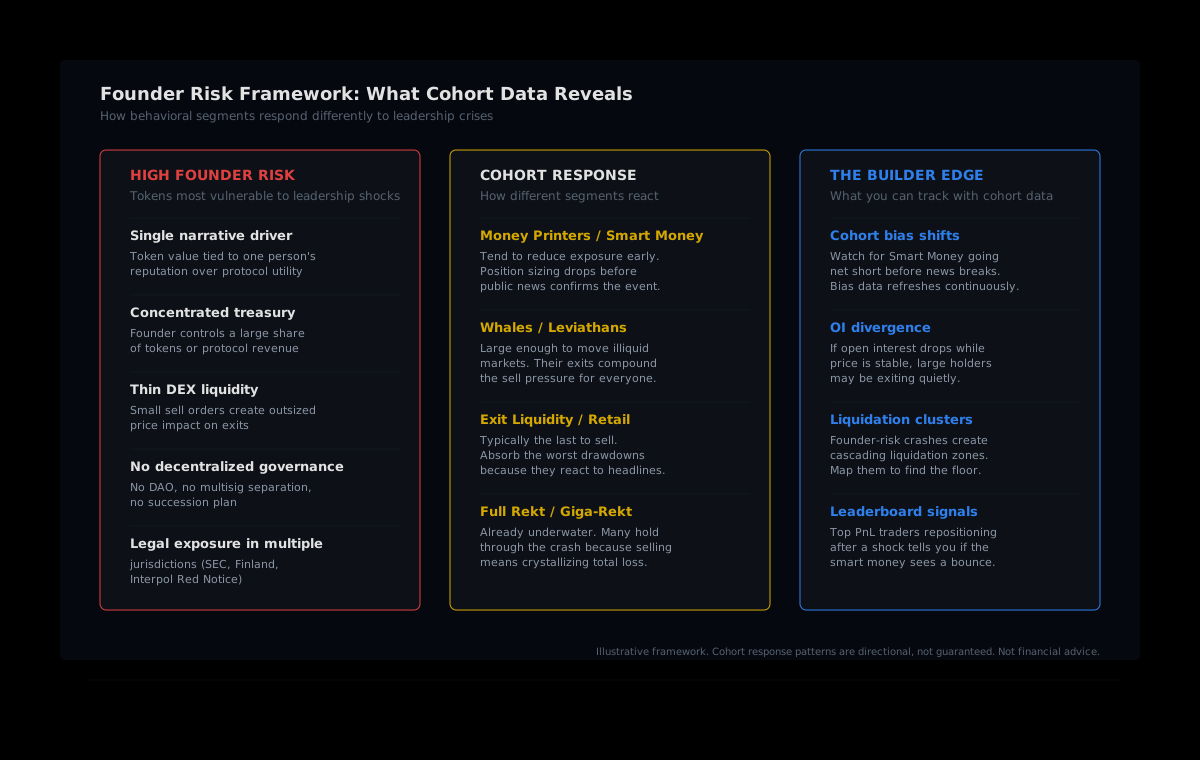
This is founder concentration risk in its purest form. When a single individual controls the narrative, the treasury, the public identity, and in many cases the technical direction of a token ecosystem, their personal legal exposure becomes the token's downside risk. There is no DAO to absorb the shock, no multisig separation, no succession plan. The token's price is a function of the founder's freedom.
Founder Risk Is Structural, and It Shows Up Everywhere
HEX is an extreme case, but the dynamic is not unique. Crypto has a long history of tokens repricing violently on founder-related news: Do Kwon's arrest triggered a secondary sell-off in remaining Luna-adjacent assets. The Celsius founder's indictment killed any residual recovery narrative. Even Binance's BNB traded lower when CZ accepted his guilty plea, though BNB recovered because Binance had actual revenue, institutional custody infrastructure, and a succession plan.
The pattern is consistent. Tokens with genuine protocol utility, decentralized governance, and revenue independent of any single person absorb founder shocks. Tokens that depend on one personality for narrative momentum collapse under the same pressure.
For perp traders, this distinction matters because founder-risk crashes create the most volatile, fast-moving opportunities in the market. They tend to overshoot fair value on the way down (thin DEX liquidity amplifies panic), and they often produce sharp reversals when the initial selling exhausts itself. The question is whether you can read the flow clearly enough to distinguish genuine capitulation from a dead-cat bounce.
How Cohort Analytics Reads the Aftermath
This is where behavioral segmentation becomes useful. Instead of watching a single price candle and guessing who is selling, cohort data breaks the market into segments by wallet size and historical PnL performance. Our data classifies every wallet on Hyperliquid into 16 behavioral cohorts: eight by perp equity size (Shrimp through Leviathan) and eight by all-time PnL track record (Money Printer through Giga-Rekt).
When a founder-risk event hits a token that trades on Hyperliquid (or a correlated asset that does), the cohort data tells you something the price chart alone cannot: which segments are selling, and which are positioning for the other side of the trade.
Smart Money Versus Retail Response
In crisis events, the Money Printer and Smart Money cohorts (wallets with the strongest all-time PnL) tend to reduce exposure early. They often adjust positioning before headlines confirm the news, because they are plugged into information networks that move faster than mainstream media. The bias endpoint in our API gives you a rolling read on whether these segments are net long or net short on any given asset.
Exit Liquidity and smaller retail cohorts typically react later, chasing headlines. They sell after the biggest move has already happened, absorbing the worst of the drawdown. This lag between informed and uninformed selling is where the tradeable signal lives.
Open Interest as a Conviction Gauge
Open interest tells you how much capital is at stake, and who is adding or removing it. When OI drops sharply in Whale and Leviathan cohorts while remaining stable in smaller segments, it signals that large holders are closing positions. The converse is equally revealing: if large-holder OI stays flat through a crash, the selling may be coming from smaller, overleveraged wallets that are getting liquidated rather than making deliberate decisions.
This distinction matters for timing. Liquidation-driven crashes tend to produce sharper V-shaped recoveries because the selling is forced, and it stops once the margined positions are wiped. Conviction-driven exits by large holders suggest more sustained downside because the selling reflects a genuine reassessment of the asset's value.
A Crisis Playbook for Builders
Whether you are building a copy-trading bot, a risk dashboard, or an alert system, founder-risk events are exactly the kind of scenario where pre-built analytics infrastructure pays for itself. Trying to manually track wallet movements across an entire exchange during a crisis is like trying to drink from a fire hose. Cohort data distills it into actionable segments.
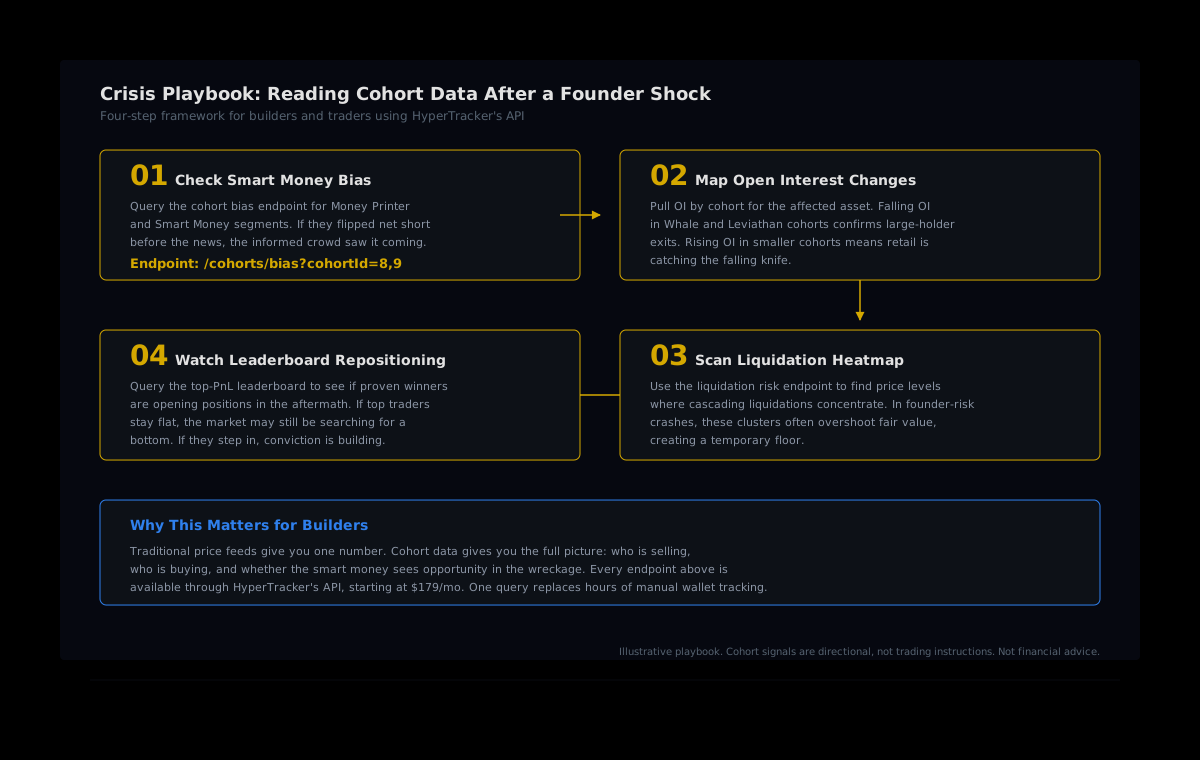
The playbook breaks down into four steps:
- Check Smart Money bias. Query the cohort bias endpoint for Money Printer and Smart Money segments to see if informed wallets shifted their positioning before the news broke.
- Map OI changes by cohort. Pull open interest by cohort for the affected asset. Falling OI in large-holder cohorts confirms deliberate exits. Rising OI in smaller cohorts suggests retail is trying to catch the falling knife.
- Scan the liquidation heatmap. Use the liquidation risk endpoint to find price levels where cascading liquidations cluster. In founder-risk crashes, these zones often sit below the current price and act as magnets pulling the market lower until the liquidation pressure exhausts itself.
- Watch leaderboard repositioning. Query the top-PnL leaderboard to see if proven winners are opening positions in the aftermath. If the best traders stay flat, the market may still be finding a bottom. If they step in, conviction is building from the top down.
Beyond HEX: Founder Risk on Hyperliquid
HEX and PulseChain do not currently trade as perpetual contracts on Hyperliquid. But the founder-risk framework applies to any token listed on the platform, especially as Hyperliquid's permissionless listing mechanism (HIP-3) continues to expand the roster of tradeable assets. Any project where a single founder dominates the narrative carries the same structural fragility HEX demonstrated this week.
The more interesting application is indirect contagion. When a major token crashes on founder news, the volatility ripples outward. Correlated assets move. Funding rates shift. Liquidity migrates. Cohort data across the broader Hyperliquid market can reveal which segments are repositioning in response to contagion versus trading the primary event. That signal separation is the difference between reacting to noise and trading with conviction.
For builders, the lesson is practical. If you are building an alert system, add founder-risk signals. If you are building a copy-trading bot, filter for cohorts with strong track records, because those segments tend to navigate crisis events more effectively than aggregate market data suggests. If you are building a risk dashboard, surface OI-by-cohort breakdowns during high-volatility events so your users can see who is driving the move.
Track Who Panics and Who Profits
HyperTracker's API gives you 16 behavioral cohorts, open interest by segment, liquidation risk scoring, and top-trader leaderboards. One API call replaces hours of manual wallet tracking. Free tier available.
Extradition, Legal Limbo, and What Comes Next
Heart has not been convicted of anything. Turkey must now decide whether to extradite him to Finland, a process that can take months. Finland's formal extradition request has not yet been filed publicly, and Turkish courts will weigh the case on its merits.
For traders and builders, the legal timeline creates a secondary dynamic. Every courtroom development becomes a potential catalyst for volatility. An extradition denial could trigger a relief rally. A conviction could push HEX ecosystem tokens to new lows. Both scenarios create opportunities for anyone with the right data infrastructure to read the flow.
The broader lesson from Heart's arrest is not about HEX specifically. It is about how much downside risk hides inside projects that depend on a single person. The code did not change. The supply schedule did not change. The on-chain mechanics are identical today to what they were on October 13. What changed is one man's legal status, and the market treated it as a 64% event.
If your portfolio holds any token where the founder is the product, that is the risk you carry every day. Cohort data will not eliminate it, but it will tell you who else sees the risk coming and how they are positioning around it. In a market built on narrative, that is the edge worth having.