
Robinhood Brought 28 Million Users to On-Chain Perps. Now What?
By CMM Team - 18-Jul-2026
Robinhood Brought 28 Million Users to On-Chain Perps. Now What?
On July 1, 2026, Robinhood launched its own Layer 2 blockchain with perpetual futures trading baked in from day one. Lighter, a perp DEX backed by Robinhood Ventures, went live as the chain's official derivatives partner. Within two weeks, the chain processed $3.1 billion in DEX volume and ranked among the top five chains by DEX activity.
Robinhood serves nearly 28 million customers. Most of them have never touched a perpetual futures contract, let alone traded on-chain. But the infrastructure is now live, the on-ramp is frictionless, and the question every perp DEX builder should be asking is: what happens when millions of retail users start generating on-chain derivatives flow?
The answer matters because on-chain perps create readable signals. Every position, every fill, every liquidation is public. When trading happens on a CEX, that flow is invisible. When it happens on-chain, builders can classify it, aggregate it, and turn it into intelligence. More users on-chain means more signal for everyone building on top of it.
What Robinhood Actually Shipped
Robinhood Chain is an Arbitrum-based Layer 2 built for tokenized real-world assets and DeFi. The launch included four categories of products that, taken together, make this the most aggressive DeFi push by a traditional broker in crypto history.
Perpetual futures via Lighter and Arcus. Lighter operates as a zero-knowledge rollup DEX with a 50/50 revenue share model with Robinhood. Arcus, built by the dYdX team, pairs stock tokens with crypto perpetuals on the same chain. Both were live on day one.
Stock tokens across 120+ countries. Tokenized equities (NVDA, GOOG, AAPL, and others) trade 24/7 through the Robinhood Wallet and can be used as collateral, deposited into lending pools, or traded on Uniswap and 1inch.
DeFi yield through Morpho. Robinhood Earn lets eligible users lend USDG (Robinhood's stablecoin) for an estimated 7% APY, with insurance through Lloyd's of London covering cyber incidents and smart contract exploits.
EU perps on commodities, ETFs, and FX. European users can trade GOLD, SILVER, QQQ, EUR/USD, WTI, and Brent crude perpetuals with up to 10x leverage, 24/7. This is not crypto-only anymore.
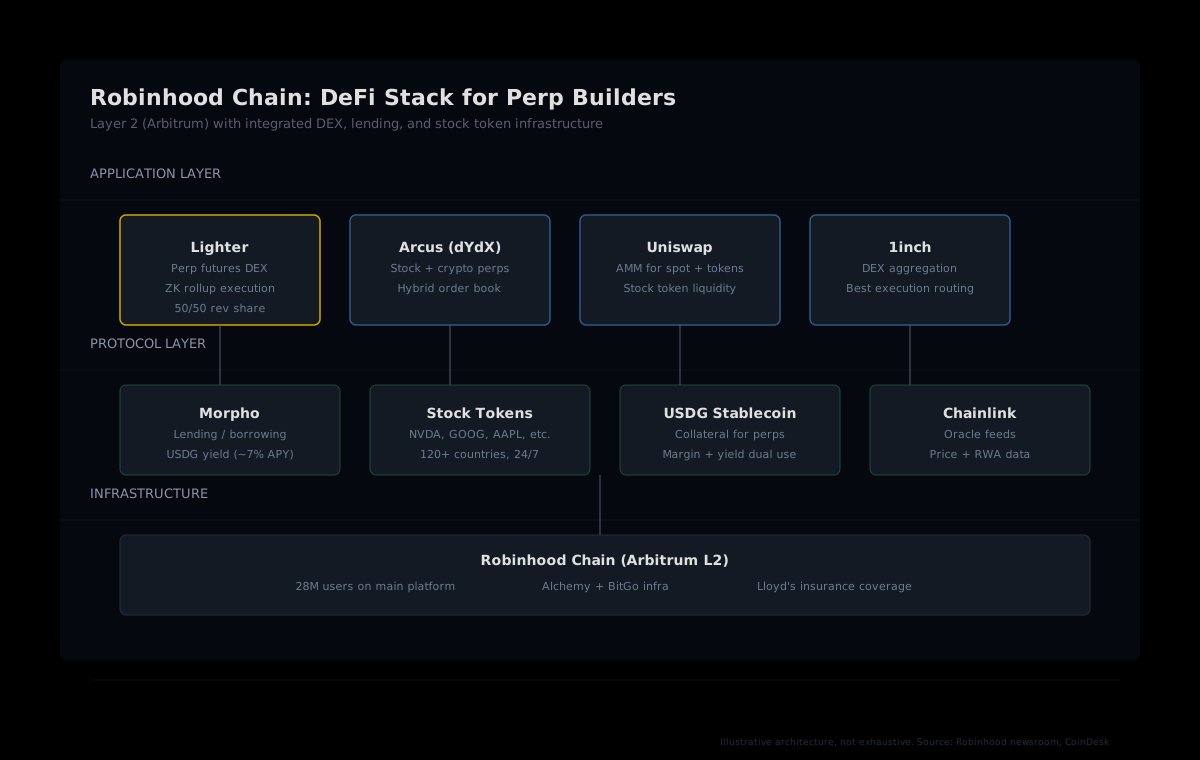
Early Traction: Top Five by DEX Volume in Two Weeks
Bernstein analysts noted "strong early adoption" and highlighted the "growing convergence of tokenized real world assets with the broader DeFi ecosystem." Over 65,000 users already hold assets on the network, with $13 million in tokenized stocks and $300 million in stablecoins deployed.
Lighter raised $68 million at a $1.5 billion valuation in November 2025, with Robinhood Ventures participating. CEO Vlad Tenev serves as an advisor. The perp DEX uses zero-knowledge proofs to process trades off-chain for speed, then posts cryptographic proofs on-chain for verification.
One detail that shapes the competitive landscape: perpetual futures through Robinhood Wallet are unavailable in the US, UK, Canada, and several other jurisdictions due to regulatory restrictions. The initial user base for on-chain perps skews European and global, which means builders need to think about geographic segmentation from day one.
Why This Matters for Perp DEX Builders
The core thesis is simple: more users trading perpetual futures on-chain creates more readable signal for builders. And "readable" is the operative word, because it draws a hard line between centralized and decentralized venues.
On a CEX, order flow is locked inside matching engines. You cannot see who is buying, how large their position is, or whether smart money is accumulating before a move. The exchange operator sees everything. Everyone else sees the tape.
On-chain, that dynamic inverts. Every wallet's positions, trades, and liquidations are publicly auditable. Classification by size, by profitability, by behavior becomes possible because the data is open. When Robinhood pushes millions of new users toward on-chain derivatives, the total addressable signal for builders grows proportionally.
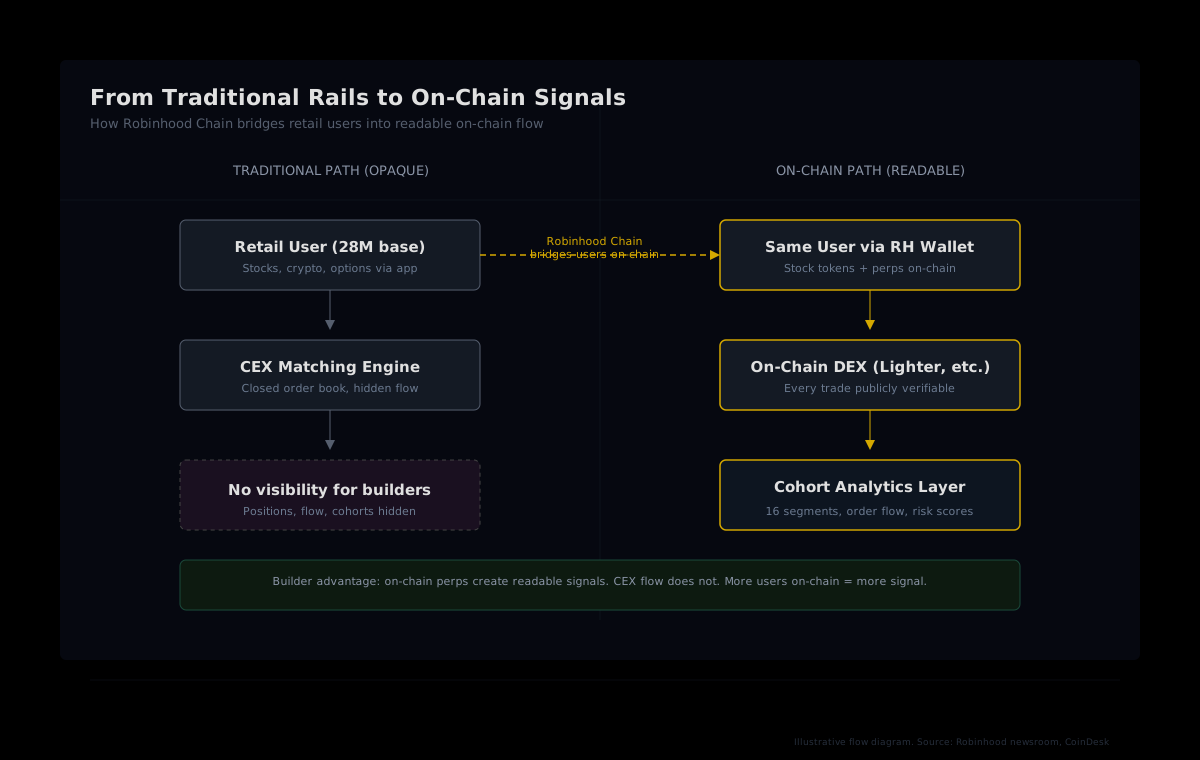
The structural shift: CEX perps keep flow hidden. On-chain perps make every trade auditable. Robinhood Chain just lowered the barrier for millions of users to start generating that on-chain flow.
Larger cohort samples, stronger signals
Behavioral analytics depend on sample size. When only a few thousand wallets trade perps on a given chain, cohort-level patterns are noisy. When tens or hundreds of thousands of wallets are active, the statistical significance of behavioral signals improves dramatically. This applies to our cohort system on Hyperliquid, where 16 behavioral segments (8 by wallet size, 8 by all-time PnL) classify every wallet from Shrimp through Leviathan. The same principle extends to any chain where builders can classify wallets by behavior.
New trader profiles entering the mix
Robinhood's user base is predominantly equity-native. These are people who think in terms of P/E ratios, earnings beats, and share buybacks. When they start trading perpetual futures, their behavioral patterns will look different from crypto-native degens. They will likely use lower leverage, hold positions longer, and react to traditional market catalysts. For builders tracking cohort behavior, this creates new signal: you can watch how equity-trained traders perform in crypto derivatives, whether they cluster in specific cohorts, and how their risk profiles diverge from existing participants.
Stock Tokens as Perp Collateral: A New Variable
One of the most interesting details in Robinhood's launch is that stock tokens can serve as collateral across DeFi. On Lighter, users deposit USDG as margin for perpetual futures positions. But the broader architecture allows stock tokens to function as lending collateral on Morpho, which means a trader could hold NVDA tokens, earn yield on them, and simultaneously use USDG from lending as perp margin.
This cross-asset collateral dynamic introduces new liquidation mechanics. When a trader's perp margin depends on the value of their stock token collateral, an equity market selloff can trigger crypto derivatives liquidations. Builders who track liquidation risk across asset types will have an edge, because traditional liquidation models assume crypto-only collateral.
For anyone building liquidation alert systems or risk engines, this is a new input variable. Our liquidation risk scoring on Hyperliquid already covers asset-level exposure. As cross-collateral perp trading grows across chains, the builders who can model these interdependencies will have a clear advantage.
The Competitive Landscape Just Got More Crowded
Robinhood Chain joins a growing list of venues competing for on-chain perpetual futures volume. Hyperliquid processed $619.46 billion in perp volume during Q1 2026 and remains the dominant perp DEX by a wide margin. The broader DEX perp market grew from 2.0% to 10.2% of total perpetual futures trading between January 2024 and January 2026.
Robinhood's entry does not threaten existing perp DEXes directly. The user bases are different: Robinhood brings equity-native retail, while Hyperliquid serves crypto-native traders and builders. But it does two things that affect the broader ecosystem:
- It validates the on-chain perps model. When a publicly traded brokerage with a market cap north of $95 billion launches its own chain with integrated perpetual futures, that is a strong signal about where the derivatives market is heading. Regulatory concerns aside, the direction is clear.
- It raises the bar for builder tooling. As more chains offer perp trading, raw execution becomes table stakes. The differentiator shifts to intelligence: who is trading, how are they positioned, where does the smart money sit. Builders who can answer those questions have an edge regardless of which chain their users trade on.
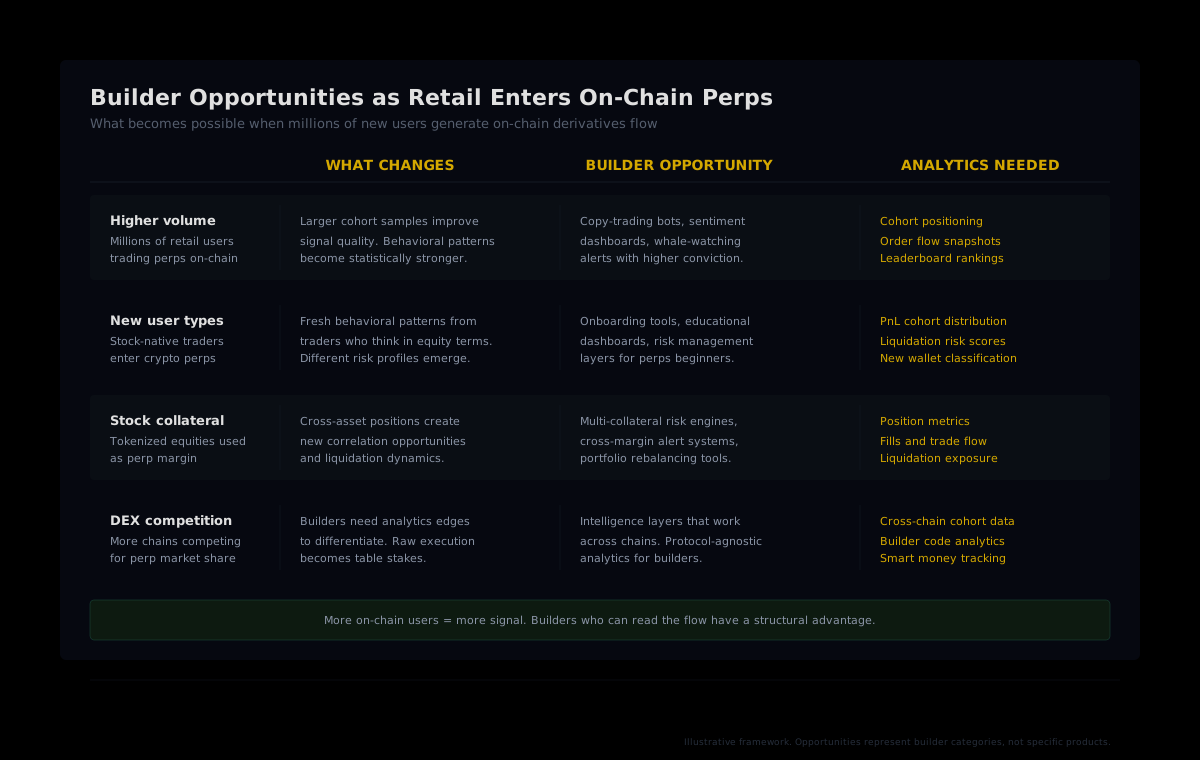
What Builders Should Watch Next
Several developments will shape how this plays out over the coming months:
US regulatory clarity for on-chain perps. Lighter's perp futures are currently unavailable to US users through Robinhood Wallet. If that changes, the volume and user impact would be an order of magnitude larger. Watch for CFTC guidance on decentralized derivatives.
Cross-chain flow patterns. Traders who discover perps on Robinhood Chain may explore other venues. Monitoring wallet migration between chains, and tracking whether Robinhood-originated wallets show up on Hyperliquid or other perp DEXes, will reveal how fungible the user base actually is.
Stock token correlation effects. When tokenized NVDA and BTC perps live on the same chain, correlation traders will arbitrage between them. The on-chain footprint of those strategies will be readable, and builders who can classify correlation-driven flow separately from directional flow will have cleaner signals.
Agentic trading adoption. Robinhood announced AI agent trading capabilities that let users connect third-party AI models to Robinhood's data and execution layer. If agentic trading generates significant on-chain volume, the flow patterns will look fundamentally different from human-driven trading. Cohort classification would need to account for bot vs. human behavior.
Building With the Signal, Regardless of the Chain
The practical takeaway for perp DEX builders is that the total pool of on-chain derivatives flow is expanding, and the users entering through Robinhood's funnel will generate new categories of tradeable signal. Whether you build on Hyperliquid, Robinhood Chain, or across multiple venues, the intelligence layer is what separates commodity execution from competitive advantage.
Our API gives you access to 16 behavioral cohorts (8 by wallet size, 8 by all-time PnL), order flow analytics with stop/TP visibility, liquidation risk scoring at the asset level, and leaderboard data ranking traders by performance. The data refreshes every five minutes, with rolling five-minute order snapshots for granular flow analysis. Tiers start at $179/mo for Pulse, scaling through to $1,999/mo for Stream with WebSocket and webhook delivery.
Turn on-chain flow into builder intelligence
HyperTracker's API delivers 16 behavioral cohorts, order flow analytics, and liquidation risk scoring. Start with the free tier, or unlock full cohort data at $179/mo.
Robinhood just told 28 million users that perpetual futures belong on-chain. The flow is coming. The builders who can read it will be the ones who profit from it.