
Same Volume, 3x Fewer Users: How Based Matches Phantom on Hyperliquid
By CMM Team - 22-Jul-2026
Same Volume, 3x Fewer Users: How Based Matches Phantom on Hyperliquid
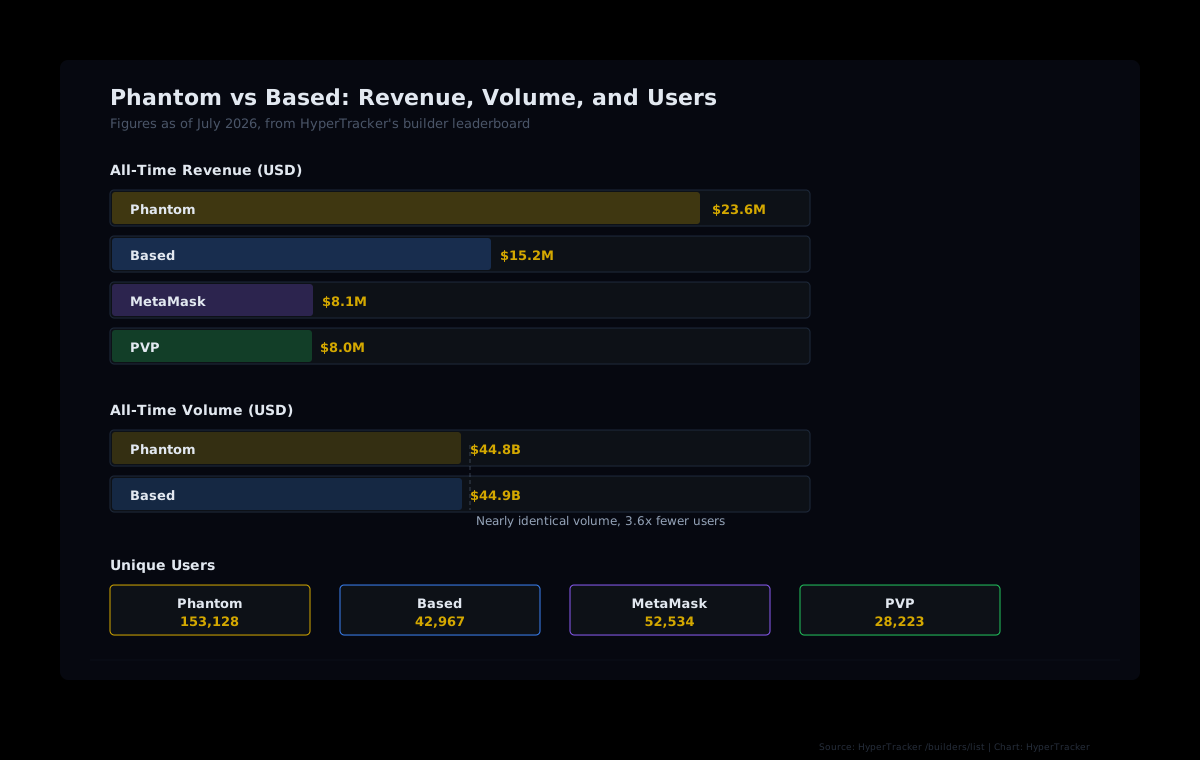
Phantom has 153,128 users on Hyperliquid. Based has 42,967. Yet both have routed nearly identical all-time volume through the exchange: $44.8 billion for Phantom, $44.9 billion for Based. That means Based's average user generates roughly 3.6 times more volume than Phantom's. Same leaderboard, completely different playbooks.
Figures as of July 2026, from HyperTracker's builder leaderboard.
These two builders sit at the top of Hyperliquid's builder code rankings, having pulled in $23.6 million and $15.2 million in lifetime fees respectively. Together they account for roughly 43% of the $90.7 million in total builder code revenue the program has generated. But the routes they took to get there are almost opposite, and the gap between their user counts reveals something fundamental about how builder code economics actually work on Hyperliquid.
The Numbers That Don't Add Up (Until They Do)
At first glance, the builder leaderboard looks like a straightforward revenue race. Phantom sits at number one with $23.6 million in all-time builder code fees. Based is second with $15.2 million. A clear $8.4 million gap. Case closed, right?
Look at the volume column and the story flips. Based has actually processed slightly more total volume than Phantom: $44.9 billion compared to $44.8 billion. That $100 million difference is a rounding error on volumes this size. So why does Phantom earn 55% more revenue on essentially the same volume?
The answer is fee rate. Phantom charges a higher builder fee per trade than Based does. When you're routing tens of billions of dollars, even a few basis points of difference compounds into millions.
Phantom's Playbook: Distribution as a Moat
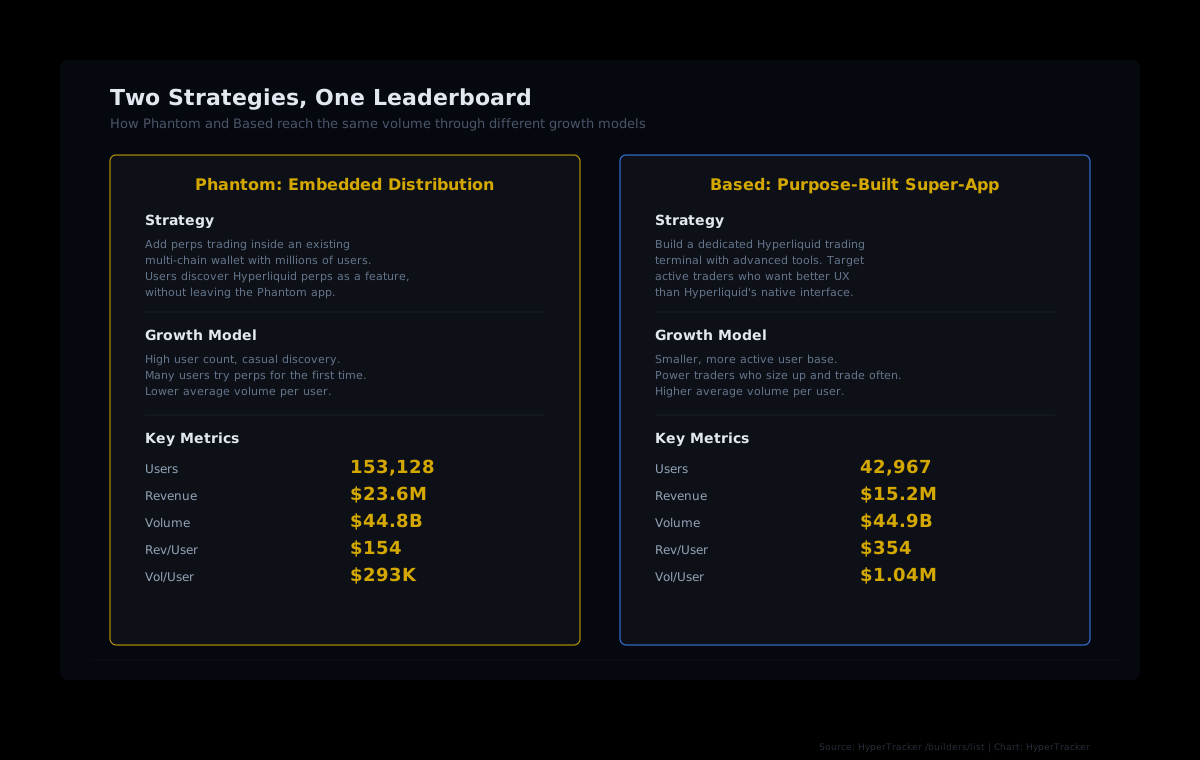
Phantom launched its Hyperliquid perps integration in July 2025, and the strategy was pure embedded distribution. Phantom already had millions of active wallets across Solana and other chains. Adding perpetual futures trading inside the existing wallet meant users could discover and trade Hyperliquid perps without installing another app, navigating to a new site, or managing a separate account.
The friction reduction was massive. A Phantom user holding SOL could tap into perps from the same interface they use for swaps and staking. The wallet handles USDC conversion and settlement behind the scenes. Users don't need to understand builder codes, fee approvals, or cross-chain bridging. They just trade.
This approach explains the user count. Phantom's 153,128 Hyperliquid users include everyone from power traders running complex strategies to casual users who opened one position out of curiosity. Many of those 153K users may trade infrequently or in small size, which is exactly what you'd expect from a general-purpose wallet that happens to offer perps. The per-user volume reflects this: roughly $293,000 in lifetime volume per user, which averages out to modest activity over the year since launch.
What Phantom sacrifices in per-user intensity, it makes up in sheer reach. Over 100 teams now participate in Hyperliquid's builder code program, but Phantom commands more users than any other builder by a wide margin.
Based's Playbook: The Power-Trader Magnet
Based took the opposite path. Rather than embedding Hyperliquid perps inside an existing product, Based built a purpose-built trading super-app from scratch. The platform combines Hyperliquid perpetuals, prediction markets, and a crypto Visa card into a single interface designed for active traders.
Edison Lim, Based's co-founder and CEO, has been explicit about the product philosophy. As he told Privy: "We don't just replicate what exists, we constantly push new features that give our users an edge." Features like privacy TWAP orders (designed to minimize market impact on large trades) and HyENA, a Hyperliquid-native perpetuals venue running on Based's core stack, signal a product built for traders who care about execution quality.
The result is a smaller but far more active user base. Based's 42,967 users generate $1.04 million in lifetime volume per user, roughly 3.6 times the per-user volume of Phantom's base. These aren't casual explorers. They're traders who chose a dedicated trading terminal because it offers tools the native Hyperliquid interface doesn't.
Based recently raised an $11.5 million Series A led by Pantera Capital, with Coinbase Ventures and Wintermute Ventures participating. That capital is going toward expanding the product's AI-driven trading features and cross-chain integrations. But the builder code revenue already flowing in means Based isn't dependent on venture funding for survival, a meaningful distinction in DeFi where many trading apps burn through runway without finding product-market fit.
Revenue Per User: The Metric That Separates Builders
Total revenue tells you who's winning. Revenue per user tells you how.
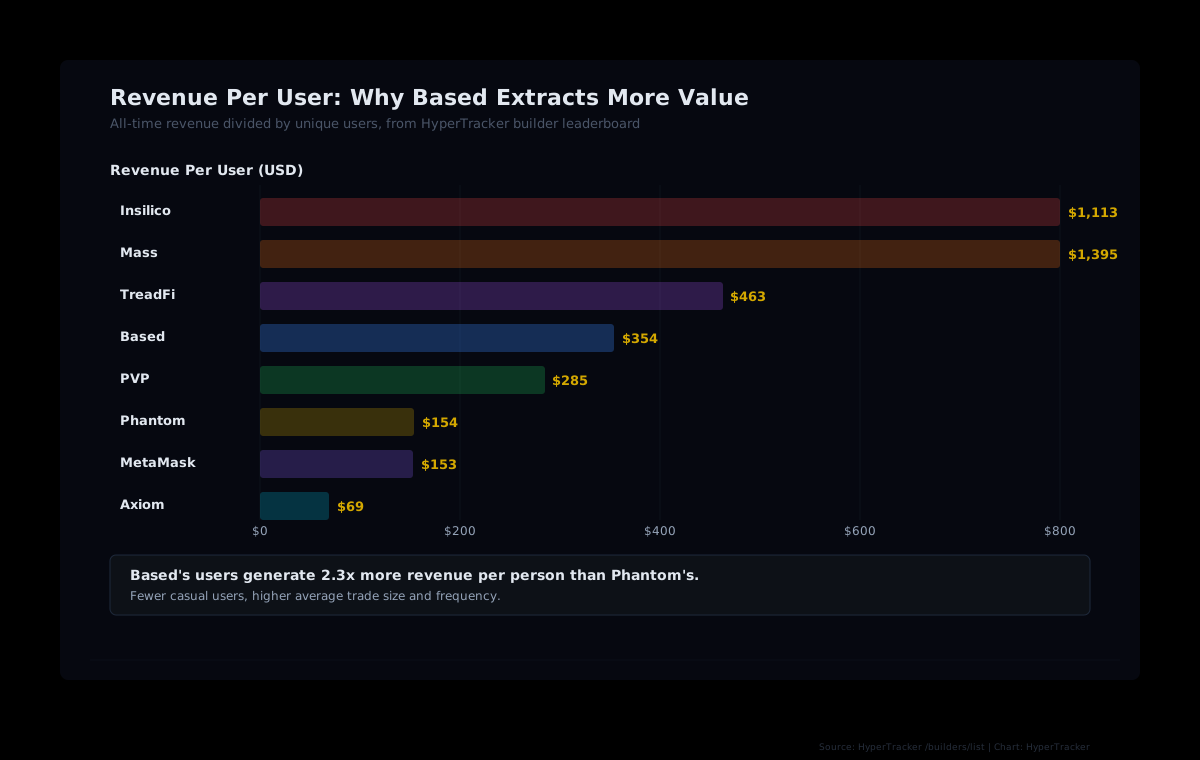
Phantom earns roughly $154 per user in lifetime builder code fees. Based earns $354 per user, which is 2.3 times more. That gap captures the fundamental difference between a high-reach, lower-intensity distribution model and a focused, high-intensity trading product.
But neither builder comes close to the outliers. Insilico, ranked fifth with $3.7 million in revenue from just 3,339 users, earns $1,113 per user. Mass, ranked twelfth, earns $1,395 per user from 1,054 users. These are niche products serving small groups of very active (or very large) traders. High revenue per user, but limited total revenue because the user bases are small.
The top of the leaderboard by total revenue belongs to builders who found scale. The top by revenue per user belongs to builders who found intensity. Phantom and Based each optimized for one side of that tradeoff, and both reached the $15M+ tier because of it.
Fee Strategy: Where the $8 Million Gap Comes From
Hyperliquid caps builder fees at 0.10% (10 basis points) on perpetuals and 1.00% on spot. Within those limits, each builder sets its own rate. The fee is specified per-order using the f parameter (expressed in tenths of a basis point), so a builder can even vary rates across different products or user tiers.
The math is direct. Phantom generated $23.6 million on $44.8 billion in volume, which implies an effective fee rate of roughly 5.3 basis points (0.053%). Based generated $15.2 million on $44.9 billion, implying roughly 3.4 basis points (0.034%). That 1.9 basis point difference, multiplied across $45 billion in volume, accounts for the entire $8.4 million revenue gap.
Why would Based charge less? Competitive dynamics. Based is a dedicated trading platform competing for users who have alternatives: the native Hyperliquid interface (zero builder fee), other trading terminals like PVP.trade, and general-purpose DEX aggregators. Lower fees reduce a source of friction for price-sensitive power traders. Phantom, by contrast, benefits from its captive distribution. Users trading inside their wallet aren't comparison-shopping fee rates, they're paying for convenience.
Builder code fee mechanics: Users must approve a maximum builder fee for each builder address via the
ApproveBuilderFeeaction, signed by their main wallet. Each user can hold at most 10 active builder code approvals at a time. The approval is explicit, revocable, and on-chain.
The Rest of the Leaderboard
Phantom and Based dominate the top, but the builder code ecosystem is broader than a two-horse race. The full top-10 shows distinct builder archetypes.
| Rank | Builder | Revenue | Users | Volume | Rev/User | | --- | --- | --- | --- | --- | --- | | 1 | Phantom | $23.6M | 153,128 | $44.8B | $154 | | 2 | Based | $15.2M | 42,967 | $44.9B | $354 | | 3 | MetaMask | $8.1M | 52,534 | $9.0B | $153 | | 4 | PVP | $8.0M | 28,223 | $17.1B | $285 | | 5 | Insilico | $3.7M | 3,339 | $36.3B | $1,113 | | 6 | Infinex | $2.8M | 9,283 | $5.2B | $298 | | 7 | Axiom | $2.4M | 34,093 | $23.0B | $69 | | 8 | TreadFi | $2.2M | 4,835 | $11.1B | $463 | | 9 | Dreamcash | $1.8M | 11,215 | $7.6B | $164 | | 10 | Liquid | $1.5M | 9,499 | $3.2B | $160 |
A few standouts. MetaMask at number three with $8.1 million shows that mainstream wallets are finding real revenue in DeFi perps. MetaMask joined later (August 2025 vs June 2025 for Phantom and Based), but its enormous existing user base of 52,534 Hyperliquid users already generates meaningful flow.
Insilico is the efficiency outlier. Only 3,339 users, but $36.3 billion in volume and $3.7 million in revenue. That's $10.9 million in volume per user. Likely algorithmic or high-frequency traders using Insilico's infrastructure.
Axiom presents the other extreme: 34,093 users generating $23 billion in volume but only $2.4 million in revenue, implying a very low fee rate. High volume, low capture. A routing play rather than a revenue play.
Why Builder Codes Are a Natural Fit for Cohort Analysis
Builder codes generate a clean attribution trail. Every fill records which builder routed it, what fee was charged, and the resulting volume. That makes builder analytics a natural extension of the cohort-level intelligence HyperTracker already provides.
Our data classifies every wallet on Hyperliquid into one of 16 behavioral cohorts, eight by position size (from Shrimp at under $250 to Leviathan at $5M+) and eight by all-time PnL (from Money Printer at +$1M to Giga-Rekt below -$1M). Layering builder code data on top of cohort data lets you answer questions that raw leaderboard numbers can't:
- Are Phantom's users predominantly Shrimp and Fish (small position sizes), while Based's skew toward Dolphins and Whales?
- Do Money Printer wallets prefer one builder over another?
- Which builders attract the highest proportion of profitable traders?
The builder leaderboard endpoint (/builders/list) gives you the aggregate view: revenue, volume, users, and join dates for every active builder. Combining that with cohort endpoints lets you build a more complete picture of who is actually trading through each frontend.
Track Builder Code Performance in Real Time
HyperTracker's builder leaderboard endpoint gives you revenue, volume, and user counts for every active builder on Hyperliquid. Combine with cohort analytics to understand who's trading through each frontend.
Explore the Builder Leaderboard
What Phantom and Based Teach About Builder Economics
The builder code program has distributed $90.7 million to 1,411 builders since inception. That total, channeled through $274.9 billion in routed volume, makes it one of the largest on-chain developer incentive programs in DeFi. But the concentration at the top tells you something about market dynamics.
Phantom and Based alone account for roughly 43% of all builder revenue ever paid out. Add MetaMask and PVP, and the top four builders account for over 60%. The remaining 1,407 builders split the rest. Distribution power compounds: builders with existing user bases or compelling products capture disproportionate share, while the long tail earns modest returns.
The lesson is that builder codes are a revenue primitive, a mechanism. They're necessary but not sufficient. The builders that earn millions solved distribution (Phantom), product differentiation (Based), or both. The builder fee itself is just the capture mechanism. Becoming a builder requires 100 USDC in a Hyperliquid perpetuals account. The barrier to entry is nearly zero. The barrier to earning at scale is entirely about product and distribution.
For developers building on Hyperliquid, Phantom and Based represent two viable templates. Route trades through an existing product people already use, or build something purpose-built that active traders can't find elsewhere. Both work. Both reach the same volume. But the revenue per user, the user acquisition cost, and the competitive moat look entirely different.
The leaderboard will keep evolving. Builders who find the next distribution edge, whether that's AI-powered trading assistants, social trading layers, or institutional-grade execution tools, will climb. The ones who don't will stay in the long tail, earning a few hundred dollars a month on a protocol that's paying out millions.