Stop Loss Placement Using Liquidation Clusters on Hyperliquid
By CMM Team - 26-Apr-2026
Stop Loss Placement Using Liquidation Clusters on Hyperliquid
You bought BTC at $102,400, set a clean stop at $100,000 because round numbers feel safe, and got tapped out on a 90-second wick that retraced before you could finish your coffee. Then the market rallied 4% without you. That is not bad luck. The wick that took you out had your stop coordinates before you placed the trade, because so did everyone else who stops at round numbers, and the price level was visible to anyone reading our liquidation heatmap. The traders who held their position through that move were not braver. They put their stop somewhere the market was not going to look.
This article is a practical framework for stop placement on Hyperliquid using liquidation cluster data. By the end you will know what a cluster actually is, how to read dense versus sparse zones on a heatmap, where to place a stop relative to a cluster (and how much buffer to add), the asymmetric reads that let you size up when clusters point your way, and the three placement mistakes that produce most of the stop hunts retail traders complain about. None of this requires a quant background. It does require resisting the urge to put your stop at the price the chart suggests.
The short version: obvious stop levels (round numbers, recent lows) are also liquidation cluster zones, and clusters are gravity. Place your stop on the far side of the nearest cluster with a small buffer, size your position to the wider distance, and you remove yourself from the most predictable hunt targets on the exchange.
Why most stops on Hyperliquid get hunted
Hyperliquid runs on-chain. Every position, every leverage setting, every funding payment, and every liquidation threshold is verifiable by anyone who wants to read it. That transparency is the product's selling point, and it is also the reason naive stops get tagged so often. The information that tells you where the protocol is going to force-close other traders is the same information that tells aggressive players where the easy liquidity is.
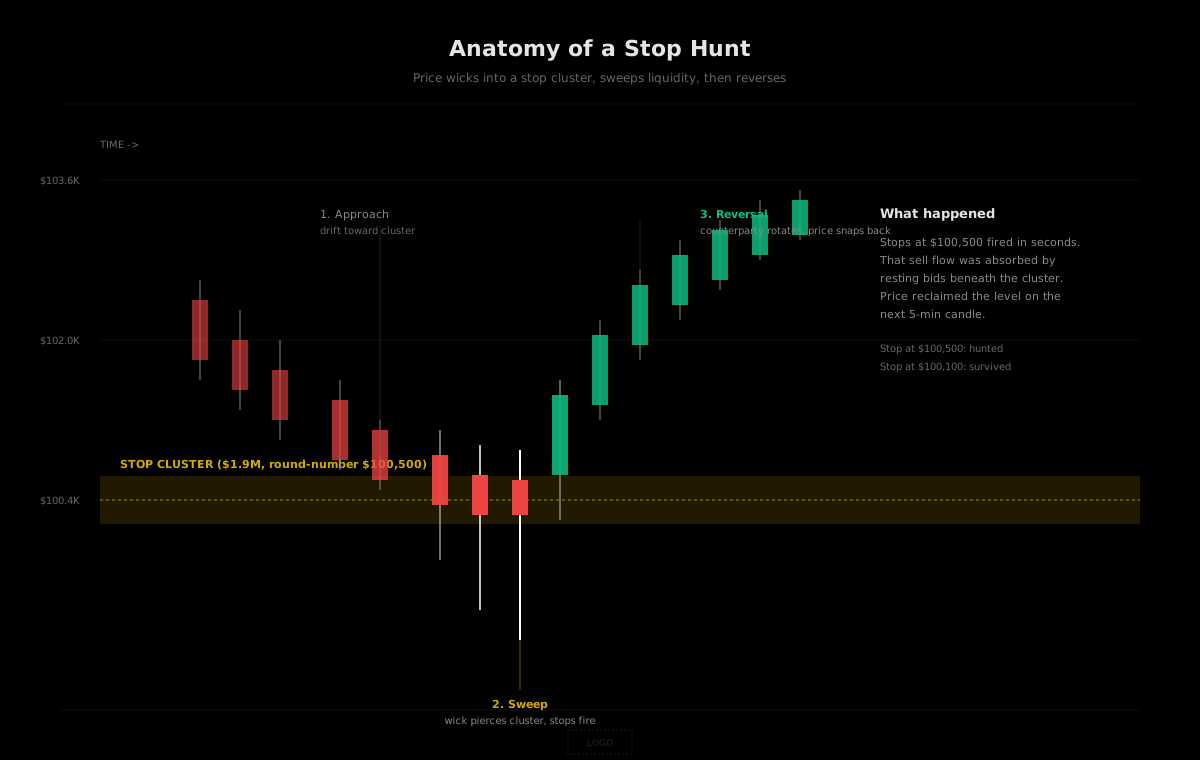
A retail trader places a stop at $100,000 because it looks like the line. A market maker, a directional whale, or any algorithm reading public state can see thousands of similar stops stacked at that exact level, plus a wall of long liquidations slightly below it. Pushing price down 1.5% to clear that zone is not a conspiracy, it is an arbitrage. The cost of the push is paid back by the liquidity that fires when the cluster triggers. So price wicks down, sweeps the stops, eats the forced selling, and reverses. The traders who placed at the cluster donate liquidity. The traders who placed beyond it stay in the trade.
The mechanic is structural. Funding settles every hour on Hyperliquid, leverage often runs hot during trends, and a meaningful share of open positions sit close to their liquidation level at any given time. That density is what shows up as a cluster on the heatmap. As long as those clusters exist, the incentive to hunt them exists, and your stop placement has to account for it.
What a liquidation cluster actually is
A liquidation cluster is a price level where a disproportionate number of positions will be force-closed by the protocol if price reaches it. It is not a chart pattern, it is not sentiment, and it is not a technical zone. It is a count of dollar-denominated exposure that flips direction at a specific price.
On a long position, the liquidation level depends on entry price, leverage, and remaining margin. A 10x long opened at $100,000 liquidates somewhere near $90,500 after fees and funding. A 25x long from the same entry liquidates near $96,000. When thousands of traders open similar positions in a similar window, their liquidation levels stack into bands. Those bands are clusters. Below current price the clusters belong to longs. Above current price they belong to shorts.
The reason clusters move price is mechanical. When price reaches a thick long-liquidation cluster, the protocol force-closes the positions, which generates a burst of market sell flow into a book that was already trending down. That sell flow can push price into the next cluster, which fires, and so on. The same dynamic runs in reverse for shorts above price. Liquidations cascade because each one creates flow in the same direction as the move that triggered it.
Stops are similar but voluntary. A trader chose $100,000 because it was a round number, or the prior swing low, or the level a Twitter account suggested. Those decisions cluster at the same prices because traders share the same charting habits. So stop clusters tend to sit at obvious technical levels and liquidation clusters tend to sit slightly beyond them. The combination is the hunt zone.
Reading the heatmap: dense versus sparse zones
Market Radar on HyperTracker maps every liquidation level, stop loss, take profit, and limit order across hundreds of thousands of wallets on Hyperliquid, and surfaces the densest zones above and below current price. The heatmap refreshes every few minutes. It is not a real-time tape and it is not orderbook streaming, it is a 5-minute snapshot of where resting and protocol-driven exposure currently sits. That cadence is plenty for placement decisions, which you make once per trade rather than per tick.
The two reads to internalize are density and proximity.
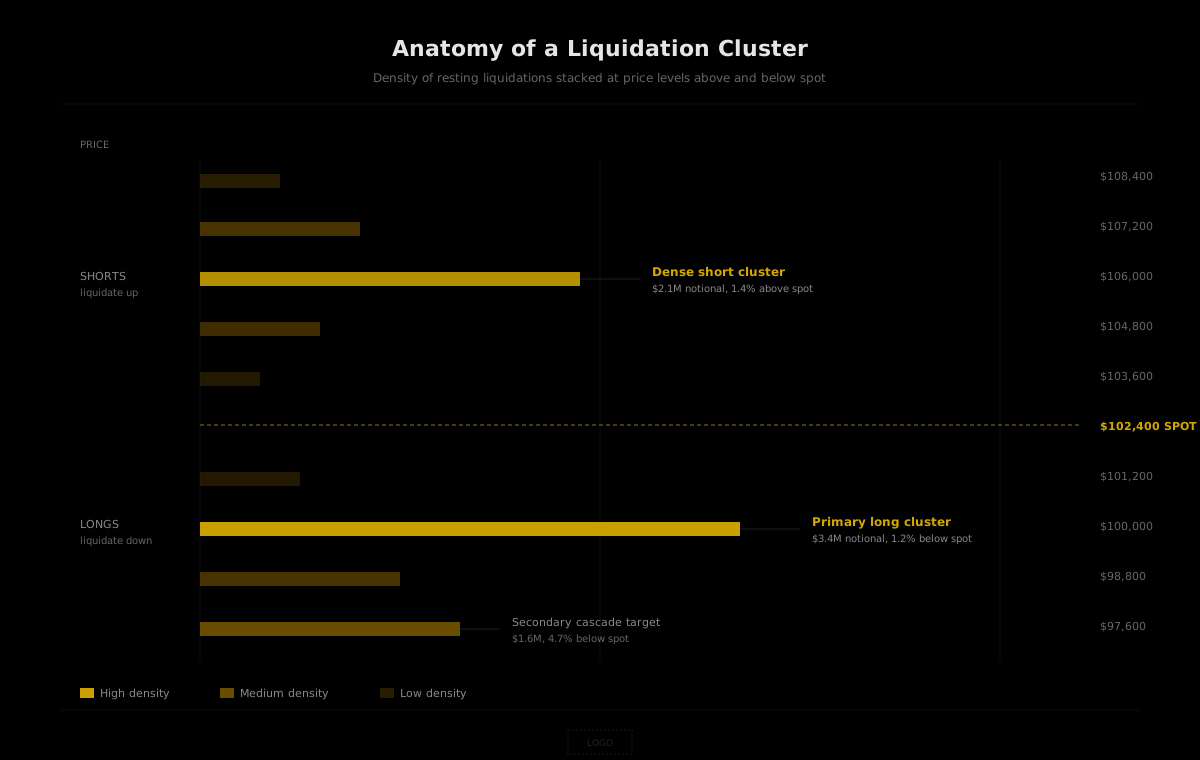
Density tells you how violent a level is likely to be. A cluster at $98,800 with $3.4 million in stacked long liquidations will produce visible market impact when it fires. A cluster at $98,400 with $400,000 stacked is closer to noise, the kind of level price can drift through without much acceleration. Treat the dense band as a magnet, the thin band as a speed bump.
Proximity tells you how relevant a cluster is to your current trade. A thick cluster 8% below price might never come into play on a normal intraday move. A thin cluster 0.4% below price will probably get tested in the next hour. The clusters that matter for stop placement are the ones close enough to be reached during the position's expected hold time.
Combine the two. The stop placement decision is driven by the nearest dense cluster in the direction of risk for your trade. If you are long, that means the nearest dense long-liquidation cluster below price. If you are short, it is the nearest dense short-liquidation cluster above. Everything beyond the first dense cluster is a secondary consideration.
The placement framework
Here is the framework, kept deliberately simple so you actually use it.
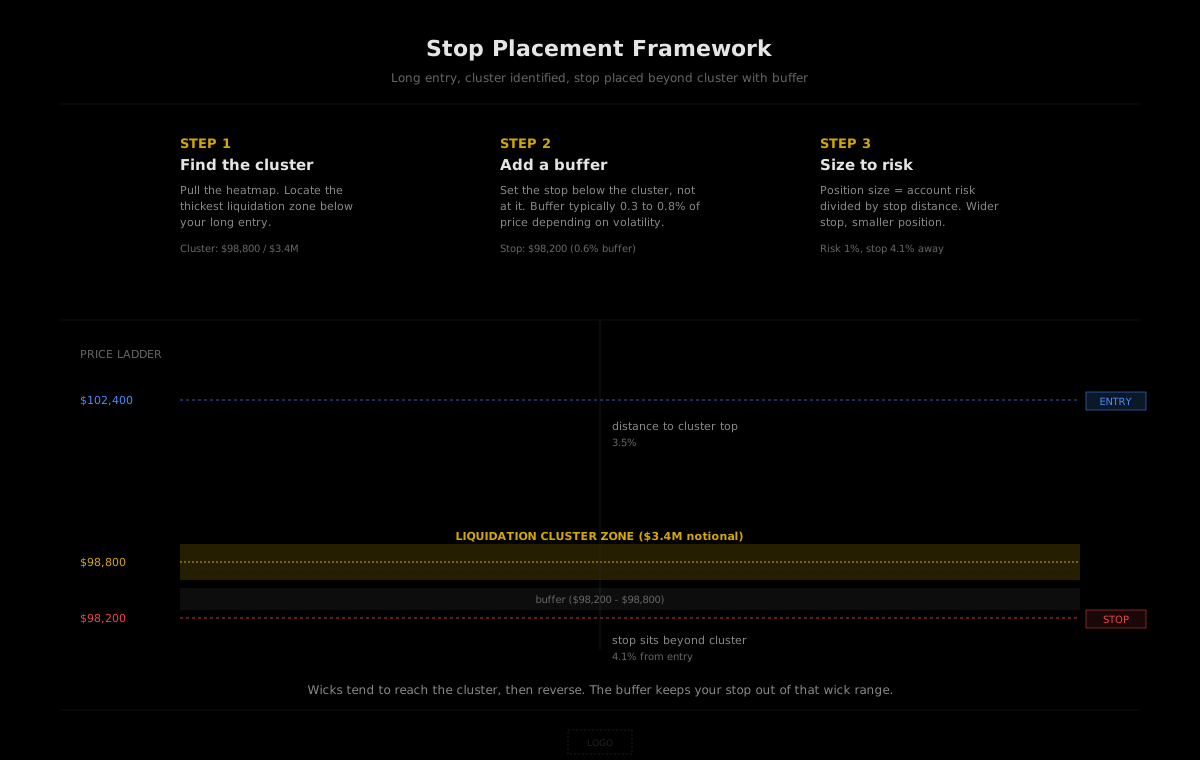
Identify the cluster. Open Market Radar, switch to the liquidation view, and find the nearest dense zone in the direction of your stop. Read the dollar value. Anything north of seven figures of stacked notional within 2% of price is worth treating as a real magnet on most majors. On lower-cap perps the threshold is lower, because the whole book is lighter.
Add a buffer. Set the stop on the far side of the cluster, with a buffer typically between 0.3% and 0.8% of price. The buffer absorbs the overshoot wick that often follows a sweep. On BTC and ETH during normal volatility a 0.5% buffer past the cluster edge tends to be enough. On more volatile mid-caps, lean toward 0.7% to 1%. The buffer is not an arbitrary cushion, it is the empirical width of the wick that typically clears the cluster before reversing.
Size the position to the wider stop. A wider stop means a smaller position at the same dollar risk. If you were going to risk 1% of your account at a 1.8% stop and you now need a 4.1% stop to clear the cluster, the position size shrinks by more than half. That is the trade-off. You give up size to remove yourself from the hunt zone. The traders who refuse to size down are the ones complaining about wicks.
If the move would require a position so small it is not worth the trade, that is the framework telling you to skip the trade or wait for a higher-conviction entry. Stop placement decisions and position sizing decisions are the same decision, made in two steps.
Asymmetric reads: when clusters point your way
The framework above is defensive. It keeps you out of obvious hunt zones. The same data supports an offensive read, and this is where Market Radar earns its keep.
If you are long and the nearest dense cluster is below price, that cluster is your risk. Place beyond it. But if the nearest dense cluster is above price, sitting on top of a thin band of resting longs, the asymmetry flips. Now the magnet is in your favor. A move into that overhead cluster sweeps short liquidations, which produces buy flow, which pushes price further into the cluster. The cohort breakdown helps here: if the larger size cohorts (Whale, Tidal Whale, Leviathan) hold most of the short exposure near that cluster, you are reading the structural pressure correctly.
This is what we mean by asymmetric placement. Stops should always sit beyond the nearest dense cluster in the direction of risk. But the trade itself has more upside when the next dense cluster is in the direction of profit. A long with a dense short-liquidation cluster overhead and a thin zone below it has structurally good risk-reward, before you even check the chart. A long with a dense long-liquidation cluster below and nothing above has structurally bad risk-reward, regardless of how good the setup looks.
Practically, this means using Market Radar twice per trade. Once for stop placement, once for thesis check. If the heatmap disagrees with your thesis (clusters point against you), you can still take the trade, but you should size smaller and treat your stop as the tightest version of the framework, not the loosest.
Common mistakes
Three placement mistakes show up over and over in trader retros, and all three are visible on a heatmap before the trade is even sized.
Round-number stops. The $100,000 stop, the $4,000 ETH stop, the round-number stop on whatever the next major asset is. These are the most-clustered prices on the exchange because they are the easiest place for a trader to default to. If the heatmap shows a dense cluster at the round number, your stop should be on the other side of it. If you cannot afford the wider stop, the trade is too big.
Pure ATR or percentage stops. A 2% stop on every trade is a clean rule and it ignores everything that makes Hyperliquid Hyperliquid. The 2% stop sometimes lands inside a dense cluster, sometimes lands well past one, and sometimes lands at the cluster edge where the wick will reach but not the close. Volatility-based stops are not wrong, they are incomplete. The fix is to use volatility to set the minimum stop distance, and use cluster data to set the actual placement. Whichever is wider wins.
Stops at the prior swing low. The recent swing low is where the chartist places the stop, the breakout trader places the stop, and the trend-follower places the stop. That convergence makes prior swing lows reliable cluster locations. The cluster sits a little above the swing in stops and a little below it in liquidations. Placing your stop exactly at the swing low puts you in the densest part of the cluster zone. Placing it 1% below the swing low, past the liquidation band, puts you in the thin zone where wicks rarely reach.
Putting it together: a worked example
Say you want to long BTC at $102,400. Your thesis is that the prior 24 hours of consolidation breaks higher on the next move, supported by smart-money cohort positioning that you have already checked. Stop placement turns the trade from a vibe into a number.
You open Market Radar, switch to the liquidation view, and look at the zones below $102,400. The heatmap shows a dense long-liquidation cluster at $98,800, with $3.4 million in stacked notional within 0.4% of width. Below that, a thinner cluster at $97,600 carrying $1.6 million. No significant limit-buy support in between. Above price, a moderate short-liquidation cluster sits at $104,800, with $2.1 million stacked.
The placement is now mechanical. The stop goes beyond the $98,800 cluster, with a 0.6% buffer for the typical sweep wick. That puts the stop at roughly $98,200, or 4.1% from entry. Account risk of 1% means the position is sized to lose 1% if price reaches $98,200. That is a smaller position than a tight 1.5% stop would have allowed, and it sits outside the densest part of the visible hunt zone.
The asymmetry check supports the trade. The first dense cluster in the direction of profit is the $104,800 short-liquidation pool, only 2.3% above entry. A move into that zone produces forced short-covering, which is mechanically supportive of the long thesis. So the trade has a defensible stop and a structural tailwind on the upside, and you sized correctly for both.
If price wicks to $98,500 over the next two days, your stop survives. If price reaches $98,000, your stop fires and the cluster has obviously broken in a way that invalidates the thesis, which is exactly when you want to be out. The framework only works when you let it work. Tightening the stop manually because the wider distance feels uncomfortable is how you end up back in the hunt zone.
See liquidation clusters before you place your next stop
Market Radar is live on HyperTracker. The heatmap shows every liquidation level, stop, take profit, and limit order on Hyperliquid, broken down by cohort. Free tier includes 100 API requests per day, no credit card. Pulse plan ($179/mo) adds 50,000 requests per month for builders who want to wire alerts to their own systems.
Closing the loop
Stop placement is the part of the trade that most retail traders treat as an afterthought, and it is the part that decides whether the rest of the analysis ever gets to play out. The chart shows you where price has been. The heatmap shows you where the next forced flows are stacked. Place the stop where the chart suggests and you are placing it where everyone else placed it, which is exactly where the next sweep is going. Place the stop on the far side of the cluster, with buffer, and the same wick that hunted the room leaves your trade alone.
Hyperliquid is on-chain. The clusters are public. There is no excuse for stopping out at the round number anymore.