
The Binance Hack Proves Perp Traders Were Right to Go On-Chain
By CMM Team - 01-Nov-2026
The Binance Hack Proves Perp Traders Were Right to Go On-Chain
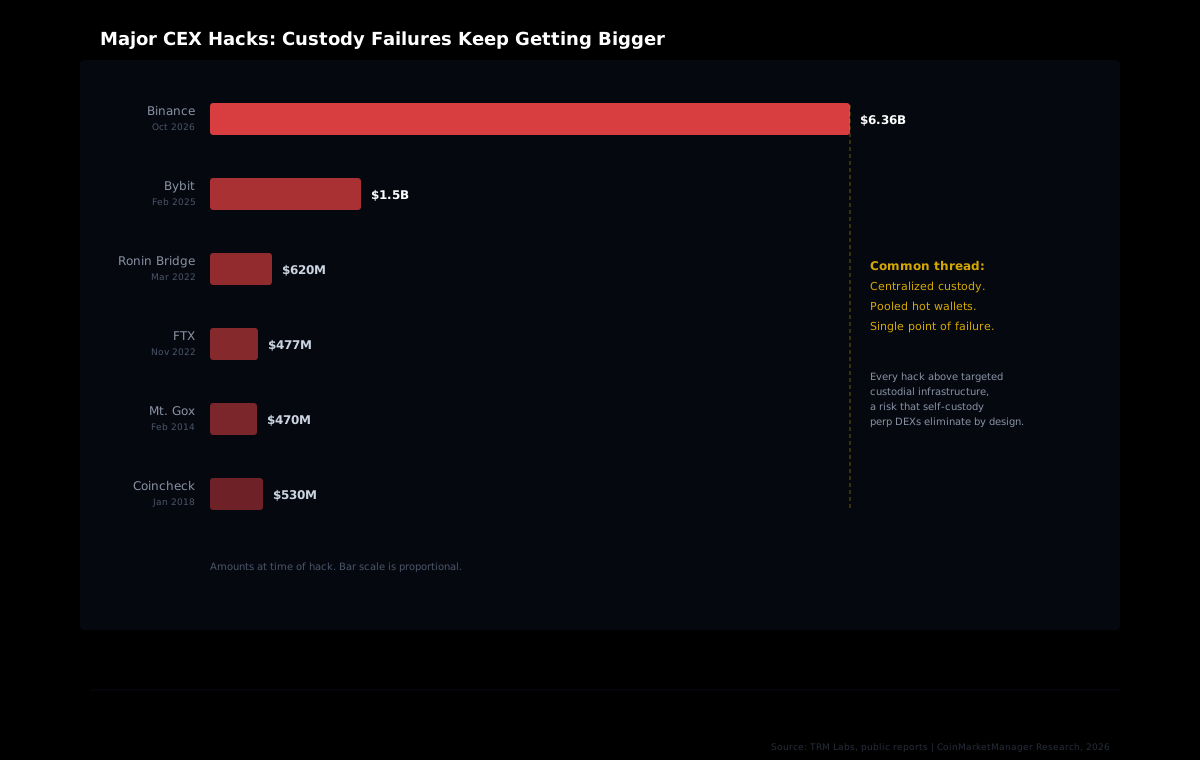
On October 29, 2026, at 20:05 UTC, hackers drained $6.36 billion from Binance's hot wallets across ten blockchains in roughly 20 minutes. It was the largest crypto theft in history, surpassing the $1.5 billion Bybit hack from February 2025 by more than four times. Bitcoin dropped to a six-week low of $76,418 as $628 million in leveraged positions were force-closed within a single hour.
The mechanics were brutally simple. A compromised DevOps engineer's laptop gave attackers access to Binance's hot wallet signing infrastructure. They used EIP-7702 delegation with 50 pre-signed authorizations to convert an Ethereum hot wallet into a sweeper contract, moving 167,464 ETH and 63 other tokens in a single transaction. On other chains, standard signed transfers emptied the rest. The FBI confirmed North Korea's TraderTraitor unit as the perpetrators within 48 hours.
But here's the part that should reshape how traders think about exchange risk: every dollar of the $6.36 billion sat in custodial hot wallets. Every dollar was controlled by Binance's keys, pooled together, and drained because one compromised endpoint gave access to the signing infrastructure. Traders on self-custody perp DEXs like Hyperliquid, where collateral lives in smart contracts under the trader's own wallet, were structurally immune to this exact attack vector.
The Night Everything Broke
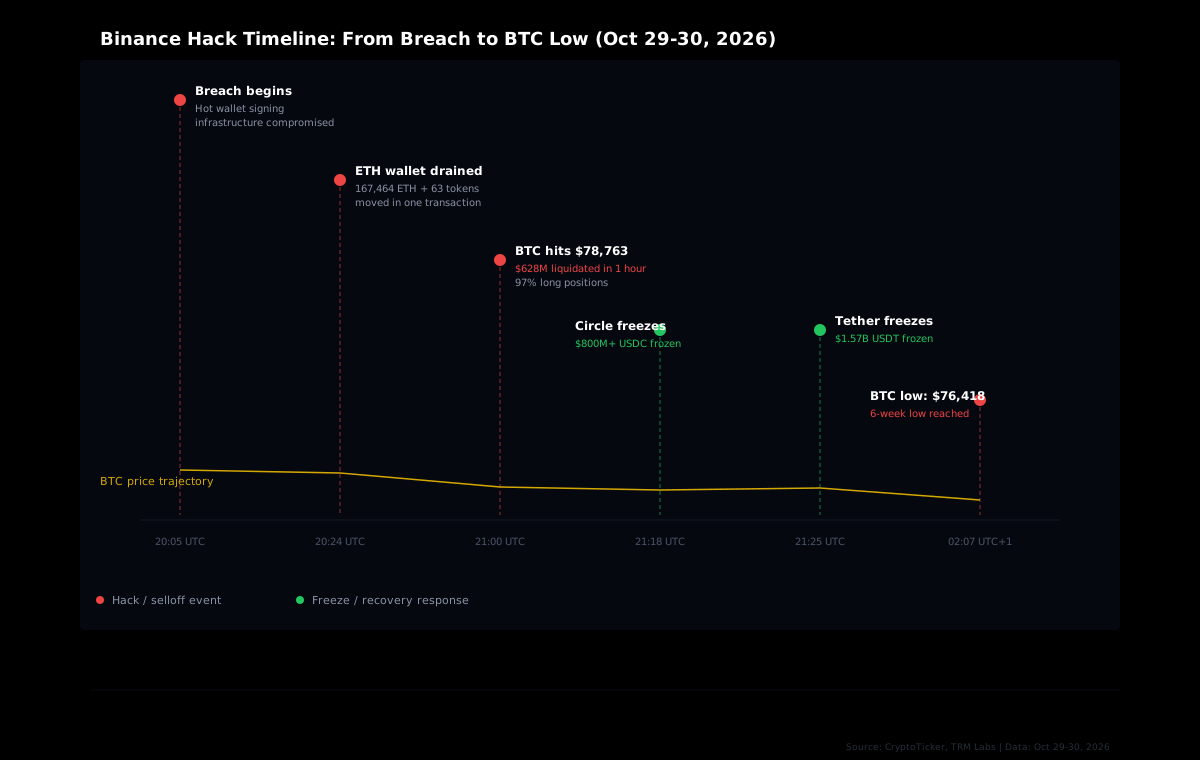
TRM Labs, the blockchain analytics firm that first attributed the hack to North Korea, documented the timeline with precision. Preparations began at least 36 hours before the theft, with attackers using Tornado Cash to fund operator wallets. The actual breach started at 20:05 UTC on October 29. By 20:24 UTC, the Ethereum hot wallet was empty. By 23:05 UTC, Avalanche and Polygon wallets had been swept too.
The damage crossed ten blockchains: $3.79 billion on Ethereum, $1.47 billion in Bitcoin (18,270 BTC), $628 million on Tron, $296 million on XRP Ledger, and $96 million on Solana, with the remainder spread across Arbitrum, Optimism, Base, Avalanche, and Polygon.
The response was fast by crisis standards, but agonizingly slow by market standards. Tether froze more than $1.57 billion in USDT at 21:25 UTC. Circle froze more than $800 million in USDC at 21:18 UTC. In total, roughly $2.7 billion was frozen across stablecoin issuers and chain security councils. But the attacker still controls approximately $2.4 billion, including over 420,000 ETH and 18,270 BTC.
The Market Fallout
Bitcoin was trading at $80,327 when the first reports of suspicious outflows hit crypto Twitter at 20:15 UTC. Within 45 minutes, it had dropped to $78,763. By 02:07 UTC the next morning, BTC touched $76,418, down 4.5% in 24 hours.
The liquidation cascade was immediate and disproportionate. Of the $628 million liquidated in that first hour, $607 million came from long positions. That's 97% longs. Traders who had built leveraged positions through the previous week's slow grind higher got margin-called into oblivion because a North Korean hacking unit compromised a single laptop. The largest individual liquidation was a BTC long on Binance itself, which adds a particularly grim irony to the situation.
BNB, Binance's native token, dropped 6.3% to $692.32 at its lowest point, though Binance co-CEO Yi He quickly pledged that the exchange would cover all user losses. Whether that pledge fully restores confidence is a different question.
Why Centralized Custody Keeps Failing
The Binance hack wasn't an anomaly. It was the latest entry in a pattern that stretches back over a decade. Mt. Gox in 2014. Coincheck in 2018. FTX in 2022. The Ronin Bridge. Bybit in February 2025. Each time, the failure mode is the same: centralized custody, pooled hot wallets, a single point of compromise that exposes billions.
The custodial model creates an inherent honeypot problem. When an exchange holds customer funds in pooled wallets controlled by the exchange's keys, every dollar becomes part of a single target. The attacker doesn't need to compromise thousands of individual wallets. They need to compromise one signing infrastructure, one DevOps engineer, one set of credentials. The Binance hack used 50 pre-signed authorizations on a single Ethereum wallet to sweep $2.8 billion in one transaction. That's the efficiency of attacking custodial infrastructure: one breach, total extraction.
Binance maintains its SAFU emergency fund at roughly $1 billion and has pledged to cover all losses. That's reassuring for Binance users specifically, but it doesn't address the structural vulnerability. The fund exists precisely because the custodial model requires it. Self-custody systems don't need emergency funds because there's no pooled target to drain.
How Perp DEXs Eliminate the Hot Wallet Problem
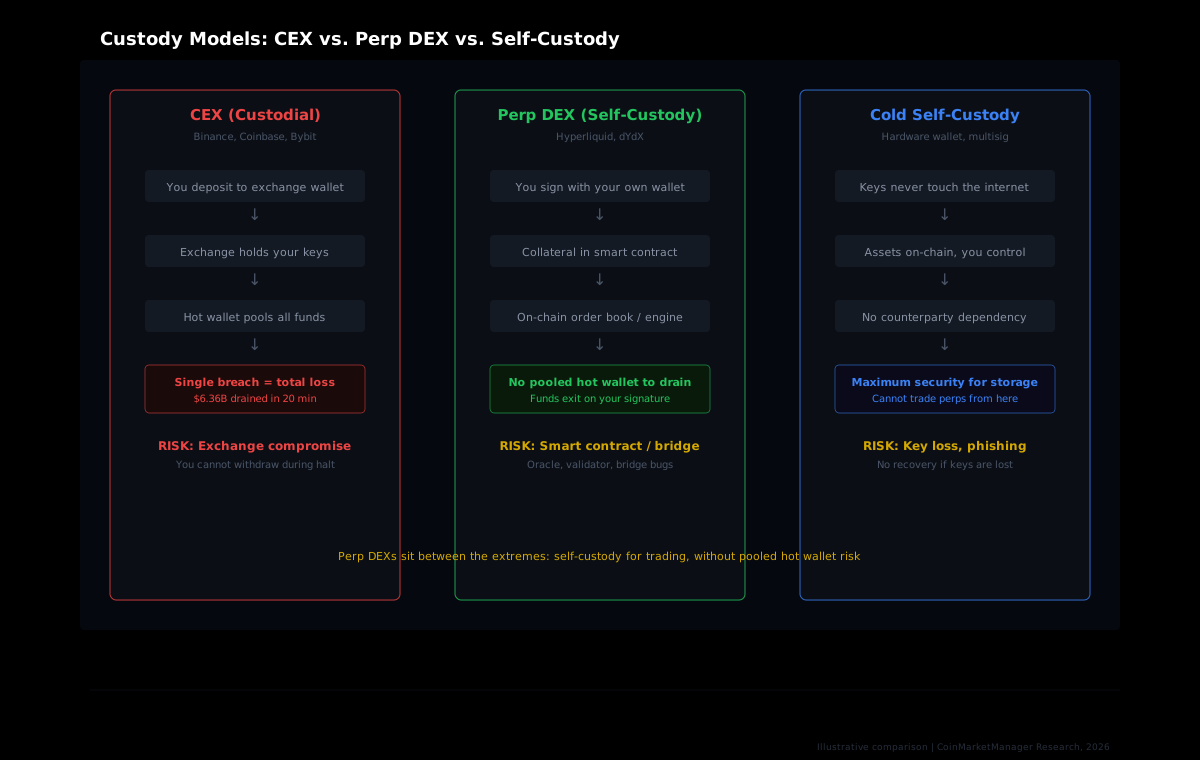
Self-custody perp DEXs like Hyperliquid use a fundamentally different architecture. When you connect a wallet and trade on Hyperliquid, your collateral lives in a smart contract on the protocol's Layer 1 chain. You sign every order with your own keys. The exchange never takes custody of your funds. There is no pooled hot wallet sitting on a server somewhere, waiting for a compromised laptop to hand it over to an attacker.
The practical difference is stark. On Binance the night of October 29, users could do nothing. Withdrawals were halted. Trading was suspended. Funds were frozen. The exchange controlled the keys, so the exchange controlled the timeline. On a self-custody perp DEX, your collateral exits when you sign the withdrawal. No halt can override your keys.
This isn't theoretical. Perp DEXs now process around 10% of all crypto perpetual futures volume, up from roughly 3% at the start of 2025. That growth accelerated after the Bybit hack in early 2025, and it's likely to accelerate again now. Traders who watched $6.36 billion evaporate from Binance's hot wallets in 20 minutes have a fresh, visceral reminder of what custodial risk actually looks like.
Perp DEXs Are Safer for Custody, but Carry Different Risks
Intellectual honesty requires acknowledging what self-custody doesn't protect against. Perp DEXs eliminate custodial exchange risk, which is the specific risk that just hit Binance for $6.36 billion. But they introduce their own failure modes: smart contract exploits, oracle manipulation, bridge vulnerabilities, and validator concentration.
The record speaks to this clearly. Drift Protocol, Solana's largest perp DEX, was exploited for roughly $285 million in April 2026. In July, two Arbitrum perp DEXs, Ostium and AFX Trade, lost a combined $42 million because of compromised oracle and bridge keys. These aren't custodial hacks. They're smart contract and key management failures.
The key distinction is the attack surface. A custodial exchange pools all user funds behind the exchange's signing infrastructure. One compromise, total exposure. A perp DEX distributes risk across smart contracts, bridges, and oracles. One compromise might affect a specific protocol mechanism (an oracle, a bridge), but it can't sweep every user's collateral in a single transaction the way Binance's hot wallet was swept.
Hyperliquid specifically runs its own Layer 1 with an on-chain order book validated by a public node set. Collateral sits in the protocol's smart contracts, bridged from Arbitrum via a bridge secured by the HyperBFT validator set and staked HYPE tokens. No pooled hot wallet. No company holding your keys. The trade-off is that bridge risk and validator concentration are real, but those are different (and generally smaller) attack surfaces than a centralized exchange's entire signing infrastructure.
The risk profile difference matters for how you size your exposure. On a CEX, a single infrastructure breach can drain everything. On a self-custody perp DEX, the risks are more granular: a specific bridge, a specific oracle, a specific smart contract upgrade. That granularity means you can evaluate and manage risk per protocol, instead of trusting one company's entire security stack.
What This Means for Builders
If you're building trading tools, bots, or analytics platforms, the Binance hack reshapes the infrastructure conversation. Every builder who integrated with Binance's API had their users' trading capability suspended for over 40 hours. Positions couldn't be closed. Stop-losses didn't fire. Automated strategies sat frozen while the market moved without them.
Building on self-custody perp DEXs sidesteps this failure mode entirely. When the exchange layer can't halt your access, your trading infrastructure stays operational regardless of what happens to any single company. The on-chain architecture means your API calls interact with a public protocol, and the protocol doesn't have a "pause all trading" switch that one compromised employee can flip.
This is where the build-vs-buy calculation shifts. Building on a custodial exchange means inheriting its custody risk. Building on a self-custody perp DEX means the custody layer is handled by the blockchain itself. Your intelligence layer, the analytics, cohort data, and position monitoring that sits on top, becomes the value differentiator rather than infrastructure plumbing that might go dark when the exchange gets hacked.
Our data classifies every wallet on Hyperliquid into 16 behavioral cohorts. When events like the Binance hack send shockwaves through the market, cohort analytics show you which groups are selling, which are accumulating, and where the smart money is moving. That intelligence layer works because the underlying protocol is self-custody: no trading halts, no withdrawal freezes, no waiting for the exchange to come back online.
Track How Smart Money Reacts to Market Shocks
HyperTracker's API gives you cohort-level positioning data across all 16 behavioral segments on Hyperliquid. See how Money Printers, Leviathans, and every other group move when the market panics.
The Custody Question, Answered Again
The crypto industry answers the custody question roughly once every 18 months, and the answer is always the same. Mt. Gox in 2014 taught the first generation. Coincheck in 2018 taught the second. FTX in 2022 proved that even regulated, audited exchanges can fail catastrophically. Bybit in 2025 showed that even the most operationally competent exchanges can be breached. And now Binance in 2026, the largest exchange in the world by volume, lost $6.36 billion because of one compromised laptop and a set of pre-signed authorizations.
Every time this happens, the same conclusion emerges: if you're actively trading derivatives, self-custody perp DEXs offer a structurally different risk profile than custodial exchanges. The risks aren't zero. Smart contracts can be exploited. Bridges can be compromised. Oracles can be manipulated. But the honeypot problem, the one where a single compromise exposes every user's funds simultaneously, is eliminated by design.
Perp traders who moved on-chain over the past two years didn't predict the Binance hack specifically. They read the pattern. Custodial infrastructure keeps getting bigger, the targets keep getting juicier, and the attackers keep getting more sophisticated. Self-custody removes your funds from that target surface entirely. That's the lesson, and after $6.36 billion in 20 minutes, it shouldn't need repeating.