
The Complete Guide to Hyperliquid's 16 Trader Cohorts
By CMM Team - 13-Apr-2026
The Complete Guide to Hyperliquid's 16 Trader Cohorts
Two traders open the same-sized BTC long at the same price on the same minute. One has made $3 million trading perps over the last year. The other has lost $200,000. Aggregate open interest goes up by the same amount either way and the chart looks identical. But the signal those two positions carry about what happens next is completely different, and on Hyperliquid you can tell them apart.
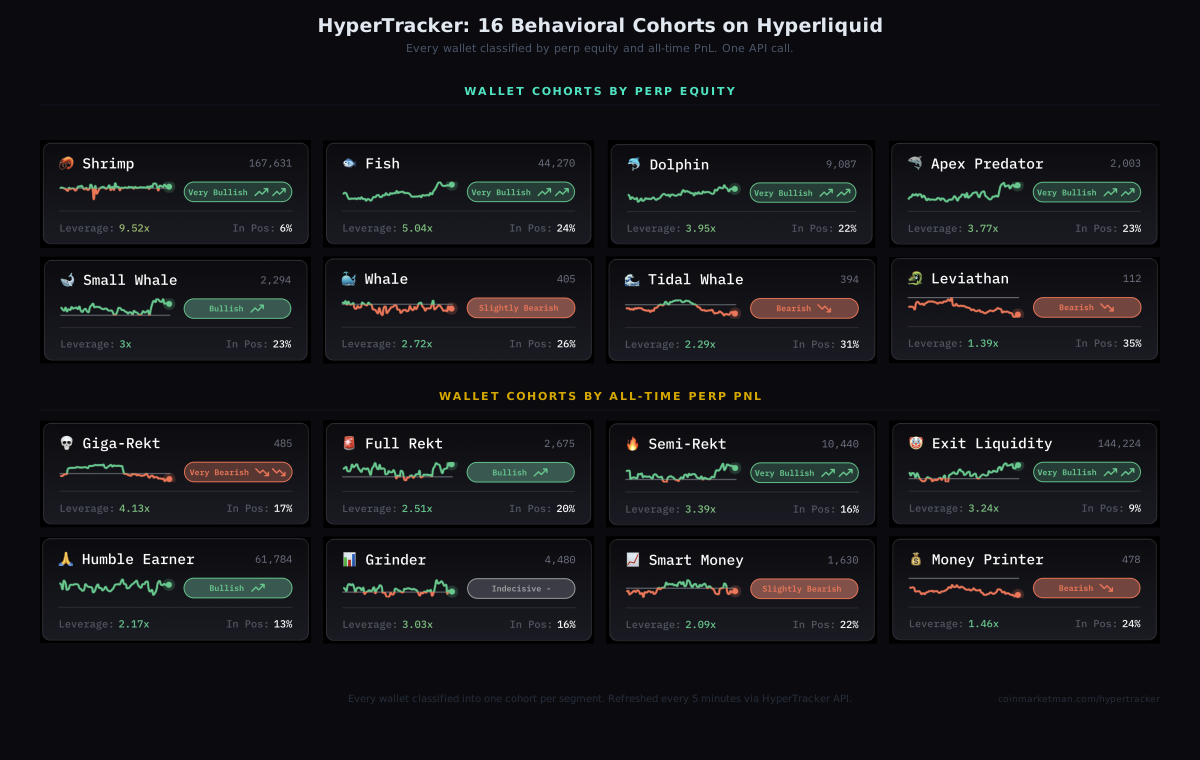
HyperTracker classifies every wallet on Hyperliquid into one of 16 behavioral cohorts based on total perp equity and all-time profitability. When the Money Printer cohort and the Giga-Rekt cohort disagree on direction, the trade is already decided. The only question is whether you checked before you entered.
This guide walks through all 16 cohorts by name, what each one represents, how they behave during trends and ranges and reversals, what their positioning reveals about market conditions, and how to query cohort data from the API to build your own reads. By the end, you will be able to look at any Hyperliquid asset and see not just how much is positioned, but who owns the position and what that historically means.
What are behavioral cohorts and why do they matter?
A behavioral cohort is a group of wallets classified by a shared characteristic, tracked as an aggregate instead of individually. HyperTracker runs 16 cohorts on Hyperliquid, split across two axes: perp equity (how much capital does this wallet hold?) and all-time profitability (how much has this wallet made or lost?). Every wallet gets a classification on both axes, updated every 5 minutes from raw Hyperliquid state. The result is a full-market positioning map stratified by both scale and skill. (For a deeper look at why cohorts work better than individual wallet tracking and how to query the API programmatically, see Hyperliquid Analytics API: Smart Money and Cohort Data Explained.)
The 8 size cohorts
Size cohorts classify wallets by total perp equity: the amount of capital the wallet holds in perpetual futures. Larger wallets carry more market impact and are generally run by more experienced (or at least more capitalized) traders. Here are all eight, from smallest to largest.
Shrimp (ID 16) perp equity between $0 and $250. The smallest active wallets on the exchange. Often new accounts testing the platform, micro-traders, or bot-generated test positions. Individually meaningless, collectively they are a sentiment gauge for retail onboarding.
Fish (ID 1) perp equity between $250 and $10,000. The core retail trader on Hyperliquid. This is the largest cohort by wallet count and the segment most likely to chase momentum, pile into trending positions, and capitulate on reversals.
Dolphin (ID 2) perp equity between $10,000 and $50,000. The upper tier of retail. More deliberate, fewer impulse trades, but still susceptible to the same behavioral patterns as Fish on a longer timeframe.
Apex Predator (ID 3) perp equity between $50,000 and $100,000. The bridge between retail and professional. This segment is often the first to show divergence from the smaller cohorts during regime changes.
Small Whale (ID 4) perp equity between $100,000 and $500,000. Professional-grade capital. These wallets tend to have cleaner entries and exits and are often early to position changes that smaller cohorts follow later.
Whale (ID 5) perp equity between $500,000 and $1 million. Institutional-tier positions that move the book when they enter or exit. Their positioning is worth tracking for market impact alone.
Tidal Whale (ID 6) perp equity between $1 million and $5 million. The upper institutional tier. Positioning changes in this cohort are visible on the chart as direct price impact.
Leviathan (ID 7) perp equity above $5 million. The largest positions on Hyperliquid. A handful of wallets, each one capable of single-handedly moving the market. When the Leviathan cohort shifts direction, the book feels it immediately.
The 8 PnL cohorts
PnL cohorts classify wallets by cumulative all-time profitability on the exchange. This is the axis that carries the most signal, because it tells you not how much capital a wallet controls, but how good that wallet has historically been at deploying it. Here are all eight, from most profitable to least.
Money Printer (ID 8) all-time PnL above $1 million. The absolute top of the profitability distribution. These wallets have demonstrated sustained edge over hundreds or thousands of trades. When the Money Printer cohort takes a position, the historical base rate says they are more likely to be right than wrong.
Smart Money (ID 9) all-time PnL between $100,000 and $1 million. The recognizable "smart money" segment. Profitable, consistent, and typically early to position changes. This is the default benchmark cohort for divergence signals.
Consistent Grinder (ID 10) all-time PnL between $10,000 and $100,000. Solidly profitable but at a scale that could reflect skill or survivor bias. Useful as a middle-tier benchmark.
Humble Earner (ID 11) all-time PnL between $0 and $10,000. Marginally profitable. These wallets are roughly at breakeven and their positioning tends to track the consensus rather than lead it.
Exit Liquidity (ID 12) all-time PnL between -$10,000 and $0. Slightly underwater. The name says it all: this cohort is where profitable traders' gains come from. When Exit Liquidity is heavily positioned in one direction, the contrarian trade has historically paid.
Semi-Rekt (ID 13) all-time PnL between -$100,000 and -$10,000. Consistently on the wrong side. This cohort is the first to pile into crowded trades and the last to exit them.
Full Rekt (ID 14) all-time PnL between -$1 million and -$100,000. Deeply underwater across their entire history. Their aggregate positioning is often the single best contrarian indicator on the platform.
Giga-Rekt (ID 15) all-time PnL below -$1 million. The bottom of the distribution. These wallets have lost more than a million dollars cumulatively. When Giga-Rekt and Money Printer disagree on direction, historically the Money Printer side is the one to follow.
How cohorts behave during different market conditions
The useful thing about cohorts is not just knowing who is positioned where at a single moment. It is watching how different segments react to the same market event. The patterns are consistent enough to be tradeable.
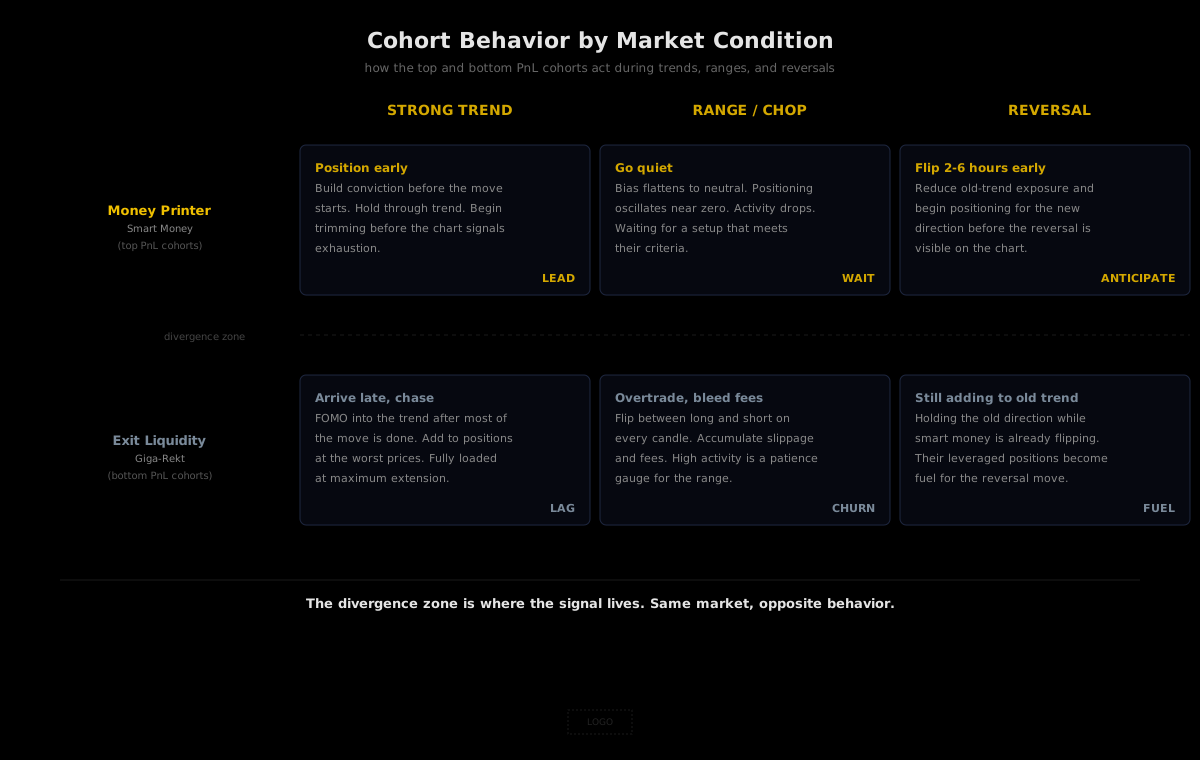
During a strong trend (directional rally or sell-off): The profitable cohorts (Money Printer, Smart Money, Consistent Grinder) tend to position early, hold through the trend, and begin trimming before the trend ends. The losing cohorts (Exit Liquidity, Semi-Rekt, Full Rekt, Giga-Rekt) tend to arrive late, chase the move, and add to their positions just as the profitable cohorts are reducing. The size at which the losing cohorts are fully loaded is often the point of maximum extension.
During a range (sideways, no clear direction): The profitable cohorts go quiet. Their aggregate positioning flattens and their bias oscillates close to neutral. They are waiting. The losing cohorts tend to overtrade the range, flipping between long and short on every candle, accumulating fees and slippage. The total activity of the bottom PnL cohorts during a range is often a useful "patience gauge": if they are hyperactive, the range is probably going to resolve with a squeeze of whoever was most recently positioned.
During a reversal (trend exhaustion into direction change): This is where cohort data is most valuable. The profitable cohorts start reducing exposure or outright flipping direction 2-6 hours before the reversal shows up on the chart. The losing cohorts are still adding to the old trend. The divergence between the two is one of the cleanest pre-reversal signals Hyperliquid produces. By the time the chart confirms the reversal, the profitable cohorts are already positioned for it and the losing cohorts are the fuel for the move.
Reading divergence between cohorts
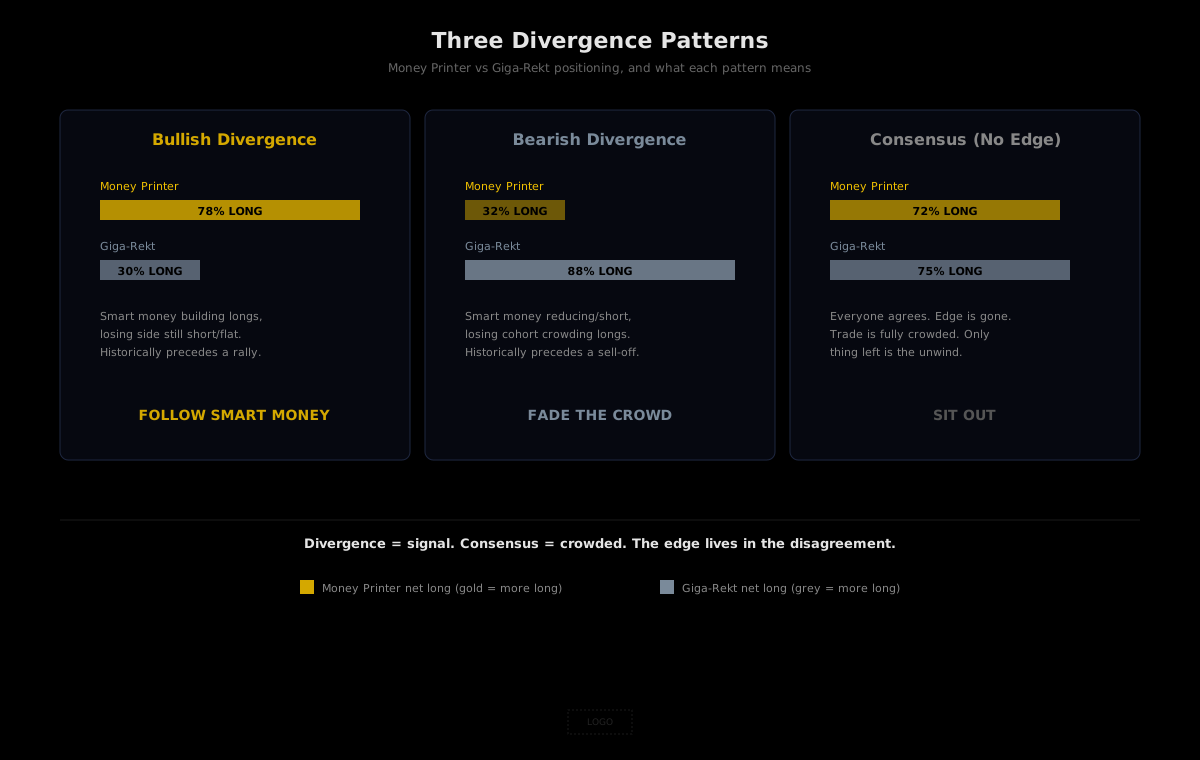
The single most useful thing you can do with cohort data is compare the positioning of the top PnL cohort to the bottom PnL cohort and watch for divergence. When they agree, the trade is crowded and the edge is gone. When they disagree, the historically profitable side is the one worth following.
Three divergence patterns show up consistently:
Bullish divergence. Money Printer / Smart Money are net long, Exit Liquidity / Semi-Rekt / Giga-Rekt are net short or flat. The smart money is building a position that the losing side has not yet recognized. This pattern precedes rallies more often than not, especially when it persists for several hours.
Bearish divergence. Money Printer / Smart Money are net short or reducing longs, while the bottom cohorts are aggressively long. The profitable side is getting out of the way while the losing side is crowding in. This precedes sell-offs, and the sell-off often accelerates as the losing cohorts' leveraged longs begin liquidating.
No divergence (consensus). Everyone is on the same side. The profitable and the losing cohorts agree on direction and the market is fully positioned. This is the most dangerous setup to trade, because the edge has already been captured by whoever positioned first, and the only thing left to happen is the unwind.
The 12-hour rolling bias endpoint (/segments/{segmentId}/bias-history) is the cleanest way to spot divergence forming, because it shows you whether a cohort's lean is fresh (last hour) or persistent (half a day). A divergence that has persisted for 6+ hours is a much stronger signal than one that appeared 30 minutes ago.
Querying cohort data from the API
Three endpoints power cohort analytics on HyperTracker:
/cohort/metrics?coin=BTCreturns aggregate long/short exposure for all 16 segments on any asset. One call, full market map./segments/{segmentId}/summaryreturns trader counts, aggregate positioning, and the top 10 open perps for a single cohort. Useful for seeing where a segment's conviction is concentrated./segments/{segmentId}/bias-historyreturns the rolling 12-hour directional bias. This is the endpoint that tells you whether a divergence is fresh (last hour) or persistent (half a day).
For worked Python examples showing how to pull these endpoints and build a divergence detector, see Hyperliquid Analytics API: Smart Money and Cohort Data Explained, which walks through the full code step by step.
Free tier on HyperTracker allows 100 requests per day, enough to check all 16 cohorts on one asset several times per hour. No credit card required.
Closing thoughts
Most perp traders watch the same chart, read the same indicators, and wonder why they end up on the wrong side of the same trades as everyone else. The chart treats every position as equal. A $50 test position from a wallet that has lost $500,000 moves the open interest print the same direction as a $50 conviction add from a wallet that has made $3 million.
Cohort analytics is the layer that breaks that symmetry. It takes the same raw data and stratifies it by the only two things that actually matter: how much capital a wallet controls and how good it has been at using it. Sixteen segments, two axes, one API call per asset.
Every trade on Hyperliquid has a wallet behind it. Every wallet has a track record. The traders who check which cohort is on which side before they enter are the ones who stop being someone else's exit liquidity.