
The Democrat Sweep Just Sent Crypto Regs Back to Square One
By CMM Team - 05-Nov-2026
The Democrat Sweep Just Sent Crypto Regs Back to Square One
The crypto industry spent roughly $176 million across more than 100 congressional races this cycle. On Tuesday night, that investment went sideways. Democrats took both chambers, the CLARITY Act is functionally dead, and Elizabeth Warren is set to chair the Senate Banking Committee. The regulatory landscape that builders and traders mapped out over the past two years just got redrawn.
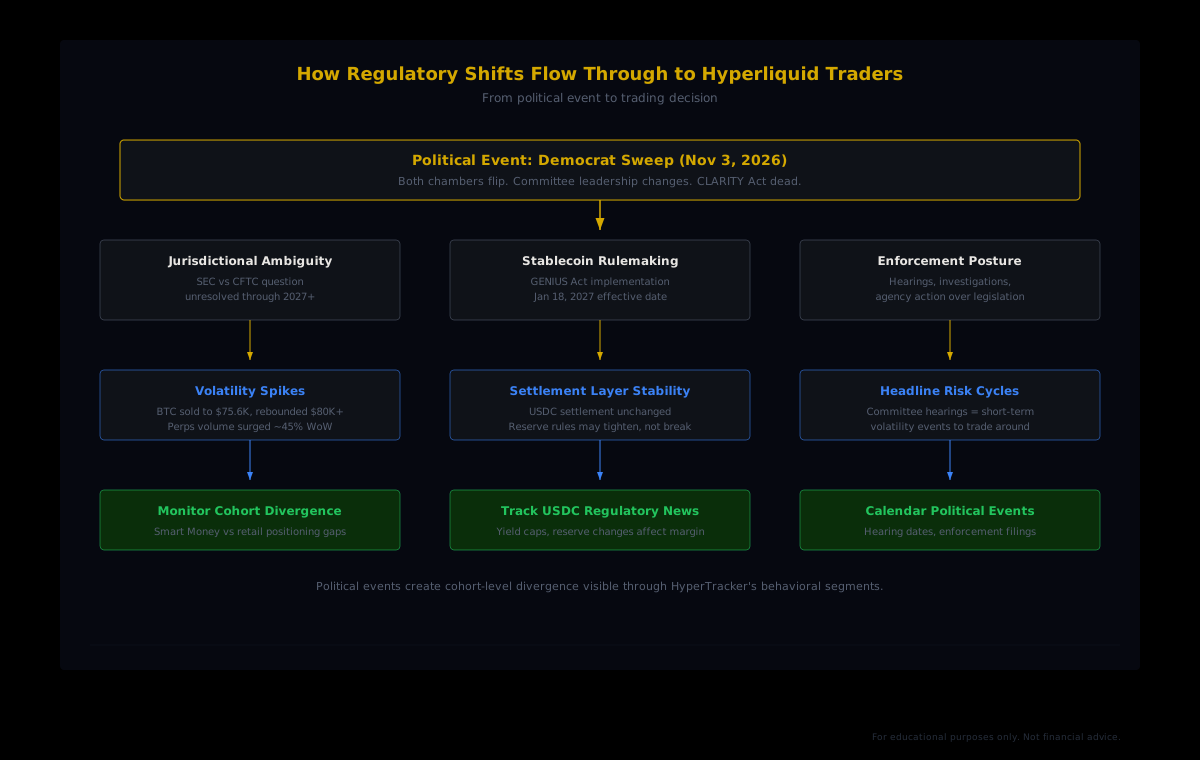
Bitcoin reacted the way Bitcoin does when uncertainty resolves: it sold off to roughly $75,600 before snapping back above $78,000 within 24 hours. Hyperliquid perps volume surged 44.93% week-over-week. Volatility creates opportunity, and the biggest question now is whether this political reset changes the structural environment for on-chain derivatives or just reshuffles the committee chairs.
This article breaks down exactly what happened, what survives the transition, what is dead, and what the regulatory shift means for anyone building or trading on Hyperliquid.
What the midterms actually changed
The November 3 midterm results flipped both chambers of Congress to Democratic control. That reversal carries specific consequences for crypto legislation because the committees that approve digital asset bills are now run by different people with different priorities.
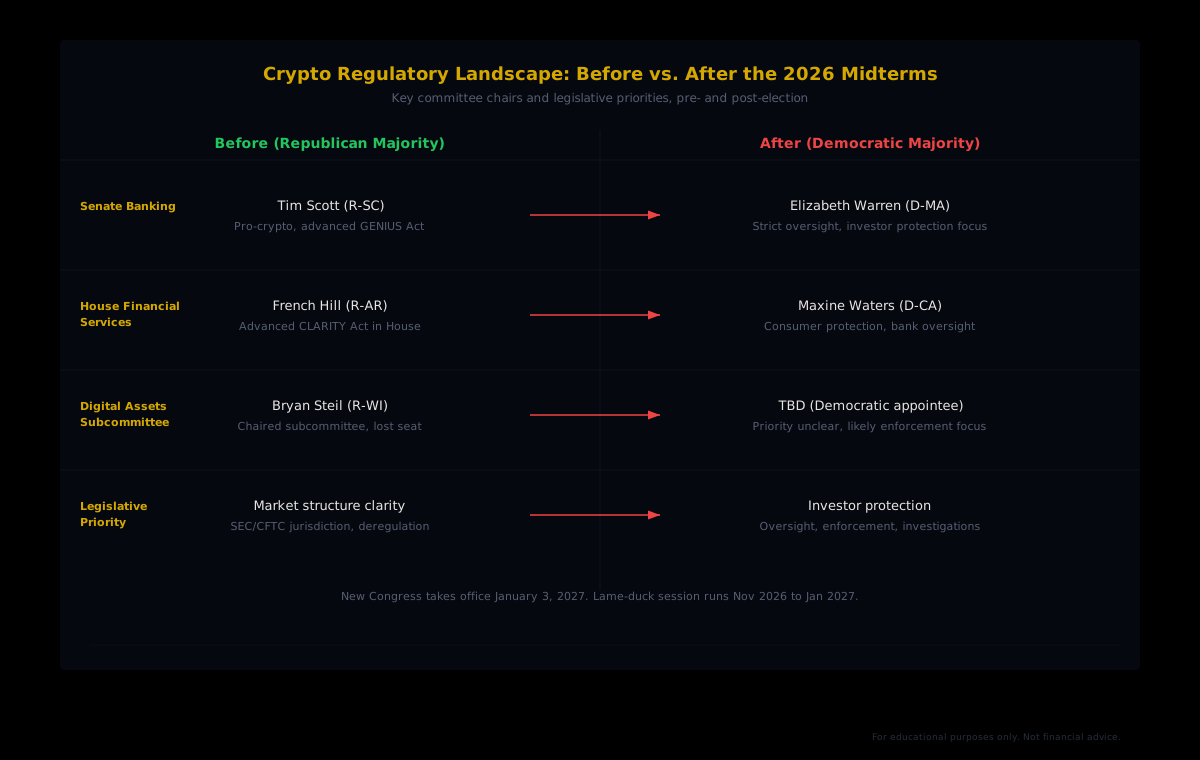
The CLARITY Act, which would have established a formal market structure framework splitting oversight between the SEC and CFTC, failed on a 49-50 procedural vote on September 15. It needed 60 votes to advance. Under the incoming Democratic majority, that bill is unlikely to resurface in its current form because the new committee leadership has signaled a preference for stricter investor protections over the regulatory clarity the industry was seeking.
Three crypto-friendly House members lost their seats: Bryan Steil, who chaired the Digital Assets Subcommittee, along with Zach Nunn and Ann Wagner. In Ohio, Sherrod Brown defeated Jon Husted despite more than $64 million in crypto-related spending in that single race, including a $30 million campaign by Fairshake.
The practical result: Elizabeth Warren is positioned to chair the Senate Banking Committee, and Maxine Waters is expected to reclaim the House Financial Services chairmanship. Both have historically favored tighter crypto oversight.
What survives the transition
The sweep does not erase everything. Two pillars of the regulatory framework remain intact, and they are arguably the ones that matter most for institutional adoption.
The GENIUS Act (stablecoins)
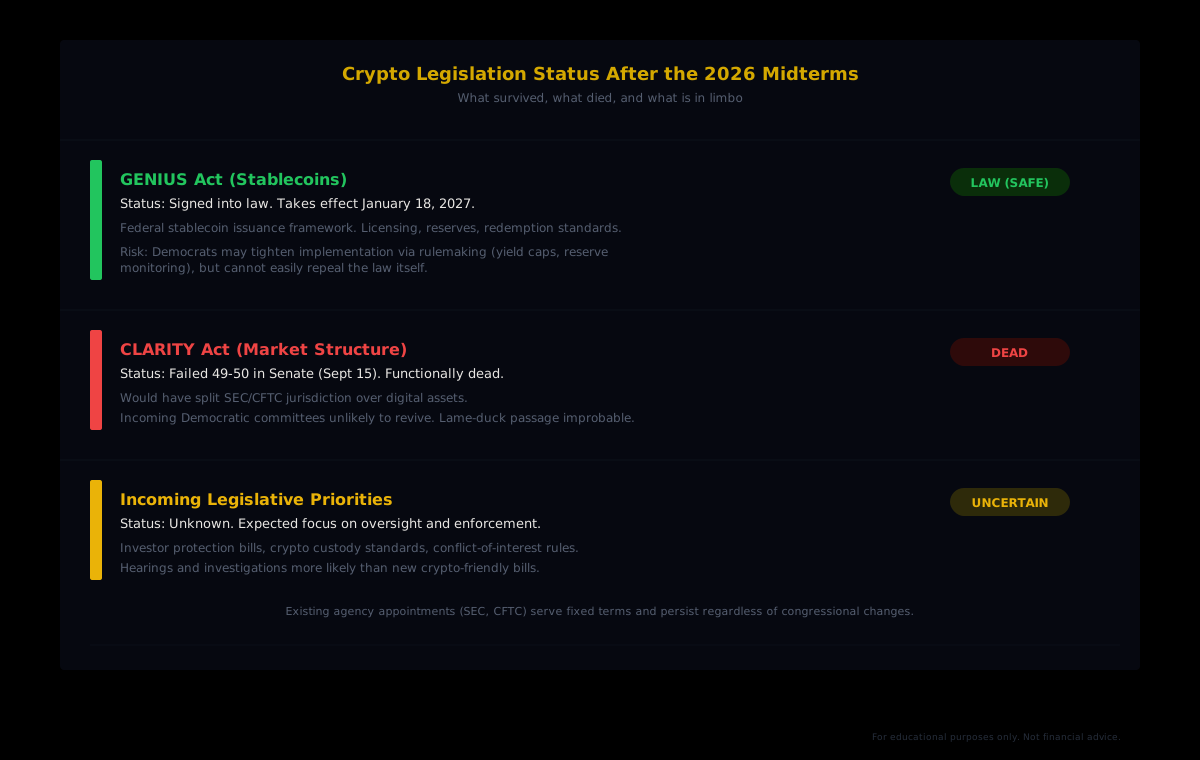
The GENIUS Act, which established a federal framework for stablecoin issuance, passed under the Republican majority and is already law. It takes effect on January 18, 2027. Democrats cannot easily repeal it, though they can tighten its implementation through rulemaking. Stablecoin supply currently sits around $300 billion, within about 6% of its all-time high, and the infrastructure around stablecoin payments is too deeply embedded in TradFi partnerships to unwind quickly.
The risk here is not repeal but restriction. New committee leadership could push for yield caps on stablecoin products, stricter licensing requirements for issuers, and reserve monitoring obligations that favor traditional banks over crypto-native companies.
Tokenization and blockchain rails
Wall Street's plans to put stocks, bonds, and funds on blockchain rails can proceed under existing securities law. Tokenization does not require new legislation the way broader crypto market structure does, which insulates it from the committee reshuffle. George Varghese, CEO of 0G Labs, noted that stricter regulation is "not necessarily negative for institutional adoption" because "large investors can operate within demanding regulatory frameworks."
Existing agency appointments
Crypto-friendly officials remain at the SEC and CFTC. Agency heads serve fixed terms, which means the pro-crypto orientation at both regulators persists regardless of congressional leadership changes. The next crypto battle, as PYMNTS put it, "may be fought less through legislation than through regulatory implementation, agency oversight and disputes over which institutions can offer digital financial services."
What is dead (for now)
The CLARITY Act is the headline casualty. Without it, there is no formal framework defining which digital assets fall under the SEC and which belong to the CFTC. That jurisdictional ambiguity has been the central regulatory uncertainty hanging over crypto for years, and it will persist through at least 2027.
Mati Greenspan, founder of Quantum Economics, called the Democratic sweep "the final nail in the Clarity Act's coffin." The outgoing Republican Congress can still attempt to pass it during the lame-duck session before January 3, 2027, but the votes that failed in September are unlikely to materialize during a transition period.
Beyond the CLARITY Act, expect scrutiny of any new deregulatory proposals. The incoming committees are more likely to hold hearings and request documents than to advance crypto-friendly bills. Investigation of Trump-linked crypto ventures is also on the table, which could create headline risk even if the investigations produce no policy changes.
How the market processed the news
Bitcoin's initial reaction looked dramatic but resolved quickly. The price dropped to around $75,600 on election night, its lowest level in roughly seven weeks. By November 4, it had rebounded to $78,300 and continued climbing toward $80,000. Ether jumped nearly 6%.
The V-shaped recovery followed a pattern familiar from past political events: sell the uncertainty, buy the clarity. A resolved election, even one with unfavorable regulatory implications, removes the binary risk that was priced into options and futures leading up to November 3.
Spot ETFs saw significant outflows during the uncertainty window. Over three sessions from October 30 through November 3, Bitcoin ETFs recorded roughly $1.16 billion in net withdrawals, with BlackRock's IBIT alone seeing about $95 million in redemptions on November 3. That kind of outflow is meaningful but temporary. Institutional capital tends to rotate back once the political dust settles.
On the derivatives side, crypto futures volume climbed 27% while open interest rose just 3%. That gap suggests the volume spike was driven by short covering and hedging activity rather than new directional bets. Traders were closing positions and re-establishing risk, which is exactly the behavior you would expect when a binary event resolves.
What this means for Hyperliquid traders
The regulatory reset affects on-chain perps in specific and measurable ways. Here is what to watch.
Volatility regimes and cohort behavior
Political uncertainty creates volatility, and volatility creates divergent behavior across trader cohorts. Our data consistently shows that during high-volatility events, the gap between what larger, profitable wallets do and what smaller or unprofitable wallets do widens significantly. Money Printers and Smart Money cohorts tend to reduce leverage and tighten stops ahead of known events, then re-enter aggressively once the event resolves. Exit Liquidity and below tend to hold through the drawdown and get liquidated.
Hyperliquid's 7-day perps volume was up nearly 45% heading into November 5, reflecting exactly this dynamic: high-conviction traders capitalizing on the dislocation while overleveraged positions get flushed.
The jurisdictional question
Without the CLARITY Act, on-chain perps exist in the same regulatory gray zone they have occupied since launch. The CFTC has asserted jurisdiction over crypto derivatives, but enforcement has been selective and focused on centralized platforms. Decentralized protocols like Hyperliquid operate in a space where the rules have not been formally written.
That gray zone is not new, and it was not going to be resolved even under a Republican Congress (the CLARITY Act addressed spot market structure, not derivatives specifically). But the incoming committee leadership is more likely to push the CFTC toward enforcement actions than the outgoing leadership was. For traders, this means monitoring regulatory developments becomes a risk management task, alongside the usual technical and fundamental analysis.
Stablecoin changes and settlement
Hyperliquid settles in USDC. The GENIUS Act's implementation could affect USDC's regulatory status, reserve requirements, and yield capabilities. If the new Congress pushes for yield caps on stablecoins, that could reduce the opportunity cost of holding USDC in margin accounts (because you are giving up less yield by locking it in positions). Stricter reserve standards, on the other hand, could increase confidence in USDC's backing, which is structurally positive for any protocol that depends on stablecoin solvency.
Tracking the shift with on-chain data
Regulatory transitions create a specific kind of information asymmetry. Some traders process the implications quickly, adjust their positioning, and benefit from the repricing. Others react late, chase the move, or ignore the shift entirely. The gap between these groups shows up in cohort-level positioning data.
HyperTracker's 16 behavioral cohorts, eight based on account size and eight based on all-time profitability, give you a real-time view of how different market participants are responding to the regulatory shift. When Money Printers start reducing net long exposure while Shrimp accounts pile into leverage, that divergence is a leading indicator of where the next liquidation cascade will form.
The cohorts that matter most during political transitions are the PnL-based tiers. Wallets classified as Money Printer (cumulative PnL above $1M) and Smart Money ($100K to $1M) have survived multiple regulatory cycles and tend to position conservatively ahead of uncertainty. Wallets in the negative PnL cohorts tend to trade reactively, chasing moves after they have already happened.
Our data refreshes every 5 minutes, which means you can track these cohort-level shifts as they happen. During the election night selloff, for example, watching how each cohort's aggregate leverage and directional bias changed in real time was the difference between catching the bottom and chasing the bounce.
Track cohort positioning during regulatory volatility
HyperTracker's API gives you real-time access to 16 behavioral cohorts on Hyperliquid: see what Money Printers, Smart Money, and every other segment are doing. Cohort bias, leverage, positioning, and order flow, all through a single API.
The lame-duck window and what comes next
The outgoing Congress has until January 3, 2027, to attempt last-minute legislation. In theory, Republicans could try to advance the CLARITY Act during this window. In practice, the procedural barriers that blocked it in September still exist, and departing members have little incentive to spend political capital on a bill that may be reversed by the incoming majority.
The more realistic timeline is that regulatory action shifts from legislation to agency rulemaking in 2027. The GENIUS Act's implementation on January 18, 2027, will be the first major test. How the OCC, SEC, and CFTC interpret and enforce the stablecoin framework will set the tone for the broader regulatory environment.
Varghese captured the core risk: "The bigger risk is another two years of regulatory fragmentation while capital and innovation continue flowing toward jurisdictions offering more predictable conditions. There's a competitive cost to delay."
For builders on Hyperliquid, the practical implication is that U.S. regulatory clarity is not arriving in 2027. Build for a world where the rules remain ambiguous, and design systems that can adapt when clarity eventually comes. For traders, the implication is that political risk is now a standing variable in your models. Committee hearing dates, enforcement announcements, and rulemaking timelines all generate the kind of volatility that creates opportunity on a platform processing billions in daily perps volume.
The money did not leave crypto on election night. It repriced, rotated, and came back within 24 hours. The same thing will happen with regulatory uncertainty: it will get priced in, traded around, and eventually resolved. The question is whether you are positioned to benefit when it does.