
The ICE CEO Called Hyperliquid "Bigger Than NASDAQ." He's Right.
By CMM Team - 29-May-2026
The ICE CEO Called Hyperliquid "Bigger Than NASDAQ." He's Right.
Jeffrey Sprecher built Intercontinental Exchange from a single energy trading floor into the company that owns the New York Stock Exchange. When someone running the world's largest exchange group looks at a crypto protocol built by 11 people and calls it "bigger than NASDAQ," the trading world pays attention.
At Bernstein's 42nd Annual Strategic Decisions Conference this week, Sprecher did exactly that. He described Hyperliquid's team as "very, very smart people" and disclosed that ICE has met with the protocol's founders multiple times. His tone wasn't hostile. It was fascinated, maybe even envious: "I love this. I wish I were younger so I could jump in and do it myself."
The remarks weren't a passing compliment. They represent a structural acknowledgment from TradFi's most important exchange operator that onchain perpetual futures have crossed from experiment to existential competitor. Here's why his comparison holds up, what it signals for the perp DEX market, and what traders and builders should be watching next.
The Comparison: By Volume, Not Valuation
Sprecher's "bigger than NASDAQ" line is provocative, but context matters. He wasn't comparing market capitalizations. Nasdaq Inc. trades at roughly $50 billion; Hyperliquid's HYPE token carries a market cap around $13.8 billion. The comparison falls apart on that metric alone.
Where the comparison holds is trading activity. Hyperliquid commands more than 70% of decentralized perpetual futures volume, and its daily notional turnover routinely exceeds the daily equity derivatives volume on Nasdaq's options exchange. The perp DEX sector accumulated $1.8 trillion in trading volume in a single quarter alone this year, more than the entire niche's volume in 2024. Hyperliquid captured the majority of that.
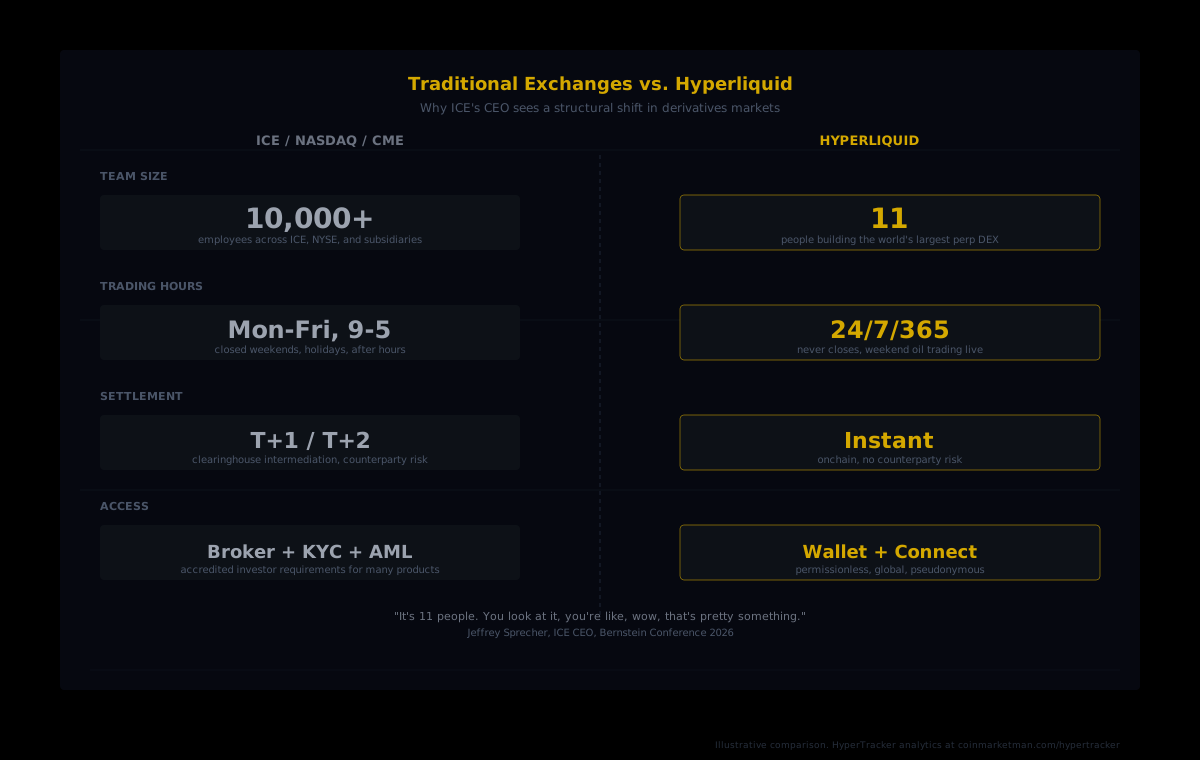
Sprecher's framing also highlights the team-size asymmetry. ICE employs thousands of people across its exchanges, clearing houses, and data services. Hyperliquid built a venue that processes billions in daily volume with 11. That efficiency gap is what made Sprecher say: "You look at it, you're like, wow, that's pretty something."
Why Weekend Oil Changed Everything
The trigger for TradFi's attention wasn't crypto-native volume. It was oil.
Hyperliquid's crude oil perpetual contracts trade 24 hours a day, seven days a week. ICE's Brent crude futures, the global oil benchmark, close on Friday and don't reopen until Sunday evening. That gap matters because geopolitical shocks keep landing on weekends. Iran escalation headlines, OPEC surprise announcements, and military strikes all move oil prices while ICE's markets sit dark.
Traders noticed. Hyperliquid's oil perps have driven over $1.6 billion in 24-hour trading volume, with $1.3 billion in open interest. JPMorgan analysts flagged the pattern: non-crypto traders are using Hyperliquid for off-hours oil exposure, turning a crypto-native venue into a de facto weekend commodities exchange.
Sprecher himself acknowledged this dynamic. ICE responded not with hostility but with adaptation: a partnership with OKX to launch oil perpetual contracts linked to ICE Brent Crude and WTI benchmarks, backed by ICE's investment in OKX at a $25 billion valuation.
The message is clear. When the world's largest energy exchange operator starts building perp products because a crypto protocol beat it to the trade, the competitive landscape has permanently shifted.
The Institutional Signal Stack
Sprecher's comments didn't arrive in isolation. They're the latest in a series of institutional signals that have converged around Hyperliquid in 2026:
- HYPE spot ETFs launched on May 12. Both THYP (on Nasdaq) and BHYP (on NYSE) began trading, and within their first 10 trading days, they attracted $100 million in combined net inflows.
- Russell 3000 inclusion. Hyperliquid Strategies (ticker: PURR), the largest HYPE treasury company holding approximately 20 million HYPE tokens, joins the Russell 3000 Index effective June 26. That means passive index funds tracking Russell 3000 will automatically purchase PURR shares.
- ICE invested in OKX at a $25 billion valuation and secured a board seat, then announced a joint oil perpetual product. The exchange that owns the NYSE is now funding a crypto exchange to compete on perpetual futures.
- Multiple ETF filings. Grayscale, Bitwise, and 21Shares have all filed for HYPE products, adding an institutional wrapper to what was previously retail-dominated flow.
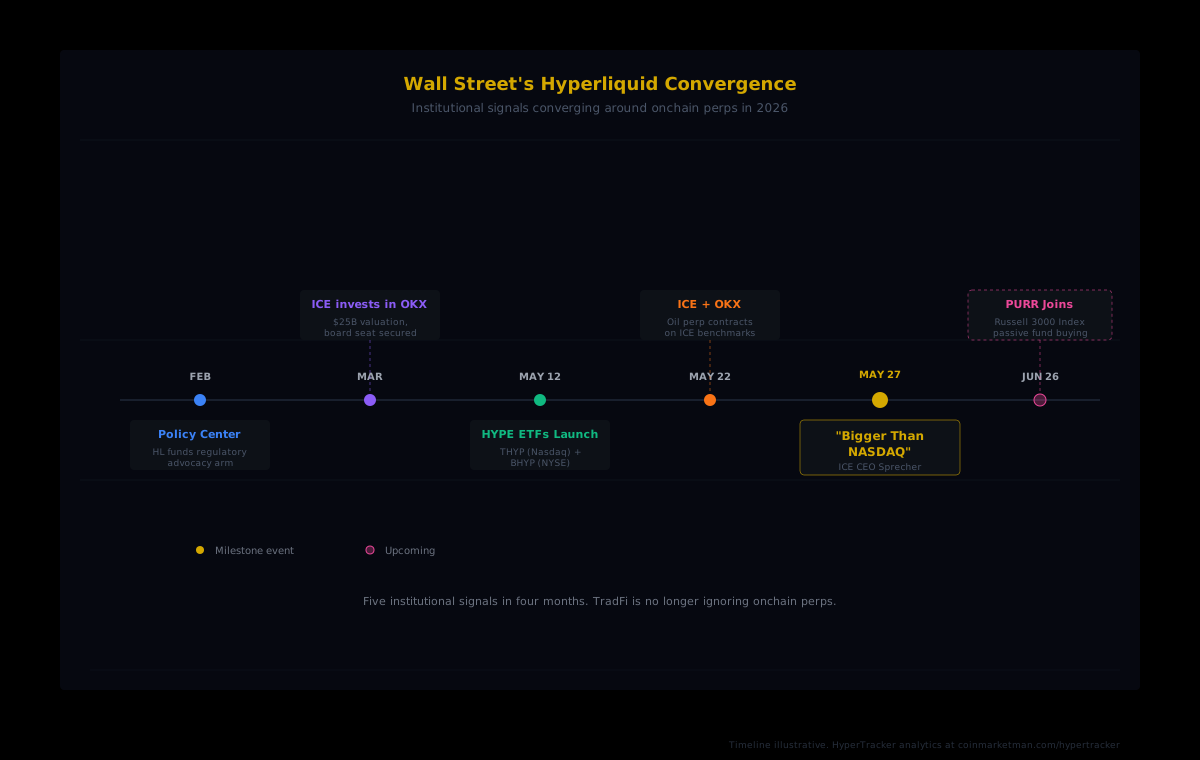
Five distinct institutional signals in four months. Each one independently noteworthy. Together, they represent a pattern: traditional finance is building around Hyperliquid's gravity, and the pace is accelerating.
Perp DEX Market Share: The Dominance Numbers
The reason institutional attention keeps landing on Hyperliquid, and on no other perp DEX, is market share dominance. Over 70% of all decentralized perpetual futures volume flows through Hyperliquid.
Every major competitor lost ground in 2026. Aster dropped from early highs. Jupiter, dYdX, GMX, and Drift each hold less than 3% individually. The competitive landscape isn't a race. It's a procession.
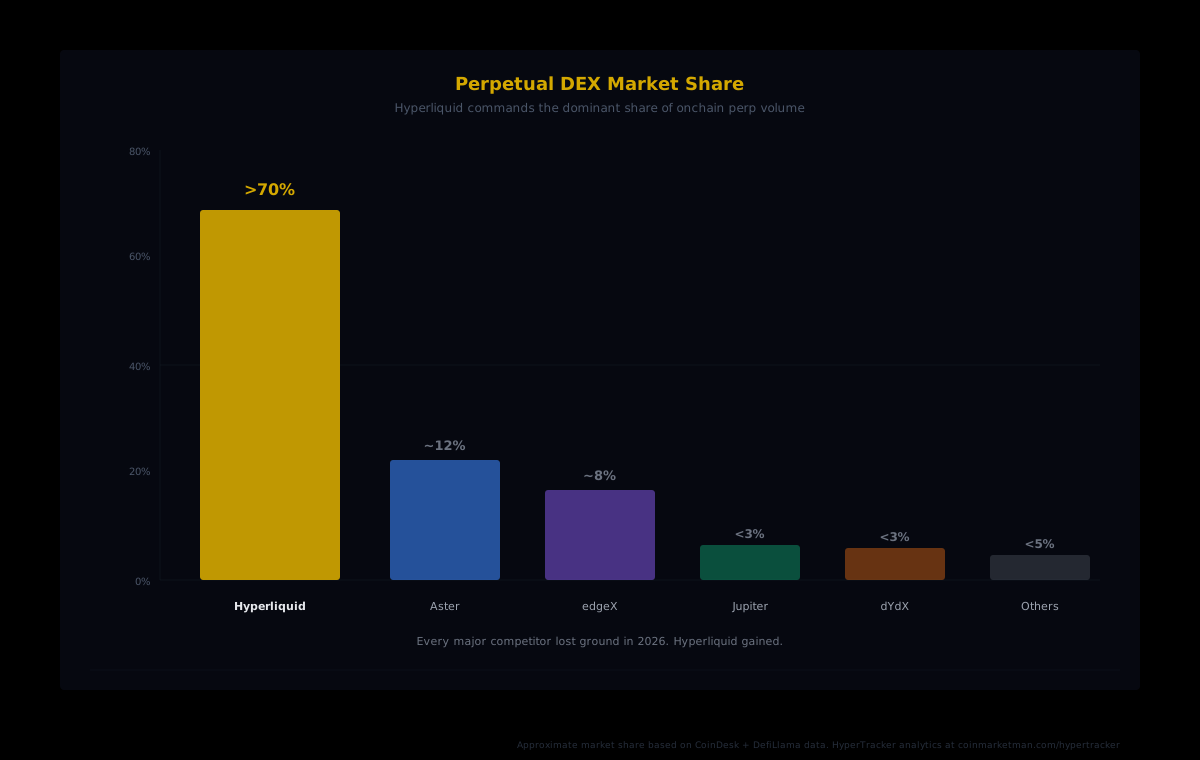
This dominance creates a self-reinforcing cycle. Liquidity attracts traders, which deepens the order book, which attracts more liquidity. Institutional interest follows the same gravity. ETF issuers, index committees, and TradFi exchange operators don't partner with the fourth-largest perp DEX. They engage with the one that processes more volume than all competitors combined.
The Regulatory Fork in the Road
Sprecher didn't just praise Hyperliquid. He also raised the regulatory question that will shape the next chapter of perp DEX growth.
"Why are you prohibiting us from doing this when it's already happening? And can't we have a level playing field?"
His argument: Hyperliquid operates offshore, unregulated, processing billions in derivatives volume. ICE and CME are bound by Dodd-Frank, capital requirements, and clearing mandates. That asymmetry can resolve in two ways. Regulators can create a new category for perpetual futures, establishing rules that crypto-native venues can comply with. Or they can classify perps as swaps under existing frameworks, which would impose traditional derivatives regulation on protocols like Hyperliquid.
Neither outcome kills the perp DEX model. A new regulatory category would legitimize it, potentially opening the door to U.S. retail access. Classification as swaps would raise compliance costs but also create a clearer path for institutional participation. Either way, the conversation has shifted from "should we ban this?" to "how do we regulate this?" That's progress, and Sprecher's lobbying for a level playing field implicitly concedes that Hyperliquid is a real competitor worth regulating rather than a fringe experiment worth ignoring.
Sprecher also told the audience: "We're not freaked out about it. We're actually talking to these people and learning about it." When the CEO of the NYSE's parent company describes his relationship with a DeFi protocol as mutual learning, the Overton window for onchain derivatives has moved permanently.
HYPE's Market Response and the ETF Flywheel
The market rewarded Sprecher's endorsement. HYPE jumped roughly 10% to $62.50 after his remarks, pushing the token within striking distance of its all-time high near $64.
The ETF inflows add a structural bid. U.S. HYPE spot ETFs saw inflows every trading day since launch, with $100 million in cumulative net inflows within the first 10 sessions. One standout: Bitwise's fund pulled in $19.05 million in a single day on May 27, the same day Sprecher spoke at Bernstein.
When PURR enters the Russell 3000 on June 26, passive index funds will automatically begin purchasing shares. That creates a secondary demand channel that doesn't depend on crypto sentiment: if you track the Russell 3000, you own exposure to HYPE's treasury company whether you know what a perpetual future is or not.
Tracking the Smart Money Response
When an institutional endorsement of this magnitude lands, the smart money response tells you more than the headline. Cohort-level analytics reveal how different trader segments are positioning around the news: are whales accumulating during the pop or distributing into retail excitement? Are the consistent performers (the wallets with strong all-time PnL) sizing up or trimming?
This is where analytics infrastructure becomes a competitive edge. Our data classifies every wallet on Hyperliquid into 16 behavioral cohorts, eight by size (from Shrimp to Leviathan) and eight by all-time PnL (from Money Printer to Giga-Rekt). When institutional narratives shift, cohort positioning shifts first. Seeing that shift in near-real-time, across every segment, is the difference between trading the headline and trading what the market is actually doing.
Track Institutional Flows on Hyperliquid
Our API gives you cohort-level positioning data across all 16 behavioral segments. See how whales, smart money, and retail are responding to the ICE endorsement. One API call. Updated every 5 minutes.
The Bigger Picture: TradFi's Perp DEX Playbook
Sprecher's comments crystallize a playbook that's been forming for months. TradFi's approach to Hyperliquid follows three steps: observe, engage, then build adjacent products.
ICE observed Hyperliquid's weekend oil trading. It engaged by meeting the founders, discussing regulatory frameworks, and investing in OKX. Now it's building: oil perpetual contracts on ICE benchmarks, delivered through a crypto exchange it partially owns. CME is watching the same playbook unfold.
For traders, this convergence means more liquidity, tighter spreads, and eventually clearer regulation. For builders, it means the infrastructure layer around Hyperliquid, analytics, execution tools, risk management, copy trading systems, and portfolio dashboards, becomes more valuable as institutional capital flows in. When a fund manager allocates to HYPE through an ETF, their next question is how to understand what's happening on the platform underneath. That's where cohort analytics and order flow data go from "nice to have" to "need to have."
The ICE CEO said Hyperliquid is bigger than NASDAQ. By volume, he's right. By team efficiency, he's understating it. By trajectory, the gap between TradFi acknowledgment and TradFi integration just closed by half in a single conference talk. The 11 people building Hyperliquid are no longer on TradFi's radar. They're on TradFi's org chart, whether they want to be or not.