
The Mystery Codes Climbing Hyperliquid's Builder Leaderboard
By CMM Team - 08-Oct-2026
The Mystery Codes Climbing Hyperliquid's Builder Leaderboard
Open Hyperliquid's builder leaderboard and scroll past the names you recognize. Phantom, Based, MetaMask, PVP. Below these familiar faces sit rows that look different: a question mark, a truncated wallet address, and columns full of numbers that tell you someone is building something people actually use. You just have no idea who.
These unclaimed builder codes are among the most interesting signals on the leaderboard, because they represent projects gaining real traction before any public announcement, any branding, any marketing push. If you can spot them early, you can identify the next major Hyperliquid front-end before it shows up on Crypto Twitter.
This guide covers what unclaimed codes reveal, how to filter the noise from the signal, and how to use HyperTracker's builder API endpoints to build a watchlist of mystery codes worth following.
The builder ecosystem is bigger than you think
Hyperliquid's builder code system is simple in concept. Any front-end that routes orders to the exchange can register a code. When traders execute through that front-end, a small fee (set by the builder) gets attached to each fill. The fee goes to the builder's address. This is how front-ends make money on Hyperliquid, and it creates a transparent, on-chain record of which products are actually being used.
Figures as of July 2026, from HyperTracker's builder leaderboard: the ecosystem had 1,411 registered builder codes, with $90.7 million in cumulative all-time revenue flowing through them, against $274.9 billion in total volume. By mid-October 2026, the dashboard showed 889 active builder codes listed over the 30-day timeframe. The gap between those two numbers tells you something important: many codes get registered but only a fraction generate meaningful activity.
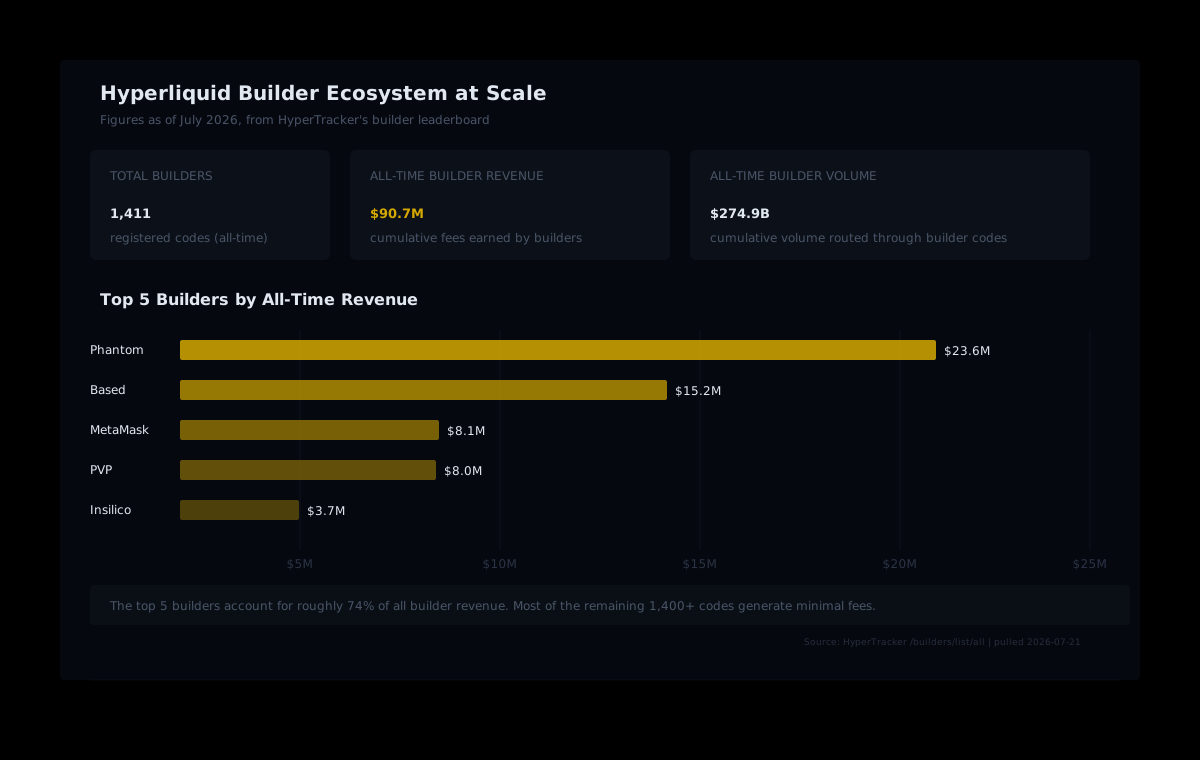
The top of that leaderboard is dominated by known names. Phantom leads with $23.6 million in all-time revenue from over 153,000 users. Based follows at $15.2 million. MetaMask and PVP both sit around $8 million each. These are established products with public identities. What is more interesting is who comes next.
What an unclaimed code looks like
When a builder registers a code on Hyperliquid but hasn't linked it to a named project in HyperTracker's database, the leaderboard shows a "?" prefix followed by a truncated wallet address. The columns still fill with real data: rank, age, usage fee, volume, users, average revenue per user, and total revenue. Everything about the code's performance is visible. The only thing missing is a name.
This matters because a named code means the project has claimed its identity, usually because it has launched publicly and wants to be recognized. An unclaimed code means one of two things: the team hasn't bothered claiming it yet, or they're operating quietly, possibly in a private beta, possibly in stealth mode, possibly building something they haven't announced.
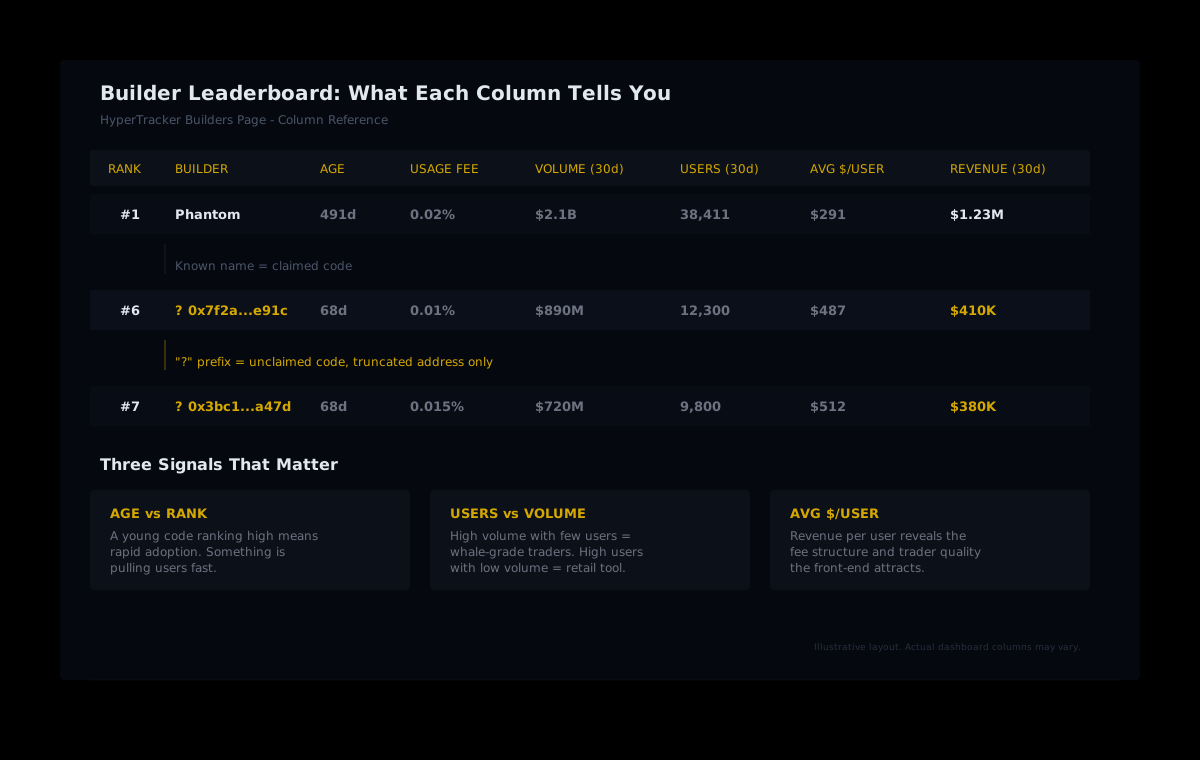
As a real example from the dashboard on October 13, 2026: two unclaimed codes, both just 68 days old, were sitting at rank #6 and #7 by 30-day revenue. Two months of existence and they were already outperforming builders that had been live for over a year. Whatever these projects were, real traders were routing real volume through them.
The signals worth reading
Raw rank is attention-grabbing but incomplete. A code can rank highly by revenue because it charges a high fee to a small number of users, which is very different from a code that charges a low fee to tens of thousands. The leaderboard gives you enough columns to tell these stories apart.
Age versus rank
This is the single most revealing ratio. The builder leaderboard tracks how many days ago a code was first registered. A code that is 68 days old and ranks in the top 10 is absorbing users at an unusual pace compared to codes that took a year or more to reach similar levels. Young age plus high rank suggests organic growth, the kind that happens when a product solves a real problem and spreads through word of mouth or private communities.
Users versus volume
The 30-day user count and 30-day volume tell you what kind of traders a front-end attracts. A code with few hundred users but massive monthly volume has a very different profile than one with tens of thousands of users and moderate volume. The first is a tool for serious traders moving large positions. The second is a consumer-facing product with broad adoption and smaller average trade sizes. Both are legitimate businesses, but they represent very different front-ends.
Average revenue per user
This column is effectively the fee structure multiplied by how much each user trades. A high average-per-user on an unclaimed code tells you the front-end is either charging a higher fee (possible with premium tools) or attracting traders who move enough size that even a small fee generates meaningful revenue. Compare it against known builders to get a baseline. If the mystery code's per-user revenue is multiples higher than retail-facing platforms, its users are probably not retail.
How to build a watchlist with the API
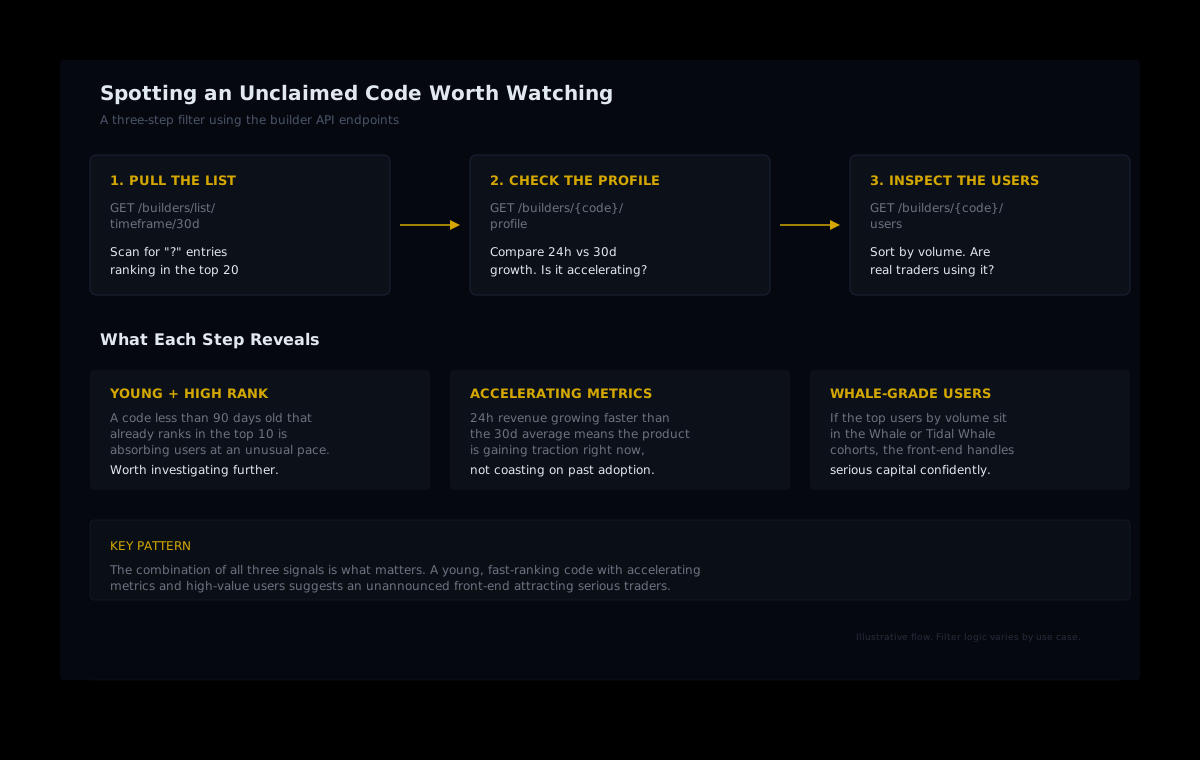
The dashboard gives you a snapshot. The API lets you systematize the process and run it on a schedule. Three endpoints do the work.
Step 1: Pull the full builder list
GET /builders/list/timeframe/30d
This returns every builder ranked by 30-day revenue, including previous-period comparisons (revenuePrev, volumePrev, usersPrev). You can also call the 24h, 7d, or all timeframes. The response redirects to a pre-signed file containing the full list.
Scan the list for entries without a recognized name. In the API response, unclaimed codes use the raw wallet address as their identifier. Filter to codes ranking in the top 20 or 30 by revenue, then flag any that are younger than 90 days. That is your initial candidate set.
Step 2: Inspect the profile
GET /builders/{builder}/profile
Pass the builder address to get a full profile with revenue, fee rates, and analytics across 24-hour, 7-day, 30-day, and all-time windows. The key comparison here is growth trajectory. If 24-hour metrics are growing faster than the 30-day average, the code is accelerating. If the 30-day numbers are strong but the 24-hour slice is flat or declining, early traction may have plateaued.
Step 3: Look at the users
GET /builders/{builder}/users?orderBy=volume&period=30d
This returns the wallets that have traded through a given builder code, sortable by volume, PnL, builder fee paid, or equity. Sorting by volume shows you whether the front-end's activity comes from a handful of whales or a broad base of smaller traders.
You can cross-reference individual user wallets against HyperTracker's cohort data. If the top users by volume belong to the Whale, Tidal Whale, or Leviathan size cohorts, the front-end is handling serious capital. If the top users are Smart Money or Money Printer by PnL, the front-end is attracting profitable traders, which is an even stronger signal.
What you should avoid assuming
The temptation with mystery codes is to guess who owns them. Resist it. A truncated address gives you no reliable basis for attribution, and wrong guesses in public can create problems for both you and the actual project behind the code. Let the data speak for itself. The performance metrics tell you whether a code is worth watching. They don't tell you who is behind it, and that is fine.
It is also worth remembering that some unclaimed codes will stay unclaimed. Certain projects operate as headless infrastructure, routing orders for bots, aggregators, or internal desks with no interest in public branding. A strong code with no name is not always a stealth consumer product. Sometimes it is backend plumbing that will never have a landing page.
The other trap is reading too much into short windows. A code that spikes for one week because a single whale routed volume through it looks spectacular on a 7-day view and unremarkable on a 30-day view. Always compare multiple timeframes before adding something to your watchlist.
A practical filter you can run today
Here is a concrete workflow for identifying unclaimed codes worth following:
- Pull
/builders/list/timeframe/30dand sort by revenue. Identify unclaimed codes in the top 30. - Filter by age. Codes younger than 90 days that rank highly suggest rapid adoption.
- Cross-check the 7d and 24h timeframes. Is the code's rank climbing across all three windows, or did it peak and start fading?
- Hit
/builders/{code}/profilefor each candidate. Compare 24h revenue to the 30d daily average. If the 24h number is above the daily average, the code is still accelerating. - Pull
/builders/{code}/users?orderBy=volume&period=30dand check the top 10 users. Are they large wallets? Are they profitable by PnL cohort? - Add survivors to a watchlist. Re-run this filter weekly. Codes that appear on consecutive weeks with improving metrics are the ones most likely to announce themselves soon.
The whole filter takes a few minutes if you script it, and less than ten API calls per candidate. On the free tier (100 requests per day), you can screen a dozen candidates comfortably.
Why this matters for builders and traders
For builders, the leaderboard is a competitive intelligence tool. If an unclaimed code enters your market (say, a new aggregator that competes with your front-end), you will see its growth in the builder data before you see it on Twitter. Tracking mystery codes is a form of early-warning radar.
For traders, unclaimed codes represent an opportunity to identify products before they become mainstream. Early adoption of a front-end often comes with benefits: lower fees during beta, access to features before public launch, and the kind of edge that comes from using tools the rest of the market hasn't discovered yet.
And for researchers and analysts, the builder leaderboard is one of the few places in DeFi where you can measure actual product traction in dollars, users, and volume rather than vanity metrics. Every number comes from on-chain activity. No self-reported stats, no inflated MAU claims.
Explore the builder leaderboard
The builder list, profile, and user endpoints are available on every HyperTracker API plan, starting with the free tier at 100 requests per day. Build a watchlist, set up a weekly scan, or just browse the leaderboard and see who is climbing.
Start exploring the builder data
The leaderboard rewards curiosity
Every major Hyperliquid front-end was once an unclaimed code. Phantom was just an address generating volume before it became the top builder by revenue. The same pattern will repeat: a mystery code climbs the ranks, generates serious traction, and then one day announces itself publicly. By the time it shows up on Crypto Twitter, the builder data already told the story weeks earlier.
The data is public. The API is free to query. The only question is whether you are paying attention to the codes that don't have names yet.