Three L2s Died in 90 Days. Is Your Builder Stack Next?
By CMM Team - 04-Oct-2026
Three L2s Died in 90 Days. Is Your Builder Stack Next?
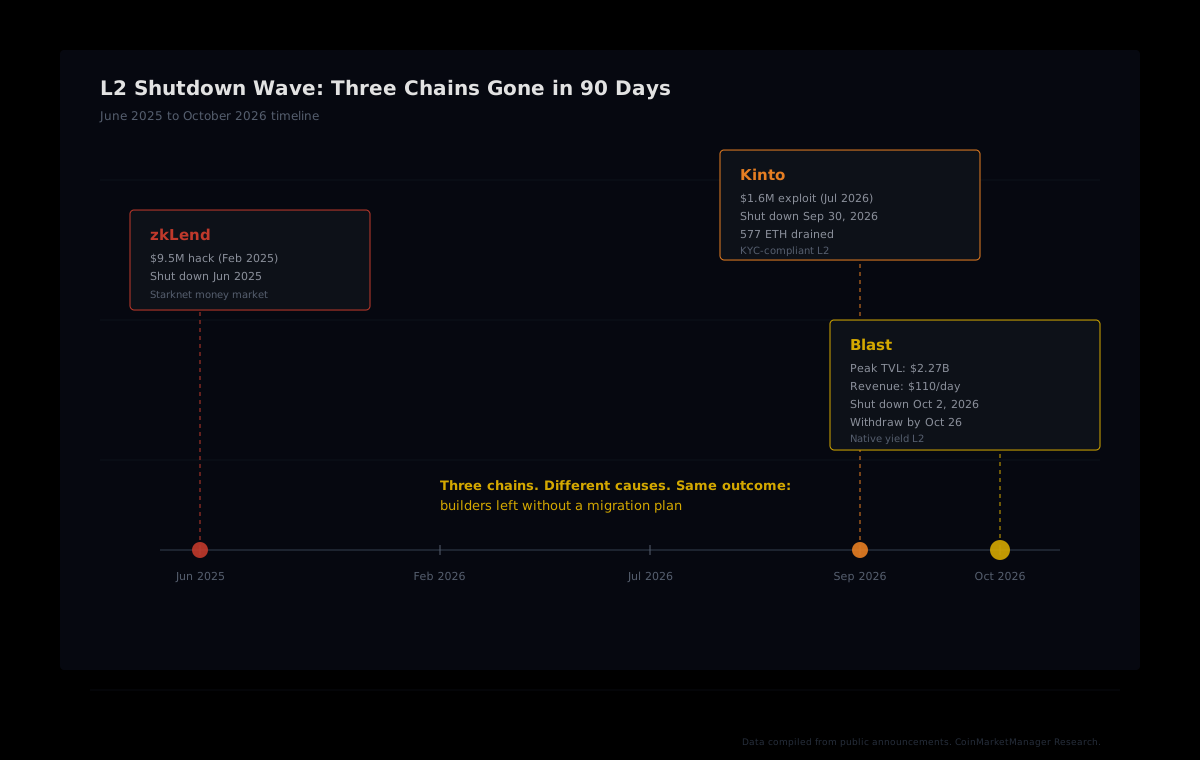
On October 2, Blast announced it would wind down its Ethereum layer-2 network because operating costs exceeded revenue. The chain that once held over $2 billion in deposits was earning $110 per day before pulling the plug. Users have until October 26 to withdraw.
Blast is the third L2 to shut down in roughly 90 days. Kinto closed on September 30 after a $1.6 million exploit, and zkLend shut down in June 2025 following a $9.5 million hack. Three chains, three different failure modes, one shared outcome: builders who deployed there got zero warning and zero migration support.
This article breaks down why these shutdowns happened, what the pattern tells us about L2 economics, and how builders can structure their stack so that a dying chain does not kill their product.
What Killed Three L2s
Each chain died for a different reason, which is exactly what makes this concerning. It is not a single bug or a single market condition. The failure surface for L2s is broader than most builders account for.
Blast: the economics never worked
Blast launched in early 2024 with a native yield model that attracted speculative deposits. TVL peaked near $2.27 billion before the mainnet launch on February 29, 2024. By early October 2026, DeFi apps on Blast held about $32 million in total value locked, a decline of nearly 99%.
The chain's revenue dropped to $110 per day while infrastructure costs continued running. Roughly $51 million remains bridged into Blast's contracts, with $46.6 million of that in staked ETH sitting with Lido. The withdrawal timeline gives users until October 26 through the standard interface, after which they must interact directly with Blast's bridge contracts on Ethereum L1.
A critical governance detail: five keyholders control Blast's bridge contracts, and any three of them can alter those contracts or pause withdrawals. For builders with user funds on-chain, this is the kind of centralization risk that should appear on every pre-deployment checklist.
Kinto: a hack with no recovery runway
Kinto positioned itself as a KYC-compliant L2 built on Arbitrum, targeting institutional traders and regulated firms. On July 10, 2026, an attacker exploited an ERC-1967 proxy weakness to mint 110,000 fake Kinto tokens and dump them, draining 577 ETH (roughly $1.6 million).
The hack itself was survivable. What killed Kinto was the aftermath: failed fundraising attempts, rising debt, and a team that had been working unpaid since July. Founder Ramón Recuero pledged $55,000 from his personal funds to reimburse affected users, covering up to $1,100 per address. Kinto shut down on September 30.
zkLend: trust erosion after a hack
zkLend, a money market protocol on Starknet, lost $9.5 million in an exploit on February 12, 2025. The protocol survived the initial hack but could not recover user confidence. By June 2025 it shut down, citing the exploit's impact on trust and the delisting of its ZEND token from Bybit and KuCoin, which "further constrained token liquidity and accessibility." The remaining $200,000 in treasury was directed toward user recovery.
The L2 Consolidation Pattern
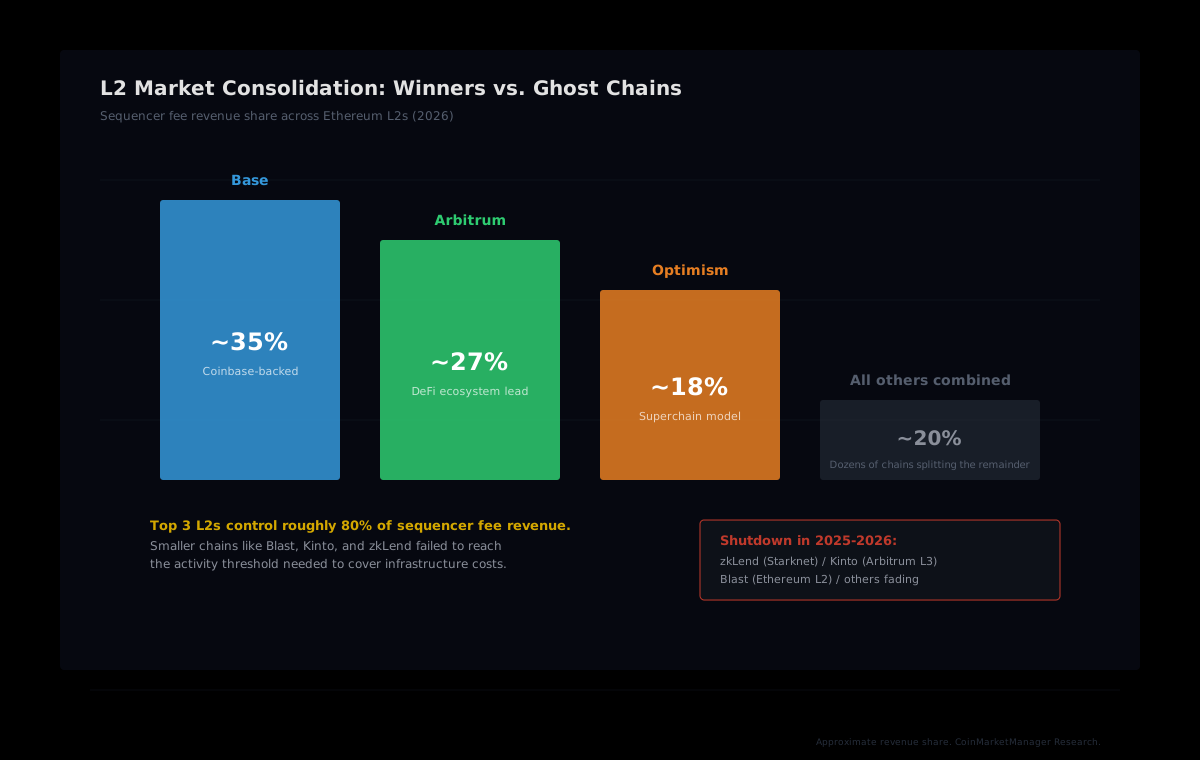
These three shutdowns are symptoms of a structural shift. The Ethereum L2 market is consolidating hard. The top three networks by TVL (Base, Arbitrum, and Optimism) now control roughly 80% of all sequencer fee revenue, according to research from Yellow and BlockEden.xyz. Everyone else splits the remaining 20%, and for many of those chains, the math simply does not work.
The pattern is similar to what happened in centralized exchanges between 2019 and 2022. Dozens launched, a handful captured the liquidity, and the rest slowly faded. The difference for L2s is that a shutdown has technical consequences: smart contracts become unreachable, bridge contracts may require manual interaction, and builders who anchored their infrastructure to a dying chain face real migration costs.
Blast's daily revenue was $110. Running a sequencer, maintaining bridge contracts, and paying for security audits costs orders of magnitude more. When revenue collapses and token incentives dry up, the chain becomes a liability for its operators.
For builders, the lesson is concrete: chain selection is a business-continuity decision. Deploying on a chain with weak unit economics carries the same category of risk as building on a startup's proprietary API. When the parent fails, everything built on top goes dark.
The Builder Migration Playbook
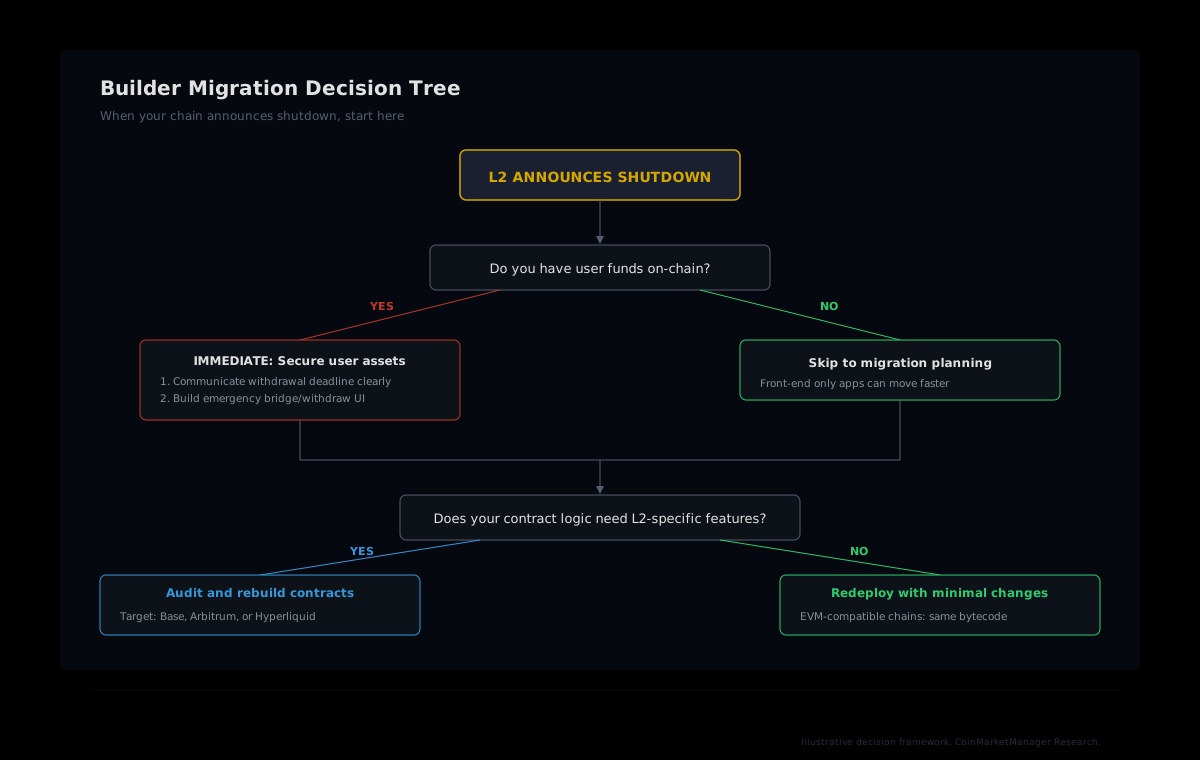
If your chain announces a shutdown, or if you are assessing chain risk before it happens, here is a framework that separates the panic from the planning.
Phase 1: Secure user assets (hours, not days)
If your protocol holds user funds on-chain, this is the only thing that matters in the first 24 hours. Communicate the withdrawal deadline clearly across every channel. Build an emergency UI if your existing interface depends on chain-specific infrastructure that might go offline. If the chain has a bridge withdrawal window (like Blast's October 26 deadline), make sure your users know the exact process before that window closes.
Fantasy Top, a trading card game on Blast, returned approximately $20 million to its community through ETH, BLAST, and rewards over its lifetime. Projects that had a user-first shutdown plan earned community goodwill. Projects that went silent destroyed it.
Phase 2: Audit your chain dependencies
Before picking a new chain, you need to know exactly what you depend on. Most builders are surprised by how deep their chain-specific integrations go. Common dependencies include:
- Native yield mechanics: Blast's native yield on ETH and USDB was a chain-specific feature. If your protocol logic depended on it, you cannot simply redeploy the same contracts elsewhere.
- Oracle infrastructure: If you rely on chain-specific oracle deployments (Pyth on Starknet for zkLend, for example), those need replacement on the target chain.
- Bridge contracts: Any cross-chain messaging or canonical bridge integrations need to be rewired.
- Gas token assumptions: Contracts optimized for one chain's gas model may behave differently elsewhere, particularly if you are moving between optimistic and zk rollups.
Write down every external contract address your protocol calls. For each one, determine whether that contract (or an equivalent) exists on your target chain. This dependency audit saves weeks of debugging later.
Phase 3: Choose your target chain deliberately
The natural instinct is to pick the biggest L2 and redeploy. That is often correct, but it is worth being deliberate about the decision. Key factors:
| Factor | What to evaluate | | --- | --- | | Sequencer revenue | Is the chain generating enough fee revenue to cover operating costs? If not, how long can its treasury sustain it? | | TVL trajectory | Is TVL growing, flat, or declining? A declining TVL is the same signal Blast showed before shutdown. | | Builder ecosystem | Are other builders deploying here? Active builder communities mean better tooling, more composability, and more users. | | Governance structure | How many signers control the bridge? Are there timelocks on admin actions? Blast's 3-of-5 multisig was a governance risk that most builders never checked. | | EVM compatibility | If you are migrating from an EVM chain, another EVM chain lets you redeploy bytecode directly. Moving from a non-EVM chain (like Starknet for zkLend) means rewriting contracts. |
Pacmoon, Blast's largest meme coin, migrated to Solana in August 2024 and rebranded as ARMY. That was a non-EVM migration, which meant a full rebuild. If your product is EVM-native, migrating between Ethereum L2s is significantly cheaper because the bytecode ports directly.
Phase 4: Build chain-agnostic from day one
The most important lesson from the L2 shakeout is architectural. If you are building a new product today, structure it so that the chain is a deployment target, not a dependency. Concretely:
- Abstract your data layer. If your application consumes on-chain analytics (cohort data, order flow, position metrics), pull from an API that is chain-agnostic rather than reading directly from chain-specific contracts. When Hyperliquid's analytics are available through a single API endpoint, your front-end does not care which chain the data originates from.
- Keep business logic off-chain where possible. Smart contracts should handle settlement and custody. Pricing logic, risk models, and alerting systems belong in your own infrastructure.
- Maintain deployment scripts for multiple chains. If you test on both Arbitrum and Base, migrating to either one in an emergency takes hours. If you have only ever deployed to one chain, migration takes weeks.
Build Chain-Agnostic Analytics Into Your Stack
HyperTracker's API gives builders pre-computed cohort analytics, order flow, and liquidation risk for Hyperliquid. One integration, no chain dependency. Free tier available.
Signals That a Chain Is Dying
The three shutdowns shared early warning signals that were visible months before the official announcements. If you are deployed on a smaller L2, watch for these:
- TVL decline with no recovery. Blast went from $2.27 billion to $32 million over two years. That is a slow bleed, not a sudden crash. If TVL drops by more than half with no catalyst for recovery, the chain's days are numbered.
- Token price collapse. BLAST dropped roughly 98% from its launch price. A dying token means a dying incentive structure, which means builders and users leave, which accelerates the death spiral.
- Revenue below operating costs. Blast was earning $110/day when it shut down. Sequencer costs, infrastructure, and security spending are not optional. When revenue cannot cover them, the chain runs on treasury, and treasuries run out.
- Builder departures. Pacmoon left Blast in August 2024, a full two years before shutdown. When notable projects start leaving, they are often seeing internal data (team engagement, grant funding, roadmap stalling) that has not gone public yet.
- Exchange delistings. zkLend's token was removed from Bybit and KuCoin before shutdown. South Korean exchanges Upbit and Bithumb placed BLAST on watchlists after the Blast announcement. Exchange delistings or watchlist additions are strong confirmatory signals.
Why This Matters for Perp Builders Specifically
Perpetual futures builders carry a heavier version of this risk because their applications hold user margin. When a spot DEX's chain dies, users lose convenience. When a perp DEX's chain dies, users can lose collateral. The Drift exploit on Solana (a separate event from the L2 shutdowns) demonstrated this dynamic with roughly $295 million in losses.
For perp builders, chain selection is a fiduciary decision. Every dollar of user margin sits in a smart contract on the chain you chose. If that chain's bridge operators can pause withdrawals (as Blast's 3-of-5 multisig allows), you have introduced a custodial risk that your users may not fully understand.
This is where chain-agnostic data infrastructure becomes a strategic advantage. If your trading analytics, risk models, and alerting systems are decoupled from the chain your contracts run on, migrating the settlement layer becomes a contained engineering task rather than a full product rebuild. Our data tracks 16 behavioral cohorts on Hyperliquid, and builders who integrate through our API maintain their intelligence layer regardless of which chain handles the settlement.
The Shakeout Will Continue
Blast raised $20 million from Paradigm and Standard Crypto. Kinto had institutional backing and a compliance angle. zkLend was built on Starknet, one of the most technically ambitious L2 frameworks. Capital, narrative, and technology were not enough. What mattered was sustainable unit economics: enough users generating enough fees to cover the cost of running the chain.
The L2 market in late 2026 looks like the exchange market in 2020. A handful of winners are pulling away. Coinbase is building Base. Robinhood launched its own chain. Optimism runs the Superchain model with multiple chains sharing infrastructure. These are the well-capitalized, high-activity networks where the math works. Smaller chains without a clear path to fee sustainability are on borrowed time.
For builders, the right response is not to avoid L2s. It is to treat chain selection with the same rigor you apply to choosing a database or a cloud provider. Check the revenue. Check the TVL trajectory. Check the governance. And build your stack so that if the chain dies, your product does not die with it.
Three chains went dark in 90 days. The next one will not send a warning either.