
Trump Just Name-Dropped Hyperliquid at the White House. Now What?
By CMM Team - 20-Aug-2026
Trump Just Name-Dropped Hyperliquid at the White House. Now What?
On August 19, a sitting U.S. president mentioned a decentralized perpetual futures exchange by name during a White House crypto summit. HYPE posted double-digit gains within hours. That part made headlines. But the sentence that matters for builders came right before the rally:
"As far as I know, Mike [Selig] is also working on bringing Hyperliquid into the United States in a fully compliant and legal way."
That quote turns a speculative regulatory question into an active workstream. CFTC Chair Michael Selig, confirmed as the 16th chairman in December 2025, has been laying the groundwork for months. He told the House Agriculture Committee in April 2026 that he wanted to "onshore" decentralized perpetual markets like Hyperliquid. Now the president has publicly confirmed that work is happening.
For traders, this is a momentum catalyst. For builders, it rewrites the assumptions you use to size your market.
The Regulatory Ground Has Already Shifted
Trump's statement did not arrive in a vacuum. The CFTC has been assembling a perpetual futures framework all year, and the pieces are now in place for something that would have been unthinkable 12 months ago: regulated, on-chain perpetual derivatives in the United States.
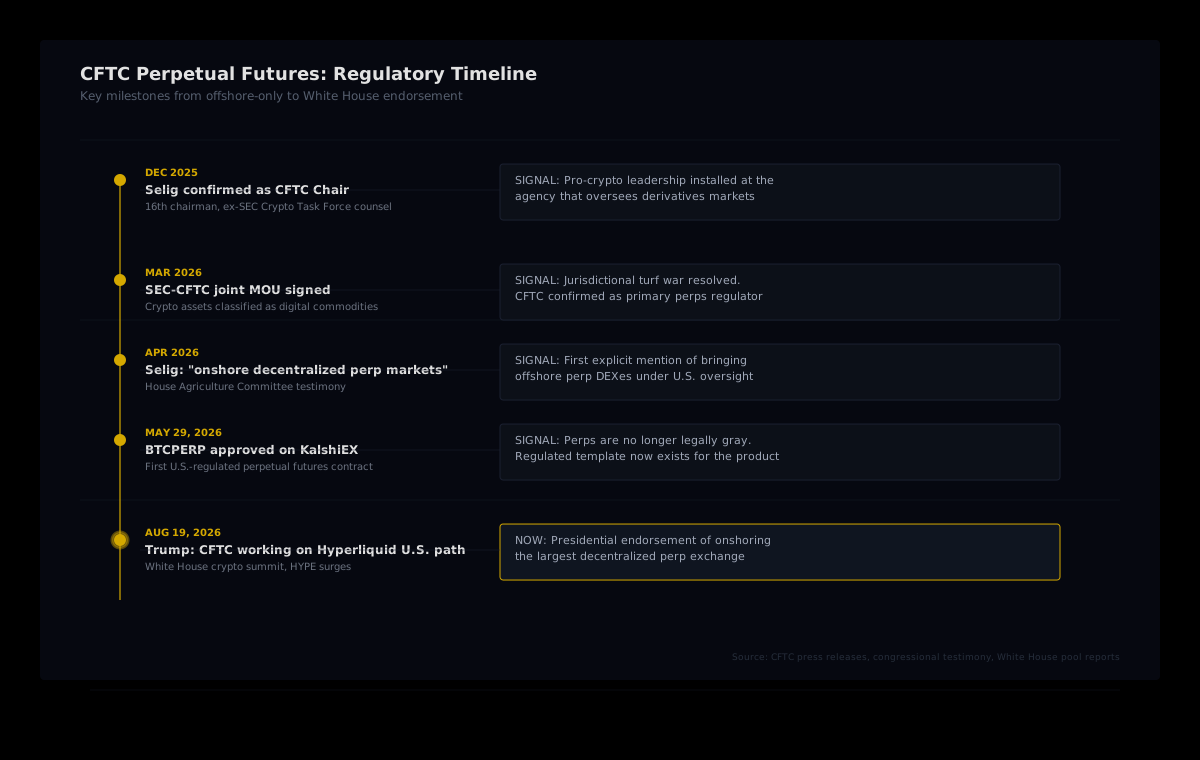
The sequence matters. In March 2026, the SEC and CFTC signed a joint Memorandum of Understanding that classified most crypto assets as digital commodities, which effectively confirmed the CFTC as the primary regulator for perpetual futures. That cleared the jurisdictional ambiguity that had paralyzed crypto policy for years.
Then came the landmark: on May 29, 2026, the CFTC approved KalshiEX to list a cash-settled Bitcoin perpetual futures contract, the first perpetual ever approved for listing on a CFTC-regulated exchange. Alongside the approval, the agency issued a policy statement guiding future perpetual contract submissions and granted Coinbase Financial Markets no-action relief to intermediate customer access to foreign-listed perpetuals via CFTC Letter 26-17.
In plain language: perpetual futures are no longer a legal gray area in the U.S. A regulated template exists. The question is how decentralized platforms like Hyperliquid fit into it.
Two Paths to U.S. Perps
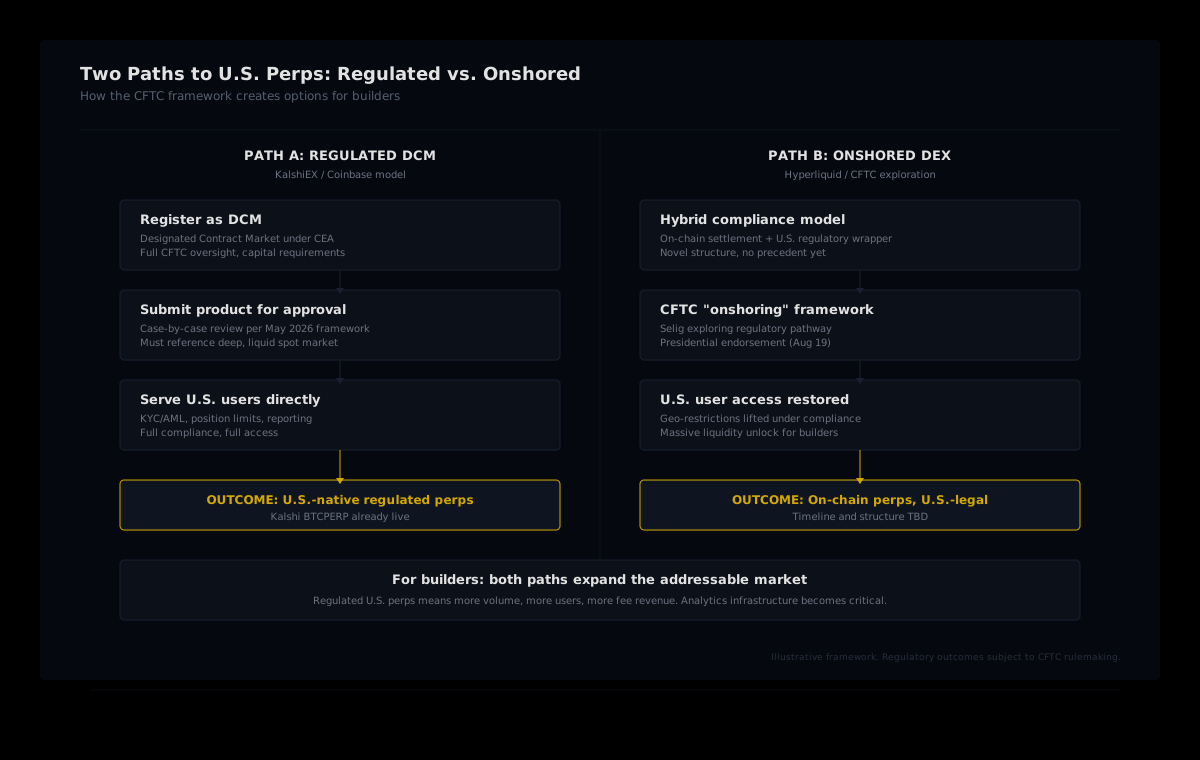
The CFTC framework creates two distinct paths for perpetual futures to reach American users, and builders should understand both because each one shapes the tools that will be needed.
Path A: the registered exchange model
This is the KalshiEX and Coinbase route. Register as a Designated Contract Market (DCM) under the Commodity Exchange Act, submit products for case-by-case CFTC review, and serve U.S. users directly with full KYC/AML, position limits, and regulatory reporting. This path is already live. Kalshi's BTCPERP contract is trading.
The approval was limited to perpetual futures referencing "digital commodities with deep, active, and continuous spot market trading." Contracts on agricultural products, precious metals, or securities must go through a separate voluntary approval process, which is more restrictive. But Kalshi has already filed to expand into equity-index and copper perpetuals, which signals how quickly the framework is evolving.
Path B: the onshored DEX model
This is where Hyperliquid sits. No precedent exists for bringing a fully decentralized, on-chain perpetual futures exchange under U.S. regulatory oversight. The settlement happens on-chain. There is no central order book operator in the traditional sense. Positions are permissionless.
But Trump's statement confirms the CFTC is exploring exactly this kind of hybrid model: on-chain settlement with a U.S. regulatory wrapper. Selig has been calling it "onshoring" since his April testimony. What that looks like in practice, whether it means a U.S. entity registering as a DCM while the protocol continues to run on-chain, or some new classification entirely, remains undefined.
The key point: both paths expand the addressable market for perp builders. Regulated U.S. perpetuals, whether centralized or decentralized, mean more users, more volume, and more demand for the analytics infrastructure that supports them.
Why Builders Should Care More Than Traders
The HYPE price reaction is what everyone saw. But the second-order effects on the builder ecosystem are where the real value shift happens. Consider what changes if U.S. users can legally access Hyperliquid.
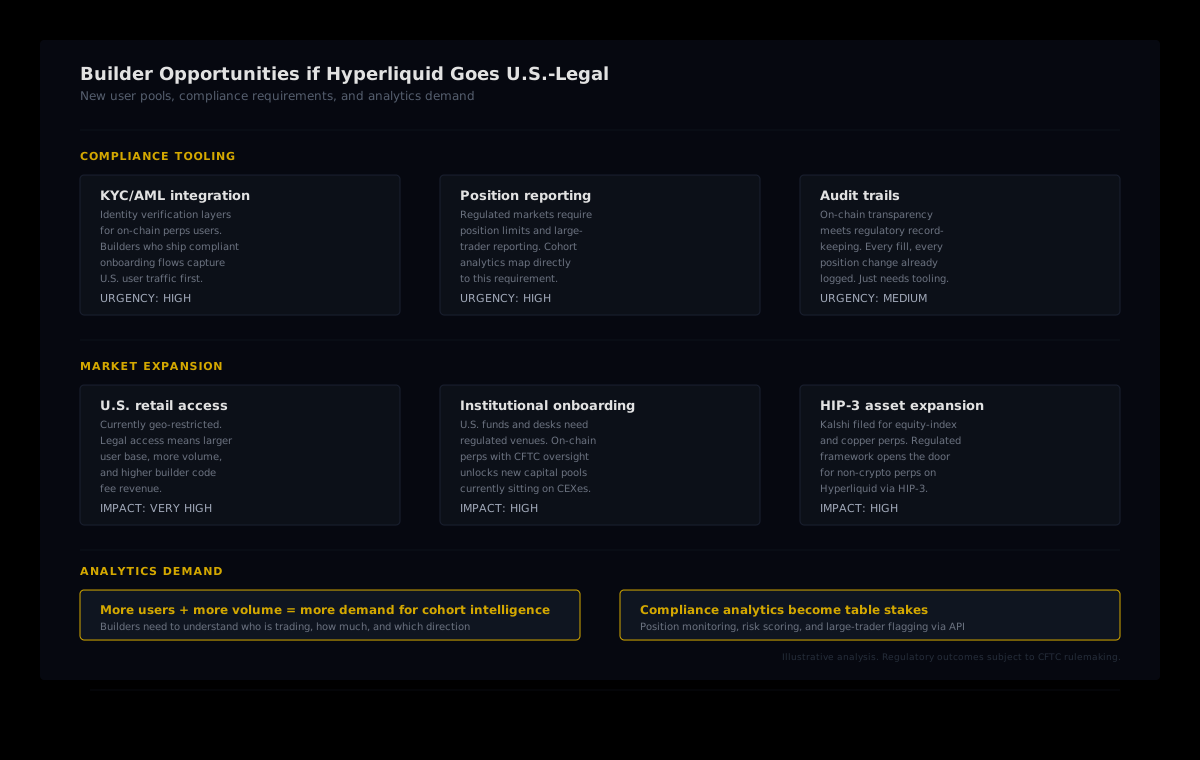
The user base grows. Hyperliquid currently geo-restricts U.S. users. Removing that restriction unlocks the largest retail and institutional trading population in the world. More users means more volume, which means more fee revenue for anyone running a builder code.
Institutional capital arrives. U.S. funds and trading desks are largely confined to CFTC-regulated venues. If Hyperliquid operates under a compliance framework that satisfies those requirements, the capital pools currently sitting on centralized exchanges start flowing toward on-chain perps. The Nasdaq-listed Hyperliquid Strategies fund already rose 30.4% to $9.39 on the news alone, a signal of institutional appetite.
Compliance tooling becomes mandatory. Regulated markets require position reporting, large-trader monitoring, and audit trails. On-chain transparency makes the raw data available, but someone has to build the tooling layer that makes it digestible for compliance teams. Cohort-level analytics, which classify every wallet by size and track record, map directly to position-reporting requirements. Builders who ship compliant analytics infrastructure early will be positioned to capture this demand.
The HIP-3 Angle: Non-Crypto Perps on Chain
One detail that flew under the radar: the CFTC's perpetual futures framework is already expanding beyond crypto. Kalshi filed to list perpetuals tied to the MerQube US Large Cap Index (effectively an S&P 500 proxy) and copper. That is a traditional asset class, listed as a perpetual, under CFTC oversight.
Hyperliquid's HIP-3 standard already enables permissionless listing of non-crypto assets, and it has full support in HyperTracker's analytics suite. If the U.S. regulatory framework expands to cover equity-index and commodity perps on-chain, HIP-3 becomes the rails for a new class of 24/7 tradable products that have never existed outside offshore venues.
For builders, this means the analytics layer becomes even more critical. Tracking cohort positioning across crypto perps is one thing. Tracking it across oil, gold, equity indexes, and crypto on a single on-chain venue is an entirely different scale of opportunity. The builders who have cohort intelligence infrastructure already running will be the ones institutional desks call first.
The CLARITY Act and What Comes Next
Trump also used the White House summit to push for the CLARITY Act, which he described as "a very powerful, structured legislation, which will keep us ahead of China, keep us ahead of everyone else." The bill would establish a CFTC registration framework for digital commodity exchanges, brokers, and dealers, which is exactly the kind of legal scaffolding a Hyperliquid onshoring effort would plug into.
The CLARITY Act faces a procedural vote in the Senate on September 15, 2026. If it passes, it gives the CFTC explicit statutory authority to regulate digital commodity venues, which would fast-track the onshoring process. If it stalls, the CFTC can still proceed through its existing rulemaking authority, but the timeline gets murkier.
Builders should watch three things in the next 90 days:
- CFTC Innovation Advisory Committee (scheduled August 20): This committee meeting happens the day after Trump's remarks and could include preliminary discussion of the Hyperliquid onshoring framework.
- CLARITY Act Senate vote (September 15): Passage gives the CFTC explicit jurisdiction. Failure means regulatory ambiguity continues.
- CFTC rulemaking on decentralized venues: The agency has indicated it will issue guidance on how on-chain platforms can comply with DCM requirements. No date set, but the political will is clearly there.
What This Means for Your Stack
If you are building on Hyperliquid today, this regulatory shift does not change your code. It changes your market. The same API calls, the same builder codes, the same analytics infrastructure that works for offshore users will serve a much larger pool of U.S. users once legal access opens up. But the demand profile shifts.
Offshore users are primarily crypto-native traders who understand perps intuitively. U.S. retail and institutional users coming through a regulated pathway will expect dashboards, risk scoring, position monitoring, and compliance-ready reporting. The raw data is already on-chain. The analytics layer that turns it into actionable intelligence is what builders need to have ready.
Our API classifies every wallet on Hyperliquid into 16 behavioral cohorts, 8 by account size and 8 by all-time PnL, with position metrics, order flow snapshots, and liquidation risk scoring. For builders preparing for a regulated U.S. market, that is the kind of pre-computed intelligence that compliance teams and institutional desks require. One API call gives you the cohort breakdown. You do not need to build the classification infrastructure from scratch.
Build for the Regulated Future
HyperTracker's API gives you 16 cohort classifications, order flow analytics, and liquidation risk scoring, the analytics layer perp builders need as Hyperliquid moves toward U.S. legal access. Start with the free tier.
The Bigger Picture
A U.S. president publicly endorsing a path to legal status for the largest decentralized perpetual futures exchange is not a small moment. It is the clearest signal yet that on-chain derivatives are moving from the regulatory fringe to the regulatory mainstream.
The pieces are lining up: a CFTC chair who has explicitly called for onshoring decentralized perp markets, a regulatory framework that already approved the first U.S.-listed perpetual futures contract, a Clarity Act that could give the agency explicit statutory authority, and now a presidential statement that the work is actively underway.
For traders, this is directionally bullish for HYPE and for on-chain perps as an asset class. For builders, it is something more concrete: a regulatory signal that the market you are building for is about to get significantly larger. The builders who have their analytics, compliance tooling, and infrastructure ready before that door opens are the ones who will capture the wave.
The White House just said the door is opening. The question is whether your stack is ready for what walks through it.