
Unitree's $9B IPO Meets a $38B Perp Price. Someone's Wrong.
By CMM Team - 16-Aug-2026
Unitree's $9B IPO Meets a $38B Perp Price. Someone's Wrong.
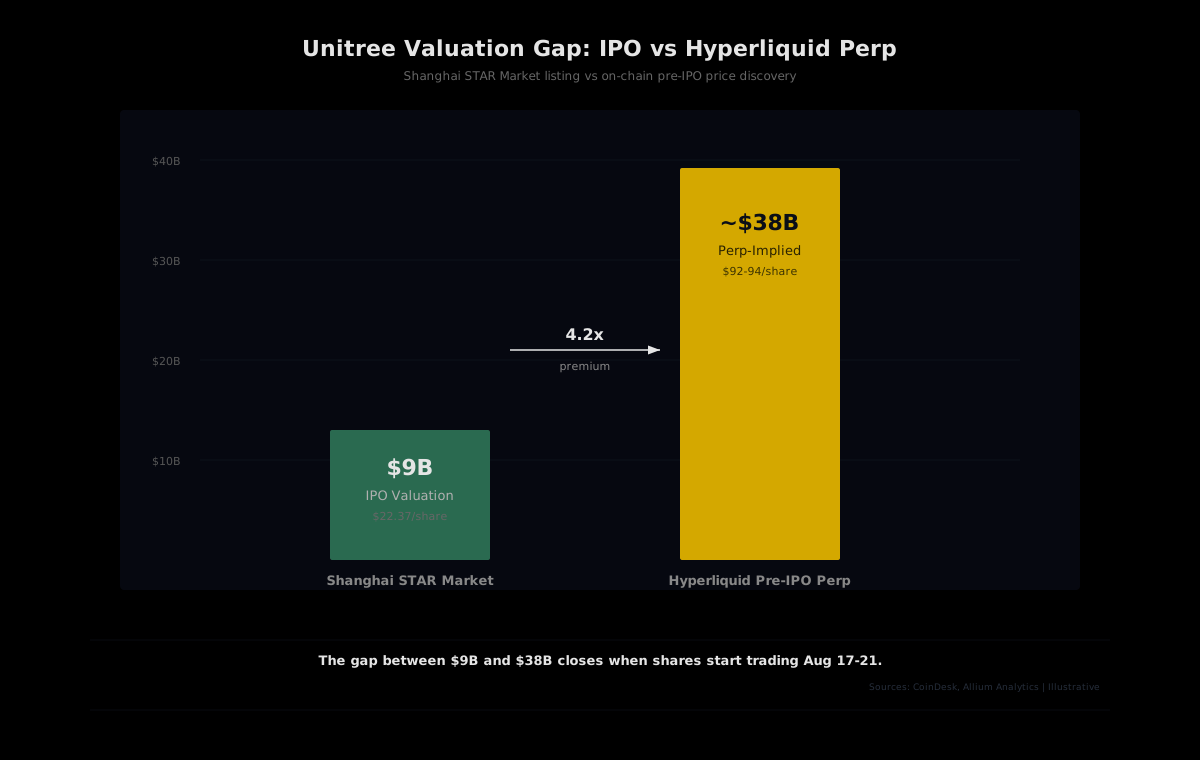
Unitree Robotics priced its Shanghai STAR Market IPO at 150.80 yuan ($22.37) per share, valuing China's first publicly traded humanoid robot maker at roughly $9 billion. Over on Hyperliquid, pre-IPO perpetual contracts are trading between $92 and $94, which implies a valuation of about $38 billion. That is more than four times the official offering price.
With shares expected to start trading between August 17 and August 21, the gap between these two numbers will collapse in one direction or the other. Either the Shanghai market validates what crypto traders have been pricing in for weeks, or a wave of leveraged longs gets wiped out in a matter of hours. This article breaks down the mechanics, the positioning data, and what it means for anyone tracking sentiment through on-chain derivatives.
Pre-IPO Perps on Hyperliquid: How the Market Works
Hyperliquid's HIP-3 upgrade, live since October 2025, lets anyone deploy perpetual futures markets on the protocol's on-chain order book. Trade.xyz, the biggest deployer in this space, has focused specifically on pre-IPO contracts. The idea is simple: synthetic, 24/7 derivative markets for companies that haven't started public trading yet, priced in implied share value rather than company tokens.
Pre-IPO perpetual contracts do not provide ownership in the underlying company, and positions cannot be converted into actual shares. They are cash-settled bets on where the stock will open. Traders post USDC margin and take leveraged long or short positions. When the company lists, the contract transitions to a standard equity perp tracking the live share price.
This model has already proven its price-discovery accuracy. A previous pre-IPO contract for CXMT, a Chinese memory chipmaker, came within 2.5% of its actual Shanghai opening price. That kind of precision lends credibility to the mechanism, but also raises the stakes: if the market is efficient, Unitree's perp price might actually be "right" about the opening pop. And if it's wrong, the liquidation cascade will be severe.
Why Retail Oversubscription and Perp Markets Tell Different Stories
Unitree's IPO was reportedly 8,000 times oversubscribed by retail traders. That number sounds staggering, but Chinese STAR Market IPOs frequently see extreme oversubscription because retail allocation is tiny and demand for tech listings is structurally intense. High oversubscription ratios in Shanghai signal demand, but they do not predict the magnitude of the opening premium. A 2x first-day pop and a 4x first-day pop would both be consistent with 8,000x oversubscription.
The Hyperliquid perp market, by contrast, is putting real capital behind a specific price target. With about $9.1 million in open interest and roughly $59 million in cumulative turnover across two markets, these are not paper predictions. Every dollar of long exposure above the IPO price is a leveraged bet that Unitree opens high enough to justify the premium. Every short position is a bet that it won't.
The company's fundamentals support bullishness at some level. Revenue reached $253 million last year, up 335%, and humanoid robot shipments topped 5,500. DeepSeek is among the strategic investors. But a 4x premium over the IPO price requires an exceptional debut, and the history of Chinese tech IPOs shows that kind of opening pop is rare even for the most hyped names.
Positioning Data: Who's Long, Who's Short, and Where the Pain Lives
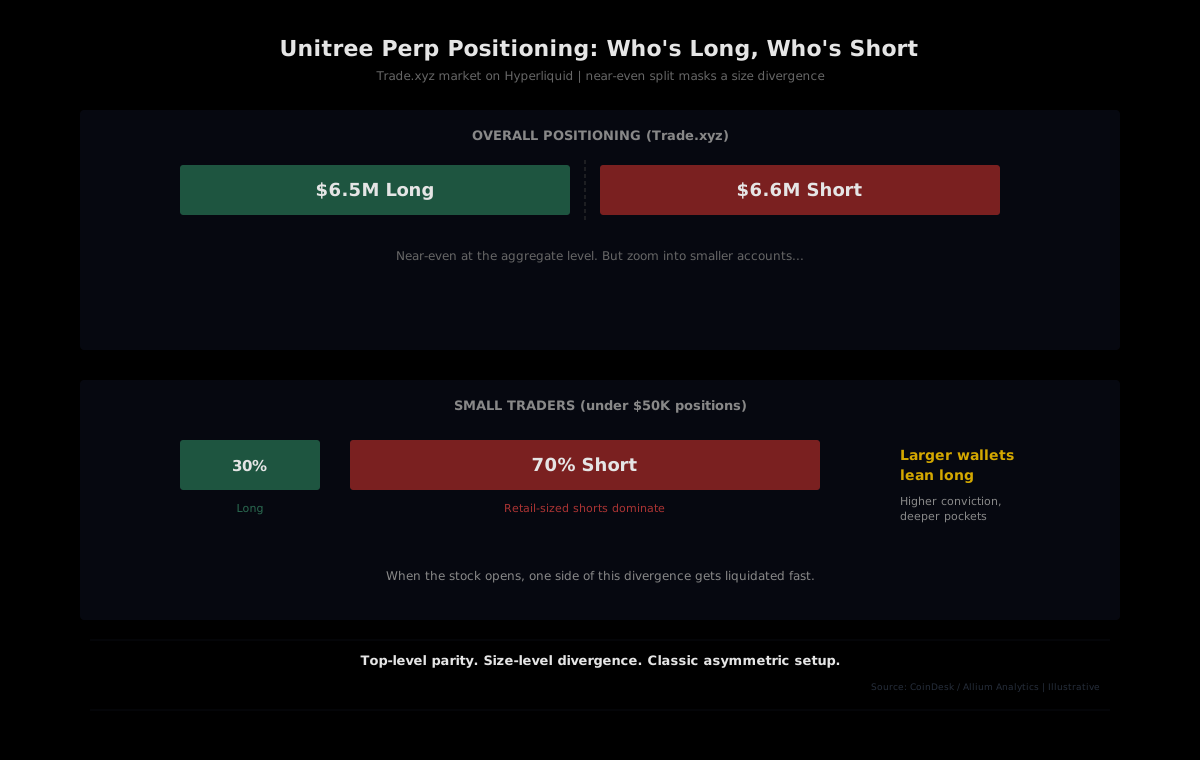
The positioning split on Trade.xyz is almost perfectly balanced: $6.5 million long and $6.6 million short. But this top-level parity hides an important divergence. Smaller traders (positions below $50,000) are 70% short by value. Larger accounts are leaning long.
This creates a classic asymmetry. Retail-sized shorts are betting the perp price is too high. Larger wallets, presumably with more conviction and deeper pockets, are betting the opening will validate or exceed the current level. When the stock actually starts trading, one side of this trade gets liquidated fast.
The Liquidation Math
Blockchain analytics firm Allium mapped out the liquidation scenarios in detail. Their analysis is sobering for both sides:
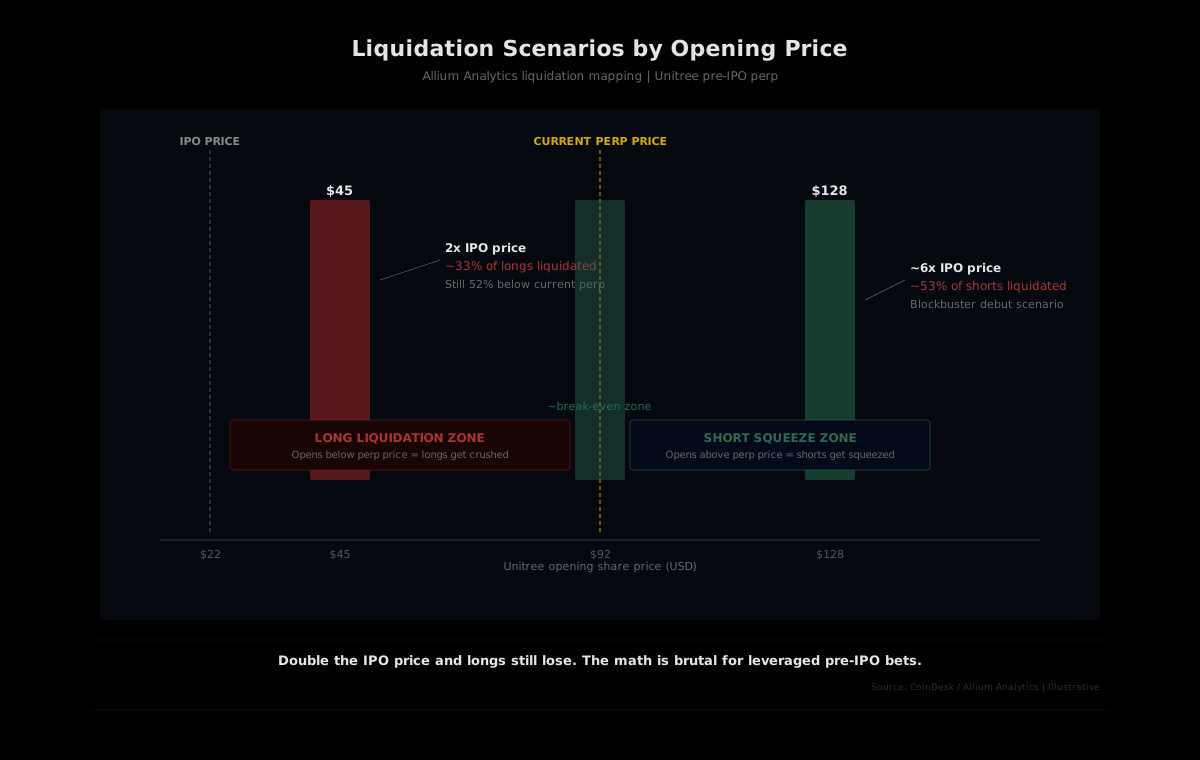
"Unitree can open at twice its IPO price and still liquidate a third of long exposure."
An opening around $45 (double the IPO price, but about 52% below the current perp price) could liquidate roughly 33% of long exposure. At the other extreme, a $128 opening (nearly 6x the IPO price) could liquidate an estimated 53% of short positions.
The range between these two outcomes is enormous. A $45 open would mean Unitree doubles from its IPO price, a strong debut by any measure, yet longs would still lose massively because they entered at $90+. A $128 open would be a blockbuster 5.7x pop, and even then, nearly half the shorts survive. The market is pricing in a very narrow window where both sides avoid catastrophic losses, and that narrow window rarely materializes in practice.
Concentrated Short Exposure Adds Another Risk Layer
Earlier this week, the UNITREE perp traded at $81.9, down about 5.3% over 24 hours and roughly 10.6% below its August 7 high of $91.6. What made the pullback notable was the concentration of short exposure.
The largest short, identified as address 0x091, held a position worth about $924,000, accounting for close to 47% of total short-side exposure. That single address was roughly 5.4 times the size of the largest long. When nearly half of one side's exposure sits in a single wallet, a liquidation of that position could cascade through the entire order book.
On the bid side, address 0x727 had layered orders between $20 and $65 for about 8,921 UNITREE contracts at a weighted average of around $42.5. These deep bids suggest at least one large participant is preparing for a scenario where the perp price drops significantly toward the IPO level.
What Pre-IPO Perps Mean for On-Chain Price Discovery
The broader trend here matters as much as the Unitree trade itself. Pre-IPO perpetual futures have expanded rapidly on Hyperliquid in 2026, moving beyond crypto into commodities like oil and gold, and now into private company valuations. The SpaceX pre-IPO contract drew strong first-day volume when it launched in May. The Cerebras Systems contract traded within 1.3% of the stock's actual Nasdaq opening price.
These markets are doing something that prediction markets and private secondary exchanges have tried to do for years: providing continuous, liquid price discovery for assets that traditional markets can only price at discrete intervals (funding rounds, tender offers, IPO bookbuilds). The difference is that on-chain perps settle in USDC, run 24/7, and publish every trade and position to a public ledger.
For traders and builders in the Hyperliquid ecosystem, this creates a new category of data to monitor. Positioning imbalances, concentration risk, and liquidation thresholds in pre-IPO markets all generate signals about broader sentiment. When retail is 70% short on a hot IPO while larger wallets lean long, that divergence is information, and it is readable through the same cohort-level analytics frameworks used for crypto-native assets.
Reading the Signal Before the Opening Bell
The Unitree trade will resolve within days. But the pattern it establishes will recur every time a high-profile company lists and Hyperliquid's HIP-3 infrastructure provides the on-chain arena for pre-market price discovery. The question for traders tracking these events is not just "will the stock open high or low," but "who is positioned where, how concentrated is the risk, and what does the liquidation map look like?"
Our cohort-level positioning data cuts through the noise of raw open interest numbers. Knowing that small traders are overwhelmingly short while large wallets are long tells you something about the conviction distribution. Knowing that 47% of short exposure sits in a single address tells you about fragility. These are the kinds of insights that separate informed participants from tourists betting on headlines.
Track Cohort Positioning on Hyperliquid
HyperTracker classifies every active wallet on Hyperliquid into 16 behavioral cohorts by size and all-time PnL. See where Smart Money, Whales, and retail are positioned across every perpetual market, including pre-IPO contracts. One API call. Refreshed every 5 minutes.
The gap between $9 billion and $38 billion will close. When it does, the on-chain record will show exactly who was right, who was wrong, and how much capital changed hands in the process. That transparency is the point. In pre-IPO markets running on crypto rails, there are no fabricated account statements and no Photoshopped PnL screenshots. Just positions, prices, and the unforgiving math of leverage.