
Wall Street Is Trading Perps Now. Here's Where the Flow Is Going.
By CMM Team - 21-Aug-2026
Wall Street Is Trading Perps Now. Here's Where the Flow Is Going.
Six months ago, the idea that T. Rowe Price would allocate to a perp DEX token sounded like a fever dream. Now it's a line item in a multi-asset ETF. Monetalis is rotating millions out of UNI into HYPE through Cumberland. And S&P Dow Jones Indices, the people who run the index your 401(k) tracks, have licensed their benchmark to an on-chain perpetual futures platform built on Hyperliquid.
This is the institutional crypto summer, and the flow is going somewhere most people aren't looking: perpetual decentralized exchanges.
The shift isn't subtle. DEX perpetual futures volume surged from $81.7 billion in January 2024 to $739.5 billion by January 2026. But volume alone doesn't tell the story. What matters is who's showing up, and which instruments they're trading. That composition change reshapes everything downstream: how builders design products, how traders read flow signals, and which cohorts carry the most predictive weight.
The Three Layers of Institutional Entry
Institutional capital doesn't just appear on-chain overnight. It arrives in waves, each with different risk tolerance, infrastructure requirements, and flow characteristics.
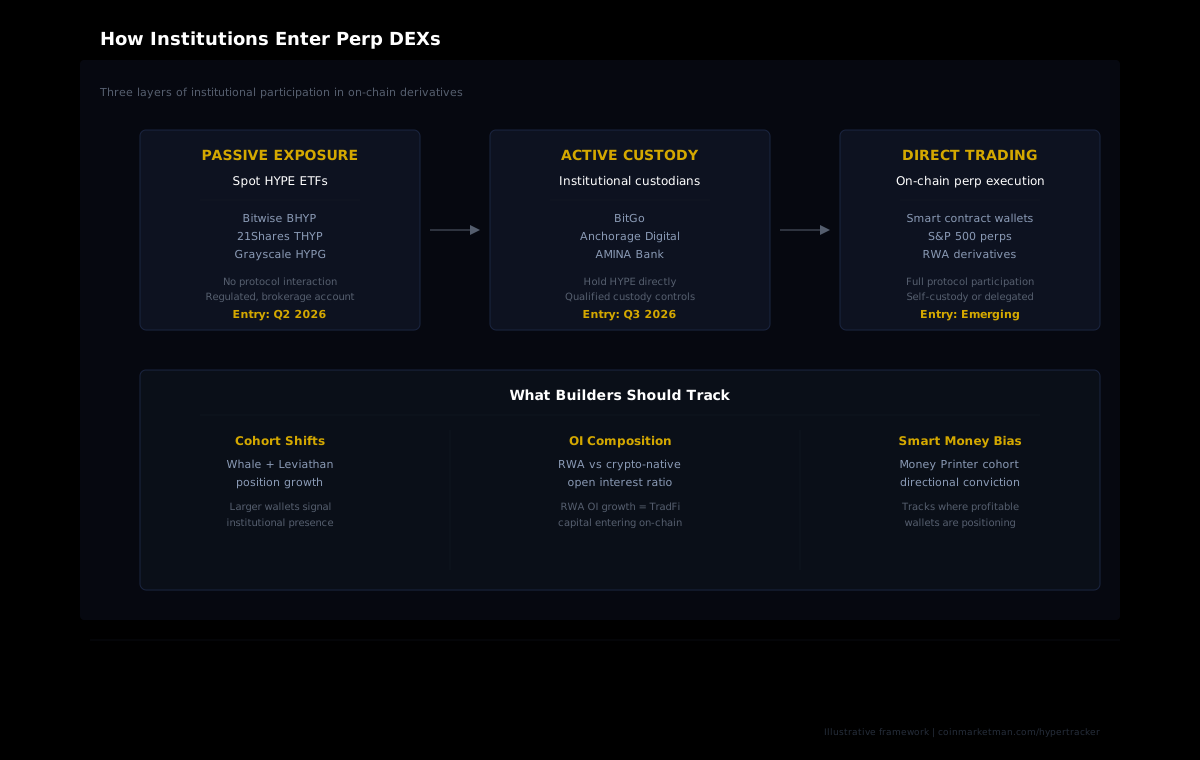
Layer 1: Passive Exposure Through ETFs
The lowest-friction entry point arrived in Q2 2026. Bitwise launched its spot HYPE exchange-traded fund (BHYP) in May 2026, followed by products from 21Shares (THYP) and Grayscale (HYPG). As of early August 2026, cumulative net inflows across these three HYPE ETFs sat near $280.82 million.
That's small compared to Bitcoin ETF flows, where a single week in mid-August drew $1.1 billion across BTC and ETH products combined. But HYPE ETFs represent something new: regulated vehicles that let pension funds, family offices, and RIAs gain exposure to perp DEX economics without touching a wallet.
These investors don't generate on-chain flow directly. They're price participants, not protocol participants. But their buying pressure affects HYPE token dynamics, which cascades into staking yields, protocol revenue expectations, and builder incentive calculations.
Layer 2: Custody-Backed Holding
The second layer is more direct. Institutions like AMINA Bank, BitGo, and Anchorage Digital now offer qualified custody for HYPE, letting funds hold the token under institutional controls without interacting with the chain themselves. T. Rowe Price allocated approximately 6% of its multi-token digital-asset ETF to HYPE, which signals traditional asset managers are comfortable with perp DEX exposure.
Monetalis, the advisory firm behind one of MakerDAO's largest real-world asset vaults, went further. On-chain data from August 17, 2026 shows wallets linked to Monetalis sold 3.72 million UNI tokens (roughly $13 million) through market maker Cumberland and used the proceeds to purchase 171,543 HYPE tokens worth approximately $9.56 million.
That's a deliberate rotation: out of a governance token and into a perp DEX protocol token. The flow signal isn't just "institutions are buying HYPE." It's "institutions are re-weighting toward perp infrastructure."
Layer 3: Direct Protocol Trading
The most consequential layer is still emerging. When S&P Dow Jones Indices licensed its S&P 500 benchmark to TradeXYZ for a perpetual futures contract on Hyperliquid, it created a product that institutional desks can actually trade. This is the first officially licensed on-chain S&P 500 perpetual contract. Not a synthetic, not a knock-off. A licensed derivative from the index provider itself.
This matters because it collapses the distinction between "crypto trading" and "derivatives trading." A macro fund that trades S&P 500 perps on Hyperliquid generates the same kind of order flow as any other market participant. Their positions show up in open interest, their fills register in trade data, and their size places them in specific cohorts, all on-chain.
RWA Perps Are the Trojan Horse
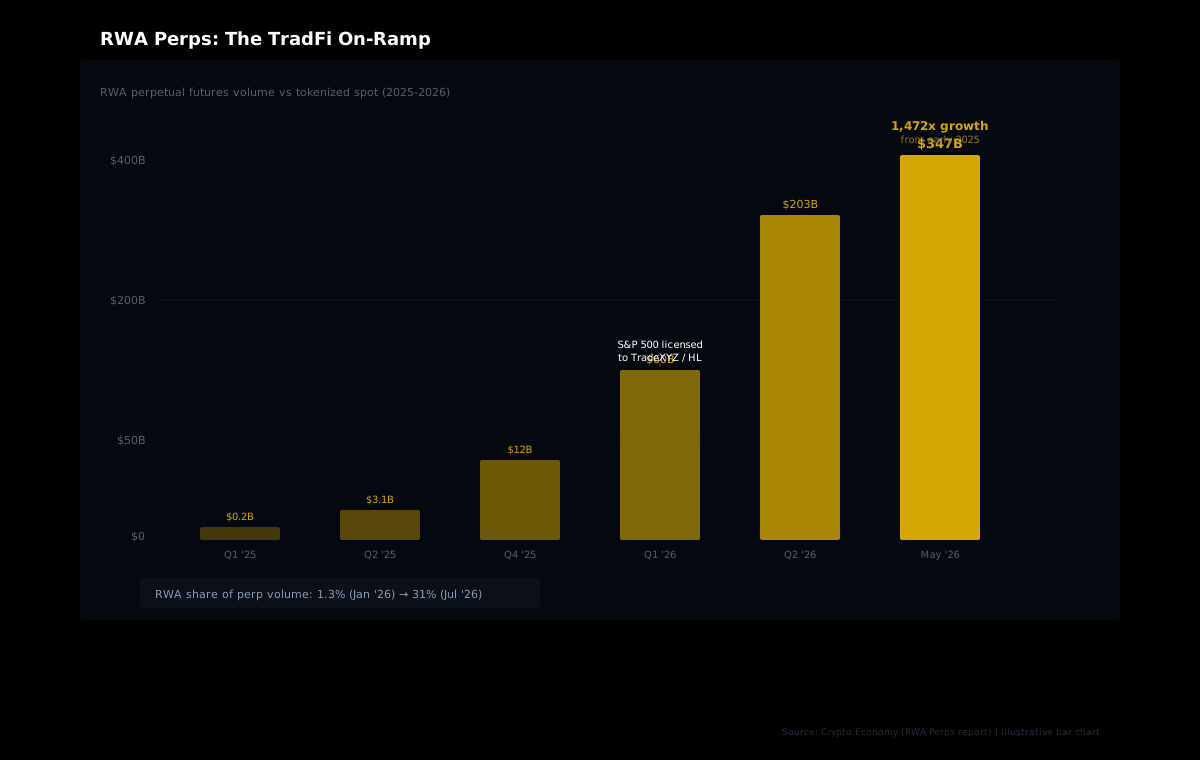
The numbers behind real-world asset perpetuals are staggering. In May 2026, RWA perp trading volume hit $347 billion, a 1,472x increase from the $230 million recorded at the start of 2025. The proportion of total perp volume coming from RWA instruments rose from 1.3% at the start of 2026 to 31% by July 2026.
And between July 13 and 19, tokenized equities and commodities generated $25 billion in weekly volume, representing 52% of the platform's weekly total and surpassing crypto perpetuals for the first time.
This is the Trojan horse. RWA perps are drawing TradFi-native capital onto on-chain venues because the products themselves are familiar: S&P 500 futures, equity perpetuals, commodity contracts. The venue is different, but the instrument is the same. And once that capital is on-chain, it trades alongside crypto-native flow, creating a richer, more complex signal environment.
Why this matters for flow analysis: When a macro fund trades S&P 500 perps on Hyperliquid, their wallet gets classified into the same cohort system as every other participant. A Whale or Leviathan-sized allocation to equity perps looks identical, from a data perspective, to a Whale-sized crypto position. The composition of what each cohort is trading is changing even if the cohort structure stays the same.
What the Market Share Shift Actually Looks Like
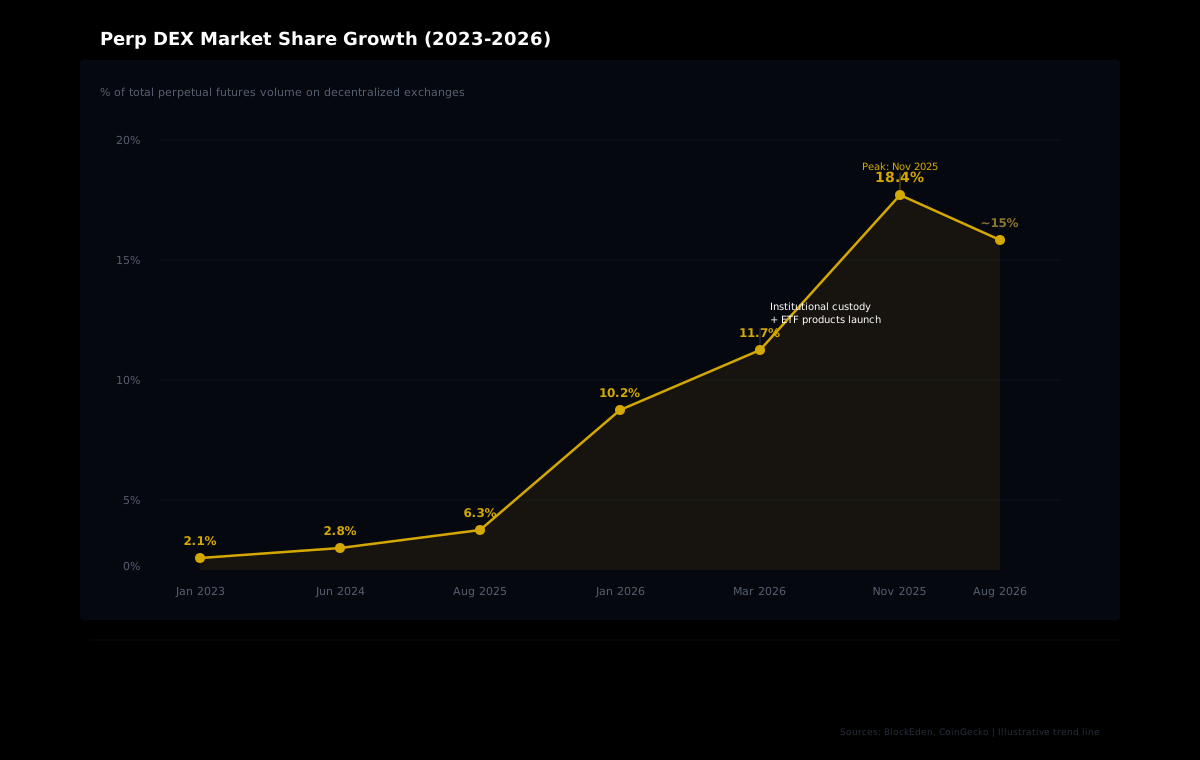
Perp DEX market share hit 10.2% of total perpetual futures volume by January 2026, up from 2.1% in January 2023. It peaked at 18.4% in November 2025 as lower fees and infrastructure improvements attracted larger players.
The flip side of the DEX gain is visible in centralized exchange open interest, which declined 20.8% in 2025 while DEX open interest surged 229.6% over the same period. Hyperliquid processed $1.59 trillion in cumulative trading volume between August 2025 and January 2026, with daily volumes routinely exceeding $5 billion.
The growth isn't linear, though. Market share dipped from that November peak as activity rotated across newer venues and crypto perp volumes softened in mid-2026. That's normal in a maturing market. What matters for builders and traders is the structural direction: more capital is settling on-chain, and the types of participants are diversifying.
How Institutional Flow Changes Cohort Signals
Here's where this gets practical for anyone building on or trading with on-chain analytics.
When perpetual DEXs were almost entirely crypto-native, the larger cohorts (Whale, Tidal Whale, Leviathan) represented a relatively homogenous group: experienced crypto traders and funds running directional or basis strategies on BTC, ETH, and altcoin perps. Our data classified wallets into 16 behavioral cohorts, eight by size and eight by all-time PnL, and the signals from each cohort were fairly consistent in what they meant.
Institutional entry is changing the composition of those cohorts. A macro fund trading equity perps on Hyperliquid might sit in the Whale ($500K-$1M) or Tidal Whale ($1M-$5M) cohort by size, but their trading behavior, holding periods, and instrument preferences look nothing like a crypto-native whale running a BTC momentum strategy.
This creates both noise and opportunity:
- Noise: Aggregate cohort bias signals may become less clean as the composition of each size tier diversifies. A "Whale cohort going long" signal carries different weight if half those wallets are trading equity perps and half are trading BTC.
- Opportunity: Builders who can segment flow by instrument type alongside cohort membership get a richer picture. Watching Smart Money ($100K-$1M all-time PnL) positioning on crypto perps specifically, versus their positioning on equity perps, tells you whether profitable wallets are rotating between asset classes.
The Leaderboard Changes, Too
Our leaderboard endpoints rank wallets by PnL across time horizons: all-time, monthly, weekly, and daily. As institutional capital enters through RWA perps, the leaderboard composition shifts. Wallets that are profitable trading S&P 500 or commodity perps will start appearing alongside crypto-native traders, and the spread between their strategies widens.
For copy-traders and signal followers, this is a moment to get more specific. Following a top leaderboard wallet without understanding what they trade, whether it's crypto or equity perps, means you might mirror a macro position when you intended to trade a crypto thesis.
What Builders Should Watch
If you're building analytics, alerts, or trading tools on Hyperliquid, the institutional shift creates concrete product considerations:
- OI composition tracking. Total open interest on perp DEXs peaked at $4.5 billion in daily OI on decentralized exchanges in July 2026. But the split between crypto OI and RWA OI matters more than the aggregate. A dashboard that shows OI by instrument category helps users understand what's driving the number.
- Cohort-by-instrument breakdowns. Our API delivers cohort positioning at the asset level. Builders can query Money Printer or Smart Money cohort bias for BTC specifically, separate from their equity perp positions, to preserve signal clarity.
- Alert thresholds that account for new flow types. If your webhook alerts trigger on Leviathan OI changes, you may want to distinguish between a $5M equity perp position opening (macro flow) and a $5M BTC position (crypto-directional). Same cohort, different signal.
- Liquidation risk layering. Institutional wallets trading RWA perps likely use different leverage profiles than crypto-native traders. Our liquidation risk scoring captures this at the asset level, which means builders can assess whether liquidation clusters are forming in crypto markets, equity markets, or both.
Track Institutional Flow Through Cohort Data
Our API classifies every wallet on Hyperliquid into 16 behavioral cohorts by size and performance. Query cohort positioning by asset, track smart money bias in real time, and build alerts for the signals that matter to your strategy.
The Bigger Picture: Why This Summer Is Different
Previous crypto summers were about retail speculation: meme coins, yield farming, NFT flips. This one is about infrastructure convergence. The same week that Bitcoin ETFs drew $189 million in inflows on August 18, Hyperliquid was processing RWA perps at volumes that dwarf tokenized spot markets by a factor of 13 to 20x.
The derivatives-to-spot ratio tells you where the energy is. Institutional capital isn't buying tokenized stocks; it's trading perpetual futures on them. The execution venue is on-chain, the settlement is in USDC, and the analytics layer is the same one that tracks crypto-native whales.
Multicoin Capital confirmed HYPE as one of its largest liquid fund positions, noting the network's revenue model as the primary thesis. In 2025, the platform generated about $873 million in revenue from roughly $2.9 trillion in volume. That's the kind of unit economics that draws institutional capital from governance tokens toward revenue-generating protocols.
Reading the Flow Forward
The institutional crypto summer isn't a spike. It's a re-plumbing. ETFs provide passive exposure. Custody providers give funds a way to hold directly. Licensed instruments like the S&P 500 perp give desks a reason to execute on-chain. Each layer feeds the next, and each one deposits more flow into the same on-chain data environment that builders and traders already read.
For anyone building on this data, the takeaway is straightforward: the wallets in your cohorts are changing. The instruments in your OI tables are diversifying. And the signals that worked when perp DEXs were a crypto-only game need to evolve to account for a market where macro funds trade equity futures next to degens running 50x on altcoin perps.
The flow is still on-chain. The analytics still work. You just need to read them with a wider lens.