
Wall Street Tokenized Your Stocks. Here's How Perp Traders Win.
By CMM Team - 04-Nov-2026
Wall Street Tokenized Your Stocks. Here's How Perp Traders Win.
Morgan Stanley just became one of the first banks to tokenize US stocks and Treasuries through DTCC's new tokenization service, which launched on October 28 with 20 institutional participants including JPMorgan, Citi, and Bank of America.
That sentence alone would have been science fiction three years ago. Today it is a press release.
The Depository Trust Company holds more than $114 trillion in assets under custody. When the entity that clears virtually every US stock trade starts putting those securities on a blockchain, the implications ripple far beyond Wall Street's internal plumbing. For perp traders on Hyperliquid and other on-chain venues, this is a structural tailwind. More tokenized assets mean more on-chain flow. More on-chain flow means more signal. And more signal means better trades.
Here is the playbook.
What DTCC Actually Launched
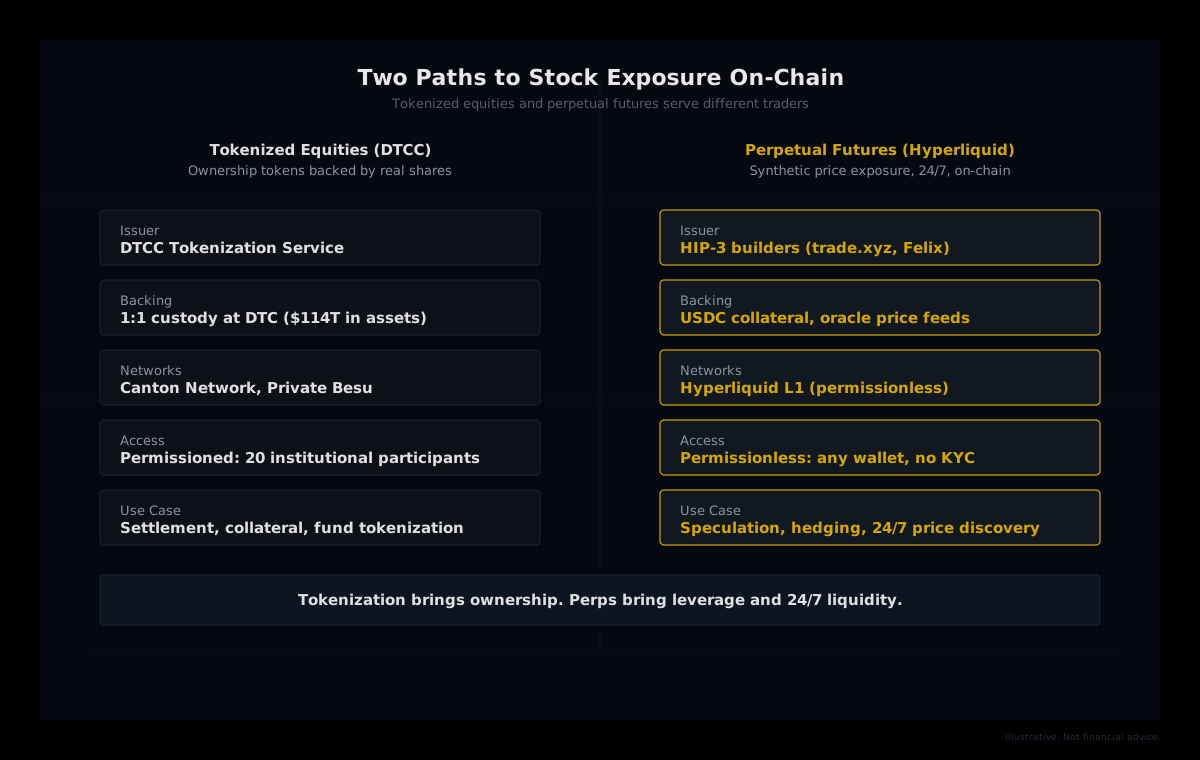
On October 28, DTCC's Depository Trust Company subsidiary went live with the DTCC Tokenization Service. The service allows eligible institutions to create blockchain-based representations of securities already held in DTC custody. The tokens retain the ownership rights and investor protections of the original securities, and users can convert between traditional and tokenized forms.
The service initially supports the Canton Network and DTCC's private Besu blockchain, with additional network integrations planned for 2027. Among the 20 launch participants are JPMorgan, Citi, Bank of America, Barclays, BNP Paribas, Fidelity Investments, State Street, and UBS.
Amy Oldenburg, Morgan Stanley's head of digital assets strategy, said the bank expects the tokenized real-world asset market to reach between $3 trillion and $10 trillion by 2030.
This is institutional infrastructure, built for settlement and collateral management. It is permissioned. You will not be trading DTCC-tokenized Apple shares from your MetaMask wallet anytime soon. But that is precisely the point: it creates demand for permissionless alternatives. And the best permissionless venue for stock price exposure already exists on Hyperliquid.
The CFTC Just Legitimized What Hyperliquid Already Built
One day before the Morgan Stanley announcement, the CFTC approved equity perpetual futures for trading on registered US exchanges for the first time. CFTC Chair Mike Selig confirmed that perpetual futures on single equities passed the agency's 45-day review without objection.
That is a regulatory green light for a product that Hyperliquid has been running permissionlessly for over a year through its HIP-3 framework. The timing is not coincidental: Wall Street is tokenizing the underlying assets, and regulators are simultaneously approving perpetual futures on those same assets. Two parallel tracks converging on the same destination.
Before the CFTC decision, Hyperliquid's stock and commodity markets already held approximately $4.1 billion in open interest. Kalshi announced plans for 58 perpetual contracts on 55 stocks including Apple and Tesla. Intercontinental Exchange, the owner of NYSE, has invested in trade.xyz and plans to offer 24/7 US futures trading on Hyperliquid's infrastructure.
The biggest regulated exchange operator in the world is building on top of a permissionless on-chain venue. That tells you everything about where equity trading is heading.
Hyperliquid's Equity Perps Landscape
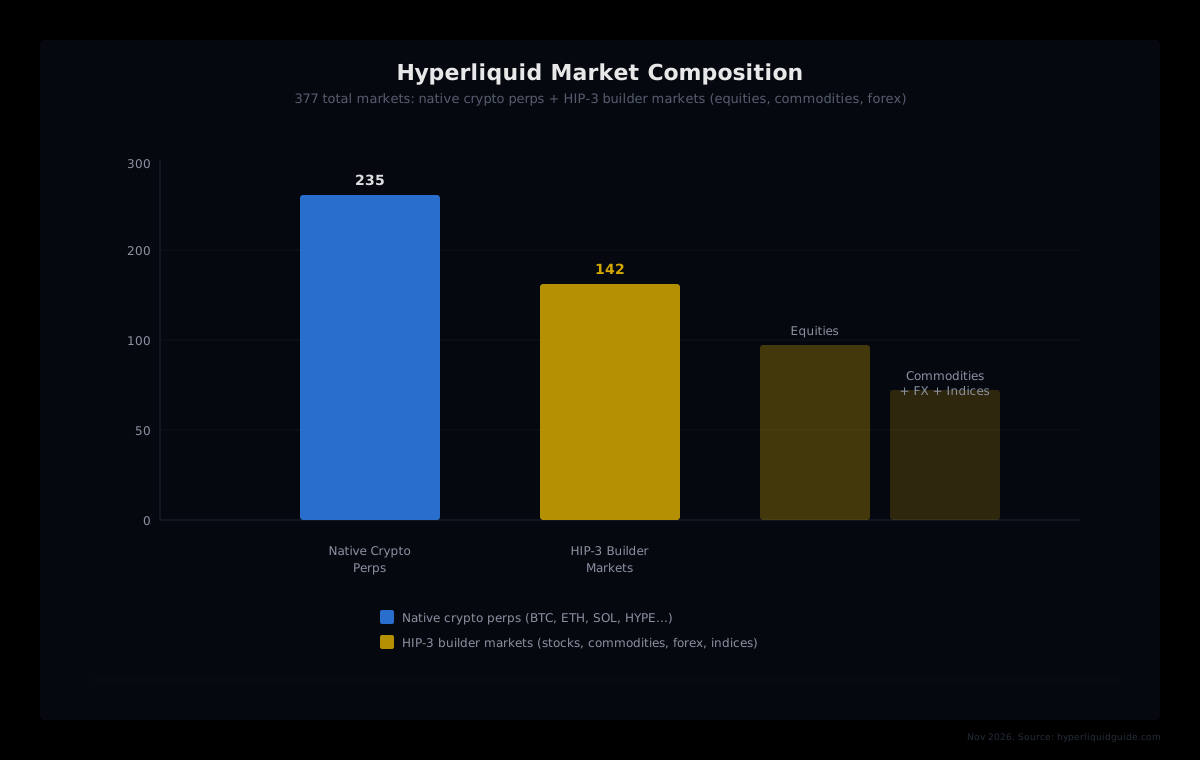
Hyperliquid currently lists 377 perpetual futures markets: 235 native crypto perps and 142 HIP-3 builder markets covering equities, commodities, forex, and indices. The dominant HIP-3 builder is trade.xyz, which runs 24/7 perpetual markets on Tesla, Apple, Nvidia, Amazon, the S&P 500, oil, gold, silver, and dozens more.
The fee structure on HIP-3 equity perps is slightly higher than native Hyperliquid markets: a portion of each trade routes to the builder who deployed the market. All positions are collateralized in USDC and settle against oracle price feeds. No broker, no KYC, instant settlement.
And the revenue numbers back up the thesis. Hyperliquid pulled in approximately $713 million in revenue over the past twelve months, with monthly revenue ranging between $38 million and $74 million throughout 2026. This is a self-funded exchange (no venture capital) generating nearly $2 million per day in protocol revenue.
Why Tokenization Creates a Tailwind for Perp Traders
Tokenized equities and equity perpetual futures are complementary products. Tokenized stocks represent ownership. Perps represent price exposure with leverage, and they trade around the clock.
Here is why the DTCC tokenization launch accelerates the opportunity for perp traders:
Institutional collateral enters the on-chain ecosystem. When Morgan Stanley and the other 19 banks tokenize Treasuries and equities, those tokens become potential collateral for on-chain protocols. Imagine posting tokenized T-bills as margin for a leveraged equity perp position. That capability does not exist yet at the DTCC-to-DeFi bridge level, but every infrastructure piece is now being built.
Price discovery shifts to 24/7 venues. Traditional stock markets close at 4 PM ET. Perpetual futures on Hyperliquid trade continuously. As tokenized equities gain liquidity, the after-hours price discovery gap becomes a tradeable edge. Perp markets reflect overnight sentiment from Asia and Europe while New York sleeps. When the NYSE opens, it often reprices toward where the perps already traded.
More participants generate more readable signal. The CFTC approval means Coinbase, Bitnomial, and ICE will soon launch regulated equity perps in the US, which drives new participants into the broader equity perps ecosystem. Many of those participants will also trade on Hyperliquid. More on-chain flow means larger, more meaningful cohort signals for builders tracking who is positioned where.
Key insight: Tokenized equities solve the ownership problem. Perpetual futures solve the access and leverage problem. Wall Street is building one; Hyperliquid already built the other. The convergence creates opportunities for traders who can read on-chain positioning across both layers.
The Perp Trader's Playbook: Reading Cohort Signals on Equity Perps
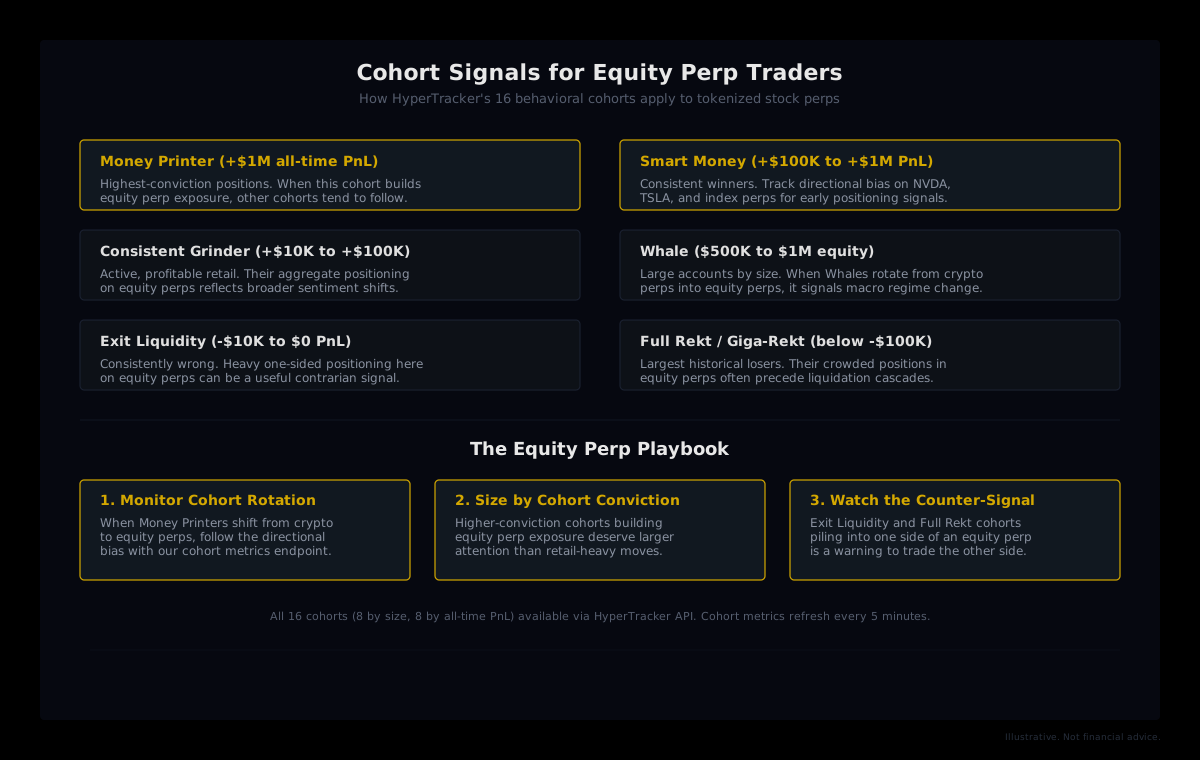
This is where HyperTracker's 16 behavioral cohorts become directly relevant. Our data classifies every wallet on Hyperliquid into one of 16 cohorts: 8 by account size (Shrimp through Leviathan) and 8 by all-time PnL (Money Printer through Giga-Rekt). That classification applies to every market on Hyperliquid, including HIP-3 equity perps.
When you query our cohort metrics endpoint for an equity perp like NVDA or TSLA, you see the same behavioral breakdown you would see on BTC or ETH. Which cohorts are accumulating? Which are dumping? Is the smart money building conviction, or is retail piling in alone?
Monitor Cohort Rotation Between Crypto and Equity Perps
When Money Printers and Smart Money wallets rotate capital from crypto perps into equity perps, that tells you something about their macro view. Crypto-to-equity rotation often signals a risk-off shift: these wallets are moving from volatile crypto exposure to equity index perps where volatility is typically lower. Our cohort metrics endpoint tracks this positioning across all markets.
Use Counter-Signals from Losing Cohorts
Exit Liquidity, Full Rekt, and Giga-Rekt cohorts have, by definition, the worst track records on the platform. When these cohorts build heavy one-sided exposure on an equity perp, experienced traders treat it as a contrarian indicator. If historically losing wallets are aggressively long TSLA perps after an earnings beat, the smart play may be to watch for the reversal.
Track Whale Size Migration
Leviathan ($5M+ equity) and Tidal Whale ($1M-$5M equity) wallets moving into equity perps is a structural signal. These are the largest accounts on the platform, and their position changes in equity markets often foreshadow regime shifts. Our data lets you track when these wallets open or close positions on any market Hyperliquid lists.
The Cash-and-Carry Trade on Tokenized Stocks
As tokenized equities and equity perps both gain liquidity, one strategy becomes increasingly accessible: cash-and-carry arbitrage.
The mechanics are straightforward. When an equity perp trades at a premium to the underlying tokenized stock (positive funding), a trader can buy the tokenized spot asset and short the perp in equal notional, collecting funding payments while holding a delta-neutral position. The reverse works when the perp trades at a discount: short the tokenized stock, go long the perp, and earn the negative funding.
This strategy already works between CEX spot and Hyperliquid perps for crypto assets. As tokenized equities become more liquid and bridges between institutional (DTCC-backed) tokens and DeFi collateral improve, the same carry trade extends to stocks. The trader who can identify funding rate divergences across equity perps on Hyperliquid has an edge that did not exist a year ago.
And with our data, you can see which cohorts are driving the funding imbalance. If Money Printers are heavily long NVDA perps and funding is positive, that persistence signal suggests the carry trade may have legs. If the long side is dominated by Exit Liquidity and Giga-Rekt cohorts, the premium may not last.
What Comes Next: The Convergence Timeline
Morgan Stanley plans to support tokenized equity trading on its Trajectory Cross alternative trading system by Q1 2027. Stellar and Circle's Arc are expected to join DTCC's supported blockchain networks in 2027. Kalshi and ICE are preparing regulated equity perps for US markets.
The convergence is not speculative. It is a project timeline. Within the next year, traders will likely have access to tokenized equities as collateral, regulated equity perps on institutional venues, and permissionless equity perps on Hyperliquid, all operating simultaneously.
For builders, that means the intelligence layer becomes critical. When capital flows between institutional tokenized stocks, regulated exchange perps, and on-chain permissionless perps, tracking who is positioned where and how much conviction they carry is the edge. That is what our cohort analytics are built for: 16 behavioral segments, every wallet classified, updated every 5 minutes.
Track Who's Trading Equity Perps on Hyperliquid
HyperTracker's API gives you cohort-level positioning data on every market Hyperliquid lists, including HIP-3 equity perps. See what Money Printers and Whales are doing before the chart moves.
Two years ago, the idea of JPMorgan and Morgan Stanley tokenizing stocks on a blockchain was a conference-panel hypothetical. Today it is live infrastructure. Two years ago, equity perpetual futures existed only on offshore venues. Yesterday the CFTC approved them for regulated US markets. And on Hyperliquid, 142 HIP-3 markets already trade stocks, commodities, and indices around the clock.
The wall between traditional equities and on-chain derivatives is coming down. The traders who see it clearly, and position accordingly, will be the ones writing the next playbook.