What Drift's $295M Hack Teaches Every Perp DEX Trader
By CMM Team - 26-Jun-2026
What Drift's $295M Hack Teaches Every Perp DEX Trader
On April 1, 2026, Drift Protocol lost $285 million in twelve minutes. The largest perpetual futures exchange on Solana was drained across 18 token types while most users were still waking up. The attackers were not anonymous hackers exploiting buggy code. They were a North Korean state-sponsored team that had spent months attending conferences, depositing real capital, and building personal relationships with Drift's security council members.
Three months later, Drift published a recovery plan built around transferable tokens pegged to verified losses. The plan is worth studying, because it exposes risk layers that most perp traders never think about until their funds are gone. Smart contract audits get the headlines. But the Drift exploit happened at a layer that audits cannot reach: human trust and admin key management.
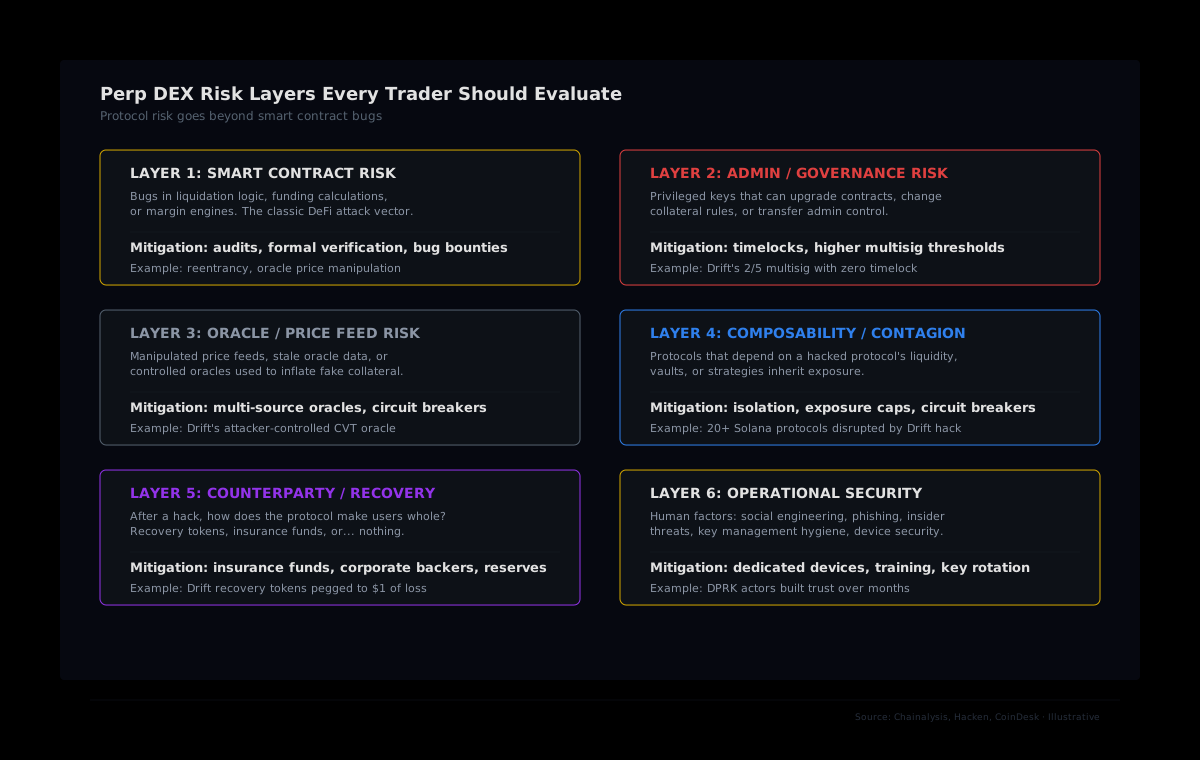
This article breaks down what happened, how the recovery works, and the six risk layers every trader should evaluate before depositing on any perp DEX.
How the Drift Attack Unfolded
The exploit was not a flash loan or a reentrancy bug. It was a months-long social engineering campaign carried out by DPRK-linked actors, as confirmed by cybersecurity firm Mandiant.
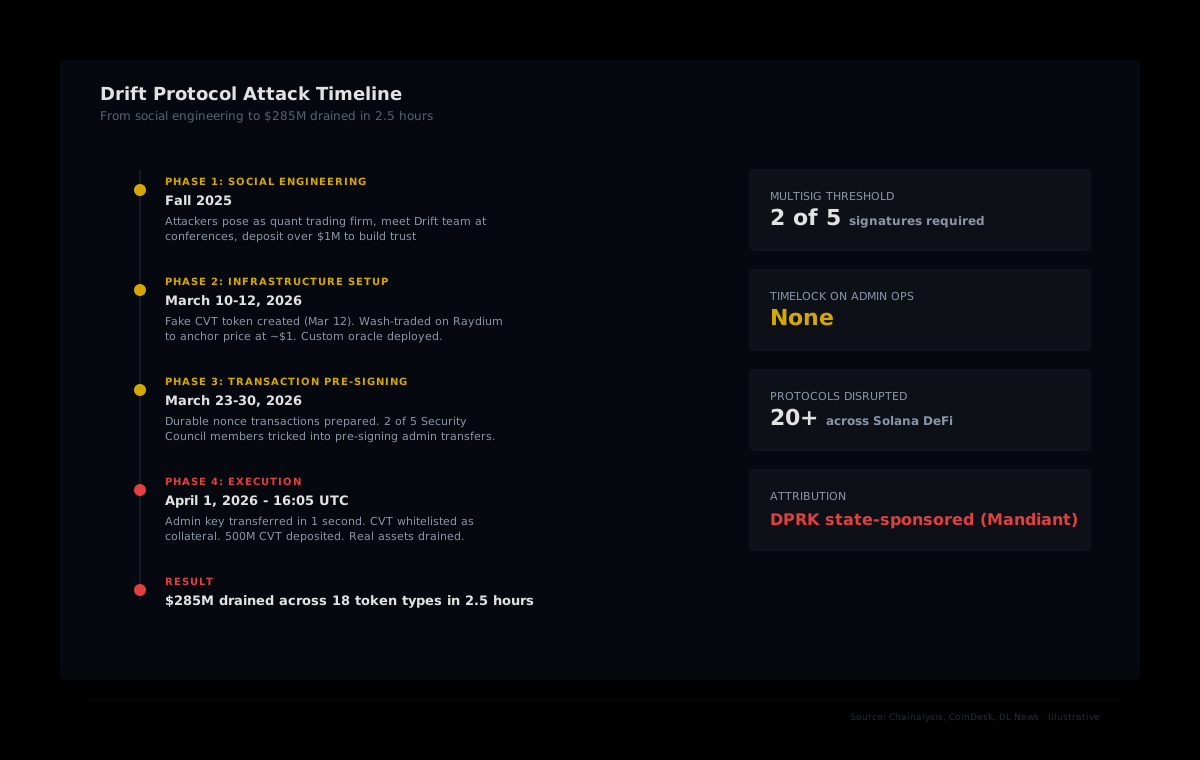
The attackers posed as a quantitative trading firm. They met Drift contributors at industry conferences, built professional relationships over months, and deposited over $1 million of their own capital into the protocol to establish credibility. The goal was simple: gain enough trust to get Drift's Security Council members to sign transactions without fully scrutinizing them.
Drift's Security Council operated a 2/5 multisig, meaning only two out of five signatures were required to execute admin-level changes. There was zero timelock: no delay between signing and execution. The attackers exploited Solana's "durable nonces" feature to get two council members to pre-sign transactions that handed over full admin control.
Between March 23 and 30, 2026, the pre-signed transactions were prepared. On April 1 at 16:05 UTC, the attackers executed the admin key transfer in one second. Once in control, they whitelisted a fake token called CVT as collateral, deposited 500 million units of it, and withdrew real assets: $71.4 million in USDC, $159.3 million in JLP, $11.3 million in cbBTC, and more.
The Recovery Token Framework
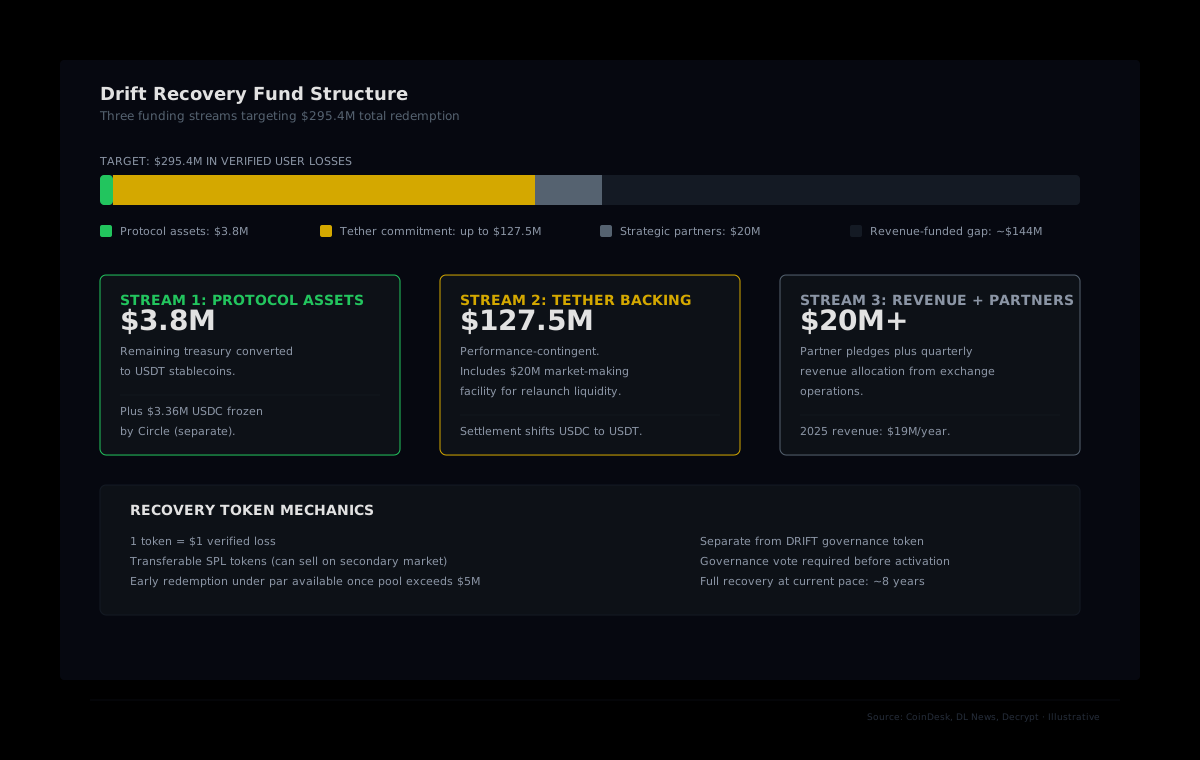
In May 2026, Drift outlined a recovery plan for the $295 million in verified user losses. The plan centers on issuing transferable SPL recovery tokens, each representing $1 of verified loss. These tokens are separate from the DRIFT governance token and can be sold on secondary markets, giving users an exit if they prefer liquidity over waiting for full redemption.
Three Funding Streams
The recovery pool is seeded from three sources:
- Protocol assets: approximately $3.8 million in remaining treasury, converted to stablecoins. Circle also froze $3.36 million in USDC.
- Tether commitment: up to $127.5 million, performance-contingent and tied to relaunch milestones. This includes a $20 million market-making facility for day-one liquidity.
- Strategic partners: up to $20 million in additional pledges, plus a quarterly cut of exchange revenue.
Users who do not want to wait can redeem recovery tokens under par once the pool exceeds $5 million. The practical challenge is obvious: Drift earned $19 million in revenue in 2025. At that rate, even with all partner commitments honored, full recovery at $295.4 million could take years.
Where the Stolen Funds Sit
Approximately 130,259 ETH remains concentrated across four monitored Ethereum wallets. Two additional transfers via the Wormhole bridge have been delayed by the protocol's governor until late July 2026, effectively locking funds in transit. A 10% bounty on recovered assets has been launched in partnership with Bybit.
Six Risk Layers Every Perp Trader Should Evaluate
The Drift hack is a case study in how protocol risk extends far beyond smart contract bugs. Here are six distinct risk layers, each of which played a role in this exploit or its aftermath.
1. Smart Contract Risk
This is the layer that gets the most attention. Bugs in liquidation logic, funding rate calculations, or margin engines can let attackers drain value. Audits, formal verification, and bug bounty programs help mitigate this risk, but they are not foolproof. The Drift exploit did not rely on a smart contract vulnerability, which is precisely the point: passing an audit does not mean a protocol is safe.
2. Admin and Governance Risk
This is the layer that failed at Drift. Privileged keys that can upgrade contracts, change collateral parameters, or transfer admin authority create a single point of failure even if the code itself is perfect. A 2/5 multisig with no timelock means two compromised signers can rewrite the entire protocol. The fix is structural: higher thresholds (like 4/7), mandatory timelocks on sensitive operations, and pre-execution evaluation tools that flag suspicious transactions before they are signed.
3. Oracle and Price Feed Risk
The Drift attackers created a fake token (CVT), deployed their own oracle to feed an artificial price of approximately $1 per token, and then used it as collateral to withdraw real assets. Oracle manipulation is not new in DeFi, but the Drift case showed how it can be combined with admin access to bypass every other safeguard. Multi-source oracle aggregation and circuit breakers that pause operations when prices diverge significantly from external benchmarks are the standard mitigations.
4. Composability and Contagion Risk
Because Solana DeFi protocols share liquidity, vaults, and yield strategies, the Drift exploit cascaded outward. At least 20 protocols reported disruptions, pauses, or losses. Many paused functionality while assessing exposure. If you are using a yield aggregator that deposits into a perp DEX's vaults, you inherit the DEX's risk profile, and you may not realize it until something breaks.
5. Counterparty and Recovery Risk
After a hack, the question becomes: how does the protocol make you whole? Drift's recovery token framework is more structured than most DeFi post-exploit responses. But "structured" does not mean "guaranteed." The Tether commitment is performance-contingent. Partner pledges depend on goodwill. Revenue-based repayment at $19 million per year against $295 million in losses is an eight-year timeline. Compare this to a CEX like Binance, which covered the $570 million BNB Bridge exploit from its own reserves within days. The recovery mechanisms available to a decentralized protocol are fundamentally different from those of a well-capitalized corporation.
6. Operational Security
This is the layer that no code audit can protect. Social engineering, phishing, insider threats, device compromise, and poor key management hygiene are all attack vectors that target the people running the protocol rather than the protocol itself. Drift's post-hack security improvements include dedicated devices for signers, mandatory quarterly security training, key rotation, and removal of the durable-nonce attack surface. These are the kinds of operational controls that institutional trading firms have enforced for decades but that most DeFi teams have not historically prioritized.
What This Means for Hyperliquid Traders
Hyperliquid runs a fundamentally different architecture than Drift. It operates its own Layer 1 blockchain with a custom on-chain order book, and the core team maintains tight control over the validator set and protocol upgrades. That design makes it resistant to certain attack vectors (like the oracle manipulation and collateral whitelisting exploits that hit Drift) but introduces its own trust assumptions around validator centralization.
For traders evaluating where to trade perps, the lesson from Drift is not "avoid DEXs." It is "understand what you are trusting." Every venue, centralized or decentralized, has a risk stack. The difference is whether that risk stack is visible.
Key takeaway: Smart contract audits cover one layer out of six. Admin governance, oracle integrity, composability exposure, recovery mechanisms, and operational security matter just as much. Evaluate all of them before sizing your exposure to any venue.
Our data classifies every wallet on Hyperliquid into one of 16 behavioral cohorts: 8 by account size (from Shrimp at $0-$250 up to Leviathan at $5M+) and 8 by all-time PnL (from Giga-Rekt below -$1M to Money Printer at +$1M+). When protocols face stress events like exploits, liquidation cascades, or sudden de-risking, cohort-level positioning data shows you who is moving and how large the flows are. That kind of visibility is what turns a news headline into a tradeable signal.
Track Smart Money Positioning in Real Time
HyperTracker's cohort analytics classify every Hyperliquid wallet by size and track record. See how Money Printers, Smart Money, and Whales are positioning before, during, and after market shocks. One API call, 16 behavioral segments, 5-minute refresh.
The Bigger Picture: Security as a Competitive Moat
The Drift hack is part of a broader pattern. DeFi losses in 2026 have already crossed $840 million through May, and the trend line is steepening. Institutions at a recent Consensus panel cited security and KYC as the two primary barriers keeping them on the sidelines of perp DEXs.
Drift itself plans to relaunch before July 2026 as a leaner, perps-only exchange with slimmed-down code, fewer collateral types, and trading limited to the most liquid assets. The protocol will deploy at a fresh address with fully rotated keys, implement timelocks on admin operations, and remove the durable-nonce attack surface entirely.
That relaunch strategy is itself a lesson: the perp DEX that wins long-term will be the one that treats security as a product feature, something to invest in proactively rather than patch reactively. Protocols that can demonstrate robust admin governance, transparent risk parameters, and credible recovery mechanisms will earn the deposits that security-conscious traders are pulling out of less rigorous competitors.
Every trade is a trust decision. The Drift hack just made the cost of misplaced trust extremely concrete: $285 million, twelve minutes, and a recovery plan that may take years to complete. The traders who studied the risk stack before depositing were somewhere else when it happened. The ones who only checked the APY were not.