
When Everyone Copies the Same Wallet on Hyperliquid
By CMM Team - 22-Aug-2026
When Everyone Copies the Same Wallet on Hyperliquid
Hyperliquid's leaderboard is public, on-chain, and impossible to fake. That is precisely why it attracts copy traders. A wallet sitting at rank 7 with seven figures in all-time profit is a compelling signal, and the barrier to mirroring its trades on a fully transparent L1 is lower than on any CEX. Build a bot, poll the wallet's positions, fire a market order whenever it moves. Three hours of work, maybe less if you vibe-code it.
The problem is that you are rarely the only one watching. By the time a wallet makes the top 50, it has attracted dozens of copy bots, each polling the same address, each racing to mirror the same fill. That collective rush creates a secondary market dynamic that the lead wallet never intended: the copy crowd moves the price before the followers finish entering. On liquid pairs like BTC and ETH, the impact is small. On thinner markets, it can erase the entire edge you thought you were copying.
This article breaks down how wallet-following clusters form on Hyperliquid, why they degrade the signal you are trying to capture, and how to detect whether a wallet is already too crowded to follow profitably.
Why copy clusters form around leaderboard wallets
The Hyperliquid leaderboard ranks wallets by realized PnL across four time windows: all-time, monthly, weekly, and daily. Every number is derived from on-chain data, which means the rankings are verifiable and manipulation-resistant. That transparency is the feature. It is also what makes leaderboard wallets magnets for copy traders.
A wallet that stays in the top 50 for weeks accumulates followers organically. Someone tweets about it. A Discord group flags it. A copy-trading platform adds it to a curated list. Each new watcher adds a bot, and each bot executes the same playbook: detect a position change, fire a same-direction order within seconds. The result is a cluster of wallets that move in lockstep with the leader, creating correlated order flow that neither the leader nor the followers control.
The clustering accelerates because of a feedback loop. A wallet that is already profitable attracts followers. The followers' correlated orders temporarily push the market in the leader's direction, which makes the leader look even more profitable, which attracts more followers. The loop runs until either the leader's strategy decays or the copy crowd becomes large enough to create visible slippage on entry.
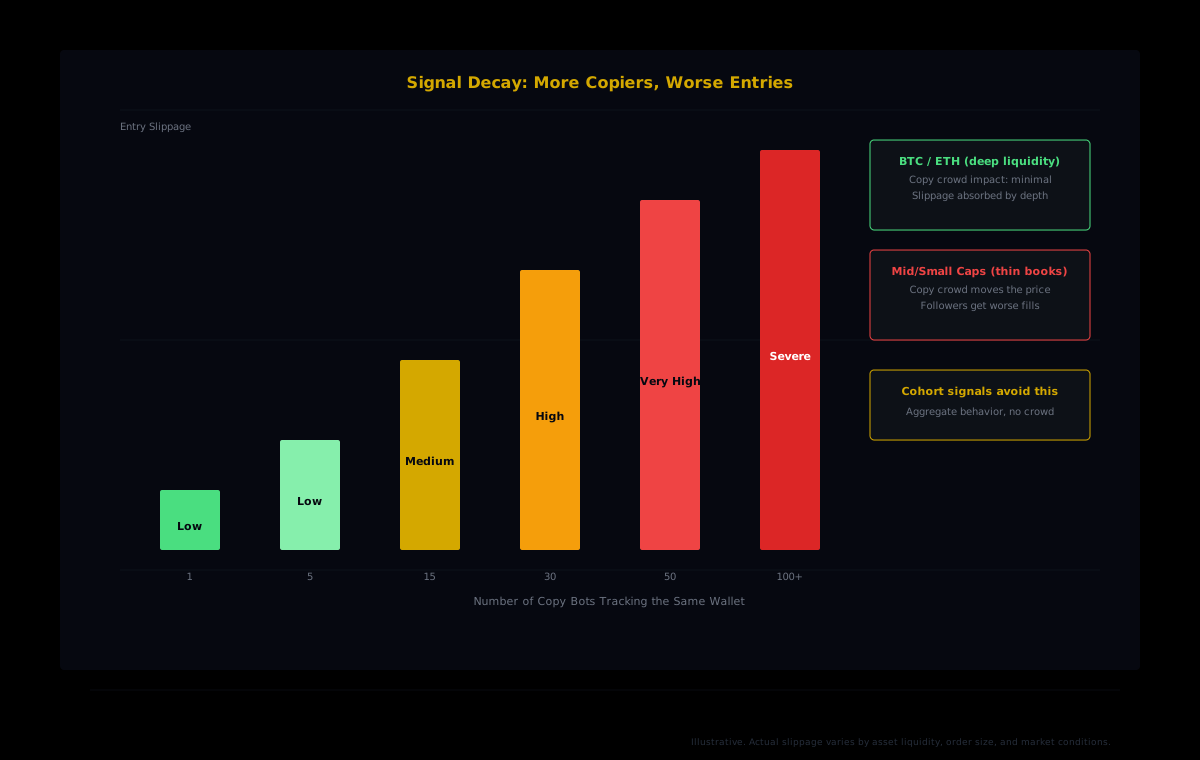
How crowded following degrades your edge
The mechanics of signal degradation are straightforward. When the lead wallet opens a long on a mid-cap asset, every copy bot watching that wallet fires a market buy within the next polling interval. If the wallet has 30 followers and each enters with a few thousand dollars of notional, that is a burst of same-direction flow hitting a thin order book within seconds of the leader's fill.
The leader got in at the price they wanted. The first few copiers got in close to that price. By copier number 15 or 20, the bids above the leader's entry have been eaten, and the remaining followers are filling against progressively worse liquidity. The last copiers in the cluster get the worst price, the most slippage, and the smallest expected edge from the trade.
The asymmetry of exits
Entry crowding is bad. Exit crowding is worse. When the leader closes the position, the same cluster of bots fires market sells simultaneously. On thin assets, this creates a mini liquidation cascade where the copy crowd's own exit flow pushes the price down, giving later exits a worse fill. If the leader captured a modest profit on the trade, the last few copiers might exit at breakeven or worse, because the exit crowd ate the spread.
This asymmetry means that even if you perfectly mirror the leader's direction and timing, your realized PnL will be structurally worse than theirs. The larger the copy cluster, the larger the gap between leader returns and follower returns.
Where the impact is worst
On BTC and ETH, Hyperliquid's order books are deep enough that a cluster of 30 copy bots adding a few thousand dollars each barely moves the price. The copy crowd problem is most acute on assets with thinner liquidity: mid-cap perps, newly listed tokens, and HIP-3 assets where the order book depth is a fraction of the majors.
If you are copy-trading a leaderboard wallet that specializes in altcoin perps, the crowding risk is significantly higher than if they primarily trade BTC. The asset matters as much as the wallet.
Detecting copy clusters with on-chain data
Hyperliquid's transparency cuts both ways. The same on-chain visibility that lets you copy a wallet also lets you measure how many other wallets are copying it. The approach is straightforward: watch the leader's fills, then scan for correlated order flow from other wallets in a tight time window after each fill.
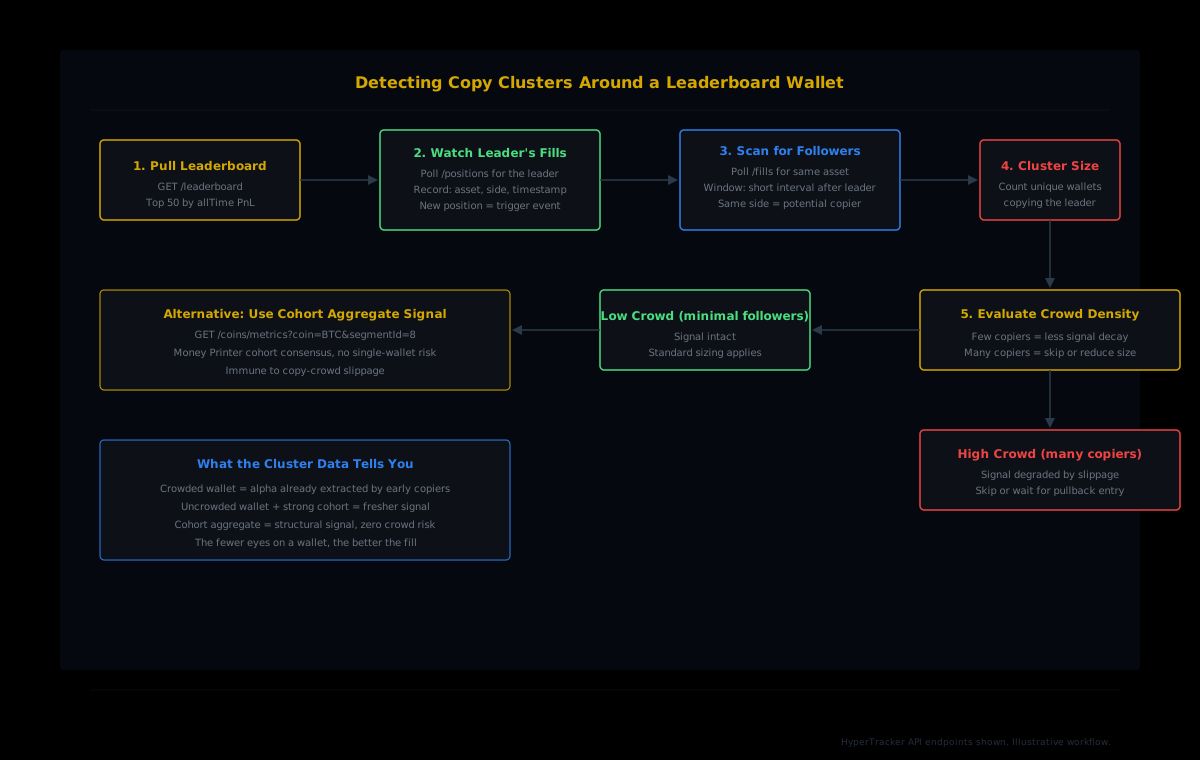
The detection workflow
The concept is simple. When the leader opens a position or adds to an existing one, poll the fills endpoint for the same asset and look for other wallets that entered on the same side within a short window. A wallet that consistently enters the same asset, in the same direction, within minutes of the leader's fill, is almost certainly copying.
Here is the basic logic using the HyperTracker API:
import requests
from datetime import datetime, timedelta

API_BASE = "https://ht-api.coinmarketman.com/api/external"
headers = {"Authorization": "Bearer YOUR_JWT_TOKEN"}

# Step 1: Get the leader's recent positions
leader_addr = "0xLeaderWalletAddress"
leader_positions = requests.get(
    f"{API_BASE}/positions",
    headers=headers,
    params={"address": leader_addr, "limit": 10}
).json()

# Step 2: For each new position, check for correlated fills
for pos in leader_positions:
    coin = pos["coin"]
    side = pos["side"]  # "long" or "short"
    entry_time = pos.get("openedAt")

    # Step 3: Pull fills for the same coin in a tight window
    fills = requests.get(
        f"{API_BASE}/fills",
        headers=headers,
        params={
            "coin": coin,
            "start": entry_time,
            "limit": 200
        }
    ).json()

    # Step 4: Count unique wallets entering same side
    copier_wallets = set()
    for fill in fills:
        if (fill["side"] == side
            and fill["address"] != leader_addr):
            copier_wallets.add(fill["address"])

    print(f"{coin} {side}: {len(copier_wallets)} potential copiers")
This is a simplified version. A production implementation would track copier consistency across multiple trades (a wallet that copies once might be coincidence; a wallet that copies five trades in a row is a bot), weight by timing (fills within 60 seconds of the leader are higher-confidence copiers than fills 10 minutes later), and maintain a running cluster-size metric for each leaderboard wallet you are evaluating.
What cluster size tells you
A leaderboard wallet with a small or nonexistent copy cluster is a fresher signal source. The fewer bots watching the same address, the less correlated flow hits the book when the leader moves, and the closer your entry will be to theirs.
A wallet with a large, consistent copy cluster is a degraded signal source. You can still follow it, but you need to account for the fact that your fill will be worse than the leader's on every trade. On thin assets, the degradation can be large enough to turn a profitable strategy into a losing one for the last copiers in the queue.
The structural alternative: cohort aggregate signals
Copy clusters are a single-wallet problem. When you follow one address, you inherit all the risks of that address: strategy decay, hidden hedges, and crowd-driven slippage. There is a structurally different approach that avoids every one of these failure modes: using the aggregate behavior of a cohort as a directional signal instead of mirroring any individual wallet.
HyperTracker classifies every wallet on Hyperliquid into 16 behavioral cohorts. Eight are based on account size (Shrimp through Leviathan) and eight are based on all-time PnL (Money Printer through Giga-Rekt). When the Money Printer cohort (wallets with $1M+ in cumulative profit) collectively shifts its net positioning on an asset, that signal reflects a consensus among hundreds of independently profitable wallets. No single wallet's decision dominates the aggregate.
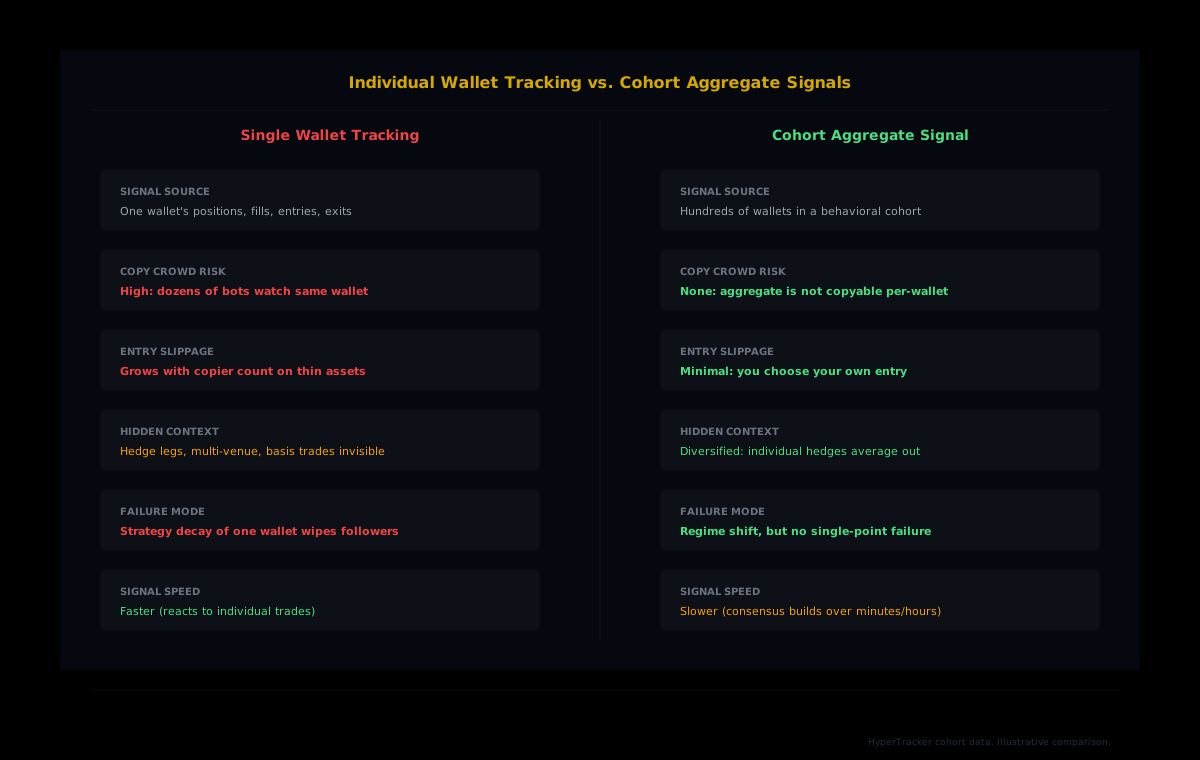
Why aggregates are immune to the copy crowd
A cohort signal cannot be crowded in the same way a single wallet can. Nobody is firing a market order because "the Money Printer cohort shifted 3 points toward long." The signal informs your directional bias, but the entry is entirely yours. You choose the asset, the size, the timing, and the execution method. There is no cluster of bots racing you to the same fill.
The aggregate also washes out the hidden-context problem. If one Money Printer wallet is long ETH as a hedge against a short position on another venue, that hedge is invisible when you track the wallet individually. But in the aggregate, hedging wallets are offset by directional wallets, and the net positioning reflects the cohort's genuine directional lean rather than any single wallet's multi-venue strategy.
Querying cohort positioning
The HyperTracker API exposes cohort-level metrics through the /coins/metrics endpoint. Here is how to check what the Money Printer cohort is doing on BTC:
# Check Money Printer cohort positioning on BTC
response = requests.get(
    f"{API_BASE}/coins/metrics",
    headers=headers,
    params={
        "coin": "BTC",
        "segmentId": 8  # Money Printer cohort
    }
).json()

print(f"Money Printer BTC positioning:")
print(f"  Long %: {response.get('longPct')}")
print(f"  Net bias: {response.get('bias')}")
print(f"  Total wallets: {response.get('totalAccounts')}")
Compare this across multiple cohorts to build a richer picture. If Money Printers (segment 8) and Smart Money (segment 9) are both shifting long on the same asset while Exit Liquidity (segment 12) and Semi-Rekt (segment 13) are going short, that divergence is a strong signal. The wallets with demonstrated skill are positioned opposite the wallets with demonstrated losses.
Combining both approaches
The strongest workflow uses individual wallet tracking and cohort signals together, but in different roles. The cohort aggregate provides the directional thesis. Individual wallet monitoring provides execution timing. And the cluster detection tells you whether the specific wallet you are watching is too crowded to follow cleanly.
The sequence looks like this:
- Check the cohort consensus. Are the profitable cohorts (Money Printer, Smart Money, Consistent Grinder) collectively moving in one direction on an asset? If yes, you have a directional lean backed by hundreds of wallets. If the cohorts are split or neutral, there is no clear thesis.
- Find individual wallets aligned with the cohort signal. Pull the leaderboard and filter for wallets that are positioned in the same direction as the cohort consensus. These wallets are both individually profitable and aligned with the crowd of proven traders.
- Run the cluster detection. For each candidate wallet, check how many copiers are already following it. Prefer wallets with smaller copy clusters, because your entry will be closer to the leader's.
- Size and enter. Use the cohort signal for direction, the individual wallet for timing, and the cluster size for position sizing. A crowded wallet on a thin asset gets a smaller allocation. An uncrowded wallet on a liquid asset gets a larger one.
This hybrid approach treats individual wallets as timing tools rather than strategy sources. The thesis comes from the cohort. The wallet just tells you when to pull the trigger. And the cluster check tells you whether pulling the trigger at that moment is worth the slippage cost.
Track Copy Clusters and Cohort Signals
HyperTracker's API gives you leaderboard rankings, wallet-level position data, and cohort-level metrics across all 16 behavioral segments. Use the leaderboard to find wallets, the fills data to detect copy clusters, and the cohort endpoints to build a directional thesis that no crowd can degrade. Start with a free account and upgrade to Pulse ($179/mo) when you are ready to build.
Crowded wallets are yesterday's alpha
The leaderboard is a discovery tool. It tells you which wallets have been profitable. What it cannot tell you is whether following that wallet today will be profitable for you. The difference depends almost entirely on how many other people are already following the same address, and on which assets the leader trades.
Detect the crowd before you join it. If a wallet has a large, stable copy cluster, the alpha has already been extracted by the earliest followers. You are getting the leftovers, priced at a premium by the slippage your predecessors created. The wallets worth following are the ones that nobody else is watching yet, with cohort credentials that confirm genuine skill. And the signals worth acting on are the ones that come from hundreds of wallets at once, where no single copier can degrade what you capture.