Why a Trader's Track Record Beats Their Wallet Size on Hyperliquid
By CMM Team - 23-Jun-2026
Why a Trader's Track Record Beats Their Wallet Size on Hyperliquid
A wallet holding $800K in perp equity opens a 20x ETH long. Crypto Twitter screenshots the position, calls it a whale play, and a hundred copy traders pile in behind it. What nobody checks before mirroring: this wallet's all-time PnL sits at negative $600K. The "whale" is a repeat loser with a gambling problem and deep pockets, which means following them is statistically worse than flipping a coin.
This scenario plays out constantly on Hyperliquid. The chain is transparent. Every position, every fill, every liquidation is visible. But most analytics tools classify wallets by one axis only: how much money they have. That tells you about capital. It says nothing about competence. When you can see both dimensions simultaneously, when you can cross-reference a wallet's size against its lifetime profit and loss, the picture shifts from "big wallet moved" to "skilled trader moved." And the trading implications of those two readings are completely different.
The problem with whale watching
Whale tracking has been a staple of crypto analysis since the early Ethereum days. The logic is intuitive: large wallets move markets, so watch what they do and move with them. On a centralized exchange this logic at least has a structural grounding, because you cannot see the whale's track record anyway, so size is the only metric available.
On Hyperliquid, that excuse disappears. The chain publishes everything. A wallet's historical trades, its realized PnL, its win rate, its average holding period, all of this is recoverable from on-chain data. Using size alone as your filter is like hiring a fund manager based on how much capital they raised without asking whether they ever made money with it.
The issue compounds with leverage. A wallet with $500K in equity running 20x leverage commands $10M in notional exposure. That is enough to move mid-cap perp prices on Hyperliquid for a few minutes. Copy traders see the position size and assume signal. But the wallet might be a serial over-leverager who blows up every third week and reloads from a CEX. The size is real. The edge is not.
Two axes, sixteen cohorts
HyperTracker classifies every wallet on Hyperliquid into 16 behavioral cohorts along two independent axes. Understanding both is the key to separating signal from noise.
The size axis groups wallets by current perp equity. Eight tiers, from Shrimp (under $250) to Leviathan ($5M and above). This is what most whale alerts track.
The PnL axis groups wallets by all-time realized profit and loss. Eight tiers, from Money Printer (+$1M and up) at the top to Giga-Rekt (below -$1M) at the bottom. This is the axis that tells you whether a wallet has actually demonstrated an edge over its lifetime of trading.
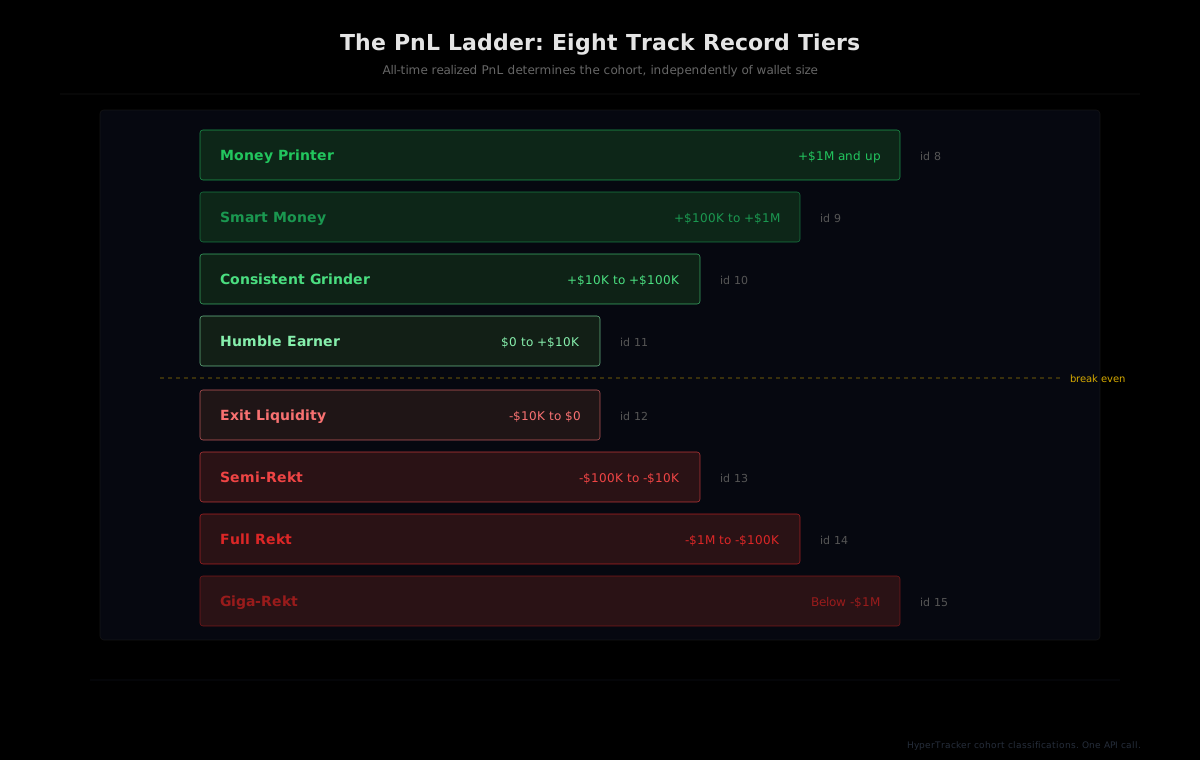
Each wallet carries exactly two cohort labels: one from each axis. A Fish by size (under $10K equity) can be a Money Printer by PnL (over $1M in lifetime realized gains). That wallet has a small current position but a demonstrated history of making money. Conversely, a Leviathan by size (over $5M equity) can be a Giga-Rekt by PnL (over $1M in lifetime realized losses). That wallet has massive capital and a proven inability to deploy it well.
The two labels together create a profile that neither label produces alone.
When the two axes disagree, pay attention
The most interesting wallets are the ones where size and PnL point in opposite directions. These mismatches reveal something that pure whale watching misses entirely.
Large size, poor PnL
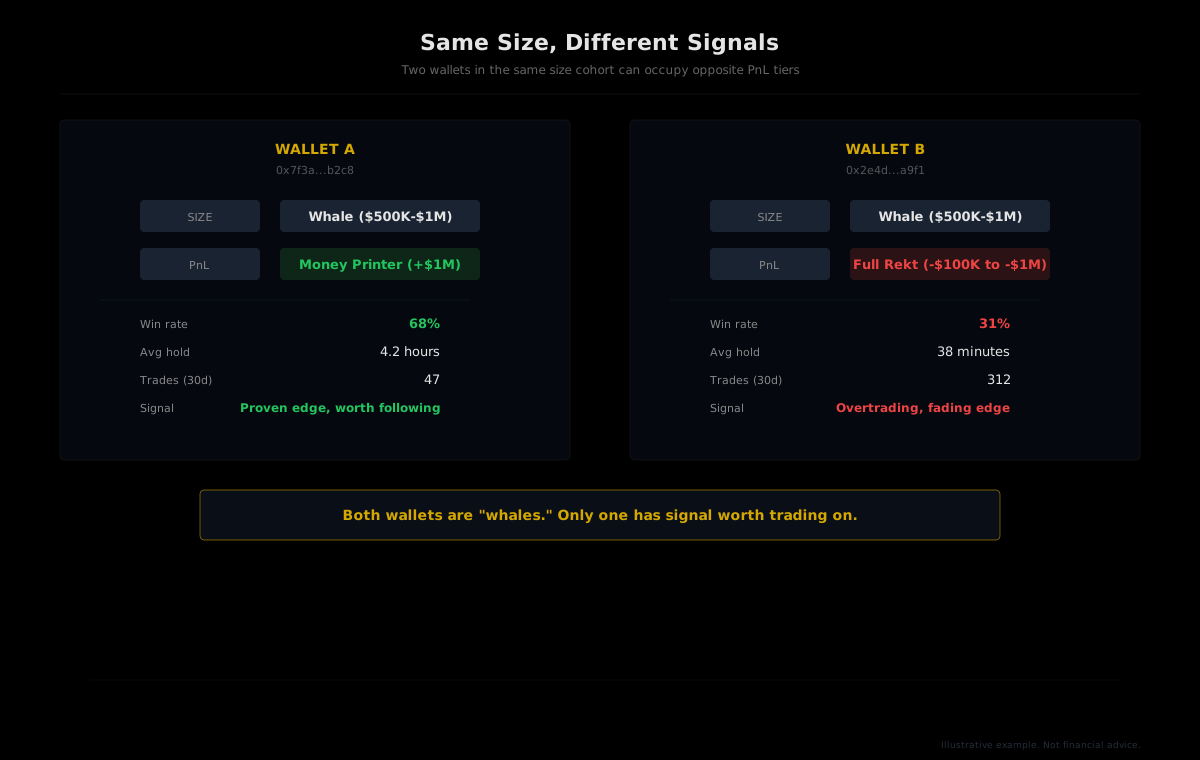
A Whale or Tidal Whale that sits in the Semi-Rekt or Full Rekt PnL cohort has capital but no demonstrated edge. These wallets are often reloaders: they lose money, bridge more from a CEX, and lose it again. Their positions can still move markets in the short term because their notional size is real. But the long-term expected value of following their directional bets is negative. When you see a large position from a wallet with this profile, treat it as market-moving noise, something to be aware of for short-term price action, but something to avoid as a trade signal.
Small size, strong PnL
A Dolphin or Apex Predator that sits in the Money Printer or Smart Money PnL cohort has limited current capital but a track record of extracting consistent profits. These wallets might be taking smaller positions now because they recently withdrew profits, because they are being cautious in a volatile environment, or simply because they trade with tight risk management and small position sizes. Their directional moves carry less market impact, but the signal quality is higher. If a Money Printer Dolphin opens a position, the probability that the trade is well-reasoned is meaningfully higher than if a Full Rekt Leviathan opens the same trade.
Here is an illustrative comparison showing what this looks like in practice:
The agreement case
When the axes agree, interpretation is straightforward. A Leviathan that is also a Money Printer has both the capital and the proven edge. These wallets generate the highest-quality directional signal on the platform. At the other end, a Shrimp that is also Exit Liquidity has neither capital nor track record. These wallets are noise by every measure.
Querying the PnL axis with HyperTracker
The cohort metrics endpoint lets you pull aggregate positioning for any cohort, including the PnL-axis ones. To see what Money Printers are doing across any asset on Hyperliquid:
curl -H "Authorization: Bearer $HT_TOKEN" \
  "https://ht-api.coinmarketman.com/api/external/cohort-metrics?segmentId=8&coin=ETH"
That returns the aggregate long/short positioning, open interest, and bias for every wallet classified as Money Printer (segment ID 8) on ETH. Compare the same call with segmentId=14 (Full Rekt) and you start to see divergences: moments where the most profitable wallets are positioned one way and the most unprofitable wallets are positioned the opposite way.
You can also query individual wallets. The /positions endpoint returns a wallet's segment IDs alongside its open positions, so a single call tells you both what the wallet is doing and which cohorts it belongs to:
curl -H "Authorization: Bearer $HT_TOKEN" \
  "https://ht-api.coinmarketman.com/api/external/positions?address=0x..."
The response includes the wallet's size segment ID and PnL segment ID, which you can map to the cohort names from the tables above. This is the building block for any wallet screening system: filter by PnL cohort first, then check what those wallets are doing.
Building a signal quality framework
Once you have both axes, you can construct a simple ranking that tells you how much weight to give a wallet's activity. The framework is not complicated. It is a 2x2 cross of "large vs. small capital" and "positive vs. negative lifetime PnL," expanded to use the full cohort granularity.
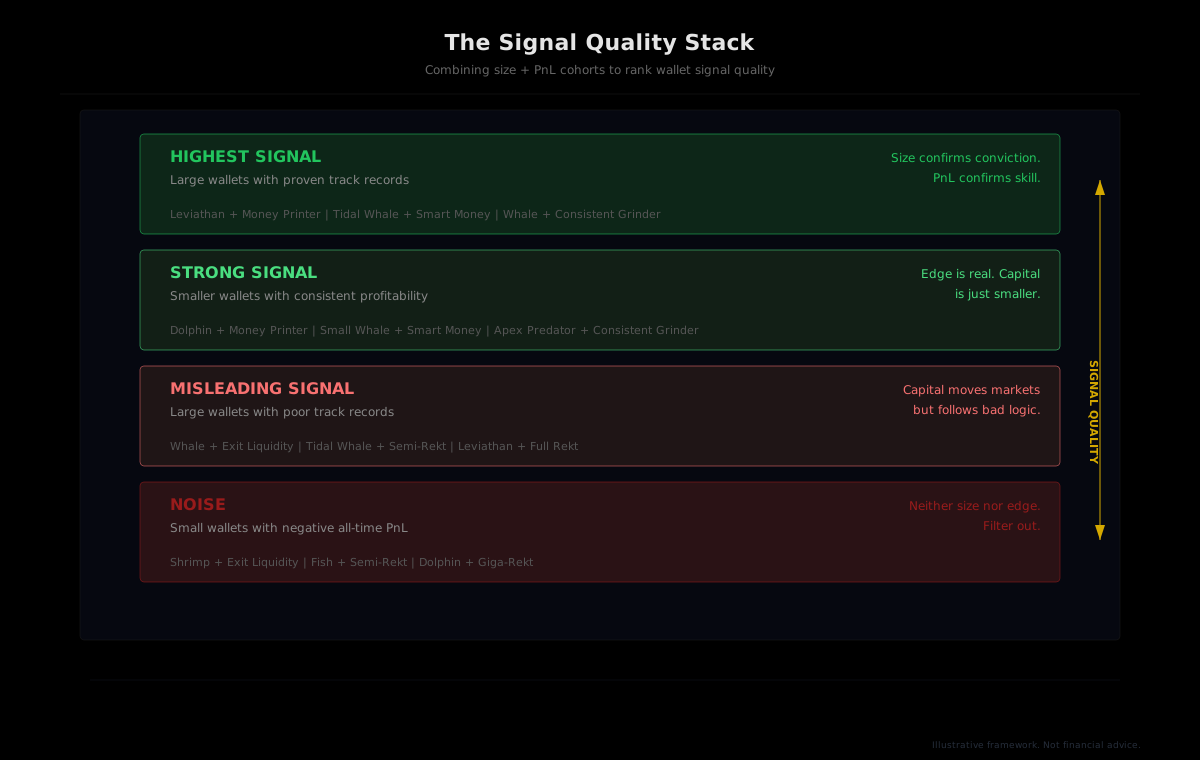
The highest-signal combinations are large wallets with strong PnL history: Leviathan + Money Printer, Tidal Whale + Smart Money, Whale + Consistent Grinder. These wallets have demonstrated both conviction (they put real capital at risk) and competence (their lifetime PnL shows consistent extraction). When these wallets build a directional position, the probability that they have done their homework is meaningfully above baseline.
The next tier is smaller wallets with strong PnL: Dolphin + Money Printer, Small Whale + Smart Money, Apex Predator + Consistent Grinder. The edge is proven but the capital deployed is smaller, which means less market impact and potentially less conviction per trade.
The misleading tier is large wallets with poor PnL: Whale + Exit Liquidity, Tidal Whale + Semi-Rekt, Leviathan + Full Rekt. These are the wallets that generate false signals for naive whale watchers. The capital is real, the positions are large, the market impact is visible, but the track record says these wallets have been consistently wrong. They move prices but in unreliable directions.
The bottom tier is small wallets with negative PnL. Filter these out entirely for directional signal purposes.
PnL cohorts in practice: three scenarios
Copy trading filters
If you are building a copy-trade system on Hyperliquid, PnL cohort filtering is the first screen to apply. Rather than mirroring any wallet above a capital threshold, filter to only mirror wallets in the Money Printer, Smart Money, or Consistent Grinder PnL cohorts. This removes the high-capital, low-skill wallets that generate the loudest signals with the worst expected outcomes. You can pull the leaderboard endpoint (/leaderboard?pnlType=allTime) for ranked wallet performance, then cross-reference cohort labels for each address.
Cohort divergence alerts
When Money Printers are net long and Full Rekts are net short on the same asset, you have a divergence that historically resolves in favor of the profitable cohort. Use the cohort metrics endpoint for both segments on the same coin and compare the longShortRatio field. A sustained divergence over multiple 5-minute snapshots is a stronger signal than a momentary blip.
Risk assessment for incoming fills
If you are a market maker or liquidity provider on Hyperliquid, knowing the PnL profile of the wallets filling against you matters. Taking the other side of a Money Printer's trade is a different risk proposition than taking the other side of a Giga-Rekt's trade. HyperTracker's order flow snapshots, refreshed every 5 minutes, let you see who is buying and selling at the cohort level.
Why size still matters (just less)
None of this means you should ignore the size axis. Capital still drives market impact, so a Leviathan opening or closing a position on a mid-cap Hyperliquid perp will move the price regardless of whether the wallet is a Money Printer or a Full Rekt. That price move is real and affects your P&L if you are holding the same asset.
The distinction is between market impact and directional signal. Size predicts market impact well. PnL predicts directional signal better. The ideal system uses both: watch size for position awareness (who is moving the market right now), and weight PnL for directional conviction (whose moves are worth following).
HyperTracker's 16-cohort system gives you both dimensions in one API call. One segmentId parameter switches between size-axis and PnL-axis views. The same endpoint structure, the same response schema, the same query pattern. The analytical lift comes from combining them, which is a logic layer you build on top of the data.
Query PnL cohorts with HyperTracker
Every wallet on Hyperliquid is classified across 16 behavioral cohorts. Eight by capital size, eight by lifetime track record. One API call returns both, refreshed every 5 minutes. Start filtering signal from noise.
The next time you see a whale alert on Crypto Twitter, check the PnL label before you act on the size label. A $2M ETH long from a Money Printer is a fundamentally different signal than a $2M ETH long from a Full Rekt. Both positions are equally large. Only one comes from a wallet that has consistently made money, and on a transparent chain where every trade is public, there is no reason to treat them the same.