Your Perp DEX Passed Its Audit. Drift's Did Too.
By CMM Team - 10-Aug-2026
Your Perp DEX Passed Its Audit. Drift's Did Too.
Drift Protocol had everything a builder could want on a security resume. Multiple smart contract audits from reputable firms. A five-member Security Council. Active bug bounties. On April 1, 2026, none of it mattered. Attackers drained $285 million from the largest perpetual futures DEX on Solana, and the smart contracts held up perfectly. The drain itself took less than a minute to execute. The code was fine. Everything around it was not.
If you are building on any perp DEX infrastructure, this is the case study that should keep you up at night. Because the attack vector was not a code bug that an audit would have caught. It was governance architecture, key management, and oracle trust: the layers that most security reviews never touch.
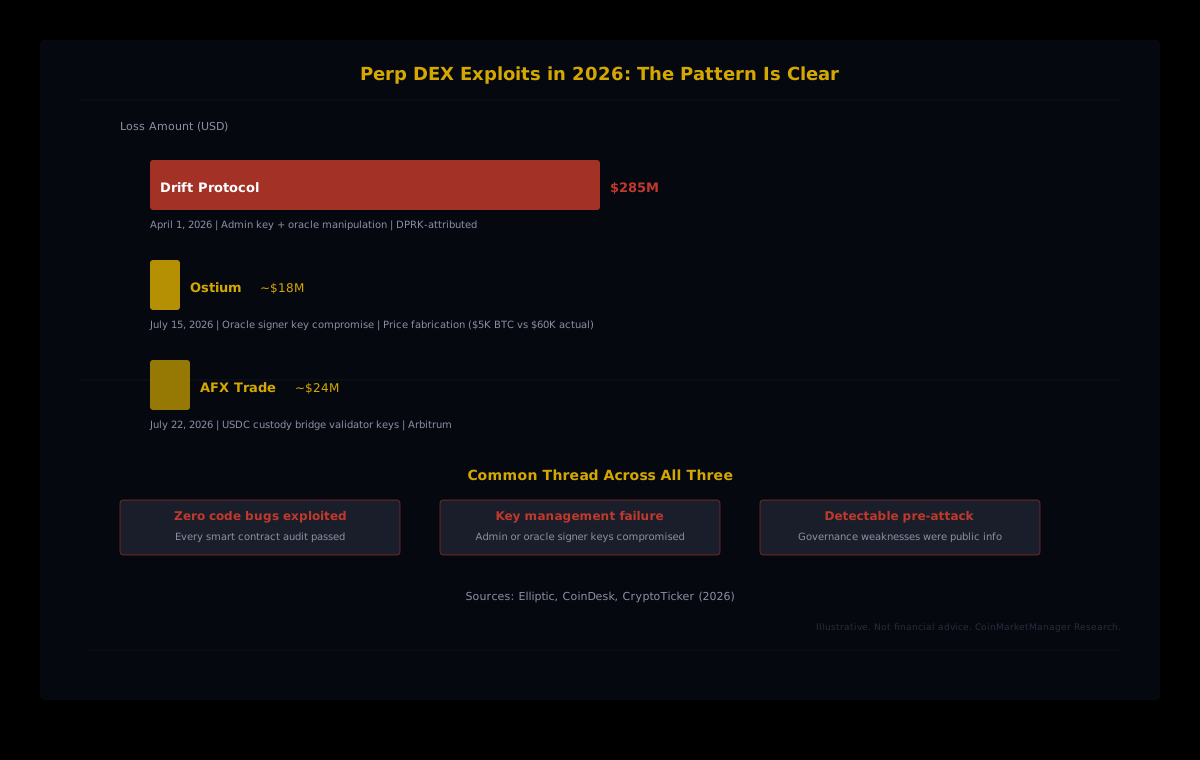
Four months later, the pattern has repeated. Ostium lost roughly $18 million in July through an oracle signer key compromise. AFX Trade lost roughly $24 million a week later via validator signing keys for its USDC custody bridge. Every protocol had passed its code audit. The failures lived elsewhere.
This article dissects what actually went wrong at Drift, identifies the specific layers that builders should audit beyond smart contracts, and explains how cohort-level intelligence can serve as an early warning system when protocol-level risk materializes in trader behavior.
How Drift lost $285 million without a single code bug
The Drift exploit was not a flash loan. It was not a reentrancy bug. It was months of patient social engineering followed by a drain that took less than a minute.
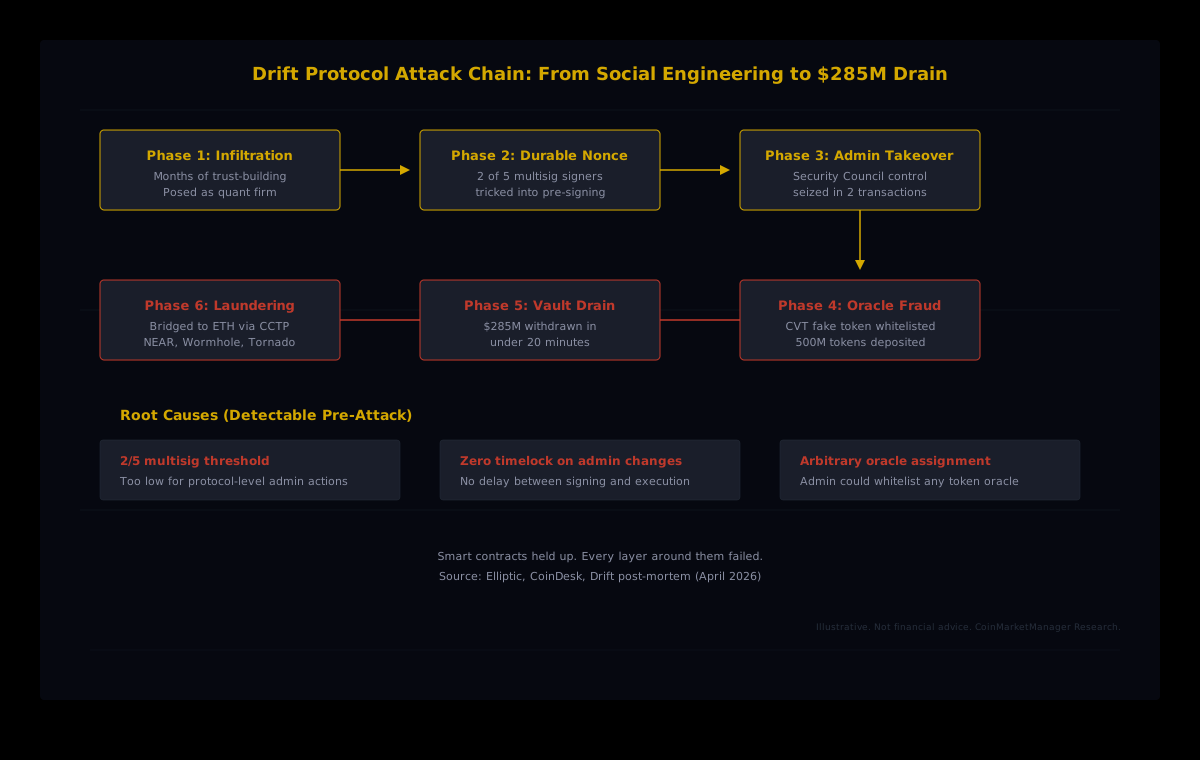
According to Drift's post-mortem and analysis from Elliptic, the attackers spent months posing as a quantitative trading firm to build trust with Drift contributors. Drift attributed the operation with "medium-high confidence" to UNC4736, a North Korean state-affiliated group also responsible for the October 2024 Radiant Capital hack.
The technical exploit chain combined two elements that no code audit would flag:
- Durable nonce exploitation: Solana's durable nonce feature allows transactions to be signed now and executed later, with no expiration. The attackers obtained pre-signed authorizations from two of five Security Council members through misrepresented transaction approvals. Because the transactions used durable nonces, they remained valid indefinitely.
- Oracle manipulation: Once the attackers seized admin control, they whitelisted a fabricated token called CVT (CarbonVote Token) as collateral. They deposited 500 million CVT tokens and used them to withdraw real assets: USDC, SOL, ETH, and JLP tokens.
The on-chain staging began on March 23, when four durable nonce accounts were created. The Security Council migration executed on March 27. The attack fired on April 1. Two transactions, four slots apart, were all it took to hand over protocol control.
Lily Liu, President of the Solana Foundation, addressed the incident directly: the smart contracts held up. The failure was in the governance layer, the key management, the trust model. Everything humans touch.
The governance layer: where audits stop and exploits start
Drift's Security Council was a 2-of-5 multisig. Only two signatures were required to execute admin-level changes to the entire protocol. There was zero timelock, meaning no mandatory delay between a transaction being signed and being executed. And the admin key had what Chaos Labs founder Omer Goldberg described as "god-like control" over the protocol, including the ability to rewrite risk rules, assign oracles, and disable safety mechanisms.
This is the gap that code audits systematically miss. A smart contract audit validates the logic inside the contract. It does not evaluate who holds the keys, how many signatures are required to deploy changes, whether a timelock forces a waiting period, or whether an admin can unilaterally whitelist new collateral types.
"If you're building in DeFi, audit the surface area of your admin key. Not only the smart contracts." Omer Goldberg, founder of Chaos Labs
For builders integrating with any perp DEX, the lesson is architectural. Before you route user funds through a protocol, you should be able to answer these questions about its governance layer:
- What is the multisig threshold, and how many total signers exist?
- Is there a timelock on admin actions? If so, how long?
- Can admin keys whitelist new collateral or assign new oracles without governance approval?
- Are there withdrawal rate limits that would slow a drain?
- What is the key rotation schedule?
At Drift, the answers were: 2/5, zero timelock, yes to arbitrary oracle assignment, no withdrawal rate limits, and no documented rotation schedule. All of that information was public before the attack happened.
The oracle problem: fake tokens, real withdrawals
The Drift attack worked because the admin could whitelist any token as collateral and assign a price oracle to it. The attackers created CVT, seeded a small Raydium liquidity pool, and wash-traded it to anchor its price near $1. They deployed their own price oracle to feed that fabricated price into Drift's system.
Once CVT was whitelisted, depositing 500 million tokens (valued at $500 million by the attacker-controlled oracle) gave them the "collateral" to withdraw real assets. The entire withdrawal happened faster than most protocols can convene an emergency governance call.
This same pattern recurred at Ostium in July. The attacker fabricated a bitcoin price of $5,000 against an actual price near $60,000, exploiting a compromised oracle signer key. Despite multiple audits and institutional backing, the specific oracle component that was exploited had been explicitly excluded from the bug bounty scope.
The takeaway for builders: oracle infrastructure is not just a data feed. It is a trust model. Who can assign oracles? Who holds the oracle signer keys? Is there a fallback mechanism if a price feed reports an anomalous value? These questions matter more than which oracle provider you use.
The builder audit checklist your code review is missing
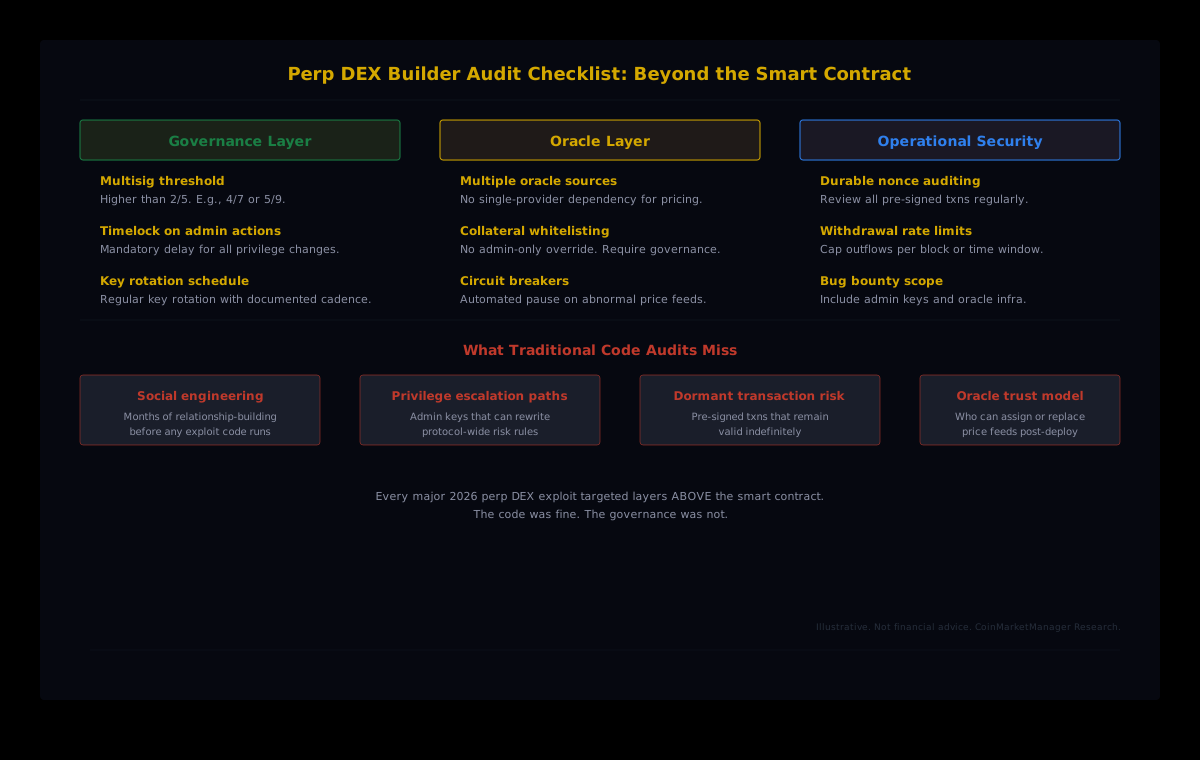
Based on the Drift post-mortem, the Ostium and AFX Trade exploits, and guidance from Chaos Labs and security researchers, here is a practical checklist for builders integrating with perp DEX infrastructure. None of these items appear in a standard smart contract audit.
Governance audit
| Check | What to look for | Drift failure | | --- | --- | --- | | Multisig threshold | Higher thresholds reduce single-point-of-failure risk. Evaluate whether the threshold scales with the protocol's TVL. | 2/5 threshold was too low for a protocol holding over $550M | | Timelock on admin actions | Any admin change should have a mandatory delay, giving the community and monitoring tools time to react. | Zero timelock. Changes were instant. | | Key rotation | Regular key rotation with documented cadence. Stale keys accumulate risk. | No documented rotation schedule. | | Admin scope | Can the admin rewrite risk parameters, assign oracles, or disable circuit breakers? If yes, those powers need additional checks. | Admin had unrestricted protocol control. |
Oracle audit
| Check | What to look for | Drift failure | | --- | --- | --- | | Oracle assignment | Can anyone with admin access assign a new oracle? This should require governance approval and time delay. | Admin could assign any oracle unilaterally. | | Multiple oracle sources | No single-provider dependency. Sanity checks against median or TWAP pricing. | Single attacker-controlled oracle accepted. | | Collateral whitelisting | Adding new collateral types should require multi-step governance, not a single admin transaction. | CVT was whitelisted by the compromised admin in one transaction. | | Circuit breakers | Automated pauses when price feeds diverge from expectations or withdrawals spike. | No circuit breakers triggered during the drain. |
Operational security audit
| Check | What to look for | | --- | --- | | Pre-signed transaction inventory | Regular review and revocation of any durable nonces or pre-signed authorizations. Treat every dormant signed transaction as a live risk. | | Withdrawal rate limits | Cap the maximum outflow per block or per time window. Forces attackers to drain slowly enough for monitoring to catch it. | | Bug bounty scope | Include admin keys, oracle infrastructure, and governance mechanisms. Ostium's oracle component was explicitly excluded from its bounty scope. | | Social engineering readiness | Team members with signing authority should have hardened communication protocols. The Drift attackers spent months building trust before requesting a single signature. |
How on-chain behavior signals protocol-level risk
When a major exploit hits, the first visible signals often appear in trader behavior before the exploit itself is confirmed. Smart money wallets start reducing exposure. Withdrawal patterns shift. Positioning across cohorts changes in ways that are detectable through cohort-level analytics.
HyperTracker classifies every wallet on Hyperliquid into 16 behavioral cohorts, eight by size (from Shrimp to Leviathan) and eight by all-time PnL (from Giga-Rekt to Money Printer). When protocol-level risk materializes, these cohorts do not move in unison. The divergence is the signal.
Consider what happens during a contagion event. Larger, more experienced cohorts (Whales, Tidal Whales, Money Printers, Smart Money) tend to de-risk faster than smaller retail-heavy cohorts (Shrimp, Fish, Exit Liquidity). If you are building a trading application or risk management tool, monitoring how these cohorts respond to external shocks gives you an early warning layer that raw price data alone cannot provide.
Our data refreshes every 5 minutes, which means cohort positioning shifts are visible in near real-time. For builders integrating with the HyperTracker API, a single call to the cohort metrics endpoint reveals whether smart money is accumulating or de-risking on any asset. During contagion events, that information is worth more than a price chart.
What Hyperliquid gets right (and what still needs scrutiny)
Hyperliquid operates differently from Drift in several important ways. All trading activity occurs on-chain, which means positions, fills, and order flow are publicly verifiable. This transparency creates a natural audit trail that makes certain categories of exploit (like hidden admin actions) more difficult to execute without detection.
The protocol's builder code system creates an additional layer of accountability. Every application routing orders through Hyperliquid attaches a builder code, creating a public record of which interface generated which trades. This attribution system makes it harder for a compromised application to hide anomalous trading patterns.
But no protocol is immune to the attack patterns described above. The builder audit checklist applies regardless of the chain or the DEX. If you are building on Hyperliquid, you should still be asking: how are validator keys managed? What is the upgrade mechanism? What oracle infrastructure do HIP-3 builder-deployed markets rely on, and who controls it?
The builders who survive the next exploit cycle will be the ones who asked these questions before the post-mortem forced them to.
Monitor smart money moves during market stress
HyperTracker's 16 behavioral cohorts show you how every segment of the market is positioned. During contagion events, cohort divergence is the earliest signal available. Start querying cohort data with the free tier.
The audit that matters now
Drift's $285 million loss was preventable. The 2/5 multisig threshold, the zero timelock, the arbitrary oracle assignment, the lack of withdrawal rate limits: all of it was public information before April 1. The governance weaknesses were detectable. The social engineering was not, but stronger governance would have made the social engineering irrelevant.
Builders cannot control whether a nation-state actor spends six months infiltrating a protocol team. But they can control which protocols they integrate with, what governance standards they require, and how they monitor on-chain behavior for signs of distress.
The biggest exploits of 2026 have all followed the same playbook. The code was fine. The keys were compromised. The governance was too weak to absorb the blow. That pattern will continue until the industry treats governance architecture with the same rigor it applies to smart contract logic.
Your perp DEX passed its audit. So did Drift's. The question is whether it would pass the audit that actually matters.