$90M in Builder Fees: The Hyperliquid Leaderboard, Ranked
By CMM Team - 20-Sep-2026
$90M in Builder Fees: The Hyperliquid Leaderboard, Ranked
Hyperliquid's builder code program just crossed $100 million in cumulative developer payouts. That number would be impressive for any crypto protocol. For a permissionless fee primitive that requires nothing more than 100 USDC and a few lines of code, it rewrites the economics of building on a DEX.
But the leaderboard tells a stranger story than "everyone wins." Phantom, a mobile wallet that doesn't operate an exchange, has earned $23.6 million. Based, a trading terminal most retail traders haven't heard of, sits at $15.2 million. Meanwhile, a quant infrastructure provider called Mass earns $1,395 per user, nine times what Phantom extracts from its 153,000-strong user base.
Figures as of July 2026, from HyperTracker's builder leaderboard.
We pulled our builder leaderboard data to rank the top 15, break down the four categories of builders actually earning fees, and show you how to track this yourself.
The Full Top 15 Leaderboard
Here are the top 15 builder codes ranked by all-time revenue, pulled directly from our /builders/list endpoint. The spread is dramatic: the top two builders have earned more than the next thirteen combined.
| Rank | Builder | Revenue | Users | Volume | Joined | | --- | --- | --- | --- | --- | --- | | 1 | Phantom | $23.6M | 153,128 | $44.8B | Jun 2025 | | 2 | Based | $15.2M | 42,967 | $44.9B | Jun 2025 | | 3 | MetaMask | $8.1M | 52,534 | $9.0B | Aug 2025 | | 4 | PVP | $8.0M | 28,223 | $17.1B | Jul 2024 | | 5 | Insilico | $3.7M | 3,339 | $36.3B | Jul 2024 | | 6 | Infinex | $2.8M | 9,283 | $5.2B | Aug 2025 | | 7 | Axiom | $2.4M | 34,093 | $23.0B | Jan 2025 | | 8 | TreadFi | $2.2M | 4,835 | $11.1B | Apr 2025 | | 9 | Dreamcash | $1.8M | 11,215 | $7.6B | Jun 2025 | | 10 | Liquid | $1.5M | 9,499 | $3.2B | Jun 2025 | | 11 | Rabby | $1.5M | 19,031 | $6.5B | Aug 2025 | | 12 | Mass | $1.5M | 1,054 | $2.5B | Jun 2025 | | 13 | Okto | $790K | 8,702 | $3.7B | Apr 2024 | | 14 | Defiapp | $780K | 8,183 | $5.5B | Mar 2025 | | 15 | Minara AI | $775K | 4,933 | $2.6B | Dec 2025 |
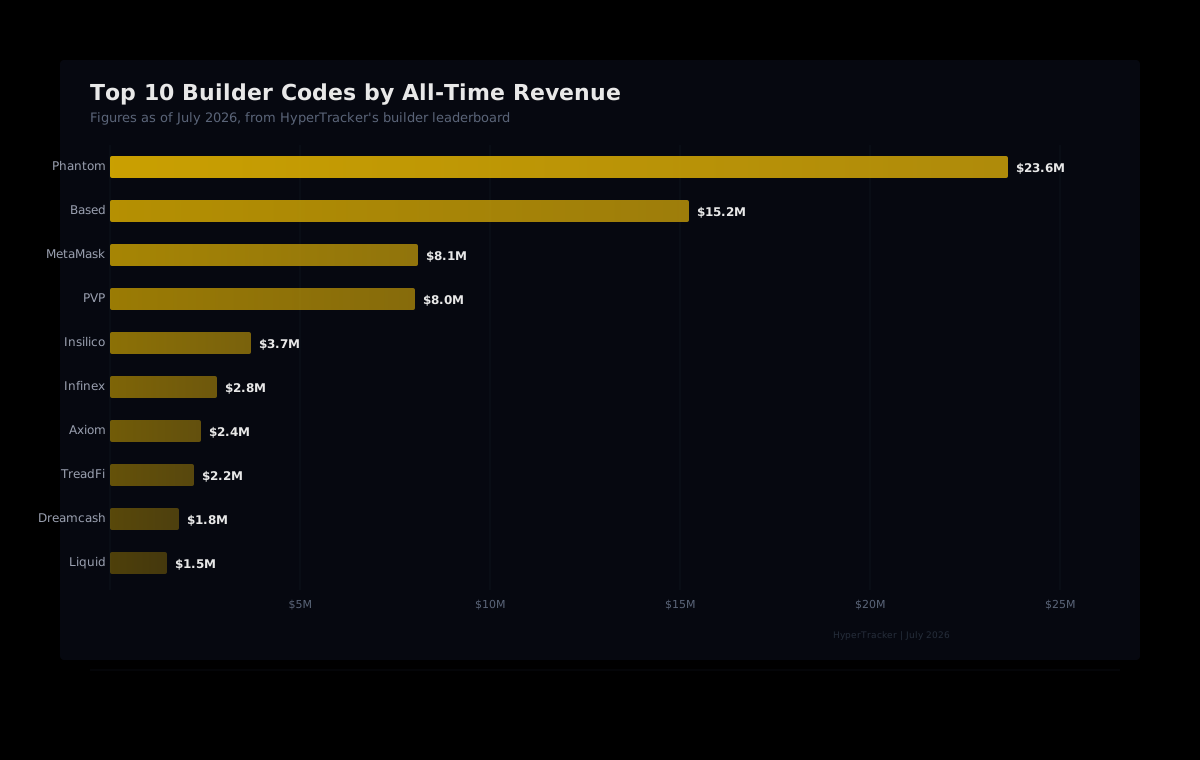
Several things jump out immediately. Phantom and Based generate nearly identical trading volume ($44.8B vs $44.9B), but Phantom earns $8.4 million more in revenue because it serves 3.5x the user base. Insilico ranks fifth in revenue but processes $36.3B in volume, more than MetaMask and PVP combined, because its small user base trades at institutional scale.
Four Categories of Builders
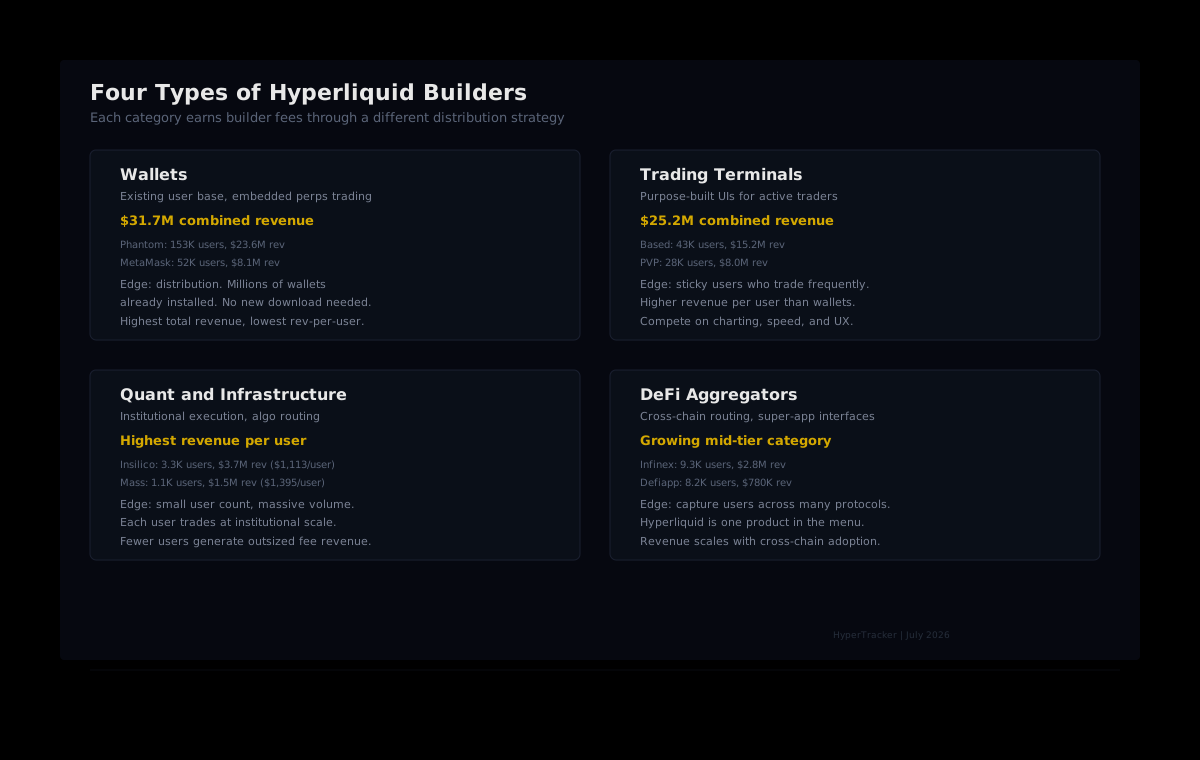
Revenue alone doesn't tell the full story. The builder leaderboard breaks into four categories, each with a distinct strategy for capturing fees.
Wallets: distribution as the moat
Phantom and MetaMask earn builder fees by embedding Hyperliquid perps inside an existing wallet experience. Users don't download a new app or visit a new site. They trade directly from the wallet they already have installed.
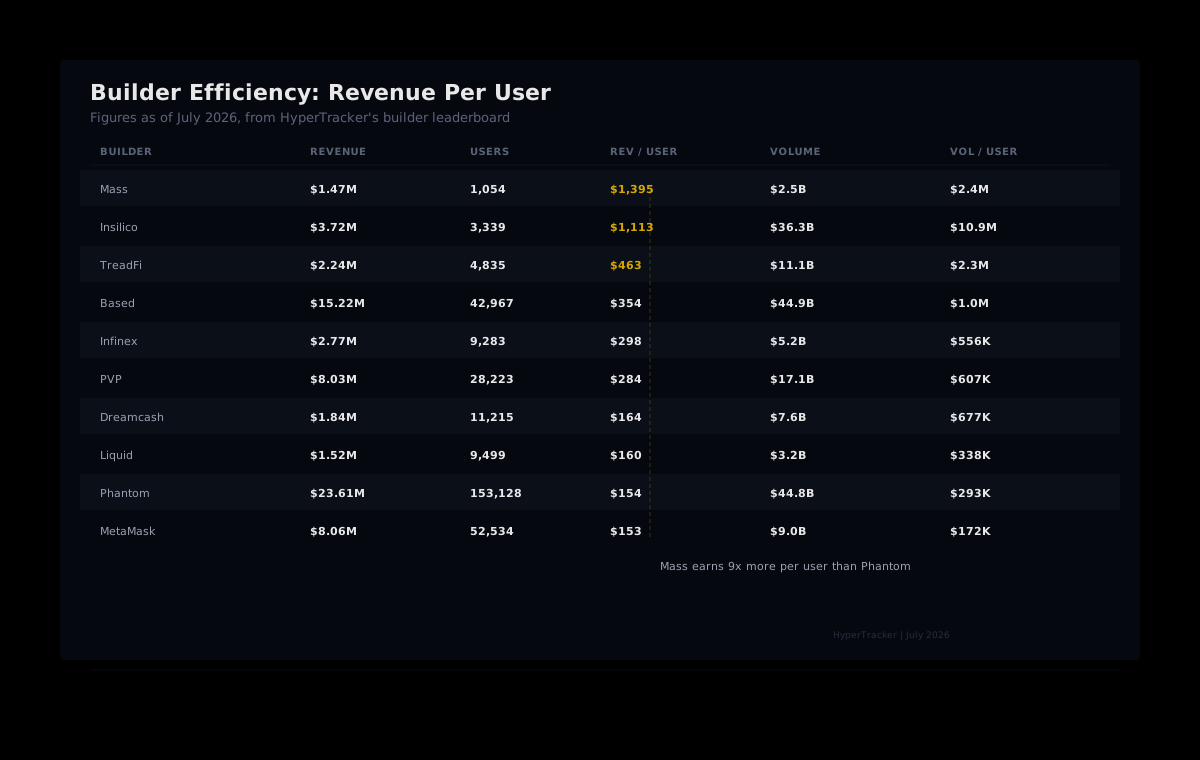
This category dominates total revenue because the user base is massive. Phantom's 153,128 users generated $23.6 million. MetaMask reached $8.1 million with 52,534 users despite joining two months later. Rabby, another wallet entrant, has already crossed $1.5 million. The tradeoff is clear: wallets capture the largest absolute fees but generate the lowest revenue per user (Phantom averages $154 per user, MetaMask $153).
Trading terminals: the power-user play
Based ($15.2M) and PVP ($8.0M) built purpose-specific trading interfaces. Their users came for better charting, faster execution, or features Hyperliquid's native UI doesn't offer. These builders generate higher revenue per user than wallets because their users trade more frequently and in larger size.
Based stands out: 42,967 users have traded $44.9B in volume, producing $354 in revenue per user. That's more than double Phantom's per-user yield, despite a smaller total user base. The lesson is that purpose-built trading interfaces attract users who stay and trade heavily.
Quant and infrastructure: small base, massive volume
Insilico and Mass represent the opposite end of the spectrum. Insilico has just 3,339 users but processed $36.3B in volume, more than any builder except Phantom and Based. Mass has only 1,054 users and still generated $1.5M in fees.
Revenue per user tells the real story. Mass earns $1,395 per user. Insilico earns $1,113. Compare that to Phantom's $154 or MetaMask's $153, and the efficiency gap is stark. These builders serve algorithmic traders, market makers, and quant funds whose individual accounts generate volume that dwarfs typical retail activity.
DeFi aggregators: the cross-chain bet
Infinex ($2.8M) and Defiapp ($780K) route users to Hyperliquid as one product in a broader DeFi menu. They earn builder fees alongside revenue from other protocols. Their user bases are growing as cross-chain interfaces mature, and Hyperliquid's deep liquidity makes it a natural destination for order routing.
This category sits between wallets and terminals in efficiency. Infinex averages $298 per user, reflecting a mix of power users who found it through the aggregator and casual traders exploring multiple venues.
The August Record: $984M in One Day
On August 21, 2026, builder code protocols processed $984 million in daily perpetual futures volume, an all-time high. Combined revenue for that session hit approximately $782,000, the second-highest daily total on record.
MetaMask accounted for roughly $143,000 of that day's revenue, while Phantom generated approximately $114,000. Together they contributed about a third of the daily total. The fact that two wallets, products that don't specialize in trading, can drive a third of record-day builder revenue underscores how much distribution matters in this ecosystem.
Ten days later, on August 31, HyperliquidNews confirmed that cumulative builder code revenue had crossed $100 million. From our July snapshot showing $90.7 million to $100 million in roughly six weeks, the run rate is accelerating.
Why the Leaderboard Keeps Shifting
Recent 30-day data shows a different picture than the all-time rankings. In September, MetaMask and Trust Wallet lead the 30-day revenue charts. Builder codes generated $10.17 million in 30-day revenue across $24.08 billion in volume. That puts the ecosystem on a roughly $120 million annualized pace.
The shift reflects a broader trend. New wallet integrations (Trust Wallet, Rabby, Blockchain) are capturing market share from early movers. The builder program's low barrier to entry, just 100 USDC and a builder code registration, means any team can spin up an integration quickly. The moat isn't technical. It's users.
This also explains why ERC-8021, a proposal to bring builder codes natively to Ethereum, has drawn so much attention. If the model works this well on a single L1 exchange, embedding it across every EVM chain could transform how all DeFi applications monetize.
Track Builder Code Revenue Yourself
You don't need to wait for someone to publish a leaderboard update. Our /builders/list endpoint returns real-time builder code data, including revenue, volume, user counts, and join dates for every builder on Hyperliquid.
curl -H "Authorization: Bearer YOUR_TOKEN" \
  "https://ht-api.coinmarketman.com/api/external/builders/list/timeframe/all"
The response includes every registered builder with their lifetime metrics. You can also query by timeframe (/30d, /7d, /24h) to see momentum shifts. Pair it with our cohort analytics to understand what types of traders each builder attracts: are Phantom users mostly retail (Fish, Dolphin cohorts) or institutional (Whale, Leviathan)?
Track Builder Codes with HyperTracker
Query real-time builder code leaderboards, revenue, volume, and user metrics. Cross-reference with 16 behavioral cohorts to see who's actually trading through each builder.
What Separates the Winners
After ranking 1,411 builders, three patterns separate the ones earning millions from the long tail earning almost nothing.
Distribution first, product second. Phantom didn't build the best trading interface. It had the most wallets. Wallets that already held crypto. Wallets where users could trade perps without leaving the app. The technical integration is straightforward. The user base is the hard part, and Phantom had it before writing a single line of builder code logic.
Retention compounds. Builder codes persist per order, which means users don't automatically stick with a builder across sessions. The builders generating sustainable revenue are the ones where users choose to return: Based's charting, PVP's execution speed, Insilico's institutional routing. One-time integrations produce spiky volume that fades.
Fee rate is secondary to volume. Builder fees max out at 0.1% on perpetuals. The difference between charging 3 basis points and 5 basis points matters far less than whether your users trade $1 billion or $10 billion through your code. Volume is the multiplier. Fee rate is the rounding error.
One thousand four hundred eleven builders have registered. Fifteen of them account for the vast majority of revenue. The rest are still looking for distribution, still building the product that makes users come back, still learning that in builder code economics, the code is the easy part.