
Spain Just Banned Prediction Markets. Hyperliquid Can't Be Stopped.
By CMM Team - 26-May-2026
Spain Just Banned Prediction Markets. Hyperliquid Can't Be Stopped.
Spain's Consumer Rights Ministry just suspended Polymarket and Kalshi. The ban, published in the country's official state gazette on May 26, 2026, accused both platforms of operating without a gambling license. Regulators gave the same justification governments always reach for: consumer protection, identity verification, minors.
Here's what makes this interesting for traders. Three weeks before Spain pulled the trigger, Hyperliquid launched HIP-4 outcome markets on mainnet. Those contracts run entirely on-chain through HyperCore's central limit order book. No company to subpoena. No servers to block. No gambling license to revoke, because the protocol doesn't need one.
The prediction market landscape is splitting in two. Centralized platforms get banned country by country while on-chain alternatives keep trading. If you're building around event contracts or following smart money flows into this space, the structural differences matter more than the headlines.
The Crackdown Is Accelerating
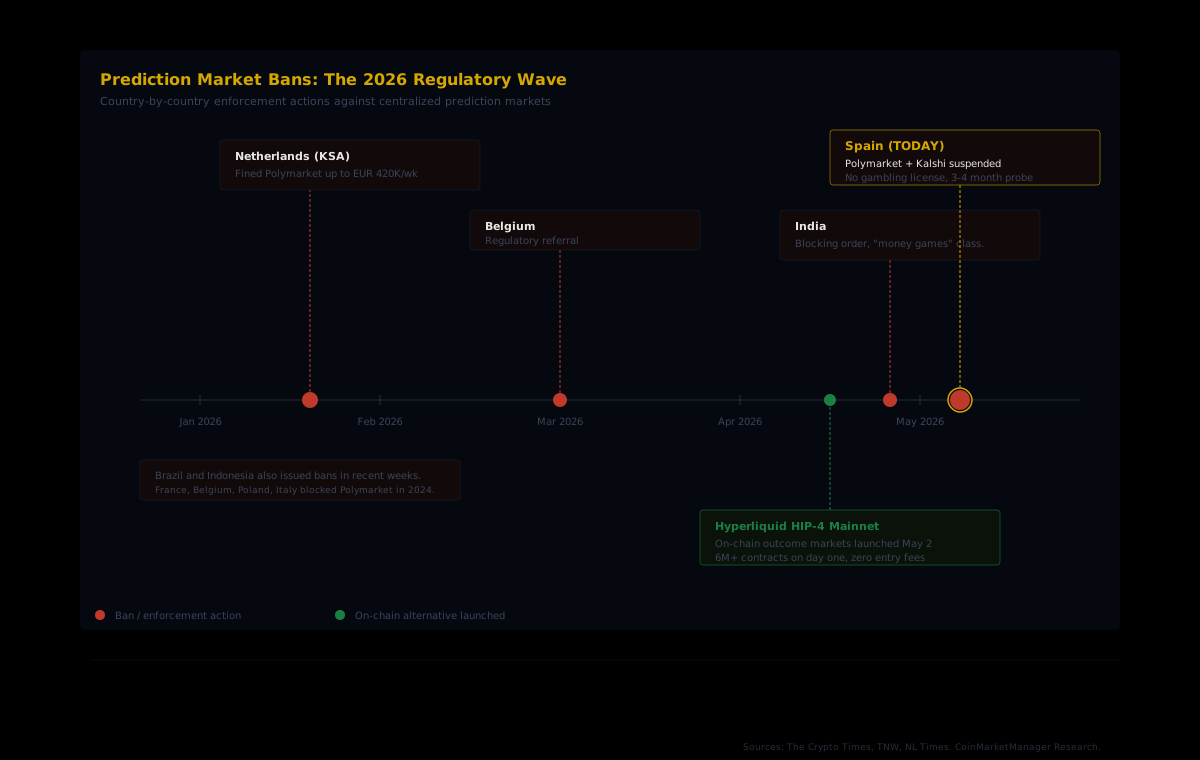
Spain's suspension didn't happen in isolation. It's the third European enforcement action against prediction markets in 2026, following the Netherlands in February and Belgium in March. The pattern is consistent across jurisdictions: regulators classify event contracts as gambling, find the platform operating without a local license, and issue a suspension order.
The Dutch case was the most aggressive. In February, the Netherlands' gambling authority KSA threatened Polymarket with fines of €420,000 per week if it continued serving Dutch users without a license, capped at €840,000. The regulator even placed a test bet to confirm the platform was accessible. By February 20, Polymarket chose to block Dutch users entirely.
India went further. On May 21, the electronics and IT ministry issued a formal blocking order against Polymarket, instructing internet service providers to cut access at the network level. India had formally reclassified prediction markets as "money games" under online gaming rules that took effect on May 1. Brazil and Indonesia followed with their own bans in recent weeks.
Spain's ban lasts an estimated three to four months while the investigation runs its course. But the direction is clear. European regulators have decided that prediction markets are gambling, period. Kalshi's argument that it operates as a CFTC-regulated derivatives exchange doesn't carry weight in Madrid, Amsterdam, or Brussels.
Centralized Platforms Have a Chokepoint Problem
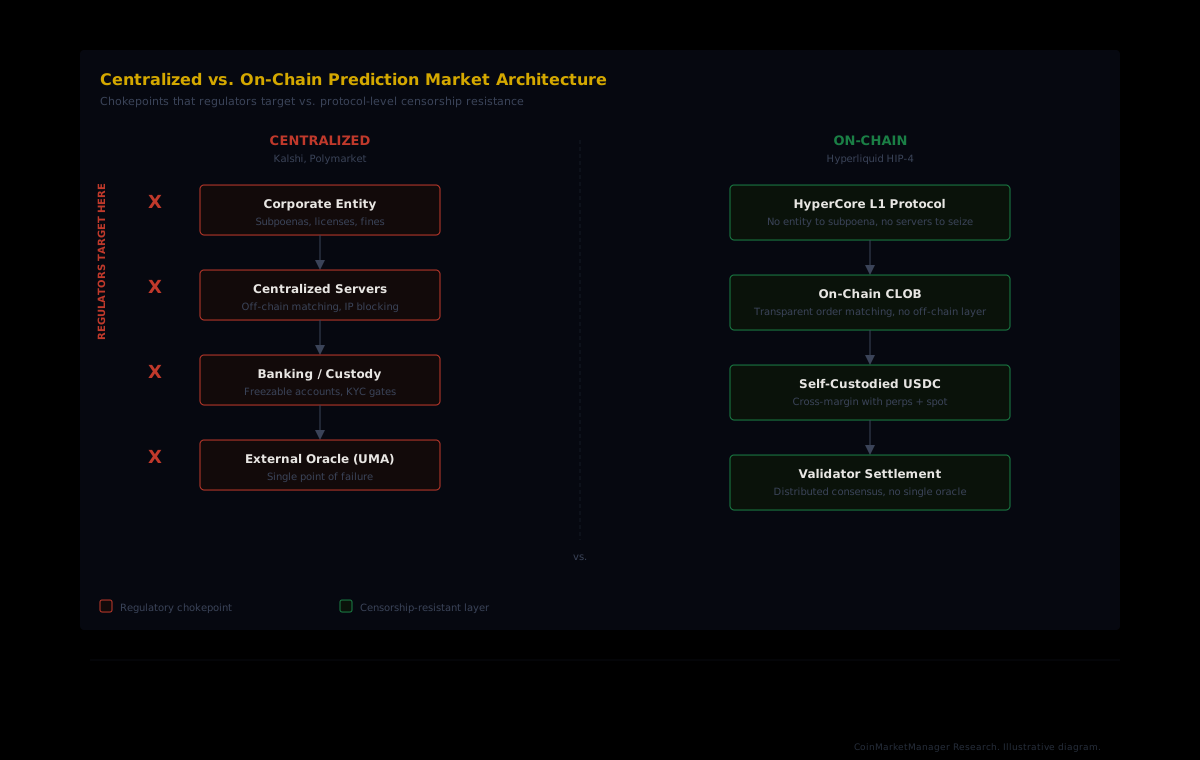
Polymarket and Kalshi share a structural vulnerability: they both run centralized infrastructure that regulators can target. Polymarket matches orders off-chain. Kalshi operates a CFTC-regulated exchange with corporate headquarters, banking relationships, and a legal entity that can receive subpoenas. When Spain says "you can't operate here," those companies have to comply or face escalating penalties.
This creates a patchwork problem for users. A Spanish trader who was active on Kalshi yesterday morning woke up today to a suspended platform. Dutch users lost access in February. Indian users lost access five days ago. Each ban fragments the liquidity pool, reduces market depth, and degrades the product for everyone remaining.
The regulatory divide: Kalshi positions itself as a financial market (CFTC-regulated in the U.S.), but European regulators treat prediction markets as gambling regardless of structure. The CFTC recently backed Kalshi against Ohio regulators, arguing that prediction contracts fall under federally regulated derivatives markets. That argument stops at the U.S. border.
The irony is that centralized prediction markets are booming by every financial metric. Kalshi raised $1 billion in its Series F at a $22 billion valuation, doubling from $11 billion just five months prior. Institutional trading volume on Kalshi jumped 800% over six months, and annualized trading volume tripled to $178 billion. Growth is not the problem. Jurisdictional exposure is.
How HIP-4 Sidesteps the Entire Problem
Hyperliquid's HIP-4 takes a fundamentally different approach. Outcome contracts run natively on HyperCore, the same L1 execution layer that powers Hyperliquid's perpetual futures and spot markets. There's no separate application, no off-chain order matching, no custodial middleman. Every trade settles on-chain through a fully transparent central limit order book.
When HIP-4 went live on mainnet on May 2, 2026, the initial Bitcoin outcome market recorded over 6.05 million contracts and roughly 4,000 unique traders on day one, capturing approximately 0.7% of global prediction market volume.
Zero Fees to Open
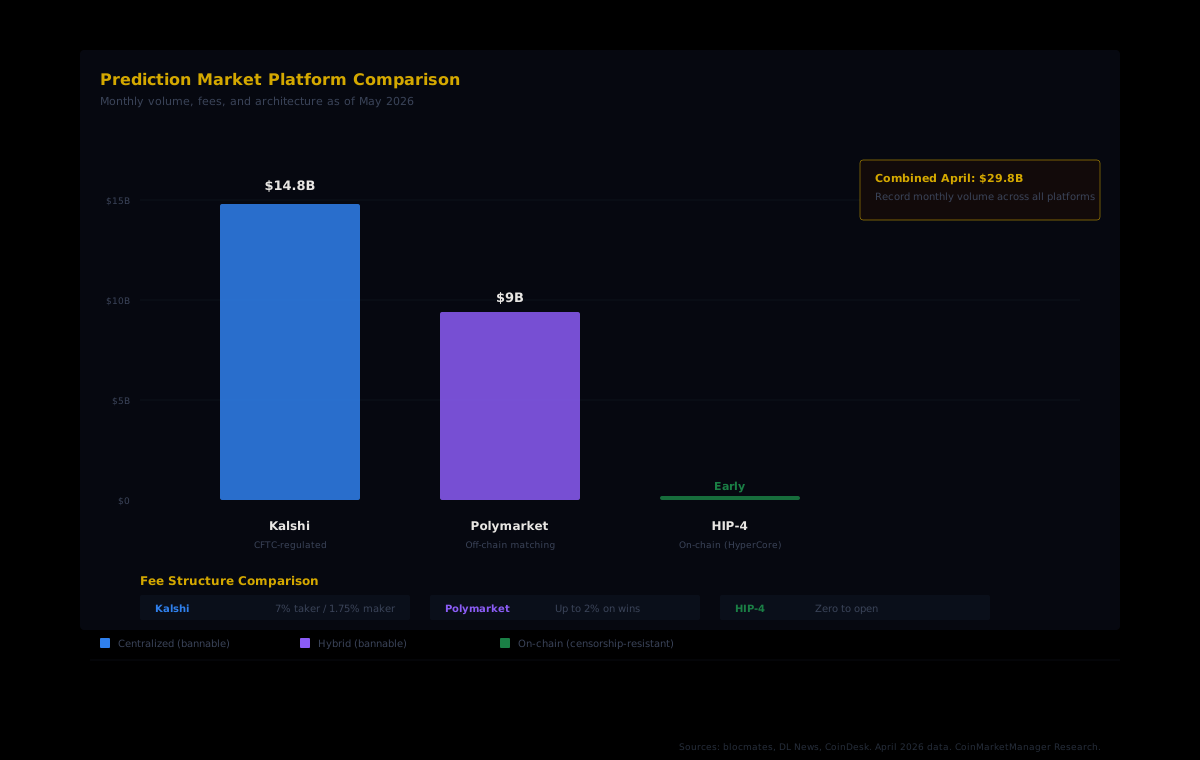
HIP-4 charges zero fees on position entry. Fees apply only when closing or settling a position. Compare that to Kalshi's taker fee of 7% and Polymarket's variable fees that can reach 2% on winning positions. For active traders placing multiple bets across different outcomes, that cost difference compounds fast.
Cross-Margin With Perps
Because HIP-4 outcome contracts live inside HyperCore alongside perpetual futures and spot markets, traders get unified cross-margining. You can hold a BTC perpetual long, a spot ETH position, and a binary "BTC above $90K" outcome contract in the same account, all backed by the same collateral pool. Polymarket and Kalshi can't offer this because prediction markets are their entire product, isolated from any broader trading infrastructure.
Validator Settlement
Hyperliquid recently expanded HIP-4 to support canonical outcome markets where validators handle both market deployment and settlement. Instead of relying on external oracles like UMA (which Polymarket uses and which was exploited for over $660K just four days ago), Hyperliquid validators ingest news feeds, decide which markets get listed, and vote on settlement outcomes. The trust assumption shifts from a single oracle provider to a distributed validator set.
| Feature | Kalshi | Polymarket | HIP-4 | | --- | --- | --- | --- | | Infrastructure | Centralized (CFTC-regulated) | Off-chain order matching | Fully on-chain (HyperCore CLOB) | | Entry Fees | 7% taker / 1.75% maker | Up to 2% on wins | Zero to open | | Cross-Margin | No | No | Yes (perps + spot + outcomes) | | Settlement | Centralized | UMA oracle | Validator consensus | | Bannable? | Yes (corporate entity) | Yes (off-chain infra) | Protocol-level (no entity to ban) |
Why Traders Should Care About the Architecture
The Spain ban matters for two reasons beyond the headline. First, it signals that more jurisdictions will follow. The European regulatory pattern is clear: Netherlands, Belgium, Spain, and the EU has no harmonized framework for event contracts. Each member state applies its own rules, which means every country represents a potential ban. France, Belgium, Poland, and Italy had already blocked Polymarket in 2024.
Second, each ban fragments liquidity. Prediction markets depend on deep order books and active participation to produce accurate prices. Every jurisdiction that goes dark reduces the number of informed bettors, which reduces price discovery quality, which makes the remaining markets less useful for everyone.
On-chain prediction markets like HIP-4 don't eliminate regulatory risk entirely. But they change the enforcement surface. Instead of serving a subpoena to a CEO, regulators would need to block access to an entire L1 blockchain. That's a much harder technical problem, similar to trying to ban Bitcoin rather than banning Coinbase.
Smart Money Is Already Moving
According to data from blocmates, approximately 14% of top Polymarket traders are already active on Hyperliquid, and those overlapping wallets have generated $189 million in perp notional volume on Hyperliquid. The infrastructure crossover is already happening. Traders who built strategies around Polymarket's event contracts now have a reason to look at HIP-4 as a censorship-resistant alternative.
The prediction market sector overall continues to grow explosively. Combined monthly volume across all platforms hit a record $29.8 billion in April 2026, and the question isn't whether the market will grow. It's which architecture survives the regulatory gauntlet.
Tracking the Shift With Cohort Analytics
When capital migrates between platforms, the flow shows up in on-chain positioning data before it shows up in headlines. Our cohort analytics classify every Hyperliquid wallet into one of 16 behavioral segments, eight by trading size (from Shrimp at $0-$250 to Leviathan at $5M+) and eight by all-time PnL performance (from Money Printer at +$1M to Giga-Rekt below -$1M).
This classification lets you see whether the capital flowing into Hyperliquid's prediction markets comes from sophisticated traders (Money Printers and Smart Money cohorts) or retail participants feeling out a new platform. When a regulatory event like Spain's ban pushes traders to migrate, our data captures the behavioral fingerprint of that migration across all of Hyperliquid's markets, including HIP-4 outcome contracts.
Combined with order flow analysis that refreshes every 5 minutes, you can track whether prediction market activity is creating new demand patterns in correlated perp markets. A spike in "BTC above $90K" outcome contracts, for example, might correlate with leveraged long positioning from the same wallet cohorts. That's the kind of signal that turns a news headline into a tradeable edge.
Track Smart Money Across All Hyperliquid Markets
HyperTracker's cohort analytics classify every wallet on Hyperliquid into 16 behavioral segments. See how smart money positions across perpetual futures, spot, and HIP-4 outcome contracts. Start with the free tier and upgrade when you need deeper access.
The Bigger Picture
Every major financial innovation goes through a phase where regulators try to fit new products into old categories. Spain calling prediction markets "gambling" is a classification choice. It reflects a legal framework. The CFTC in the U.S. treats the same products as regulated derivatives. Neither framework is objectively correct. They just reflect different political and legal traditions.
What's new in 2026 is that on-chain infrastructure gives the market a third option: protocols that exist outside any single jurisdiction's regulatory framework. HIP-4 doesn't solve the legal question. It routes around it. The same way Bitcoin didn't ask for permission to exist as a monetary network, on-chain prediction markets don't ask for a gambling license. They just run.
For traders and builders, the takeaway is structural. Centralized prediction platforms will continue to grow, raise capital, and expand, but they'll do it inside an increasingly hostile regulatory patchwork. On-chain alternatives will capture the volume that centralized platforms can't serve. The two ecosystems will coexist, each with different trade-offs in UX, liquidity depth, regulatory risk, and fee structures.
Spain's ban isn't the end of prediction markets. It's the beginning of the split.